Market Summary
Executive Summary and Global Market Analysis
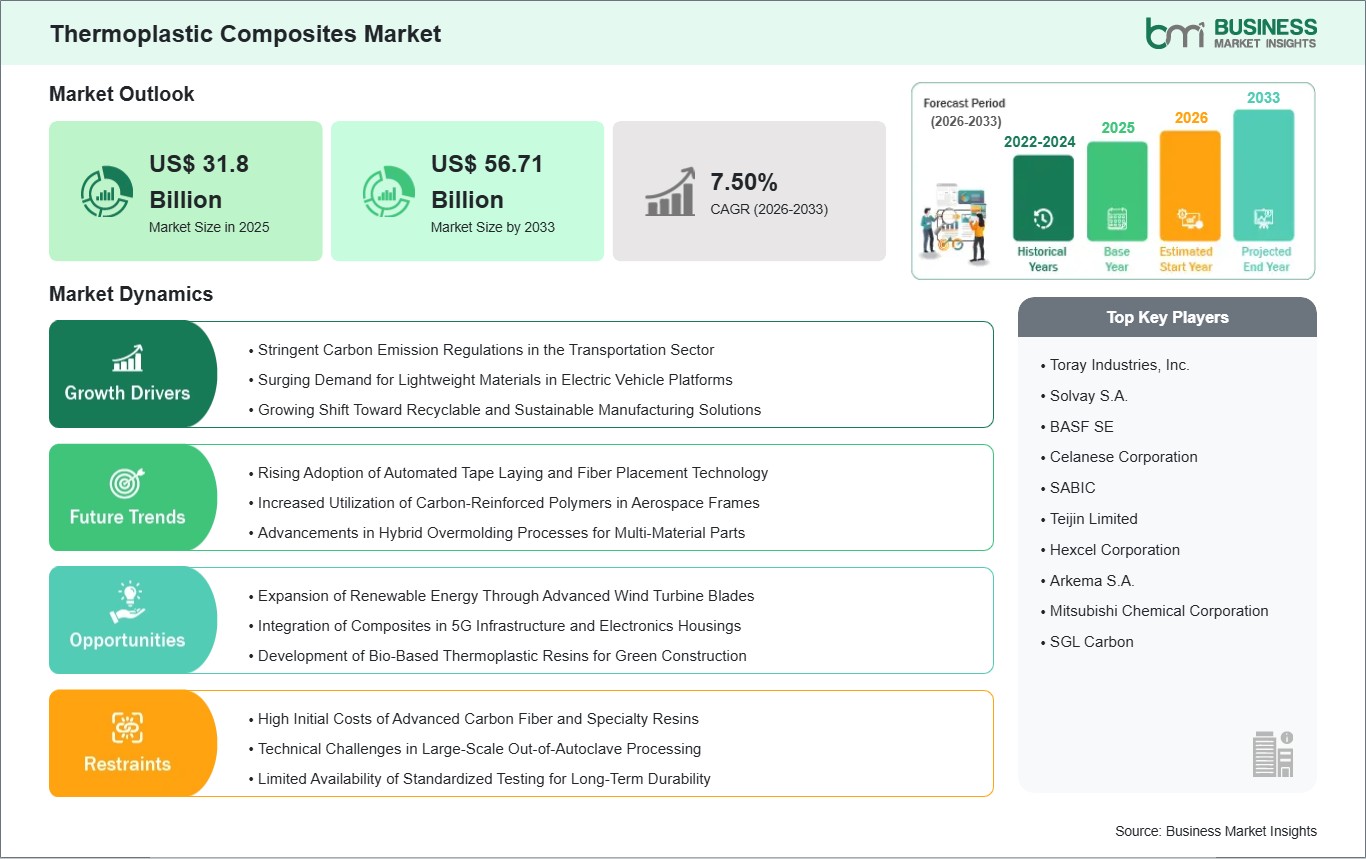
The global thermoplastic composites market is currently at a pivotal juncture, transitioning from specialized high-end applications to mainstream industrial adoption. Valued for their recyclability, rapid processability, and high impact resistance, these materials are effectively displacing traditional metals and thermoset plastics across the global supply chain. The market's growth is fundamentally anchored in the automotive and aerospace sectors, where the relentless pursuit of weight reduction and energy efficiency has turned thermoplastic composites into essential structural materials. Moreover, advancements in polymer chemistry have introduced high-temperature resins like PEEK and PPS, which allow these composites to operate in environments previously reserved for specialty alloys.
Technological advances in the manufacturing sector, such as the gain in popularity of automated fiber placement and 3D printing of continuous fibers, will drastically lower the barrier for the production of complicated parts. Although high raw material costs of carbon fiber will continue to be a problem, the cost-effectiveness of glass-reinforced polyamides and polypropylenes is still driving their demand in the segments of construction and consumer electronics. In terms of geographical distribution,
Asia-Pacific is the leader in production volume owing to its huge automotive and electronics clusters, whereas North America and Europe are still the leaders in high-value aerospace and defense applications. As players in the industry focus on sustainability and speed of operations, the market for thermoplastic composites is likely to see consistent expansion over the long term.
Segment Analysis
Thermoplastic Composites Market Segmentation
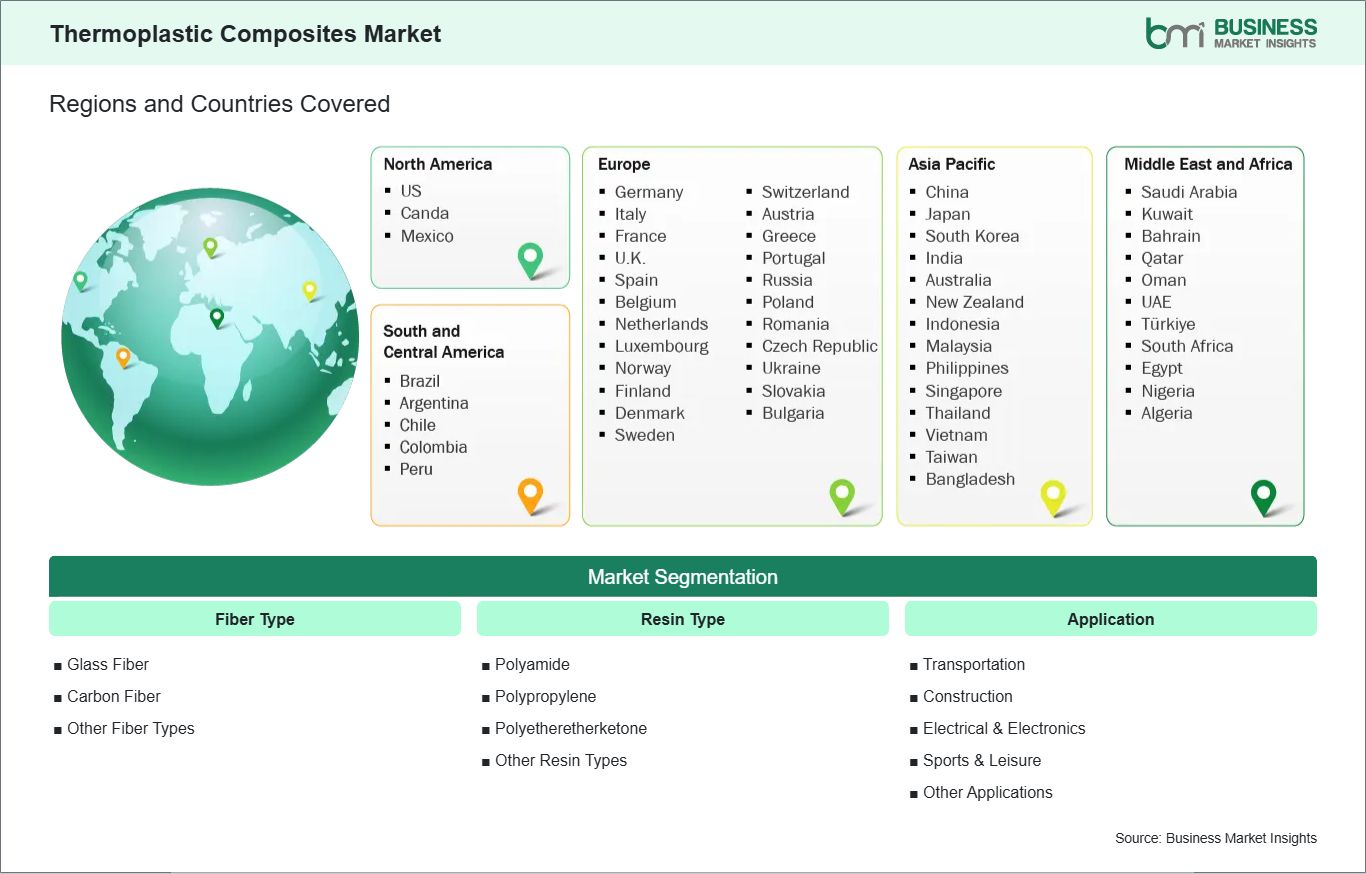
Key segments that contributed to the derivation of the Thermoplastic Composites market analysis are fiber type, resin type, and application.
- By fiber type, the thermoplastic composites market is segmented into Glass Fiber, Carbon Fiber, and Others. The Glass Fiber segment dominated the market in 2025.
- By resin type, the thermoplastic composites market is segmented into Polyamide, Polypropylene, Polyetheretherketone, and Others. The Polyamide segment dominated the market in 2025.
- By application, the thermoplastic composites market is segmented into Transportation, Construction, Electrical & Electronics, Sports & Leisure, and Others. The Transportation segment dominated the market in 2025.
Market Forces
Thermoplastic Composites Market Drivers and Opportunities
Stringent Carbon Emission Regulations in the Transportation Sector
The global legislative framework is a highly influential driver for the thermoplastic composites market, especially in the automotive and aerospace sectors. The Euro 7 legislation, as well as the U.S. Corporate Average Fuel Economy (CAFE) regulations, have forced manufacturers to significantly reduce the weights of these vehicles, which can be addressed with thermoplastic composites, as they are 30% to 50% lighter than conventional steel or aluminum, while still retaining the necessary integrity for safety components. This reduction in vehicle weights is directly proportional to the reduction in CO2 emissions for conventional engines as well as increased range for electric vehicle fleets, making these materials a non-negotiable factor in fleet designs.
Furthermore, the fast cycle times associated with thermoplastic processing allow automakers to integrate composite manufacturing directly into high-speed assembly lines. Unlike thermosets, which require lengthy curing times, thermoplastics can be stamped or injection-molded in under 60 seconds. This operational efficiency, combined with the ability to consolidate multiple metal parts into a single composite structure, reduces both the total weight of the vehicle and the complexity of the supply chain. As governments continue to tighten emission targets throughout the decade, the reliance on high-performance thermoplastics for structural and semi-structural applications is expected to intensify.
Expansion of Renewable Energy Through Advanced Wind Turbine Blades
The global drive towards carbon-neutral environments presents a huge market opportunity for thermoplastic composites in the wind energy market, as conventional wind blades are made from thermosets, which are notoriously difficult to recycle at the end of their 25-year life cycle, resulting in substantial landfill waste. Thermoplastic-based blades, however, can be recycled by thermally treating the blades, recovering the resin as well as the fiber, thereby making them a perfect fit for the renewable energy sector's sustainable agenda. This factor of recyclability is a key differentiator for government contracts and green energy initiatives, especially in regions such as Europe and North America, where the 'circular economy' concept is stringently applied.
In addition to environmental benefits, thermoplastic composites offer superior fatigue resistance and vibration damping compared to conventional materials. These properties enable the construction of longer, more aerodynamic blades that can capture wind energy more efficiently even in low-wind conditions. The ability to weld thermoplastic components also simplifies the assembly and repair of massive turbine structures, reducing maintenance costs over the equipment's lifecycle. As the world aims to double its renewable energy capacity the demand for high-performance, recyclable blade materials will position thermoplastic composites as a foundational technology for the next generation of wind infrastructure.
Size and Share Analysis
Thermoplastic Composites Market Size and Share Analysis
The global Thermoplastic Composites market is experiencing steady growth, with market size and share analysis reflecting evolving treatment preferences and competitive dynamics among key players. The report evaluates important subsegments categorized within fiber type, resin type, and application, highlighting their respective contributions to overall market performance.
By fiber type, the Glass Fiber subsegment dominated the market in 2025 due to its exceptional balance of cost-effectiveness and mechanical performance, making it the preferred reinforcement for high-volume automotive and construction applications where extreme stiffness-to-weight ratios are secondary to overall affordability.
By resin type, the Polyamide subsegment dominated the market in 2025 due to its high thermal stability, excellent chemical resistance, and compatibility with rapid injection molding processes, which are essential for manufacturing complex engine components and under-the-hood automotive parts at scale.
By application, the Transportation subsegment dominated the market in 2025 due to aggressive fuel efficiency standards and the rise of electric vehicles, where these composites are used to offset heavy battery weights through lightweight structural components, interior panels, and aerodynamic housings.
Report Coverage
Thermoplastic Composites Market Report Coverage and Deliverables
The "Thermoplastic Composites Market Size and Forecast (2022 - 2033)" report provides a detailed analysis of the market covering below areas:
- Thermoplastic Composites market size and forecast at the regional and country levels for segments covered under the scope
- Thermoplastic Composites market trends, as well as drivers, restraints, and opportunities
- Thermoplastic Composites market analysis covering key trends, regional framework, major players, regulations, and recent developments
- Industry landscape and competition analysis covering market concentration, heat map analysis, prominent players, and recent developments for the Thermoplastic Composites market
- Detailed company profiles, including SWOT analysis
Geographic Insights
Thermoplastic Composites Market Geographic Insights
The geographical scope of the Thermoplastic Composites market report is divided into: North America, Asia Pacific, Europe, Middle East & Africa, and South & Central America. North America held the largest share in 2025.
North America stands as the dominant force in the high-value thermoplastic composites market, primarily due to its sophisticated aerospace, defense, and space exploration ecosystem. The region is home to several of the world`s leading aircraft manufacturers and Tier-1 suppliers who have pioneered the use of carbon-reinforced thermoplastics for primary airframe structures and interior components. This dominance is bolstered by a strong focus on advanced manufacturing technologies, such as automated tape laying (ATL) and out-of-autoclave (OOA) processing, which allow for the high-precision production required in aerospace applications. Additionally, the U.S. Department of Energy and Department of Defense provide significant funding for research into lightweight materials, further accelerating local innovation.
The North American market also benefits from a rapidly maturing electric vehicle (EV) supply chain. With major automotive players pivoting toward all-electric lineups, there is a localized surge in demand for thermoplastic battery enclosures and structural modules that can withstand high thermal loads while protecting battery cells. Furthermore, the region`s strict environmental regulations regarding recyclability are pushing manufacturers away from traditional thermosets toward more sustainable thermoplastic alternatives. This established industrial base, combined with a robust network of raw material suppliers and research institutions, ensures that North America remains the primary hub for the development and commercialization of next-generation composite solutions.
Industry Activity
Recent Developments
The Thermoplastic Composites market is evaluated by gathering qualitative and quantitative data post primary and secondary research, which includes important corporate publications, association data, and databases. A few of the key developments in the Thermoplastic Composites market are:
- In January 2026, Toray Industries, Inc., announced the development of a new technology combining thermoset and thermoplastic carbon fiber reinforced plastics to enhance performance and productivity for next-generation aircraft structures.
- In December 2025, Toray Advanced Composites, announced that it completed NCAMP qualification for its Cetex® high-performance thermoplastic composite materials, supporting their adoption in aerospace applications.
- In June 2025, Hexcel Corporation and Arkema, highlighted advancements under the HELUES project, showcasing a thermoplastic composite aerospace structure developed to improve high-rate aircraft manufacturing.
Trust & Transparency
Research Methodology
The market analysis combines proprietary research with secondary data from government agencies, company disclosures, regulatory filings, industry databases and expert interviews. Market estimates are validated through data triangulation, cross-market benchmarking and analyst
review.
View Full Research Methodology
Key Sources Referred:
American Chemistry Council (ACC) International Council of Chemical Associations (ICCA) European Chemical Industry Council (Cefic) China National Packaging Industry Association (CNPIA) Indian Institute of Packaging (IIP) Japan Packaging Institute (JPI) Gulf Petrochemicals and Chemicals Association (GPCA) Company Websites Company Annual Reports Company Investor Presentations