Sports Composites Market Outlook (2022-2033)

Historic Data: 2022-2024   |   Base Year: 2025   |   Forecast Period: 2026-2033
Report Content: Market Scope, Market Segmentation, Market Dynamics, and Competitive Analysis

Report Coverage:
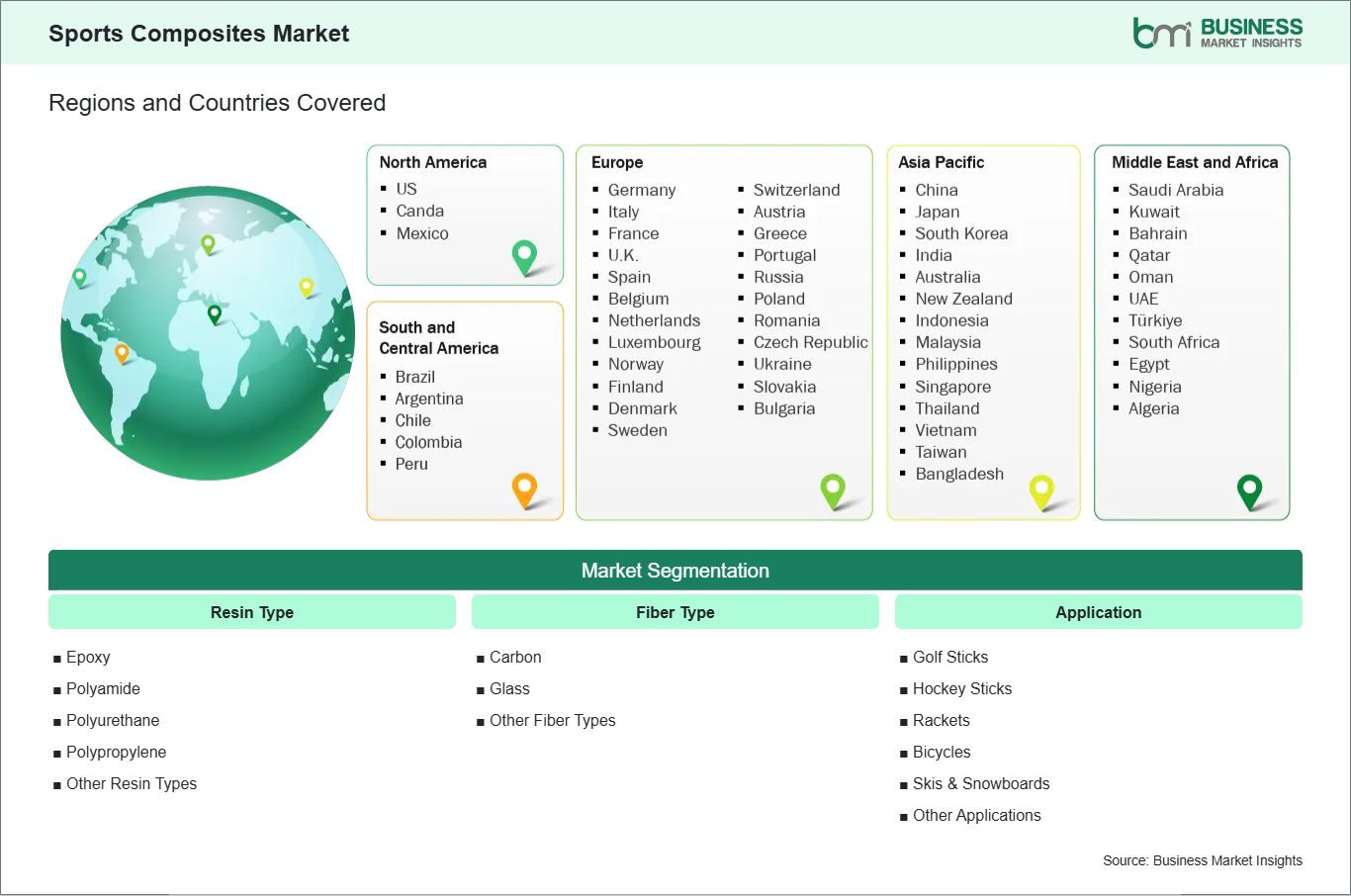
  • Resin Type (Epoxy, Polyamide, Polyurethane, Polypropylene, Other Resin Types)
  • Fiber Type (Carbon, Glass, Other Fiber Types)
  • Application (Golf Sticks, Hockey Sticks, Rackets, Bicycles, Skis & Snowboards, Other Applications)

No. of Pages: 392
Report Code: BMIPUB00034422
Category: Chemicals and Materials
Sports Composites Market

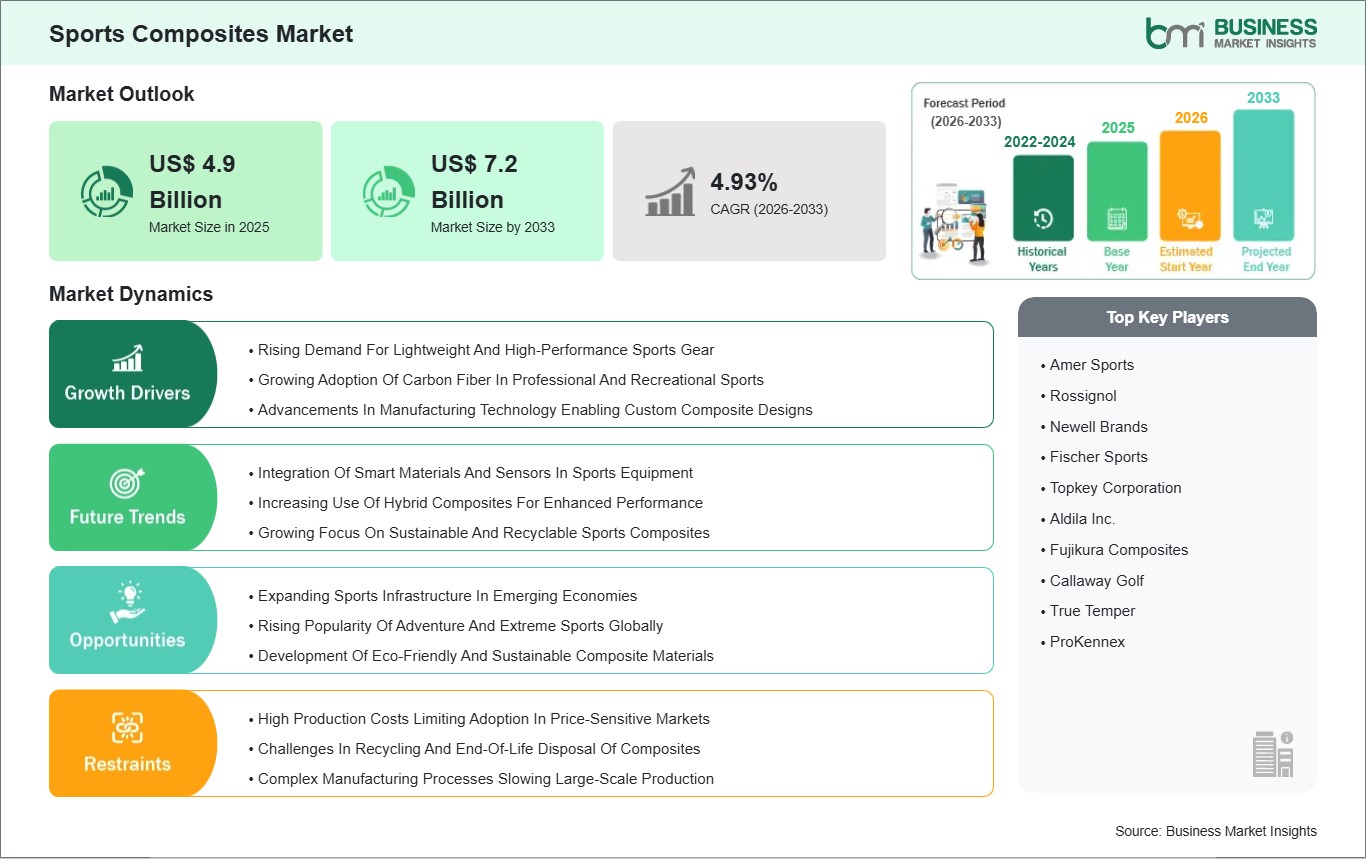
The Sports Composites Market size is expected to reach US$ 7.2 billion by 2033 from US$ 4.9 billion in 2025. The market is estimated to record a CAGR of 4.93% from 2026 to 2033.

Executive Summary and Global Market Analysis:

The global sports composites market experiences its transformation through performance-driven material innovations, which now serve as the primary design element for contemporary sports equipment. Manufacturers increasingly turn to composites, which include carbon fiber, glass fiber and aramid-based materials, as replacements for traditional metals and plastics because these materials provide superior strength, lighter weight and better fatigue resistance. The properties of these materials, which enable cyclists, tennis players, golfers, motorsport athletes and winter sports competitors to achieve performance improvements, become essential for all sports activities. The market development occurs through material science progress and the growing global demand for athletic performance improvements, safety enhancements, and product durability. The growing consumer base for professional and recreational sports drives market expansion because health awareness increases, and people choose fitness activities as their preferred way of life.

The sports equipment premiumization trend drives higher demand for composite-based products because developed markets consumers choose to spend more on products that improve their performance. Manufacturing companies can now create tailored sports equipment through technological breakthroughs in composite processing, which include automated layup techniques and hybrid material integration. Sponsorships, professional leagues and international sporting events have increased market presence because they function as indirect channels for equipment innovation. The lightweight and responsive materials that athletes prefer have created a demand among consumers, which drives increased adoption of these materials. The market encounters significant obstacles that restrict its progress.

The combination of expensive raw materials and production expenses for carbon fiber composites prevents their entry into markets that prioritize low costs. The difficulties that come with recycling composite materials and their final disposal create significant sustainability issues. The market will maintain its worldwide growth because emerging sports categories will continue to develop new applications through ongoing innovation.

Sports Composites Market - Strategic Insights:

global-market-strategic-framework
Get more information on this report

Sports Composites Market Segmentation Analysis:

Key segments that contributed to the derivation of the sports composites market analysis are resin type, fiber type, and application.

  • By resin type, the sports composites market is segmented into epoxy, polyamide, polyurethane, polypropylene, other resin types. The epoxy segment dominated the market in 2025.
  • Based on fiber type, the sports composites market is categorized into carbon, glass, other fiber types. The glass segment dominated the market in 2025.
  • In terms of application, the sports composites market is categorized into golf sticks, hockey sticks, rackets, bicycles, skis & snowboards, other applications. The skis & snowboards segment dominated the market in 2025.

Sports Composites Market Drivers and Opportunities:

Rising Demand For Lightweight And High-Performance Sports Gear

The global sports composites market is being strongly driven by the increasing demand for lightweight and high-performance sports equipment across multiple disciplines. Athletes and recreational users alike are seeking materials that reduce weight while maintaining structural strength, enabling improved speed, agility, and endurance. Carbon fiber and glass fiber composites have become the material of choice for high-performance bicycles, golf clubs, tennis rackets, and skis, where every gram saved translates into tangible performance benefits.

Professional leagues and international competitions are further accelerating this demand, as equipment manufacturers continuously innovate to meet the rigorous standards of elite sports. Consumers are also showing willingness to invest in premium, performance-enhancing gear, which has prompted brands to introduce composite-based products at multiple price points. Additionally, the rise of winter and adventure sports has expanded the use of composites in snowboards, hockey sticks, and water sports equipment, where material performance is critical under dynamic stress conditions.

Technological advancements in composite manufacturing, such as automated layup processes and hybrid material integration, are also supporting this trend. These innovations allow precise control over weight distribution and mechanical properties, enabling sports equipment to be optimized for individual athlete performance. As global awareness of fitness and professional sports continues to grow, demand for lightweight, high-performance composites is expected to remain a primary market driver.

Expanding Sports Infrastructure In Emerging Economies

Emerging economies are witnessing rapid growth in sports infrastructure, creating new opportunities for composite-based equipment adoption. Governments and private investors are increasingly developing stadiums, cycling tracks, golf courses, and ski resorts to promote both professional and recreational sports. This infrastructure expansion is fueling demand for advanced sports materials, particularly composites that deliver durability and performance under heavy usage. Countries in Asia-Pacific, Latin America, and the Middle East are leading the charge as urbanization and rising disposable incomes support investments in sports facilities.

In addition to new facilities, the growth of youth and amateur sports programs in these regions has stimulated demand for modern equipment. Schools, colleges, and community sports centers are increasingly sourcing high-quality composite materials to ensure safety, longevity, and consistent performance, which was previously limited to developed markets. The proliferation of sporting events and leagues in these regions further enhances awareness and adoption of performance-enhancing equipment.

Moreover, emerging economies offer opportunities for local manufacturing of composite-based sports equipment, reducing dependence on imports and driving cost-efficiency. Partnerships between global brands and regional manufacturers are becoming common to meet rising demand while maintaining high material quality. As sports culture and infrastructure continue to grow worldwide, emerging markets are expected to become critical contributors to the global sports composites market, supporting long-term expansion.

Sports Composites Market Size and Share Analysis:

The sports composites market demonstrates steady growth, with size and share analysis highlighting evolving trends and competitive dynamics among key players. The report examines subsegments categorized within resin type, fiber type, and application, offering insights into their contribution to overall market performance.

By resin type, the epoxy subsegment dominated the market in 2025, driven by its superior strength, durability, and excellent adhesion properties, making it ideal for high-performance sports equipment.

Based on fiber type, the glass subsegment dominated the market in 2025, driven by its low cost and versatile performance characteristics, enabling widespread use across a broad range of sports applications.

In terms of application, the skis & snowboards subsegment dominated the market in 2025, driven by high demand in winter sports and extensive use of composites to enhance strength, flexibility, and lightweight performance.

Sports Composites Market Report Highlights:

Report Attribute Details
Market size in 2025 US$ 4.9 Billion
Market Size by 2033 US$ 7.2 Billion
Global CAGR (2026 - 2033)4.93%
Historical Data 2022-2024
Forecast period 2026-2033
Segments Covered By Resin Type
  • Epoxy
  • Polyamide
  • Polyurethane
  • Polypropylene
  • Other Resin Types
By Fiber Type
  • Carbon
  • Glass
  • Other Fiber Types
By Application
  • Golf Sticks
  • Hockey Sticks
  • Rackets
  • Bicycles
  • Skis & Snowboards
  • Other Applications
Regions and Countries Covered
North America US, Canada, Mexico
Europe Belgium, Austria, Finland, Denmark, Greece, Poland, Romania, Russia, Ukraine, Czech Republic, Slovakia, Bulgaria, Italy, Luxembourg, Germany, Switzerland, France, Netherlands, Norway, Portugal, Spain, Sweden, United Kingdom
Asia-Pacific Australia, China, India, Japan, South Korea, Indonesia, Malaysia, Philippines, Singapore, Thailand, Vietnam, Bangladesh, New Zealand, Taiwan
South and Central America Brazil, Argentina, Peru, Chile, Colombia
Middle East and Africa Bahrain, Kuwait, Oman, Qatar, Saudi Arabia, United Arab Emirates, Turkiye, South Africa, Egypt, Algeria, Nigeria
Market leaders and key company profiles
  • Amer Sports
  • Rossignol
  • Newell Brands
  • Fischer Sports
  • Topkey Corporation
  • Aldila Inc.
  • Fujikura Composites
  • Callaway Golf
  • True Temper
  • ProKennex
Get more information on this report

Sports Composites Market Report Coverage and Deliverables:

The "Sports Composites Market Size and Forecast (2022 - 2033)" report provides a detailed analysis of the market covering below areas:

  • Sports Composites Market size and forecast at global, regional, and country levels for all the key market segments covered under the scope
  • Sports Composites Market trends, as well as drivers, restraints, and opportunities
  • Sports Composites Market analysis covering key trends, global and regional framework, major players, regulations, and recent developments
  • Industry landscape and competition analysis covering market concentration, heat map analysis, prominent players, and recent developments for the Sports Composites Market
  • Detailed company profiles, including SWOT analysis

Sports Composites Market Geographic Insights:

The geographical scope of the Sports Composites Market report is divided into North America, Asia Pacific, Europe, Middle East & Africa, and South & Central America. North America held the largest share in 2025.

North America stands as the primary market territory because its athletic infrastructure operates at advanced levels while athletes spend considerable amounts on top-tier equipment, and innovative companies maintain a strong market presence throughout the region. The region benefits from widespread participation in professional and recreational sports, particularly in cycling, golf, and winter sports, where composite materials are extensively used for performance enhancement.

The market in Asia Pacific is experiencing fast growth because urban areas expand while more people join the middle class and show higher interest in fitness activities and outdoor recreation. China and Japan serve as major market drivers because their manufacturing operations expand to meet rising domestic demand for low-cost yet high-quality athletic gear.

European countries maintain their important market position because of their deep athletic heritage, which includes sports like cycling, skiing, and football and their strong capacity to develop composite materials. The region develops sustainable solutions by promoting recyclable composite materials that meet environmental standards.

The market in Middle East & Africa experiences gradual growth because sports infrastructure investments and international athletic events, and health and fitness activities increase in United Arab Emirates and South Africa.

South and Central American countries are experiencing continuous development because their citizens love football and outdoor sports while better sports facilities and equipment become available in Brazil and Argentina.

The adoption of sports composites is increasing worldwide because developing regions face cost challenges, but people now understand performance advantages, and economic conditions are improving.

global-market-geography
Get more information on this report

Sports Composites Market Research Report Guidance:

  • The report includes qualitative and quantitative data in the Sports Composites Market across resin type, fiber type, application and geography.
  • The report starts with the key takeaways (chapter 2), highlighting key trends and outlook of the Sports Composites Market.
  • Chapter 3 focuses on the research methodology of the study.
  • Chapter 4 includes ecosystem analysis.
  • Chapter 5 highlights the major industry dynamics in the Sports Composites Market, including factors that are driving the market, prevailing deterrents, potential opportunities, as well as future trends. Impact analysis of these drivers and restraints is also covered in this section.
  • Chapter 6 discusses the Sports Composites Market scenario, in terms of historical market revenues, and forecast till the year 2033.
  • Chapters 7 to 10 cover Sports Composites Market segments by resin type, fiber type, application and geography across North America, Asia Pacific, Europe, Middle East & Africa, and South & Central America. They cover the market revenue forecast and factors driving the market.
  • Chapter 11 describes the competitive analysis along with the heat map analysis for the key players operating in the market.
  • Chapter 12 describes the industry landscape analysis. It provides detailed descriptions of business activities such as market initiatives, new developments, mergers, and joint ventures globally, along with a competitive landscape.
  • Chapter 13 provides detailed profiles of the major companies operating in the Sports Composites Market. Companies have been profiled on the basis of their key facts, business descriptions, products, financial overview, SWOT analysis, and key developments.
  • Chapter 14, i.e., the appendix, is inclusive of a brief overview of the company, a list of abbreviations, and a disclaimer.

Sports Composites Market News and Key Development:

The Sports Composites Market is evaluated by gathering qualitative and quantitative data post primary and secondary research, which includes important corporate publications, association data, and databases. A few of the key developments in the sports composites market are:

  • In April 2025, Kingoda (JH Composites) announced the launch of its next‑generation high‑performance carbon fiber sheets designed to deliver lighter, stronger, and more durable composite materials suitable for sports equipment applications such as high‑end rackets, racing boat components, and bicycle frames. This release highlights the company`s focus on improved strength‑to‑weight ratios and customizable designs that support advanced sports equipment manufacturing.
  • In December 2025, SYCarbonFiber announced plans to expand its production footprint with a new facility dedicated to manufacturing carbon fiber sports equipment. The planned facility in China aims to enhance the company`s ability to produce custom carbon fiber parts — including rackets, bike components, protective gear, and other lightweight sports products — responding to growing global demand for performance‑oriented composite materials.

Key Sources Referred:

  • World Health Organization (WHO)
  • Organisation for Economic Cooperation and Development (OECD)
  • The World Bank Group
  • Worldometer
  • The Lancet
  • International Bar Association
  • International Trade Administration
The List of Companies - Sports Composites Market
  • Amer Sports
  • Rossignol
  • Newell Brands
  • Fischer Sports
  • Topkey Corporation
  • Aldila Inc.
  • Fujikura Composites
  • Callaway Golf
  • True Temper
  • ProKennex
Frequently Asked Questions
How big is the Sports Composites Market?

The Sports Composites Market is valued at US$ 4.9 Billion in 2025, it is projected to reach US$ 7.2 Billion by 2033.

What is the CAGR for Sports Composites Market by (2026 - 2033)?

As per our report Sports Composites Market, the market size is valued at US$ 4.9 Billion in 2025, projecting it to reach US$ 7.2 Billion by 2033. This translates to a CAGR of approximately 4.93% during the forecast period.

What segments are covered in this report?

The Sports Composites Market report typically cover these key segments-

  • Resin Type (Epoxy, Polyamide, Polyurethane, Polypropylene, Other Resin Types)
  • Fiber Type (Carbon, Glass, Other Fiber Types)
  • Application (Golf Sticks, Hockey Sticks, Rackets, Bicycles, Skis & Snowboards, Other Applications)

What is the historic period, base year, and forecast period taken for Sports Composites Market?

The historic period, base year, and forecast period can vary slightly depending on the specific market research report. However, for the Sports Composites Market report:

  • Historic Period : 2022-2024
  • Base Year : 2025
  • Forecast Period : 2026-2033
  • Who are the major players in Sports Composites Market?

    The Sports Composites Market is populated by several key players, each contributing to its growth and innovation. Some of the major players include:

  • Amer Sports
  • Rossignol
  • Newell Brands
  • Fischer Sports
  • Topkey Corporation
  • Aldila Inc.
  • Fujikura Composites
  • Callaway Golf
  • True Temper
  • ProKennex
  • Who should buy this report?

    The Sports Composites Market report is valuable for diverse stakeholders, including:

    • Investors: Provides insights for investment decisions pertaining to market growth, companies, or industry insights. Helps assess market attractiveness and potential returns.
    • Industry Players: Offers competitive intelligence, market sizing, and trend analysis to inform strategic planning, product development, and sales strategies.
    • Suppliers and Manufacturers: Helps understand market demand for components, materials, and services related to concerned industry.
    • Researchers and Consultants: Provides data and analysis for academic research, consulting projects, and market studies.
    • Financial Institutions: Helps assess risks and opportunities associated with financing or investing in the concerned market.

    Essentially, anyone involved in or considering involvement in the Sports Composites Market value chain can benefit from the information contained in a comprehensive market report.

    Available Report Formats

    pdf-format excel-format pptx-format
    Buy Now
    Sales Assistance
    +1 646 791 7070 (US & UK)
    Customization Form

    Please tell us your area of interest
    (Market Segments/ Regions and Countries/ Companies)