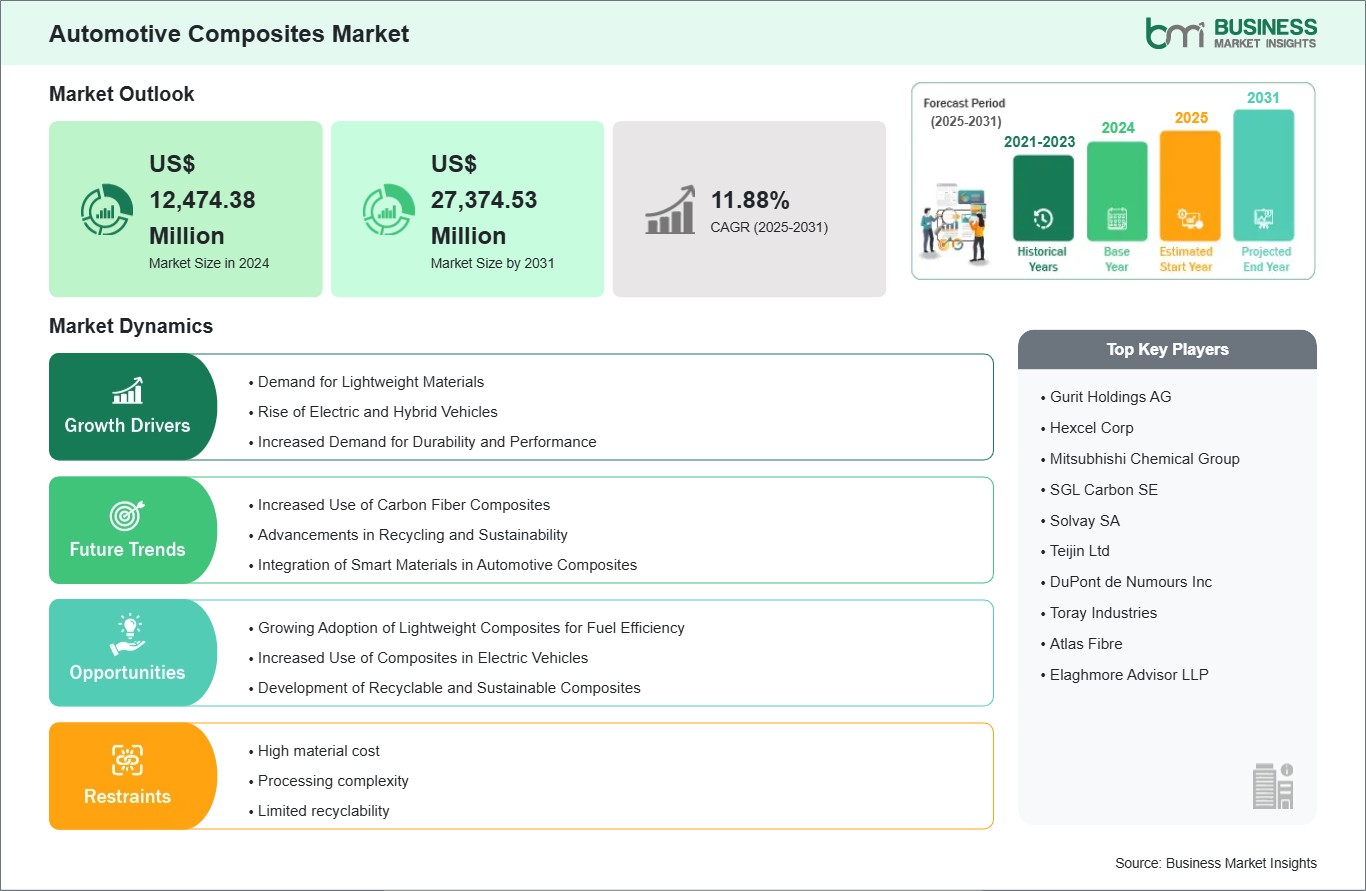
The Automotive Composites Market size is expected to reach US$ 27,374.53 Million by 2031 from US$ 12,474.38 Million in 2024. The market is estimated to record a CAGR of 11.88% from 2025 to 2031.
Executive Summary and Global Market Analysis:
Automotive composites are lightweight materials made from a combination of fibers and resins used in vehicle manufacturing to reduce weight, enhance fuel efficiency, and improve performance. These composites help meet stringent environmental regulations and support the automotive industry's shift toward sustainability. The global automotive composites market is experiencing significant growth, driven by increasing demand for lightweight materials in autmotive industry to enhance fuel efficiency and meet stringent environmental regulations.
Governments worldwide are implementing stricter emission standards and fuel efficiency requirements. Automotive composites help reduce vehicle weight, which improves fuel efficiency and lowers CO2 emissions, helping manufacturers meet these regulations.
Automotive Composites Market Segmentation Analysis:
Key segments that contributed to the derivation of the automotive composites market analysis are type and application.
- By fiber type, the automotive composites market is segmented into glass fiber composites, carbon fiber composites, and others. The glass fiber composites segment held the largest share of the market in 2024.
- By resin type, the automotive composites market is segmented into thermoset (polyester, epoxy, vinyl ester, polyurethane, and others) and thermoplastics (polyethylene, polypropylene, polycarbonate, polymethyl methacrylate, and others). The thermoplastics segment held the largest share of the market in 2024.
- By resin type, the automotive composites market is segmented into thermoset (polyester, epoxy, vinyl ester, polyurethane, and others) and thermoplastics (polyethylene, polypropylene, polycarbonate, polymethyl methacrylate, and others). The thermoplastics segment held the largest share of the market in 2024
- By technology, the automotive composites market is segmented into pultrusion, injection molding, compression molding, and others. The injection molding segment held the largest share of the market in 2024.
- By technology, the automotive composites market is segmented into pultrusion, injection molding, compression molding, and others. The injection molding segment held the largest share of the market in 2024.
- By vehicle type, the automotive composites market is segmented into passenger cars, commercial vehicles, and two wheelers and others. The passenger cars segment held the largest share of the market in 2024.
- By application, the automotive composites market is segmented into structural assembly, powertrain component, and interior. The interior segment held the largest share of the market in 2024.
Automotive Composites Market Drivers and Opportunities:
Increase in Adoption of Electric Vehicles
The rise in fuel prices and the environmental impact of conventional gasoline vehicles have paved the way for alternative fuel vehicles across the globe. Buyers are gradually getting inclined to use battery-powered or hybrid automobiles, which is anticipated to boost the demand for electric vehicles. According to the International Energy Agency's annual Global Electric Vehicle Outlook, over 10 million electric cars were sold worldwide in 2022, and the number is projected to grow by 35% in 2023 to reach 14 million. As the automotive industry witnesses a transformative shift toward electric vehicles (EVs), the role of composites has become more crucial. To promote the sale of EVs, governments are providing attractive laws and incentives. Reduced selling costs, no registration fees or minimal registration fees, and free EV infrastructure charging at various charging points are a few of these incentives. Furthermore, many countries worldwide exclude import, purchase, and road taxes due to multiple subsidies. These auto industry incentives have led to a rise in the manufacture of electric vehicles. Governments have also created beneficial policies and invested heavily in infrastructure. For example, the US government plans to spend US$ 87 billion on new highway construction over the next five years
Growth of Automotive Industry in Emerging Economies
In the last few years, the automotive industry has grown significantly across emerging economies such as Brazil, China, India, Mexico, and South Africa. With the increasing disposable income, the demand for both passenger and commercial vehicles is growing in developing countries. For instance, according to the Federation of Automobile Dealers Associations (FADA), in India, sales of passenger vehicles increased to 2,854,242 units in November 2023, compared with 2,409,535 units in November 2022. Similarly, according to the China Association of Automobile Manufacturers (CAAM), the sales of commercial vehicles accounted for 18.3% year-on-year for September 2023 in China. These stats show the increasing demand for vehicles.
The automotive industry also paved its way in Brazil and South Africa. According to the International Organization of Motor Vehicle Manufacturers (OICA), South Africa's automobile production increased by 24% to 555,889 units in 2022. According to the same source, Brazil was the largest manufacturer and exporter of light and commercial vehicles in 2023 in South & Central America. The country reported production of 2.3 million vehicles in 2022. Thus, the growth of automotive industries in emerging economies is expected to create lucrative opportunities for the automotive composites market growth.
Automotive Composites Market Size and Share Analysis
Based on fiber type, the market is segmented into glass fiber composites, carbon fiber composites, and others. The glass fiber composites segment held the largest automotive composites market share in 2024. Glass fiber composites hold a dominant position in the automotive composites market owing to their performance, cost-effectiveness, and versatility. Glass fibers are widely utilized in automotive applications due to their excellent strength-to-weight ratio, high durability, and resistance to environmental factors such as moisture and chemicals.
In terms of application, the market is segmented into structural assembly, powertrain component, and interior. The interior segment held the largest automotive composites market share in 2024. The interior segment of the automotive composites market is witnessing significant innovation as manufacturers seek to improve vehicle aesthetics, comfort, safety, and overall performance. Composites are increasingly used for various interior components, including dashboards, door panels, seat structures, headliners, and center consoles.
Automotive Composites Market Report Highlights
Automotive Composites Market Report Coverage and Deliverables
The "Automotive Composites Market Size and Forecast (2021–2031)" report provides a detailed analysis of the market covering below areas:
- Automotive composites market size and forecast at global, regional, and country levels for all the key market segments covered under the scope
- Automotive composites market trends, as well as market dynamics such as drivers, restraints, and key opportunities
- Detailed Porter's Five Forces and SWOT analysis
- Automotive composites market analysis covering key market trends, global and regional framework, major players, regulations, and recent market developments
- Industry landscape and competition analysis covering market concentration, heat map analysis, prominent players, and recent developments for the automotive composites market
- Detailed company profiles
Automotive Composites Market Country and Regional Insights
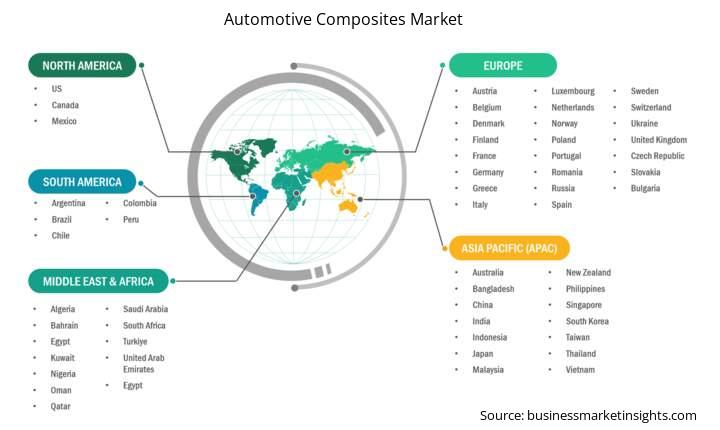
The geographical scope of the automotive composites market report is divided into five regions: North America, Asia Pacific, Europe, Middle East & Africa, and South & Central America. The automotive composites market in Asia Pacific is expected to grow significantly during the forecast period.
The automotive composites market in Asia Pacific is experiencing robust growth, owing to the region's significant automotive production and increasing demand for lightweight, durable, and fuel-efficient vehicles. Asia Pacific is a key player in the global automotive industry, with the presence of some of the world's largest automotive manufacturers, such as Toyota, Honda, Hyundai, and Tata Motors. The demand for composites in this region is spurred by the need to reduce vehicle weight, improve fuel efficiency, and meet stringent environmental regulations, which are becoming increasingly important in countries such as China, India, Japan, and South Korea. According to a report published by Fastener World Inc., Asia Pacific experienced a significant increase in production volume from over 46 million units in 2021 to over 50 million units in 2022 and over 55 million units in 2023. The region is growing rapidly in the car market owing to the rising middle-class population and disposable income. It is the largest regional base for automobile production and home to the largest vehicle buyers. The top 5 automobile producing countries are China, with more than 30 million vehicles; Japan, with nearly 9 million vehicles; India, with ~5.9 million vehicles; South Korea, with more than 4 million vehicles; and Thailand, with nearly 1.9 million vehicles.
Automotive Composites Market Research Report Guidance
- The report includes qualitative and quantitative data in the automotive composites market across fiber type, resin type, technology, vehicle type, application and geography.
- The report starts with the key takeaways (chapter 2), highlighting the key trends and outlook of the automotive composites market.
- Chapter 3 includes the research methodology of the study.
- Chapter 4 further includes ecosystem analysis along with Porter’s analysis.
- Chapter 5 highlights the major industry dynamics in the automotive composites market, including factors that are driving the market, prevailing deterrents, potential opportunities as well as future trends. Impact analysis of these drivers and restraints is also covered in this section.
- Chapter 6 discusses the automotive composites market scenario, in terms of historical market revenues, and forecast till the year 2031.
- Chapters 7 to 11 cover automotive composites market segments by type, application, and geography across North America, Europe, Asia Pacific, Middle East and Africa, and South and Central America. They cover market volume revenue forecast and factors driving the market.
- Chapter 12 describes the competitive analysis along with the heat map analysis for the key players operating in the market.
- Chapter 13 describes the industry landscape analysis. It provides detailed description of business activities such as market initiatives, new developments, mergers, and joint ventures globally, along with a competitive landscape.
- Chapter 14 provides detailed profiles of the major companies operating in the automotive composites market. The companies have been profiled on the basis of their key facts, business descriptions, products and services, financial overview, SWOT analysis, and key developments.
- Chapter 15, i.e., the appendix is inclusive of a brief overview of the company, list of abbreviations, and disclaimer.
Automotive Composites Market News and Key Development:
The automotive composites market is evaluated by gathering qualitative and quantitative data post primary and secondary research, which includes important corporate publications, association data, and databases. A few of the key developments in the automotive composites market are:
- Gurit Holding AG announced a long-term supply contract for its Kerdyn PET structural foam core. The contract allows for exclusive supply of Kerdyn PET to the company's Products for the use in office and commercial interior applications in the North American region. (Source: Gurit Holding AG, Company Website, Jan 2025)
- Hexcel Corp announced its intend to refocus its industrial business around preferred carbon fiber applications that align with its core competencies in Neumarkt, Austria. This is also expected to strengthen the company's market position in Europe. (Source: Hexcel Corp, Press Release, Oct 2024)
Key Sources Referred:
- American Society for Composites (ASC)
- The European Composites Industry Association (EuCIA)
- SAE International
- British Plastic Federation
- United States Council for Automotive Research LLC
- European Union
- China Composites Industry Association
- European Institute of Innovation & Technology (EIT)
Automotive Composites Market Strategic Insights
Automotive CompositesMarket Report Highlights
| Report Attribute | Details |
| Market size in 2024 | US$ 12,474.38 Million |
| Market Size by 2031 | US$ 27,374.53 Million |
| Global CAGR (2025 - 2031) | 11.88% |
| Historical Data | 2021-2023 |
| Forecast period | 2025-2031 |
| Segments Covered |
By Fiber Type
|
|
Regions and Countries Covered
|
|
| North America | US, Canada, Mexico |
| Europe | Germany, Italy, France, U.K., Spain, Belgium, Netherlands, Luxembourg, Norway, Finland, Denmark, Sweden, Switzerland, Austria, Greece, Portugal, Russia, Poland, Romania, Czech Republic, Ukraine, Slovakia, Bulgaria |
| Asia-Pacific | China, Japan, South Korea, India, Australia, New Zealand, Indonesia, Malaysia, Philippines, Singapore, Thailand, Vietnam, Taiwan, Bangladesh |
| South and Central America | Brazil, Argentina, Chile, Colombia, Peru |
| Middle East and Africa | Saudi Arabia, United Arab Emirates, Kuwait, Bahrain, Qatar, Oman, Turkiye, South Africa, Egypt, Nigeria, Algeria |
| Market leaders and key company profiles |
|
Automotive Composites Market Country and Regional Insights