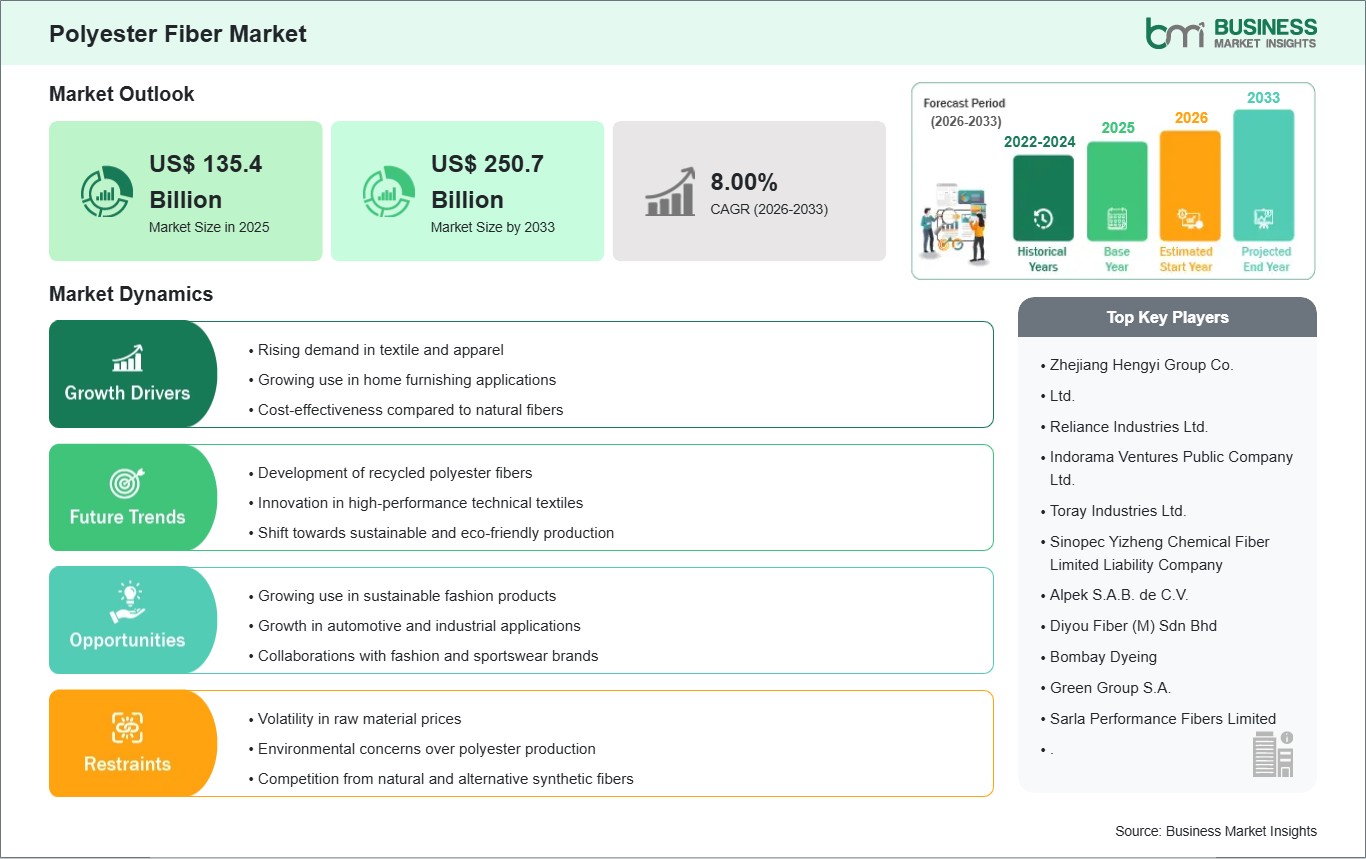
The Polyester Fiber Market size is expected to reach US$ 250.7 billion by 2033 from US$ 135.4 billion in 2025. The market is estimated to record a CAGR of 8.00% from 2026 to 2033.
The global polyester fiber market is still undergoing significant changes with the evolving demands and innovations. Polyester fibers, which possess high durability, wrinkle resistance, and cost-effectiveness, remain the dominant choice for textiles, apparel, and industrial applications. Today, the polyester fiber market is being driven by the introduction of recycled polyester and bio-based polyester, which is indicative of the importance being given to the circular economy. Polyester fibers possess high performance characteristics with the introduction of advanced production technologies such as melt spinning and microfibers. The competition level in the polyester fiber market is high, with the major players using economies of scale to ensure efficiency. Vertical integration is becoming a critical strategy, allowing companies to maintain control over raw material sourcing, polymerization, and fiber finishing processes. Innovation in functional polyester fibers, including moisture-wicking, anti-microbial, and flame-retardant properties, is also influencing market differentiation.
Moreover, the surge in e-commerce and fast-fashion retail has accelerated demand for cost-efficient, high-volume polyester fabrics. Market participants are increasingly focusing on digital supply chain management and predictive analytics to respond swiftly to market fluctuations and consumer preferences. Environmental regulations and sustainability mandates are reshaping the competitive landscape. Companies are under pressure to reduce carbon emissions, minimize water consumption, and incorporate recycled content, creating opportunities for eco-conscious product lines. Partnerships with textile recyclers and investment in green polymer technologies are becoming key differentiators.
Additionally, the rise of hybrid materials and blends, combining polyester with natural fibers like cotton or bamboo, is driving innovation in performance textiles, enhancing comfort and versatility. The overall market trajectory suggests continued growth driven by technological advancements, sustainability-focused initiatives, and strategic positioning across both mature and emerging markets.

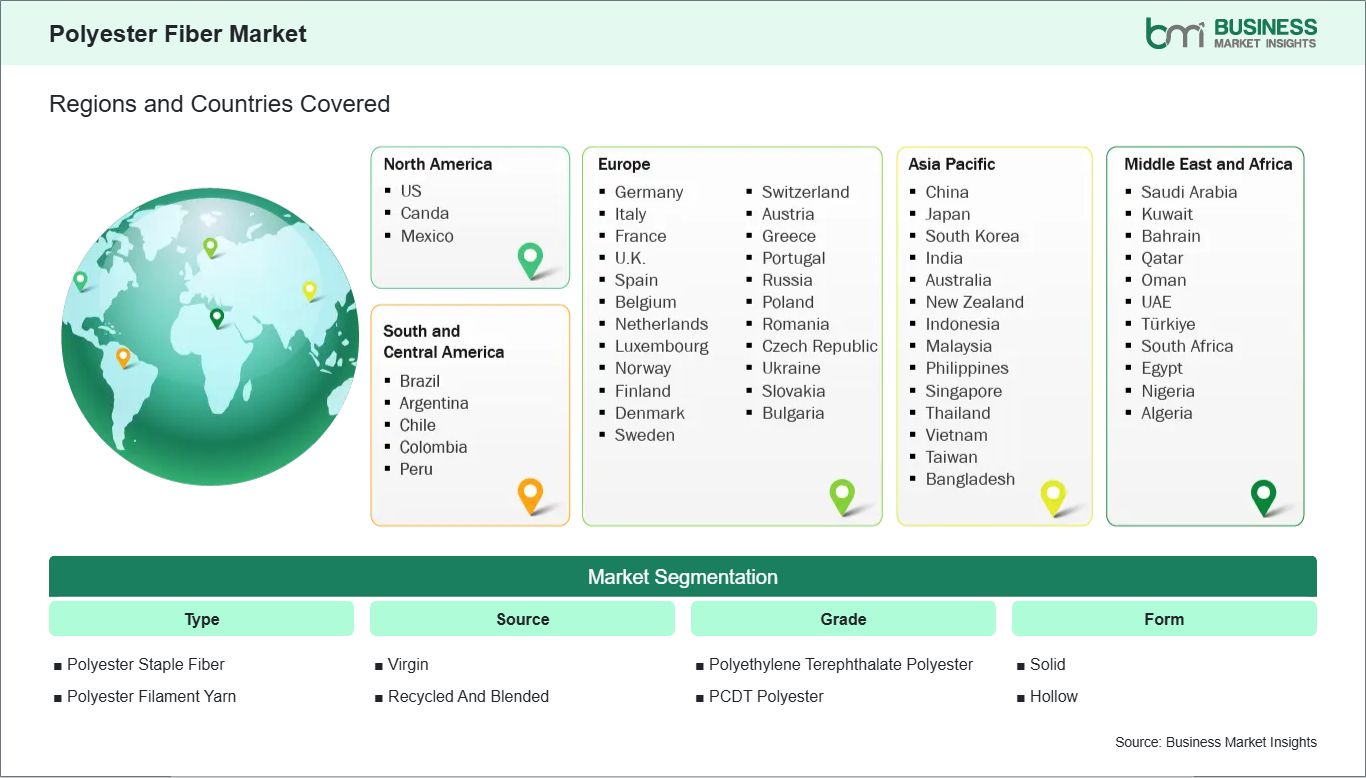
Key segments that contributed to the derivation of the polyester fiber market analysis are type, source, grade, form, denier, and application.
The global polyester fiber market is growing rapidly with the increase in demand from the textile and apparel industry. Polyester fibers are largely used in the textile and apparel industry because of their high durability, flexibility, and cost-effectiveness compared to other natural fibers such as cotton and wool. The apparel segment, including fast fashion, athleisure wear, and the mass market, is one of the major contributors to the growth of the global polyester market. Manufacturers prefer using polyester blends because they can retain their original shape even after repeated washing.
Apart from clothing, home textiles such as bed sheets, curtains, upholstery, and carpets are also contributing to the increase in polyester consumption. The non-shrinkable, non-stretchable, and dry nature of polyester fibers has made these fibers the most preferred option for textile manufacturers. Textile manufacturers globally have started producing more polyester fibers to cater to the ever-increasing demand for these fibers. The spinning technology used in textile manufacturing allows for the production of high-quality synthetic fibers at competitive prices. Thus, the supply of polyester fibers has kept pace with the ever-increasing global textile and clothing production. Apart from this, the rise of e-commerce has further fueled the demand for polyester fibers globally. The ever-increasing demand for quick order fulfillment has made polyester fibers the most preferred option for textile manufacturers globally. The non-shrinkable nature of polyester fibers has made these fibers the most preferred option for textile manufacturers globally. The ever-increasing trend of urbanization globally has made polyester fibers the most preferred option for textile manufacturers.
Sustainability is one of the important trends to watch in the polyester fibers market, with environmental awareness and pressure to comply with environmental regulations driving the demand. As such, recycled polyester fibers, also known as rPET, produced from collected post-consumer PET bottles and industrial waste, are increasingly being used in global fashion lines to replace virgin petrochemical-based fibers. Large companies are using recycled polyester fibers to manufacture clothing, sportswear, and even luxury wear to meet their organizational sustainability agendas, satisfy the demand for sustainable products among environmentally conscious consumers, and comply with upcoming global environmental regulations.
Technological developments in the recycling and processing techniques for recycled polyester fibers have enabled the production of high-quality recycled polyester fibers, which can no longer be distinguished from virgin polyester fibers. New technologies, such as closed-loop recycling and chemical depolymerization techniques, can transform collected post-consumer PET bottles into high-grade recycled polyester fibers with the ability to meet the requirements for both technical and fashion applications.
Consumer demand for environmentally friendly products around the globe remains a major driver of the sustainable polyester market. Retailers and fashion companies are increasingly launching recycled content-based apparel products, which is a positive step towards a circular economy. With the increasing awareness of consumers about the negative effects of the environment, manufacturers of polyester fibers are adopting sustainable production practices. This not only helps the recycled polyester market but also puts polyester fibers in a strong position in the global sustainable and environmentally friendly textile production landscape.
The polyester fiber market demonstrates steady growth, with size and share analysis highlighting evolving trends and competitive dynamics among key players. The report examines subsegments categorized within type, source, grade, form, denier, and application, offering insights into their contribution to overall market performance.
By Type, the Polyester Staple Fiber (PSF) subsegment dominated the market in 2025, driven by its extensive use in apparel and home textiles.
Based on Source, the virgin subsegment dominated the market in 2025, owing to consistent quality and high-performance characteristics.
In terms of Grade, the Polyethylene Terephthalate (PET) Polyester subsegment dominated the market in 2025, supported by its superior strength and versatility.
On the Basis of Form, the solid subsegment dominated the market in 2025, due to its wide applicability in textile manufacturing.
By Denier, the fine subsegment dominated the market in 2025, driven by high demand in premium apparel and home textile segments.
Based on Application, the apparel subsegment dominated the market in 2025, reflecting strong demand for polyester in clothing and fashion textiles.
| Report Attribute | Details |
|---|---|
| Market size in 2025 | US$ 135.4 Billion |
| Market Size by 2033 | US$ 250.7 Billion |
| Global CAGR (2026 - 2033) | 8.00% |
| Historical Data | 2022-2024 |
| Forecast period | 2026-2033 |
| Segments Covered | By Type
|
|
Regions and Countries Covered
| |
| North America | US, Canada, Mexico |
| Europe | Belgium, Austria, Finland, Denmark, Greece, Poland, Romania, Russia, Ukraine, Czech Republic, Slovakia, Bulgaria, Italy, Luxembourg, Germany, Switzerland, France, Netherlands, Norway, Portugal, Spain, Sweden, United Kingdom |
| Asia-Pacific | Australia, China, India, Japan, South Korea, Indonesia, Malaysia, Philippines, Singapore, Thailand, Vietnam, Bangladesh, New Zealand, Taiwan |
| South and Central America | Brazil, Argentina, Peru, Chile, Colombia |
| Middle East and Africa | Bahrain, Kuwait, Oman, Qatar, Saudi Arabia, United Arab Emirates, Turkiye, South Africa, Egypt, Algeria, Nigeria |
| Market leaders and key company profiles |
|
The "Polyester Fiber Market Size and Forecast (2022 - 2033)" report provides a detailed analysis of the market covering below areas:
The geographical scope of the Polyester Fiber Market report is divided into North America, Asia Pacific, Europe, Middle East & Africa, and South & Central America. North America held the largest share in 2025.
Regionally, the polyester fiber market demonstrates diverse growth dynamics shaped by local industry capabilities, regulatory environments, and consumer preferences. North America stands as the dominant market, driven by a mature textile industry and high demand for performance-oriented fabrics. The region’s market growth is fueled by activewear, technical textiles, and industrial applications, where functional polyester fibers with moisture-wicking, anti-microbial, and flame-retardant properties are in high demand. U.S. manufacturers are investing heavily in technological advancements, including smart textiles and advanced polymer blends, to cater to evolving consumer and industrial requirements. Supply chain optimization and resilience, particularly in response to raw material price fluctuations and trade uncertainties, remain key strategic priorities.
In the Asia Pacific, rapid urbanization, rising disposable income, and expanding textile manufacturing capacities are primary growth drivers. Countries such as China, India, and Vietnam are increasingly focusing on large-scale polyester production to meet both domestic and international demand. The region also sees significant adoption of recycled polyester, supported by government initiatives promoting sustainable production and circular textile practices. Fast-fashion demand and e-commerce expansion further contribute to high-volume consumption of polyester fibers across apparel and home textiles.
Europe emphasizes sustainability and innovation, where strict environmental regulations and eco-conscious consumer preferences are driving the adoption of recycled and bio-based polyester fibers. Manufacturers in countries such as Germany, Italy, and France are investing in R&D for low-carbon polymer solutions and advanced fiber technologies. Strategic partnerships between textile producers and fashion brands are common, aiming to align production processes with sustainability and traceability standards.
The Middle East & Africa region is witnessing moderate growth, primarily fueled by industrial applications and construction textiles. Polyester fiber demand is supported by infrastructure projects, automotive applications, and regional textile hubs such as Egypt and Turkey. Investments in production facilities and trade initiatives are gradually improving market access and competitiveness.
South & Central America presents a developing market, with Brazil, Argentina, and Colombia leading polyester fiber adoption. Growth is driven by apparel manufacturing, export-oriented textile production, and increasing urbanization. Local manufacturers are gradually integrating recycled and high-performance fibers to capture niche markets and respond to international sustainability requirements, creating a foundation for steady long-term growth.

The Polyester Fiber Market is evaluated by gathering qualitative and quantitative data post primary and secondary research, which includes important corporate publications, association data, and databases. A few of the key developments in the polyester fiber market are:
The Polyester Fiber Market is valued at US$ 135.4 Billion in 2025, it is projected to reach US$ 250.7 Billion by 2033.
As per our report Polyester Fiber Market, the market size is valued at US$ 135.4 Billion in 2025, projecting it to reach US$ 250.7 Billion by 2033. This translates to a CAGR of approximately 8.00% during the forecast period.
The Polyester Fiber Market report typically cover these key segments-
The historic period, base year, and forecast period can vary slightly depending on the specific market research report. However, for the Polyester Fiber Market report:
The Polyester Fiber Market is populated by several key players, each contributing to its growth and innovation. Some of the major players include:
The Polyester Fiber Market report is valuable for diverse stakeholders, including:
Essentially, anyone involved in or considering involvement in the Polyester Fiber Market value chain can benefit from the information contained in a comprehensive market report.
Please tell us your area of interest
(Market Segments/ Regions and Countries/ Companies)