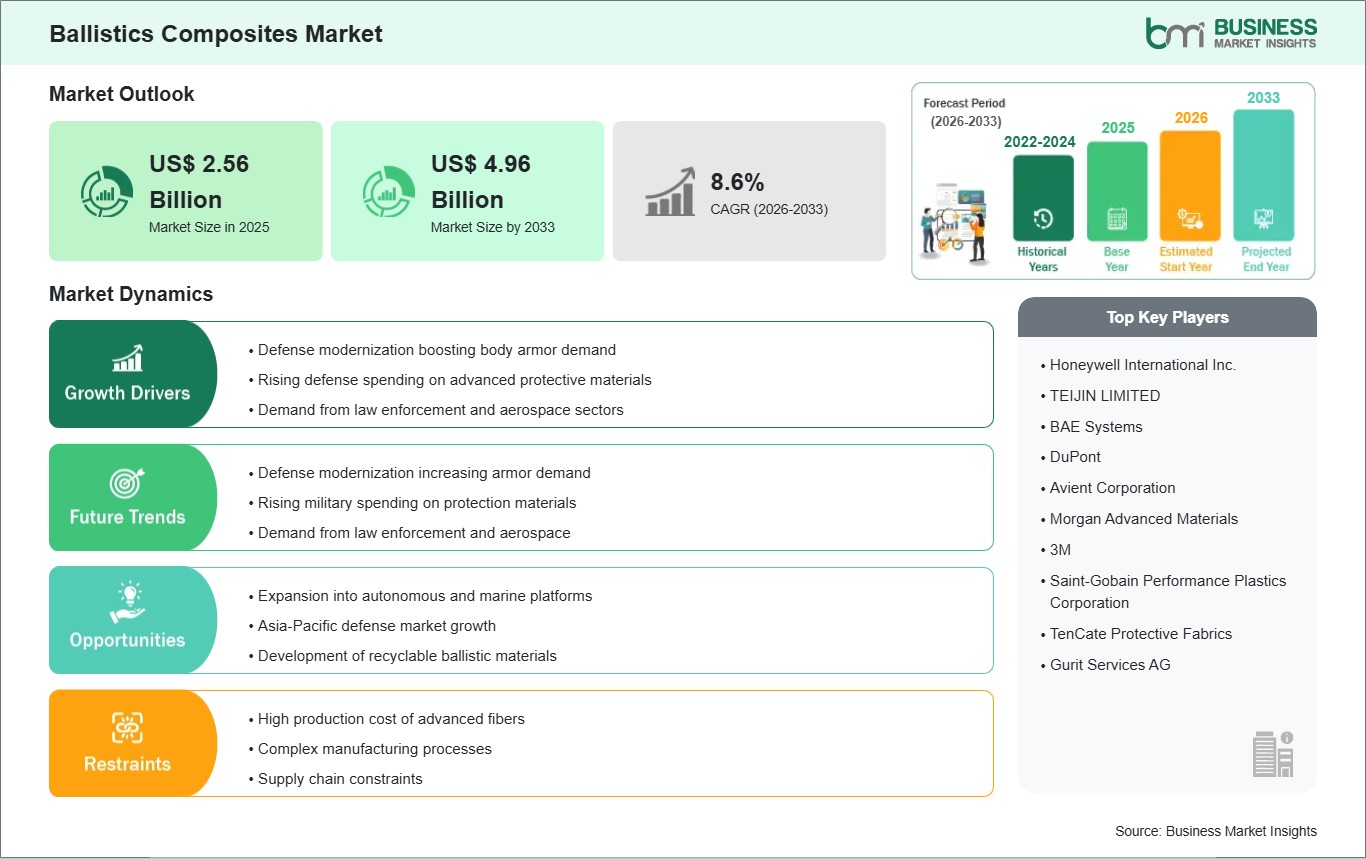
Ballistics Composites market size is expected to reach US$ 4.96 billion by 2033 from US$ 2.56 billion in 2025. The market is estimated to record a CAGR of 8.6% from 2026 to 2033.
Ballistics composites are engineered materials designed to offer high-impact resistance, energy absorption, and lightweight protection against ballistic threats and explosive forces. These composites are commonly used in personal protective equipment like helmets and body armor, as well as in military vehicles, aircraft, naval vessels, and security infrastructure, where safety and durability are crucial. They are built to withstand extreme stress, high-velocity projectiles, and harsh environmental conditions, which helps improve mobility, survivability, and operational efficiency. Typically, they include aramid fibers, ultra-high-molecular-weight polyethylene (UHMWPE), carbon fiber composites, ceramic matrix composites, and hybrid material systems. All these materials are made to meet strict defense and security standards. Their high strength-to-weight ratio, corrosion resistance, and structural integrity make them vital in military, law enforcement, aerospace, and certain civilian applications. The demand for ballistic composites is growing due to rising global defense spending, the modernization of armed forces, and increasing concerns about geopolitical tensions and asymmetric warfare. As countries invest in advanced armored vehicles, lightweight protective gear, and next-generation combat systems, the need for high-performance composite materials is expanding. More homeland security initiatives and law enforcement modernization programs are also driving market growth.
Additionally, the expansion of border security operations and peacekeeping missions is increasing the demand for lightweight, durable ballistic protection solutions. Technological advancements in materials science are significantly influencing the market. Modern defense platforms require lighter but stronger protective systems to boost mobility, fuel efficiency, and mission adaptability. Manufacturers are creating next-generation composite solutions with better multi-hit capability, improved energy dispersion, and enhanced thermal and environmental resistance. Innovations in nanomaterials, hybrid fiber structures, and advanced resin systems are leading to thinner and more durable armor products.
There is also rising interest in sustainable manufacturing processes and recyclable composite materials to address environmental concerns and lifecycle issues. Digital design tools, simulation technologies, and additive manufacturing techniques are further aiding in precision engineering and cost efficiency. Despite challenges like fluctuating raw material prices, complicated certification requirements, and significant research and development costs, the global ballistics composites market is projected to grow steadily. Increasing purchases of armored platforms, a higher demand for lightweight personal protection, and ongoing innovation in composite technologies support long-term expansion. As defense and security agencies focus on mobility, survivability, and effective threat protection, the global ballistics composites market is well-positioned for sustained growth driven by modernization programs, evolving security threats, and advancements in high-performance materials engineering.

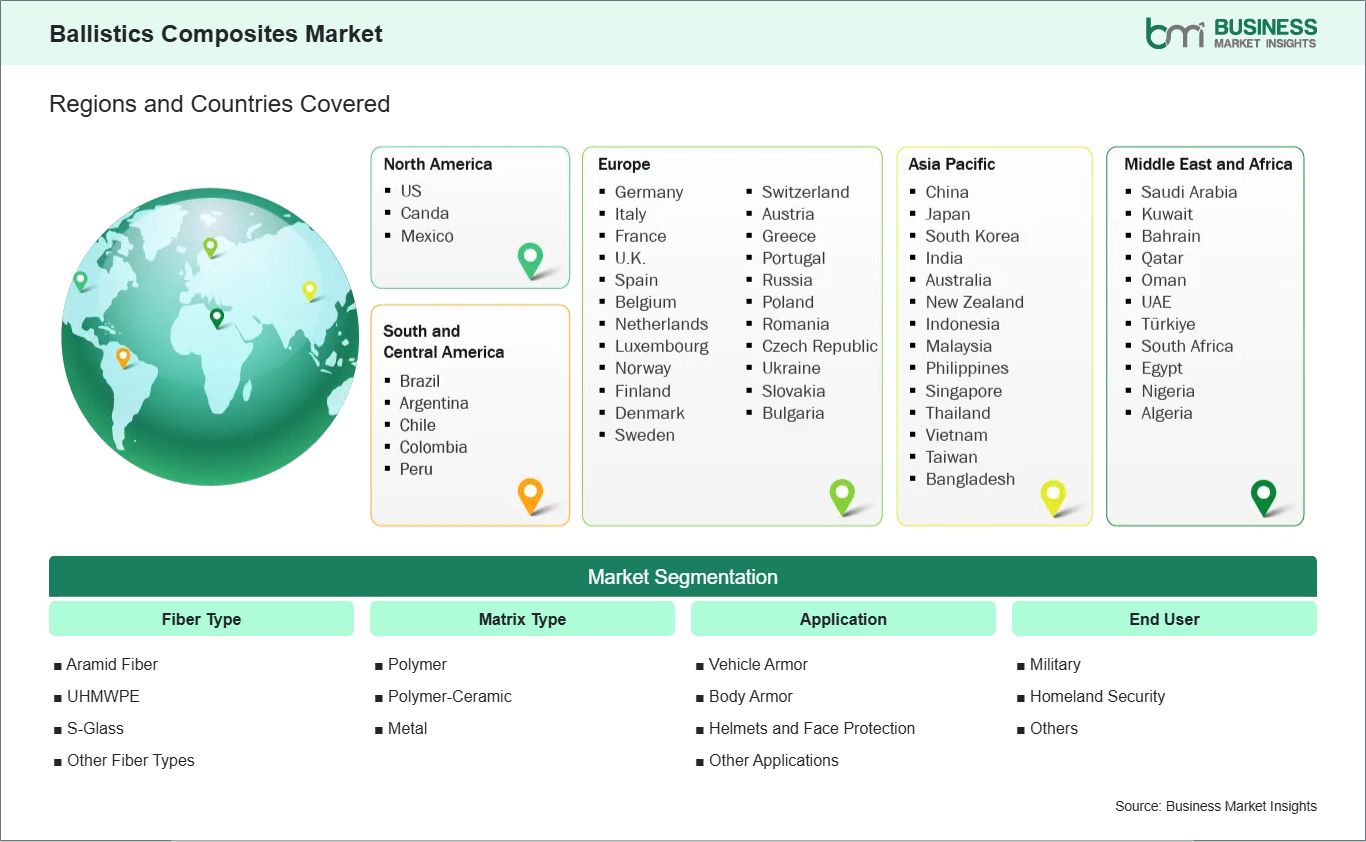
Key segments that contributed to the derivation of the Ballistics Composites market analysis are fiber type, matrix type, application, and end user.
Ongoing defense modernization efforts and the rising need for lightweight, strong protection systems largely drive the global ballistics composites market. Governments in both developed and emerging economies are investing heavily to upgrade military equipment, armored vehicles, naval vessels, and aircraft in response to changing security threats and asymmetric warfare scenarios. Modern combat operations require better mobility, faster deployment, and increased survivability. This has sped up the process of replacing traditional steel armor with composite materials. Ballistic composites like Aramid Fiber, UHMWPE, and ceramic-based hybrid systems offer better impact resistance while significantly cutting down system weight. This weight reduction enhances vehicle maneuverability, fuel efficiency, and payload capacity, giving composite armor a strategic edge in military operations. Besides vehicle protection, the demand for advanced body armor, helmets, and tactical shields for armed forces and law enforcement is steadily increasing. Rising cross-border tensions, counterterrorism efforts, and homeland security programs are driving the global procurement of personal protective equipment. Moreover, growing defense budgets in regions such as Asia-Pacific, the Middle East, and North America support large-scale acquisition programs. As armed forces continue to focus on lightweight, multi-hit capable, and highly durable protective solutions, ballistic composites are expected to see continued demand across land, air, and naval platforms.
A key factor driving the global ballistics composites market is the rapid innovation in material science and the rising need for protection against various advanced threats. Modern battlefields pose complex risks, including high-velocity projectiles, improvised explosive devices (IEDs), and blast fragmentation. These challenges require next-generation composite systems with improved energy absorption and structural resilience. Manufacturers are creating advanced hybrid composites that combine ceramics, high-performance fibers, and specialized resin systems to achieve better ballistic performance with reduced thickness and weight. These advancements enable armor systems to meet strict international ballistic standards while remaining flexible and durable. Innovations in nanotechnology, fiber weaving methods, and automated manufacturing processes are further improving product consistency and performance. Digital modeling and simulation tools allow precise engineering of armor solutions tailored to specific threat levels, boosting reliability and cost efficiency. At the same time, there is growing attention to sustainable production practices and recyclable composite materials to address environmental and lifecycle issues. Law enforcement agencies and civilian security sectors are also using advanced ballistic panels for infrastructure and vehicle protection, widening the market beyond traditional military uses. As safety needs, performance expectations, and multi-threat protection capabilities continue to change, advancements in composite engineering are likely to drive long-term growth in the global ballistics composites market.
The aramid fiber segment leads the market because of its exceptional strength-to-weight ratio, high impact resistance, and proven performance in ballistic protection applications. Its wide use in body armor, helmets, and vehicle armor systems, along with long-standing military adoption and ongoing material improvements, supports its leading position.
Based on matrix type, polymer matrices dominate because they offer excellent flexibility, lightweight properties, corrosion resistance, and efficient energy absorption when combined with high-performance fibers. Their cost-effectiveness, ease of processing, and compatibility with advanced composite manufacturing techniques further encourage widespread use.
The vehicle armor segment has the largest share of the ballistics composites market due to the growing global demand for armored vehicles for military and security operations. The rising need for lightweight composite armor that improves mobility, fuel efficiency, and multi-threat protection plays a significant role in the growth of this segment.
The military segment is the largest as defense forces worldwide keep investing in modernization programs, advanced protective gear, and armored platforms. Increasing geopolitical tensions, higher defense budgets, and the need for better soldier survivability strongly drive demand in this segment.
| Report Attribute | Details |
|---|---|
| Market size in 2025 | US$ 2.56 Billion |
| Market Size by 2033 | US$ 4.96 Billion |
| Global CAGR (2026 - 2033) | 8.6% |
| Historical Data | 2022-2024 |
| Forecast period | 2026-2033 |
| Segments Covered | By Fiber Type
|
| Regions and Countries Covered | North America
|
| Market leaders and key company profiles |
|
The "Ballistics Composites Market Size and Forecast (2022–2033)" report provides a detailed analysis of the market covering below areas:
The geographical scope of the Ballistics Composites market report is divided into five regions: North America, Asia Pacific, Europe, Middle East & Africa, and South & Central America. The Ballistics Composites market in the Asia Pacific is expected to grow significantly during the forecast period.
The Asia-Pacific Ballistics Composites market is segmented into China, Japan, South Korea, India, Australia, New Zealand, Indonesia, Malaysia, the Philippines, Singapore, Thailand, Vietnam, Taiwan, Bangladesh, and the Rest of Asia.
The Asia-Pacific region is one of the fastest-growing markets for ballistic composites. Rising defense budgets, military modernization programs, and increasing geopolitical tensions drive this growth. Countries like China, India, Japan, South Korea, and Australia are actively investing in armored vehicles, naval vessels, aircraft protection systems, and next-generation gear for soldiers. Concerns over border security and regional territorial disputes are motivating governments to strengthen land and maritime defense capabilities, which is increasing the demand for lightweight composite armor solutions. Additionally, expanding domestic defense manufacturing efforts and technology transfer agreements are boosting local production of high-performance ballistic materials. The region is also seeing growth in homeland security and law enforcement modernization, which increases the need for personal protective equipment and armored transport. These factors position Asia-Pacific as a key emerging center for the production and innovation of ballistic composites as well as long-term defense procurement. North America and Europe maintain substantial shares of the global ballistic composites market, thanks to their established defense industries, strong research capabilities, and high military spending. The United States leads the North American market with significant investments in armored vehicle upgrades, advanced body armor systems, and aerospace-grade ballistic protection. Ongoing modernization programs and the presence of major defense contractors and material science companies create a steady demand for high-performance composite solutions. In Europe, countries like Germany, France, the United Kingdom, and Italy are influential due to collaborative defense initiatives, NATO commitments, and continuous updates to military platforms. Strict performance standards and a focus on lightweight, multi-threat protection systems further drive innovation and adoption in the region.
Meanwhile, the Middle East is becoming an important growth area, supported by high defense spending, armored vehicle procurement programs, and ongoing security challenges. Several Gulf countries are investing in advanced land systems and protective solutions to enhance their national defense capabilities. Latin America is gradually expanding as governments work on modernizing security forces and improving border control infrastructure. Across all regions, the increasing demand for lightweight armor, rising investments in military modernization, and the need for better protection for personnel and vehicles are expected to support steady long-term growth in the global ballistic composites market.

The Ballistics Composites market is evaluated by gathering qualitative and quantitative data post primary and secondary research, which includes important corporate publications, association data, and databases. A few of the key developments in the Ballistics Composites market are:
The Ballistics Composites Market is valued at US$ 2.56 Billion in 2025, it is projected to reach US$ 4.96 Billion by 2033.
As per our report Ballistics Composites Market, the market size is valued at US$ 2.56 Billion in 2025, projecting it to reach US$ 4.96 Billion by 2033. This translates to a CAGR of approximately 8.6% during the forecast period.
The Ballistics Composites Market report typically cover these key segments-
The historic period, base year, and forecast period can vary slightly depending on the specific market research report. However, for the Ballistics Composites Market report:
The Ballistics Composites Market is populated by several key players, each contributing to its growth and innovation. Some of the major players include:
The Ballistics Composites Market report is valuable for diverse stakeholders, including:
Essentially, anyone involved in or considering involvement in the Ballistics Composites Market value chain can benefit from the information contained in a comprehensive market report.
Please tell us your area of interest
(Market Segments/ Regions and Countries/ Companies)