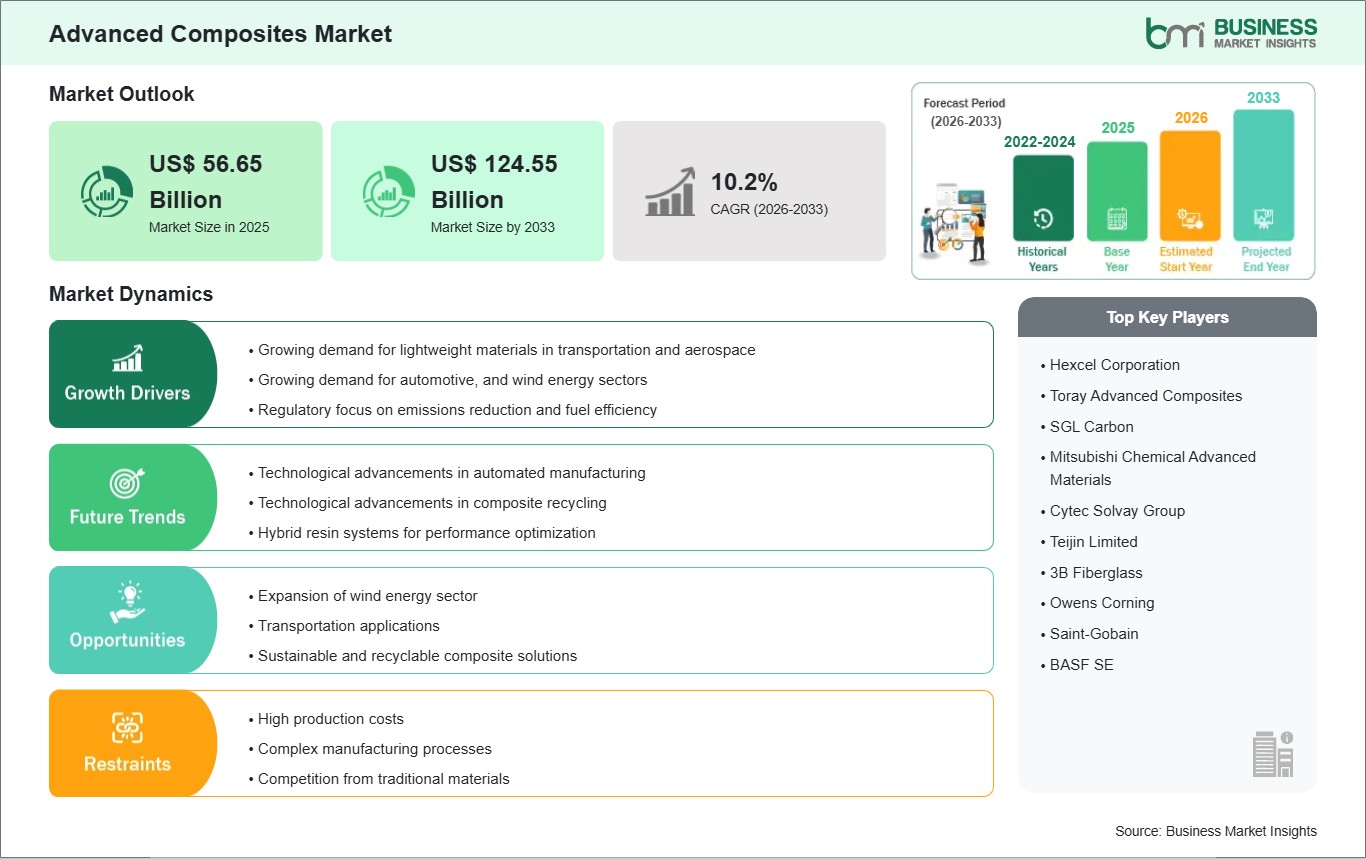
The Advanced Composites Market size is expected to reach US$ 124.55 Billion by 2033 from US$ 56.65 Billion in 2025 .The market is estimated to record a CAGR of 10.2% from 2026 to 2033.
The global advanced composites market is driven by the increasing demand for lightweight, high-strength materials in aerospace, automotive, wind energy, and civil engineering sectors. Advanced composites—particularly carbon fiber and aramid fiber composites—offer superior mechanical properties, corrosion resistance, and fatigue durability compared to traditional materials, enabling improved fuel efficiency, structural performance, and design flexibility.
This market growth reflects broader industrial trends emphasizing sustainability, operational efficiency, and technological innovation. Manufacturers are focusing on expanding production capacities, optimizing manufacturing processes such as AFP/ATL and RTM/VARTM, and developing hybrid composite materials to meet diverse application requirements.
Competitive dynamics highlight investments in automated fabrication technologies and tailored resin systems that enhance composite performance and reduce production costs. Growing emphasis on reducing carbon footprints and improving material recyclability further shapes product development strategies. The integration of composites into mainstream manufacturing is transforming multiple industries toward more efficient and sustainable solutions.

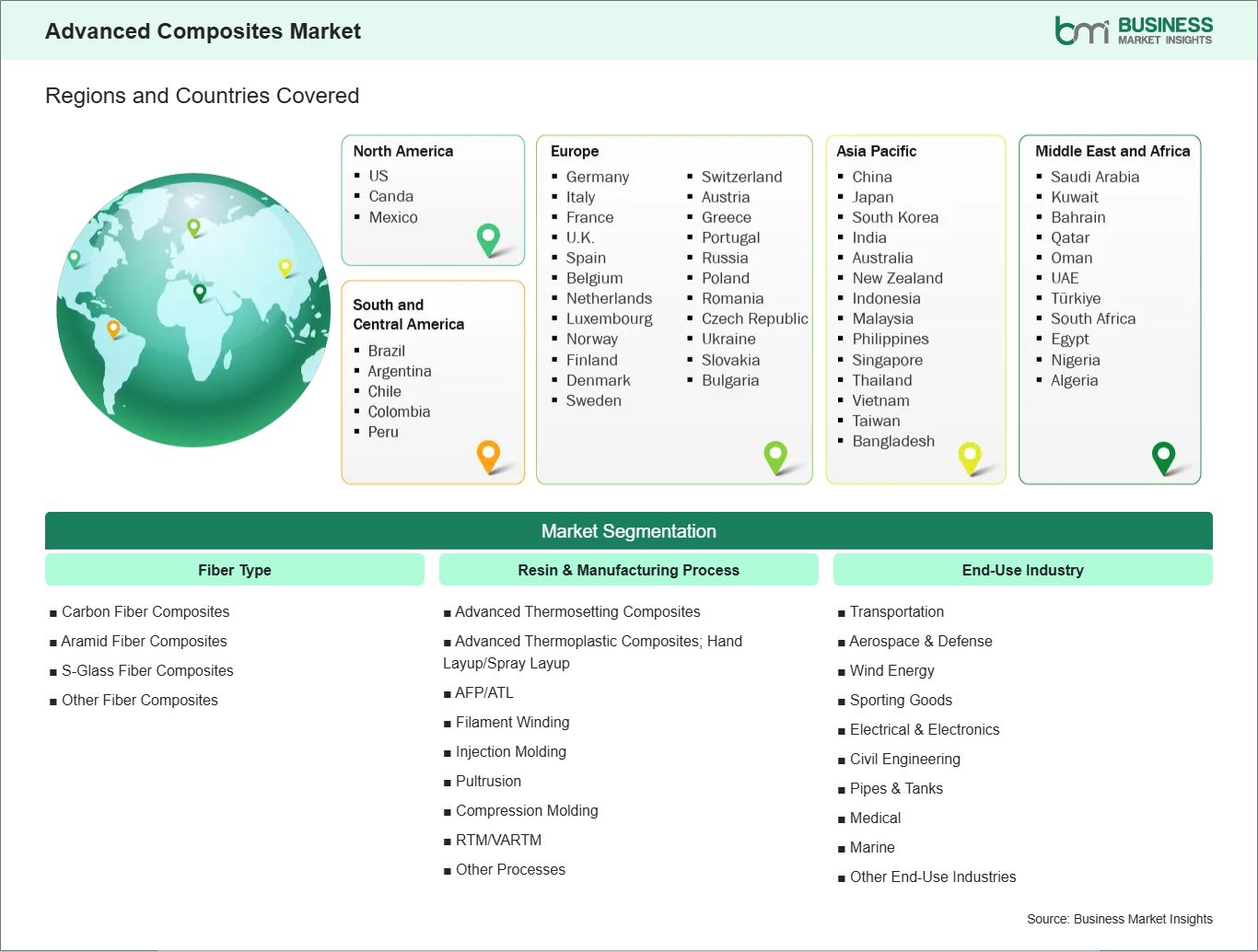
Key segments that contributed to the derivation of the advanced composites market analysis are fiber type, resin type, manufacturing process, and end-use industry.
The transportation and aerospace industries are at the forefront of adopting advanced composites, driven by global regulations targeting emissions reduction and fuel efficiency. Lightweight materials such as carbon fiber and thermoplastic composites enable significant weight savings without compromising strength, durability, or safety. This translates into improved vehicle performance, lower fuel consumption, and reduced operational costs—critical factors in today`s competitive and environmentally conscious markets.
In the automotive sector, the rise of electric and hybrid vehicles has accelerated the need for lightweight solutions. Advanced composites are increasingly used in body panels, structural reinforcements, and interior components, helping manufacturers meet stringent efficiency standards while enhancing design flexibility. Aerospace companies, meanwhile, rely heavily on composites to reduce aircraft weight, improve aerodynamics, and extend service life. Modern aircraft such as the Boeing 787 and Airbus A350 incorporate composites extensively, underscoring their importance in next‑generation aviation.
Technological innovations are further expanding opportunities. Advances in resin chemistry, automated manufacturing processes, and recyclability are making composites more cost‑effective and sustainable. The ability to recycle thermoplastic composites, for example, aligns with circular economy goals and regulatory pressures for greener production. As transportation systems evolve toward sustainability and efficiency, advanced composites are positioned as indispensable enablers of innovation, ensuring compliance with regulations while delivering superior performance.
The global wind energy industry represents one of the most dynamic growth areas for advanced composites. Wind turbine blades, often exceeding 100 meters in length, require materials that combine lightweight properties with exceptional strength, stiffness, and fatigue resistance. Carbon fiber and glass fiber composites meet these requirements, enabling efficient energy capture and ensuring long service life under demanding environmental conditions.
Governments worldwide are investing heavily in renewable energy infrastructure, supported by policies that encourage clean energy adoption. This has led to a surge in wind turbine installations, particularly in Asia, Europe, and North America. As wind farms expand both onshore and offshore, demand for advanced composite materials continues to rise.
Manufacturing innovations are also driving growth. Processes such as pultrusion, filament winding, and vacuum infusion allow cost‑effective production of large composite components at scale. These techniques improve consistency, reduce waste, and enhance structural performance. In parallel, research into advanced resin systems and fiber reinforcements tailored for wind energy applications is enabling blades that are lighter, stronger, and more durable.
The expansion of wind energy not only boosts composite demand but also fosters innovation across the industry. By addressing challenges such as recyclability and blade end‑of‑life management, composite manufacturers are aligning with sustainability goals. As renewable energy becomes a cornerstone of global power generation, advanced composites will remain critical in enabling efficient, reliable, and environmentally responsible wind energy solutions.

The Advanced Composites Market demonstrates steady growth, with size and share analysis highlighting evolving trends and competitive dynamics among key players. The report examines subsegments categorized within fiber type, resin type, manufacturing process, and end-use industry, offering insights into their contribution to overall market performance.
By fiber type, the carbon fiber composites subsegment dominated the market in 2025, driven by its superior mechanical properties and increasing aerospace and automotive applications.
By resin type, advanced thermosetting composites dominated the market in 2025, due to their broad application in structural components.
By manufacturing process, the AFP/ATL subsegment dominated in 2025, driven by automation benefits and high-quality composite fabrication.
By end-use industry, aerospace & defense dominated in 2025, due to extensive composite integration in aircraft manufacturing.
| Report Attribute | Details |
|---|---|
| Market size in 2025 | US$ 56.65 Billion |
| Market Size by 2033 | US$ 124.55 Billion |
| Global CAGR (2026 - 2033) | 10.2% |
| Historical Data | 2022-2024 |
| Forecast period | 2026-2033 |
| Segments Covered | By Fiber Type
|
|
Regions and Countries Covered
| |
| North America | US, Canada, Mexico |
| Europe | Belgium, Austria, Finland, Denmark, Greece, Poland, Romania, Russia, Ukraine, Czech Republic, Slovakia, Bulgaria, Italy, Luxembourg, Germany, Switzerland, France, Netherlands, Norway, Portugal, Spain, Sweden, United Kingdom |
| Asia-Pacific | Australia, China, India, Japan, South Korea, Indonesia, Malaysia, Philippines, Singapore, Thailand, Vietnam, Bangladesh, New Zealand, Taiwan |
| South and Central America | Brazil, Argentina, Peru, Chile, Colombia |
| Middle East and Africa | Bahrain, Kuwait, Oman, Qatar, Saudi Arabia, United Arab Emirates, Turkiye, South Africa, Egypt, Algeria, Nigeria |
| Market leaders and key company profiles |
|
The "Advanced Composites Market Size and Forecast (2022 - 2033)" report provides a detailed analysis of the market covering below areas:
The geographical scope of the Advanced Composites Market report is divided into North America, Asia Pacific, Europe, Middle East & Africa, and South & Central America. North America held the largest share in 2025.
The adoption of advanced composites varies by region, influenced by industrialization, aerospace manufacturing hubs, and renewable energy investments. North America leads due to strong aerospace and defense industries, supported by advanced manufacturing infrastructure and R&D investments.
Europe follows closely with significant aerospace and automotive manufacturing, alongside expanding wind energy projects driving composite usage. Countries such as Germany, France, and the UK are key contributors.
Asia Pacific is a rapidly growing market with increasing infrastructure development, automotive production, and wind energy installations in China, Japan, India, and Southeast Asia.
Emerging markets in the Middle East & Africa and South & Central America show growth potential, driven by infrastructure and defense modernization efforts.

The Advanced Composites Market is evaluated by gathering qualitative and quantitative data post primary and secondary research, which includes important corporate publications, association data, and databases. A few of the key developments in the advanced composites market are:
The Advanced Composites Market is valued at US$ 56.65 Billion in 2025, it is projected to reach US$ 124.55 Billion by 2033.
As per our report Advanced Composites Market, the market size is valued at US$ 56.65 Billion in 2025, projecting it to reach US$ 124.55 Billion by 2033. This translates to a CAGR of approximately 10.2% during the forecast period.
The Advanced Composites Market report typically cover these key segments-
The historic period, base year, and forecast period can vary slightly depending on the specific market research report. However, for the Advanced Composites Market report:
The Advanced Composites Market is populated by several key players, each contributing to its growth and innovation. Some of the major players include:
The Advanced Composites Market report is valuable for diverse stakeholders, including:
Essentially, anyone involved in or considering involvement in the Advanced Composites Market value chain can benefit from the information contained in a comprehensive market report.
Please tell us your area of interest
(Market Segments/ Regions and Countries/ Companies)