Market Summary
Executive Summary and Global Market Analysis
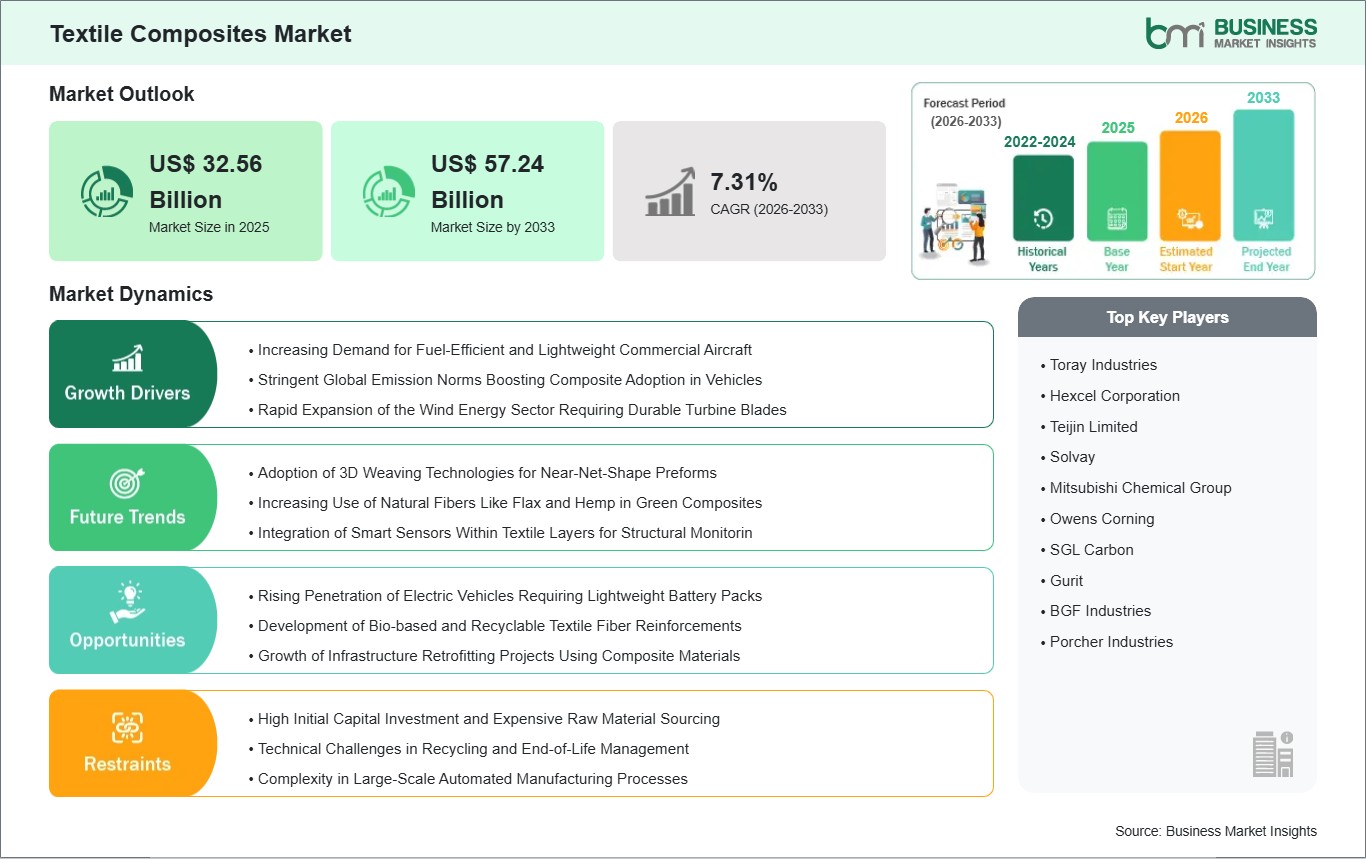
The global textile composites market is witnessing a robust growth trajectory, underpinned by the urgent need for high-performance materials that offer a superior strength-to-weight ratio. As industrial sectors face increasing pressure to reduce carbon emissions and enhance operational efficiency, textile composites have emerged as a vital solution. These materials, created by integrating fiber preforms with resin matrices, provide unmatched design flexibility and durability. While glass fiber remains the volume leader due to its affordability, carbon fiber is rapidly gaining share in high-value applications where extreme stiffness and minimal weight are non-negotiable. The market is also benefiting from technological leaps in automated manufacturing, which are beginning to address the traditional barriers of high cost and slow production cycles.
Sustainability is becoming a major theme in this field, with increased investments in bio-based fibers and enhanced recycling methods to promote a circular economy. The growth of the market is also sustained by the increased diversity of applications, including high-speed rail and marine vessels, sports equipment, and infrastructure repairs. The geographical distribution of the market has Asia-Pacific as the largest and fastest-growing market, driven by huge manufacturing activities in China and India. Going forward, the integration of smart features and the use of 3D woven structures are expected to revolutionize this market in the future. The textile composites market is set to play a crucial role in enabling engineering and sustainable visions.
Segment Analysis
Textile Composites Market Segmentation
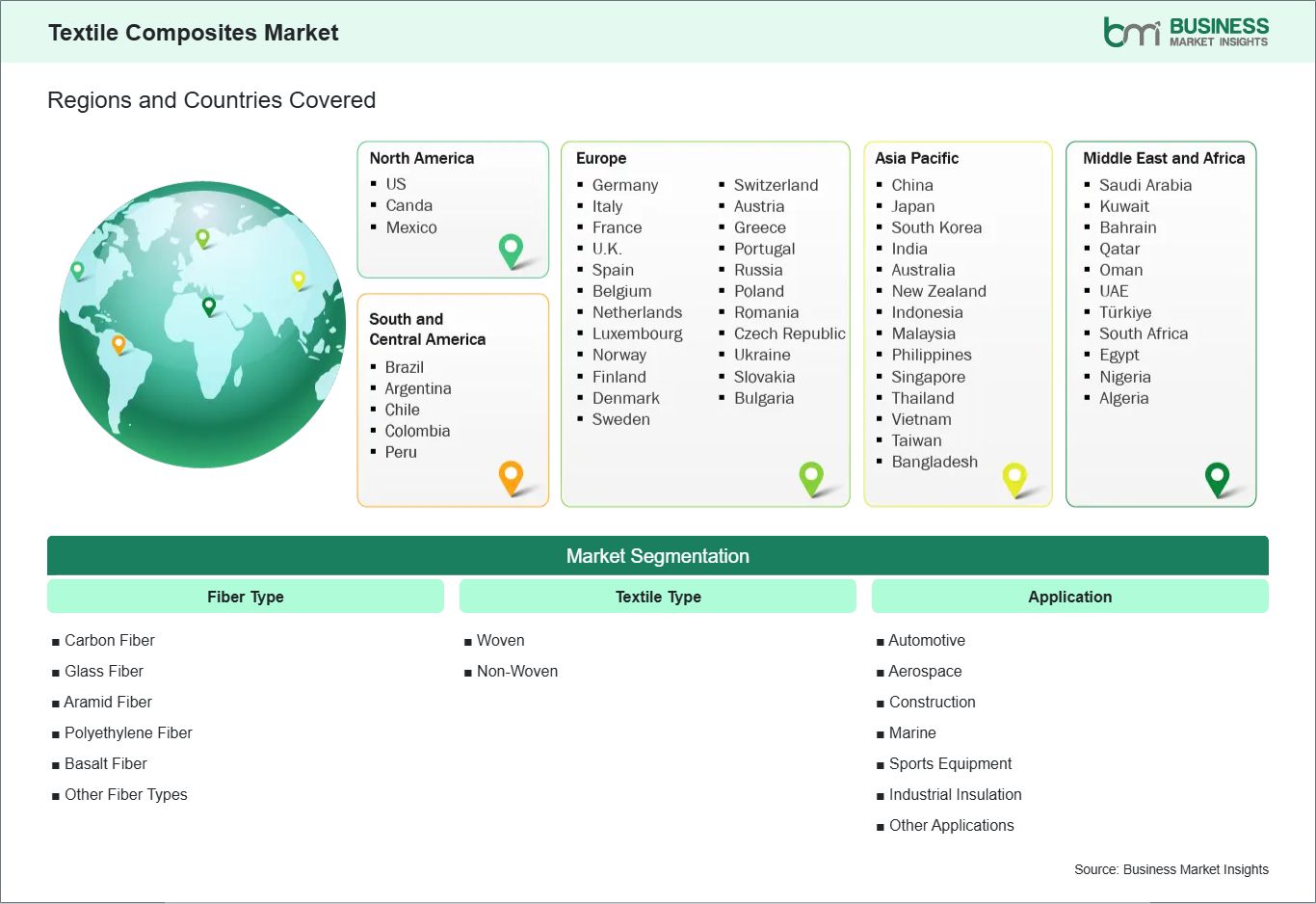
Key segments that contributed to the derivation of the Textile Composites market analysis are fiber type, textile type, and application.
- By fiber type, the textile composites market is segmented into Carbon Fiber, Glass Fiber, Aramid Fiber, Polyethylene Fiber, Basalt Fiber, and Others. The Glass Fiber segment dominated the market in 2025.
- By textile type, the textile composites market is segmented into Woven and Non-Woven. The Woven segment dominated the market in 2025.
- By application, the textile composites market is segmented into Automotive, Aerospace, Construction, Marine, Sports Equipment, Industrial Insulation, and Others. The Aerospace segment dominated the market in 2025.
Market Forces
Textile Composites Market Drivers and Opportunities
Increasing Demand for Fuel-Efficient and Lightweight Commercial Aircraft
The aerospace industry remains the primary engine for growth within the textile composites market, driven by a relentless pursuit of weight reduction to optimize fuel consumption. Modern aircraft designs, such as the Boeing 787 and Airbus A350, utilize over 50% composite materials by weight, a significant portion of which consists of advanced textile reinforcements. By replacing traditional aluminum with carbon or glass fiber textile composites, manufacturers can achieve weight savings of up to 20%, directly translating into lower operational costs for airlines and a reduced environmental footprint. This demand is further amplified by the post-pandemic recovery of global travel and the subsequent surge in new aircraft orders.
In addition to weight reduction benefits, textile composites provide superior fatigue resistance and corrosion immunity compared to metals. This enables longer maintenance intervals and increased aircraft life, thereby offering a significant economic advantage for the entire vehicle life cycle. The trend towards urban air mobility and the introduction of electric vertical take-off and landing (eVTOL) aircraft represent a new frontier for the use of textile composites in aircraft structures. These new aircraft types use high-performance textile composites almost exclusively to meet the stringent power-to-weight ratio requirements for vertical flight operations. The aviation industry's move towards a 'Net Zero' future is expected to further emphasize the use of these advanced materials.
Rising Penetration of Electric Vehicles Requiring Lightweight Battery Packs
A large opportunity for textiles composites exists in sheltering and protecting products in a battery system due to the world`s market switch over to an electric-powered mobility experience. Compared to the weight of the combustion engine vehicle, an electric vehicle will be significantly heavier due to the weight of battery cells. Hence, to maintain maximum driving distances, automotive engineers use lightweight textile composite enclosure materials in order to reduce total vehicle weight. The key design properties of textile-reinforced composites are their ability to provide the required structural integrity to protect the battery's internal components during severe accidents, flame-resistant and thermal insulation properties, which ensure safety for the passenger, and prevent the risk of thermal runaway within large high-capacity energy storage and electric vehicle (s) battery systems.
Furthermore, textile composites allow for the consolidation of parts, enabling manufacturers to design complex, integrated structures that would be impossible or too heavy to produce with steel or aluminum. Woven and non-woven mats are increasingly used in chassis components, floor panels, and interior structures to offset the weight of the powertrain. As battery technology evolves and production scales up, the cost of composite manufacturing is decreasing, making it more viable for mass-market vehicle platforms. The synergy between lightweighting and electrification ensures that textile composites will be a cornerstone of the next generation of sustainable transportation.
Size and Share Analysis
Textile Composites Market Size and Share Analysis
The global Textile Composites market is experiencing steady growth, with market size and share analysis reflecting evolving treatment preferences and competitive dynamics among key players. The report evaluates important subsegments categorized within fiber type, textile type, and application, highlighting their respective contributions to overall market performance.
By fiber type, the Glass Fiber subsegment dominated in 2025 due to its exceptional balance of cost-efficiency and mechanical performance. Its widespread availability and versatility across high-volume industries like construction and marine tanks make it the primary reinforcement choice for large-scale industrial applications.
By textile type, the Woven subsegment dominated in 2025 because it provides superior structural integrity and bidirectional strength. The interlaced pattern of woven fabrics offers high dimensional stability and impact resistance, which is critical for load-bearing components in the aerospace and automotive sectors.
By application, the Aerospace subsegment dominated in 2025 owing to the rigorous requirement for lightweight, high-strength materials to improve fuel efficiency and payload capacity. The extensive use of advanced textile preforms in primary structures like wings and fuselages drives the highest value in this market.
Report Coverage
Textile Composites Market Report Coverage and Deliverables
The "Textile Composites Market Size and Forecast (2022 - 2033)" report provides a detailed analysis of the market covering below areas:
- Textile Composites market size and forecast at the regional and country levels for segments covered under the scope
- Textile Composites market trends, as well as drivers, restraints, and opportunities
- Textile Composites market analysis covering key trends, regional framework, major players, regulations, and recent developments
- Industry landscape and competition analysis covering market concentration, heat map analysis, prominent players, and recent developments for the Textile Composites market
- Detailed company profiles, including SWOT analysis
Geographic Insights
Textile Composites Market Geographic Insights
The geographical scope of the Textile Composites market report is divided into: North America, Asia Pacific, Europe, Middle East & Africa, and South & Central America. North America held the largest share in 2025.
North America currently dominates the textile composites market, primarily due to its highly advanced aerospace and defense infrastructure. The region is home to several of the world`s leading aircraft manufacturers and Tier-1 suppliers who have pioneered the use of composite materials in primary structural components. Furthermore, the presence of a mature automotive industry that is aggressively pivoting toward electric vehicles provides a steady demand for high-performance textiles. The United States, in particular, benefits from a strong research and development ecosystem, supported by both private investment and government initiatives aimed at advancing domestic manufacturing capabilities for critical materials.
The dominance is also reinforced by the region's early adoption of stringent environmental regulations, which have mandated the use of lightweight materials to meet fuel economy standards. North American companies lead in the development of specialized resins and high-modulus fibers, maintaining a competitive edge in product innovation. Additionally, the growing wind energy sector in the U.S. and Canada utilizes massive quantities of glass fiber textiles for the production of increasingly larger turbine blades. While other regions are expanding their manufacturing bases, North America's combination of technical expertise, established supply chains, and high-value end-use sectors ensures its continued leadership in the global market.
Industry Activity
Recent Developments
The Textile Composites market is evaluated by gathering qualitative and quantitative data post primary and secondary research, which includes important corporate publications, association data, and databases. A few of the key developments in the Textile Composites market are:
- In January 2026, Chomarat Group, announced that it finalized the acquisition of CTMI, strengthening its portfolio of technical textiles and composite materials for strategic markets such as transportation and construction.
- In March 2024, Toray Industries, announced expansion plans for its carbon fiber composite production capacity to meet rising demand from aerospace and automotive sectors utilizing textile composites.
- In July 2023, Hexcel Corporation, announced that it expanded its engineered core and composite manufacturing operations in the U.S. to support growing demand for lightweight composite materials, including textile-reinforced composites in aerospace applications.
Trust & Transparency
Research Methodology
The market analysis combines proprietary research with secondary data from government agencies, company disclosures, regulatory filings, industry databases and expert interviews. Market estimates are validated through data triangulation, cross-market benchmarking and analyst
review.
View Full Research Methodology
Key Sources Referred:
American Chemistry Council (ACC) International Council of Chemical Associations (ICCA) European Chemical Industry Council (Cefic) China Petroleum and Chemical Industry Federation (CPCIF) Indian Chemical Council (ICC) Japan Chemical Industry Association (JCIA) Brazilian Chemical Industry Association (ABIQUIM) Gulf Petrochemicals and Chemicals Association (GPCA) Company Websites Company Annual Reports Company Investor Presentations