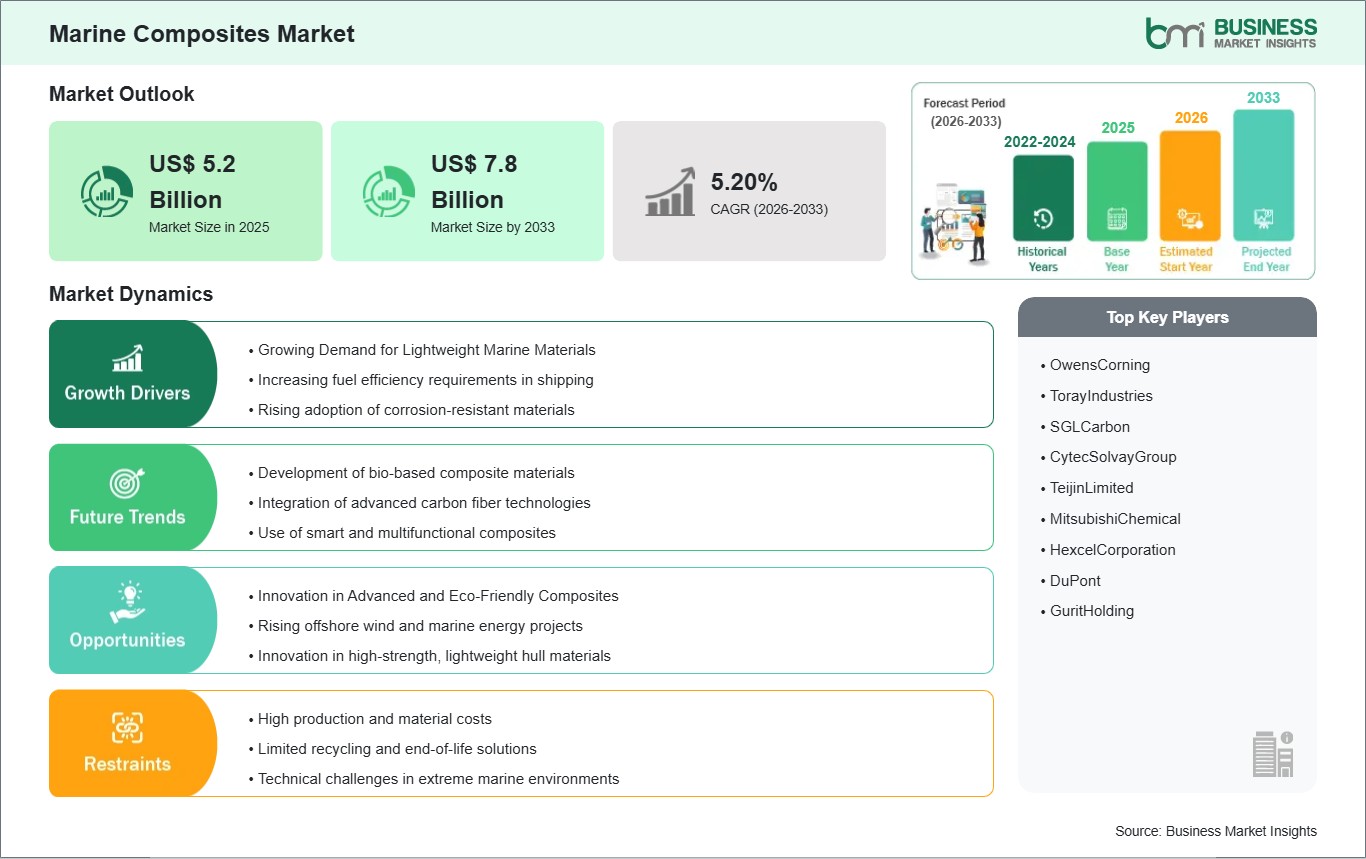
The Marine Composites Market size is expected to reach US$ 7.8 Billion by 2033 from US$ 5.2 Billion in 2025. The market is estimated to record a CAGR of 5.20% from 2026 to 2033.
The global market for marine composites is growing rapidly, with the marine industry increasingly turning to composites for performance, weight reduction, strength, and corrosion resistance. Marine composites, which are made from glass, carbon, or aramid fibers embedded in a polymer matrix, are increasingly being used to replace traditional metals in the manufacture of boats, ships, yachts, ferries, naval ships, and other offshore structures. The increasing demand for composites in the marine industry is attributed to the need to improve performance, speed, maneuverability, lifespan, and overall reduction of operating costs. The demand for composites in the marine industry is also attributed to the need to improve the lifespan of ships, which has necessitated the need to replace traditional metals with composites, which are lighter, stronger, corrosion-resistant, and provide a number of other performance benefits.
Technological advancements in composites, which have made them perform well in harsh environments, have also increased demand for composites in the marine industry. Environmental policies and sustainability strategies are driving the development of bio-based resins and recyclable composites. The market for marine composites is being driven forward by the increasing naval modernization programs, the growth of the cruise liner and merchant vessel fleets, and the increasing need for offshore wind energy structures, which require corrosion-resistant composites. The companies are investing in R&D, application-specific solutions, and process optimization to help lower the cost of production of composites used in high-performance marine applications. As the world becomes increasingly efficient, sustainable, and compliant, marine composites are becoming a vital part of modern shipbuilding.

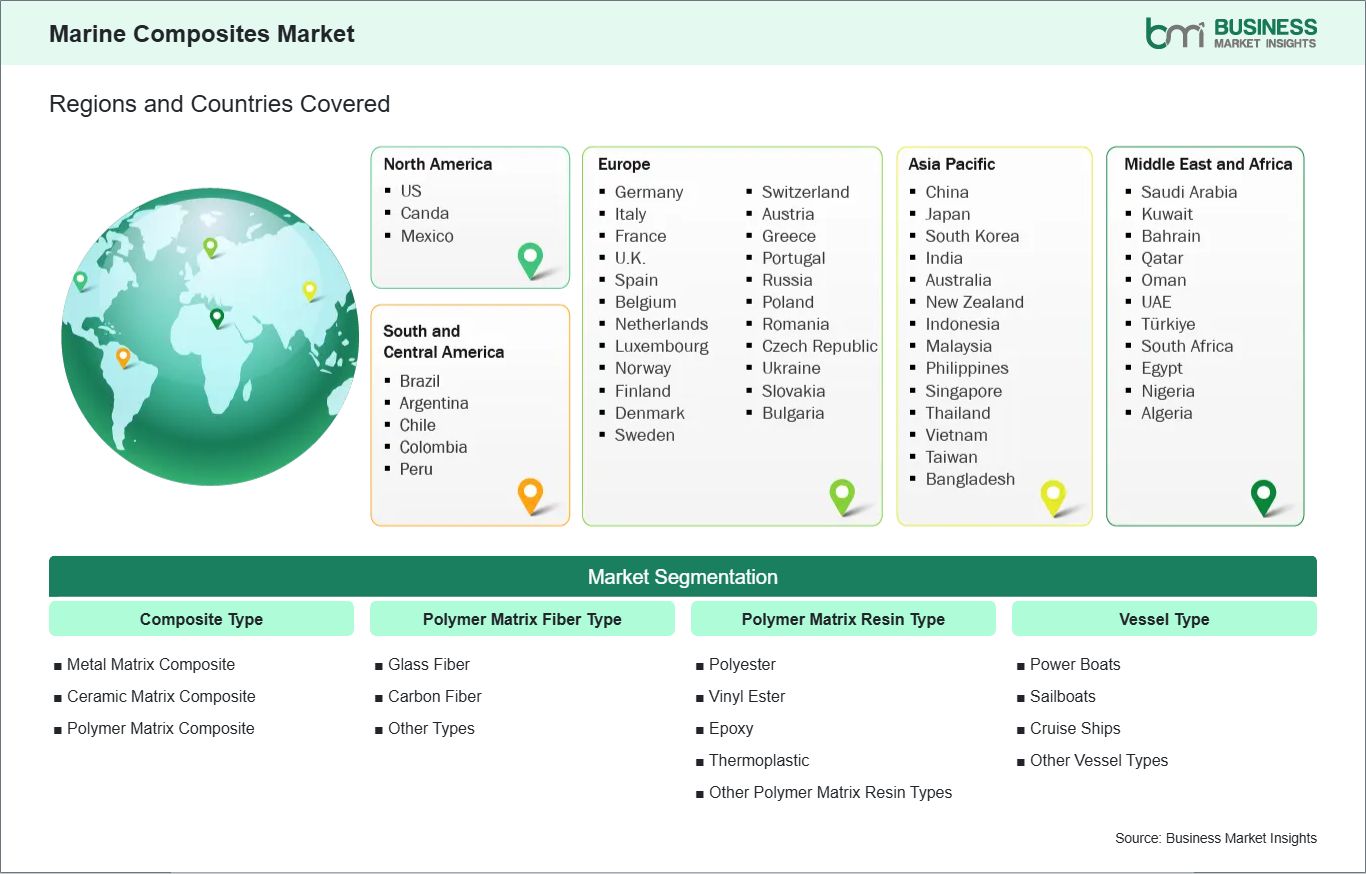
Key segments that contributed to the derivation of the marine composites market analysis are composite type, polymer matrix by fiber type, polymer matrix by resin type, and vessel type.
The global marine composites market is being driven by the rising demand for lightweight, durable materials in shipbuilding, boating, and offshore applications. Composites such as fiberglass-reinforced plastics, carbon fiber, and hybrid materials offer high strength-to-weight ratios, excellent corrosion resistance, and enhanced durability compared to traditional metals. These advantages make composites ideal for hulls, decks, superstructures, and other marine components. In commercial and recreational vessel construction, lightweight composites improve fuel efficiency, reduce maintenance costs, and enable innovative design flexibility. Offshore platforms, docks, and marine infrastructure also benefit from composites that withstand harsh environments, including saltwater exposure, UV radiation, and mechanical stress. Manufacturers are developing composites with tailored properties, including higher stiffness, impact resistance, and thermal stability, to meet industry-specific requirements.
Additionally, the emphasis on reducing operational costs, enhancing vessel performance, and extending service life is increasing the adoption of marine composites. Growing awareness of environmental regulations and sustainable shipbuilding practices further supports market growth. The combination of lightweight efficiency, durability, and design flexibility is positioning the marine composites market for steady global expansion across commercial, recreational, and offshore marine applications.
Technological innovation is creating significant opportunities in the marine composites market. Manufacturers are developing advanced composites with improved strength, corrosion resistance, and fatigue performance while incorporating eco-friendly resins and manufacturing processes. Sustainable composites reduce environmental impact and align with regulations on emissions, waste, and resource efficiency. Research is also focusing on hybrid materials, nanomaterial reinforcements, and high-performance fiber composites to meet the demands of extreme marine environments. These innovations allow for optimized structural performance, reduced weight, and increased durability in both vessel and offshore applications. Collaboration between composite producers, shipbuilders, and marine engineers is accelerating the development of customized solutions for specific vessel designs, load conditions, and environmental factors. The integration of high-performance and sustainable composites is driving broader adoption, enhancing fuel efficiency, operational lifespan, and design possibilities. These technological advancements are positioning the marine composites market for long-term global growth across commercial, recreational, and industrial sectors.
The marine composites market demonstrates steady growth, with size and share analysis highlighting evolving trends and competitive dynamics among key players. The report examines subsegments categorized within composite type, polymer matrix by fiber type, polymer matrix by resin type, and vessel type, offering insights into their contribution to overall market performance.
By Composite Type, the polymer matrix composite subsegment dominated the market in 2025, driven by its lightweight properties, corrosion resistance, and broad use across recreational and commercial marine vessels.
Based on Polymer Matrix by Fiber Type, the glass fiber subsegment dominated the market in 2025, supported by its excellent mechanical strength, cost‑effectiveness, and established use in hulls and structural components.
On the basis of Polymer Matrix by Resin Type, the polyester subsegment dominated the market in 2025, owing to its balance of performance, cost, and availability for large‑scale boat production.
On the basis of Vessel Type, the power boats subsegment dominated the market in 2025, backed by growing demand for lightweight, high‑performance recreational boats and yachts.
| Report Attribute | Details |
|---|---|
| Market size in 2025 | US$ 5.2 Billion |
| Market Size by 2033 | US$ 7.8 Billion |
| Global CAGR (2026 - 2033) | 5.20% |
| Historical Data | 2022-2024 |
| Forecast period | 2026-2033 |
| Segments Covered | By Composite Type
|
|
Regions and Countries Covered
| |
| North America | US, Canada, Mexico |
| Europe | Belgium, Austria, Finland, Denmark, Greece, Poland, Romania, Russia, Ukraine, Czech Republic, Slovakia, Bulgaria, Italy, Luxembourg, Germany, Switzerland, France, Netherlands, Norway, Portugal, Spain, Sweden, United Kingdom |
| Asia-Pacific | Australia, China, India, Japan, South Korea, Indonesia, Malaysia, Philippines, Singapore, Thailand, Vietnam, Bangladesh, New Zealand, Taiwan |
| South and Central America | Brazil, Argentina, Peru, Chile, Colombia |
| Middle East and Africa | Bahrain, Kuwait, Oman, Qatar, Saudi Arabia, United Arab Emirates, Turkiye, South Africa, Egypt, Algeria, Nigeria |
| Market leaders and key company profiles |
|
The "Marine Composites Market Size and Forecast (2022 - 2033)" report provides a detailed analysis of the market covering below areas:
The geographical scope of the Marine Composites Market report is divided into North America, Asia Pacific, Europe, Middle East & Africa, and South & Central America. North America held the largest share in 2025.
Regional trends in the marine composites market reflect shipbuilding capacities, industrial infrastructure, and technological adoption. North America leads, driven by naval modernization, offshore oil and gas infrastructure, and commercial shipbuilding in the U.S. and Canada, where composites are preferred for weight reduction, corrosion resistance, and fuel efficiency. Europe is a key market, particularly Germany, Italy, Norway, and the UK, where luxury yacht production, commercial fleets, and offshore wind energy installations encourage high-performance composite adoption. Regulatory frameworks emphasizing safety, durability, and environmental compliance further support the market.
Asia Pacific is the fastest-growing region, with China, Japan, South Korea, and India driving demand due to rapid expansion of commercial and naval shipyards, offshore structures, and recreational vessels. Cost-effective manufacturing, local supply chains, and export-oriented production enhance growth.
Middle East & Africa is emerging, with demand linked to offshore oil rigs, commercial shipping, and port infrastructure in Saudi Arabia, UAE, and South Africa. South & Central America, led by Brazil and Mexico, is gradually increasing adoption, particularly in commercial shipping, recreational vessels, and ship repair activities. Across all regions, innovation, material performance, environmental compliance, and cost efficiency are key factors influencing marine composite adoption and market competitiveness.

The Marine Composites Market is evaluated by gathering qualitative and quantitative data post primary and secondary research, which includes important corporate publications, association data, and databases. A few of the key developments in the marine composites market are:
The Marine Composites Market is valued at US$ 5.2 Billion in 2025, it is projected to reach US$ 7.8 Billion by 2033.
As per our report Marine Composites Market, the market size is valued at US$ 5.2 Billion in 2025, projecting it to reach US$ 7.8 Billion by 2033. This translates to a CAGR of approximately 5.20% during the forecast period.
The Marine Composites Market report typically cover these key segments-
The historic period, base year, and forecast period can vary slightly depending on the specific market research report. However, for the Marine Composites Market report:
The Marine Composites Market is populated by several key players, each contributing to its growth and innovation. Some of the major players include:
The Marine Composites Market report is valuable for diverse stakeholders, including:
Essentially, anyone involved in or considering involvement in the Marine Composites Market value chain can benefit from the information contained in a comprehensive market report.
Please tell us your area of interest
(Market Segments/ Regions and Countries/ Companies)