Market Summary
Executive Summary and Global Market Analysis
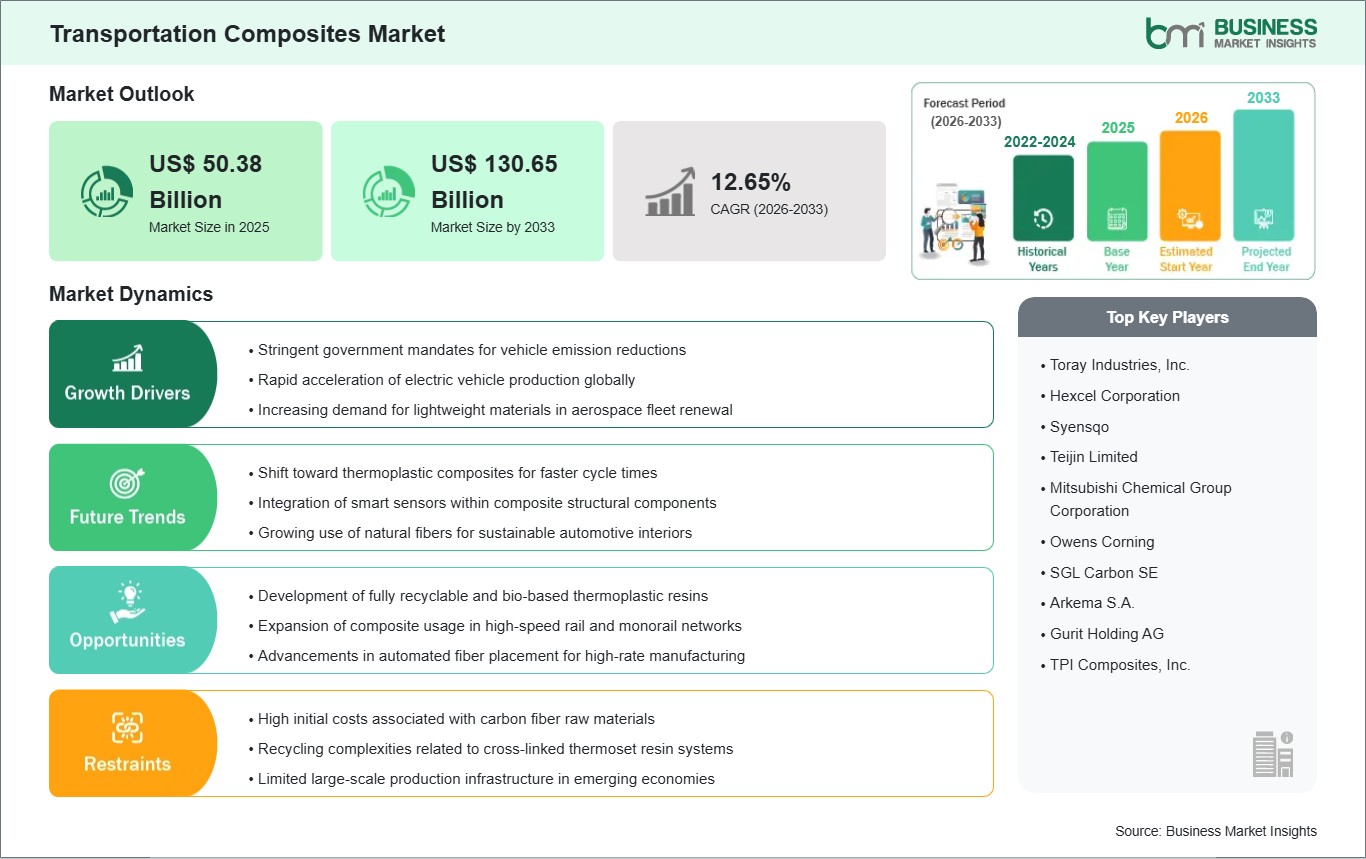
The worldwide market for transportation composites is in a state of dynamic change, with the critical need for material efficiency driving the market in the automotive, aerospace, and rail industries. The market, which represents a multi-billion-dollar industry, is largely driven by the worldwide shift toward electrification and the resulting need for lightweighting to increase the range of the batteries. As electric vehicle platforms continue to be the norm, the market for composite enclosures, shields, and reinforcements for batteries has experienced a dramatic increase. This shift has been made possible through improvements in manufacturing technologies, including automated resin transfer molding and high-speed injection techniques, which have been successful in reducing cycle times to make composites more viable in high-volume manufacturing environments.
The competitive landscape is marked by strategic partnerships between the chemical majors and the transport OEMs to create application-specific formulations. Although North America and Europe continue to dominate the high-value aerospace composites market, the Asia-Pacific region has established itself as the volume leader owing to the high volume of automotive production and the rapid development of green energy infrastructure. However, the high cost of premium fibers and the need to improve the recycling infrastructure for thermosets continue to pose challenges. Nevertheless, the trend toward recyclable thermoplastics and the use of bio-based materials are paving the way for sustainable growth in the long term. As the transport industry becomes increasingly focused on durability and sustainability, composites are poised to become the building blocks for the next generation in mobility.
Segment Analysis
Transportation Composites Market Segmentation
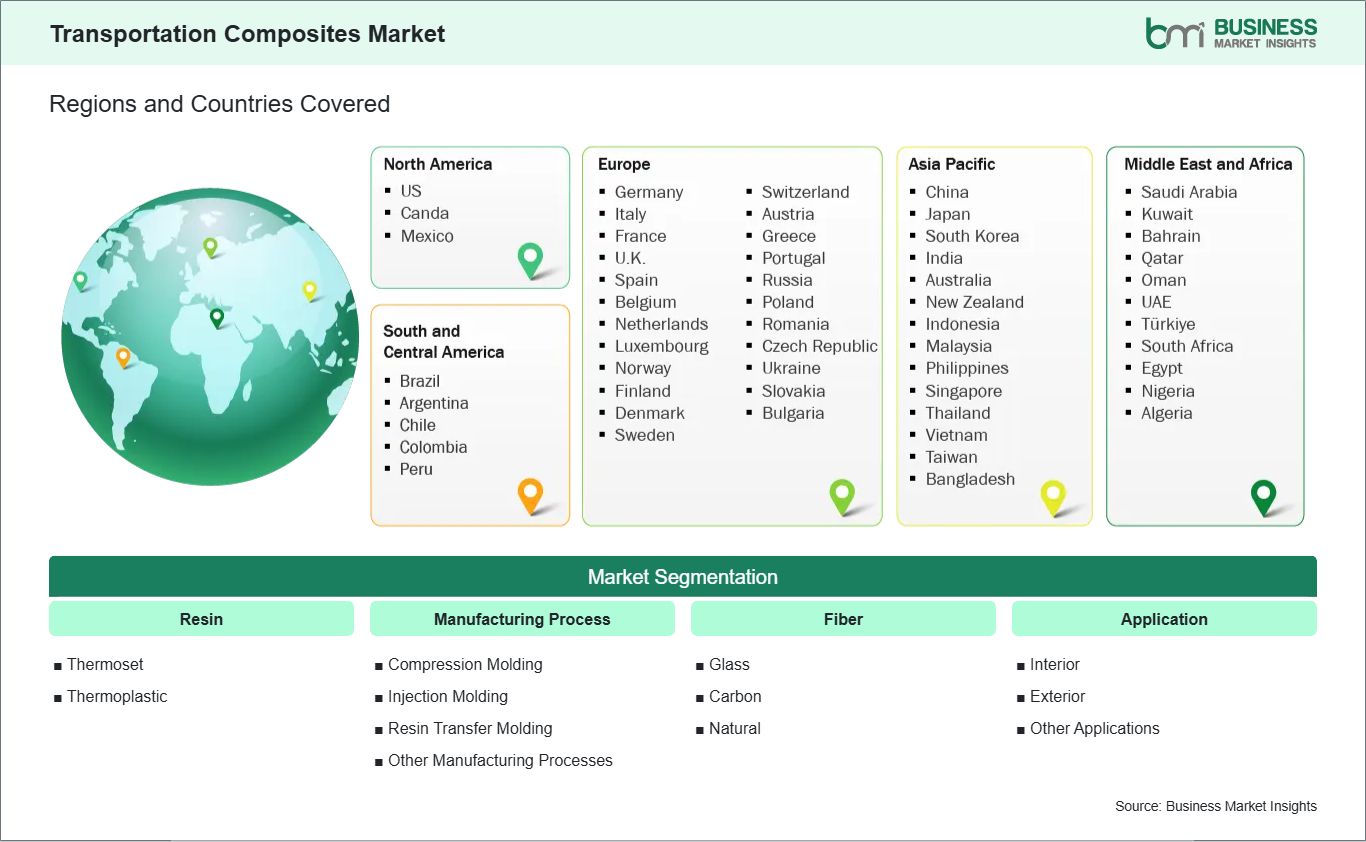
Key segments that contributed to the derivation of the Transportation Composites market analysis are resin, manufacturing process, fiber, and application.
- By resin, the transportation composites market is segmented into thermoset and thermoplastic. The thermoset segment dominated the market in 2025.
- By manufacturing process, the transportation composites market is segmented into compression molding, injection molding, resin transfer molding, and other manufacturing processes. The compression molding segment dominated the market in 2025.
- By fiber, the transportation composites market is segmented into glass, carbon, and natural. The glass segment dominated the market in 2025.
- By application, the transportation composites market is segmented into interior, exterior, and other applications. The exterior segment dominated the market in 2025.
Market Forces
Transportation Composites Market Drivers and Opportunities
Stringent government mandates for vehicle emission reductions
The present situation faced by the global automotive industry can be termed as highly regulated, with countries worldwide imposing stringent regulations regarding carbon footprint reduction. Regulations like the Euro 7 regulations and the updated Corporate Average Fuel Economy regulations in North America have made OEMs rethink the design of vehicles. To reduce the overall weight of the vehicle, thereby reducing the fuel consumption, the automotive industry has widely accepted transportation composites as a viable solution to meet the stringent requirements. Replacing steel or aluminum parts with lightweight composites can result in a lighter curb weight, thereby reducing fuel consumption.
Such regulatory-driven demand is not an isolated event but is occurring globally. In regions such as the Asia-Pacific, especially in China, subsidies for manufacturing have been tied to energy efficiency standards. This is providing a strong financial driver for the widespread adoption of glass and carbon fiber composites. As the cost of non-compliance becomes greater, the adoption of composites is now entering volume vehicle segments. The ongoing drive for environmental compliance ensures that composite materials remain an integral part of the automotive supply chain, providing necessary mechanical properties as well as meeting stringent ecological standards for the modern world.
Development of fully recyclable and bio-based thermoplastic resins
The evolution of resin chemistry offers a tremendous growth opportunity through the commercialization of new thermoplastic systems and bio-based matrices. In the past, the transportation sector has heavily depended on thermoset resins that, though robust, are difficult to recycle due to their permanent chemical cross-linking. However, the sector is moving towards thermoplastic composites that can be melted and recycled, which is in line with the circular economy and end-of-life vehicle regulations. Thermoplastic composites enable closed-loop recycling mechanisms that can be implemented through the recycling of scrap and decommissioned parts to create new parts, which can greatly reduce the environmental impact of the product’s lifecycle and meet consumer demands for sustainable products.
Furthermore, the emergence of bio-based resins derived from renewable feedstocks offers a pathway to decouple composite production from petroleum-based sources. These innovations are particularly relevant for interior applications where aesthetic quality and environmental impact are closely scrutinized. By combining natural fibers with bio-resins, manufacturers can produce "green" composites that offer comparable mechanical properties to traditional glass-reinforced plastics. As research and development efforts lower the cost of these sustainable alternatives, they are expected to capture a substantial share of the market. This shift not only addresses regulatory concerns regarding waste management but also provides a competitive edge for companies seeking to lead the transition toward a truly sustainable transportation ecosystem
Size and Share Analysis
Transportation Composites Market Size and Share Analysis
The global Transportation Composites market is experiencing steady growth, with market size and share analysis reflecting evolving treatment preferences and competitive dynamics among key players. The report evaluates important subsegments categorized within resin, manufacturing process, fiber, and application, highlighting their respective contributions to overall market performance.
By resin, the thermoset subsegment dominated the market in 2025 due to its superior thermal stability, high structural integrity, and long-standing certification in aerospace and heavy-duty automotive applications where resistance to high temperatures and mechanical deformation is critical for safety.
By manufacturing process, the compression molding subsegment dominated the market in 2025 because it enables the high-volume production of large, complex structural components with excellent dimensional stability, making it the preferred choice for automotive body panels and semi-structural parts.
By fiber, the glass subsegment dominated the market in 2025 due to its exceptional balance of cost-effectiveness, durability, and corrosion resistance, allowing for widespread adoption across mass-market passenger vehicles, marine hulls, and railway interior components.
By application, the exterior subsegment dominated the market in 2025 as manufacturers prioritized lightweighting large-surface-area components like hoods, roofs, and doors to meet stringent fuel efficiency standards and extend the driving range of electric vehicle platforms.
Report Coverage
Transportation Composites Market Report Coverage and Deliverables
The "Transportation Composites Market Size and Forecast (2022 - 2033)" report provides a detailed analysis of the market covering below areas:
- Transportation Composites market size and forecast at the regional and country levels for segments covered under the scope
- Transportation Composites market trends, as well as drivers, restraints, and opportunities
- Transportation Composites market analysis covering key trends, regional framework, major players, regulations, and recent developments
- Industry landscape and competition analysis covering market concentration, heat map analysis, prominent players, and recent developments for the Transportation Composites market
- Detailed company profiles, including SWOT analysis
Geographic Insights
Transportation Composites Market Geographic Insights
The geographical scope of the Transportation Composites market report is divided into: North America, Asia Pacific, Europe, Middle East & Africa, and South & Central America. North America held the largest share in 2025.
North America stands as the dominant region in the transportation composites market, a position rooted in its mature aerospace industry and the presence of world-leading aircraft manufacturers. The region's market leadership is sustained by the continuous renewal of commercial and defense aviation fleets, which increasingly utilize carbon fiber reinforced polymers for primary structures to enhance fuel efficiency. Additionally, the United States is a significant hub for automotive innovation, particularly in the premium and electric vehicle segments. Stringent EPA regulations regarding greenhouse gas emissions have accelerated the adoption of lightweight composite components across domestic automotive production, fostering a robust supply chain of resin and fiber manufacturers concentrated in the Midwest and Southern states.
The regional market also benefits from a high concentration of research and development activities focused on advanced manufacturing techniques. North American companies are at the forefront of implementing automated fiber placement and additive manufacturing for composites, which significantly lowers labor costs and improves part consistency. Furthermore, the rising demand for high-speed rail and public transit modernization projects provides a steady stream of opportunities for composite interiors and structural panels. Strong government support for domestic manufacturing and a well-established infrastructure for material testing and certification provide a stable environment for market growth. These factors, combined with the presence of major industry players like Hexcel and Owens Corning, ensure that North America remains the primary engine for both technological innovation and revenue generation in the global market.
Industry Activity
Recent Developments
The Transportation Composites market is evaluated by gathering qualitative and quantitative data post primary and secondary research, which includes important corporate publications, association data, and databases. A few of the key developments in the Transportation Composites market are:
- In February 2024, Toray Industries, announced the development of new high-performance carbon fiber composites aimed at reducing weight and improving fuel efficiency in next-generation aircraft and electric vehicles.
- In November 2023, Teijin Limited, announced a partnership with automotive OEMs to co-develop lightweight composite solutions for electric vehicles, focusing on improving battery range and structural strength.
- In September 2023, Hexcel Corporation, announced the expansion of its engineered core and composite materials production capacity in Europe to support increasing demand from aerospace and transportation sectors.
Trust & Transparency
Research Methodology
The market analysis combines proprietary research with secondary data from government agencies, company disclosures, regulatory filings, industry databases and expert interviews. Market estimates are validated through data triangulation, cross-market benchmarking and analyst
review.
View Full Research Methodology
Key Sources Referred:
American Chemistry Council (ACC)International Council of Chemical Associations (ICCA)European Chemical Industry Council (Cefic)China Petroleum and Chemical Industry Federation (CPCIF)Indian Chemical Council (ICC)Japan Chemical Industry Association (JCIA)Company WebsitesCompany Annual ReportsCompany Investor Presentations