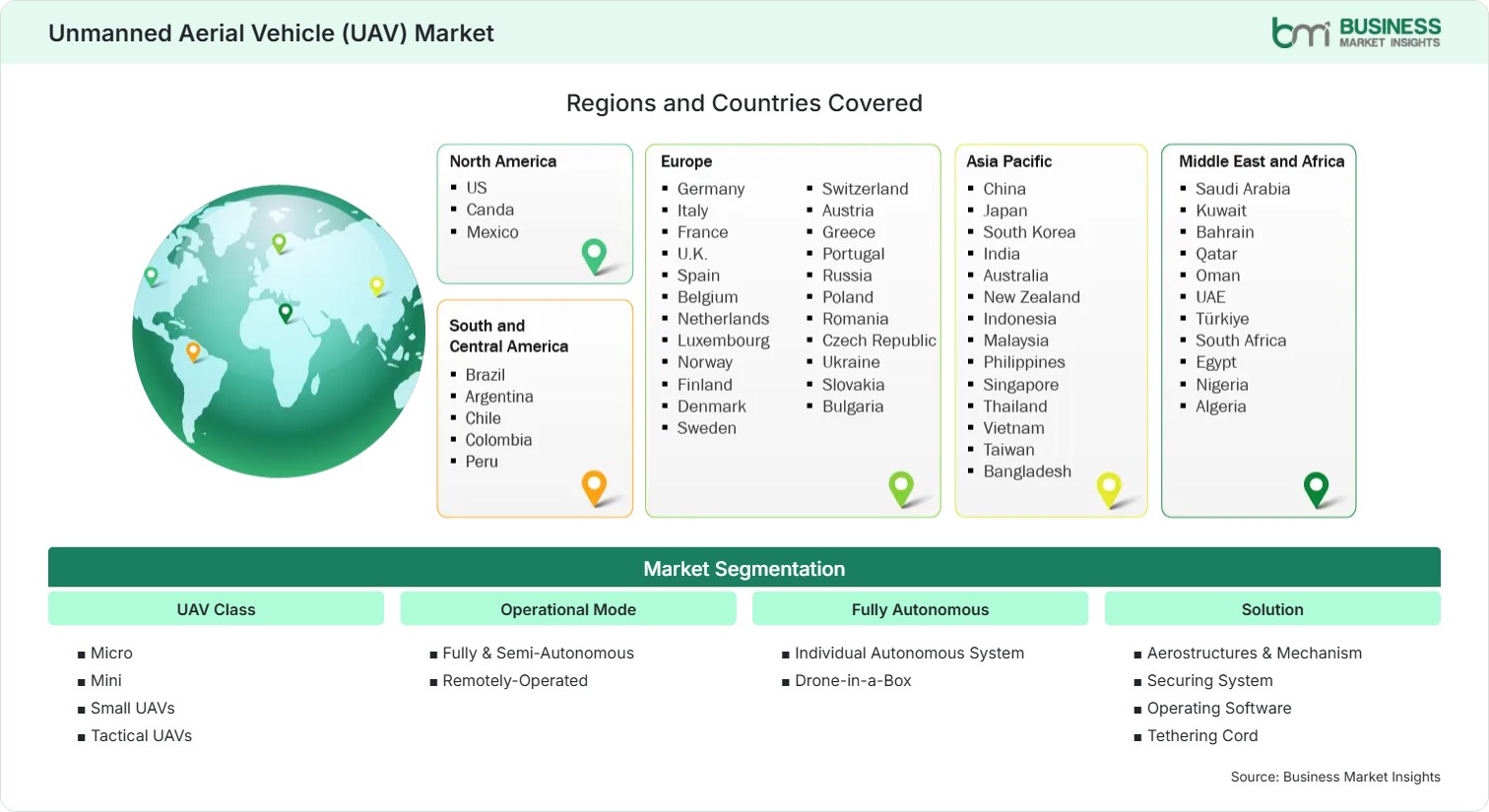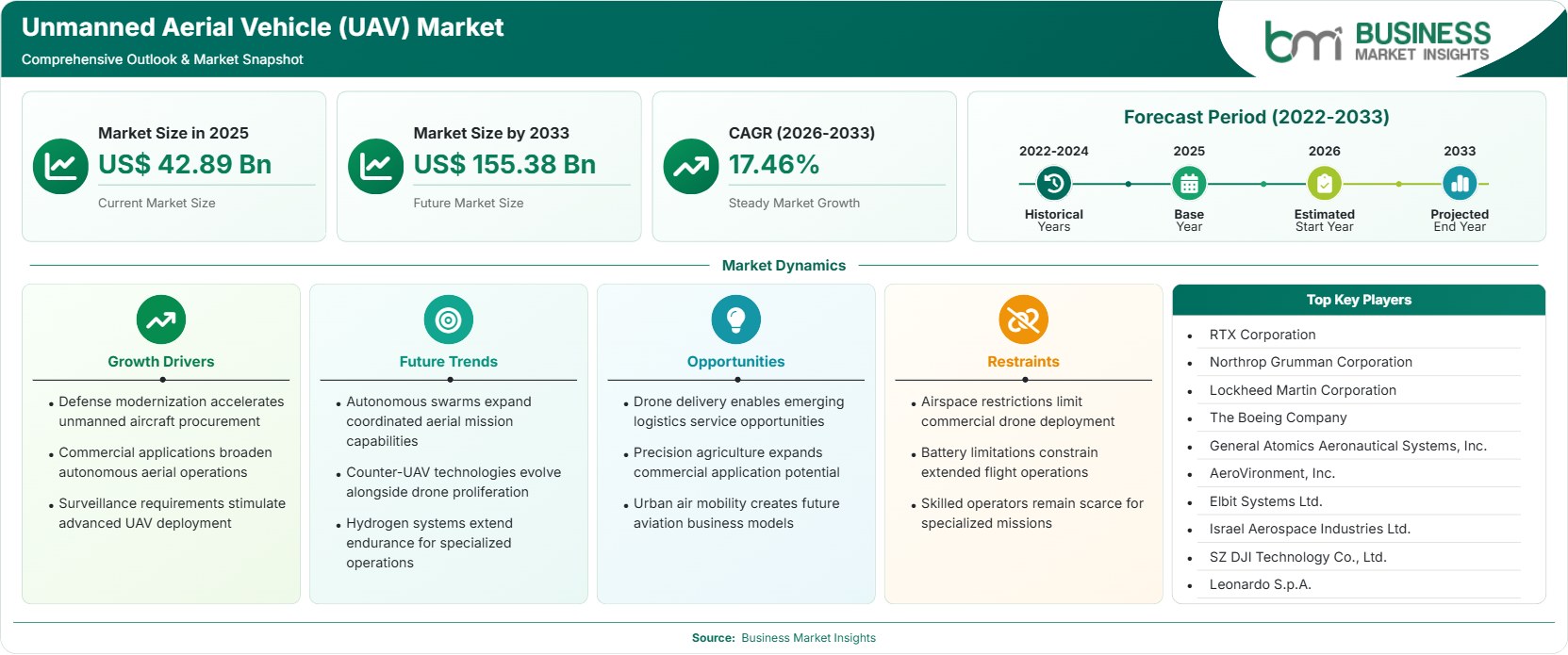
Unmanned Aerial Vehicle (UAV) Market Regional Highlights
North America Unmanned Aerial Vehicle Market
North America represents the largest regional market, accounting for 36%–39% Unmanned Aerial Vehicle Market share in 2025. The region is expected to expand at 16.2%–17.0% CAGR through 2033. Defense modernization programs, border surveillance needs, advanced aerospace manufacturing capabilities, and strong autonomous technology adoption support growth. Government agencies continue integrating unmanned systems into intelligence, surveillance, reconnaissance, and operational missions. Commercial deployment across energy infrastructure, utilities, and industrial inspection is also contributing to demand expansion throughout the forecast period.
- Defense spending prioritizes autonomous ISR systems, advanced payloads, and secure communications supporting long-term procurement pipelines across the United States and Canada.
- The agencies responsible for border security are still increasing their aerial surveillance programs to enhance the efficiency of their monitoring and, at the same time, decrease the number of personnel needed for patrolling such large land and maritime borders.
- Utility companies are now using drones more for inspecting transmission lines, which leads to greater operational efficiency and a reduction in safety risks associated with maintenance.
- The use of AI-driven analytics together with cloud-connected mission management systems is speeding up their acceptance by defense and enterprise operators.
- The strength of the domestic aerospace manufacturing sector enables constant product innovation and helps to develop a resilient supply chain.
US Unmanned Aerial Vehicle Market
The United States accounts for approximately 81%–85% of the North American market and is projected to grow at 16.5%–17.2% CAGR through 2033. Extensive defense budgets, strong R&D activity, aerospace leadership, and rapid adoption of autonomous missions strengthen deployment across military and civilian applications. Growing investments in AI-enabled combat systems, infrastructure inspection, and persistent aerial intelligence platforms continue supporting demand. Domestic innovation ecosystems and government-backed modernization programs reinforce the country's leadership position.
- The Department of Defense's plans for modernization are increasingly including autonomous aerial systems in both future military structures and in intelligence operations.
- Operators in the commercial energy sector use drone technology for carrying out inspections, for environmental monitoring, and for managing their assets over large areas of operation.
- By expanding its domestic manufacturing activities, supply chain security is strengthened and production of next-generation aerial platforms is supported.
- The ability of software to enable autonomy and to integrate sensors is attracting a great deal of venture capital and government funding.
Europe Unmanned Aerial Vehicle Market
Europe accounts for approximately 24%–27% market share in 2025 and is projected to expand at a 16.0%–17.0% CAGR through 2033. Regional growth is supported by defense modernization initiatives, border monitoring requirements, industrial inspection demand, and increasing collaborative aerospace programs. Governments across the region continue investing in sovereign unmanned capabilities to reduce dependence on external suppliers. Growth is also supported by commercial adoption across utilities, transportation infrastructure, environmental monitoring, and public safety operations, while regulatory harmonization facilitates broader operational deployment.
- France, Germany, and the United Kingdom are still the leading contributors because of their well-established aerospace industries, their defense investments, and their strong public-sector procurement programs.
- Poland and Spain are becoming high-growth markets, this being due to the need for modernization and the speeding up of their defense spending programs.
- There is steady commercial demand for energy infrastructure inspection and offshore monitoring applications within the various industrial sectors in Europe.
- There is now a greater focus on strategic autonomy, which is opening up opportunities for partnerships aimed at domestic manufacturing and technology development.
- Advances in regulation that support operations beyond the visual line of sight are increasing the possibilities for commercial deployment in the area.
Asia Pacific Unmanned Aerial Vehicle Market
Asia Pacific accounts for approximately 24%–27% share in 2025 and represents the fastest-growing regional market, advancing at a 19.0%–20.2% CAGR through 2033. Expanding defense budgets, increasing geopolitical security priorities, domestic drone manufacturing capabilities, and smart infrastructure investments support rapid adoption. Governments are strengthening indigenous aerospace ecosystems while encouraging technological innovation through policy incentives and funding initiatives. Commercial adoption across agriculture, energy, mining, logistics, and public safety operations further contributes to expansion, creating broad opportunities for platform manufacturers and software providers.
- China remains the largest regional contributor owing to manufacturing scale, technological capabilities, and extensive commercial drone deployment.
- India demonstrates one of the strongest growth trajectories, supported by domestic production incentives and defense procurement programs.
- Japan and South Korea are still making investments in autonomous technologies for use in industrial inspection, maritime security, and the monitoring of public infrastructure.
- The spread of smart-city projects is increasing the demand for aerial monitoring and data collection systems in the area.
- Increasingly, regional manufacturers are competing in export markets, which in turn enhances their production capacity and innovation activity.
Rest of World Unmanned Aerial Vehicle Market
The Rest of World region accounts for approximately 12%–15% Unmanned Aerial Vehicle Market share in 2025 and is expected to expand at a 17.5%–18.5% CAGR through 2033. Demand across the Middle East is driven by defense modernization, border security enhancement, and critical infrastructure protection requirements.
South and Central America are witnessing increasing adoption across mining, agriculture, environmental monitoring, and public security applications. Governments and enterprises are recognizing the operational efficiency advantages provided by unmanned aerial platforms, creating long-term demand potential across diverse industry verticals.
- Saudi Arabia and the United Arab Emirates lead regional adoption through significant aerospace and defense investments.
- Brazil is still the biggest market in South America, thanks to agricultural surveillance and infrastructure monitoring.
- Chile shows great potential for growth as a result of its activities in the mining sector and its environmental observation programs.
- Autonomous monitoring systems are increasingly being used by oil and gas facilities all over the Middle East to improve both operational visibility and security.
- Strategies aimed at diversifying the national industry promote the development of local aerospace industries and encourage technology transfer programs.