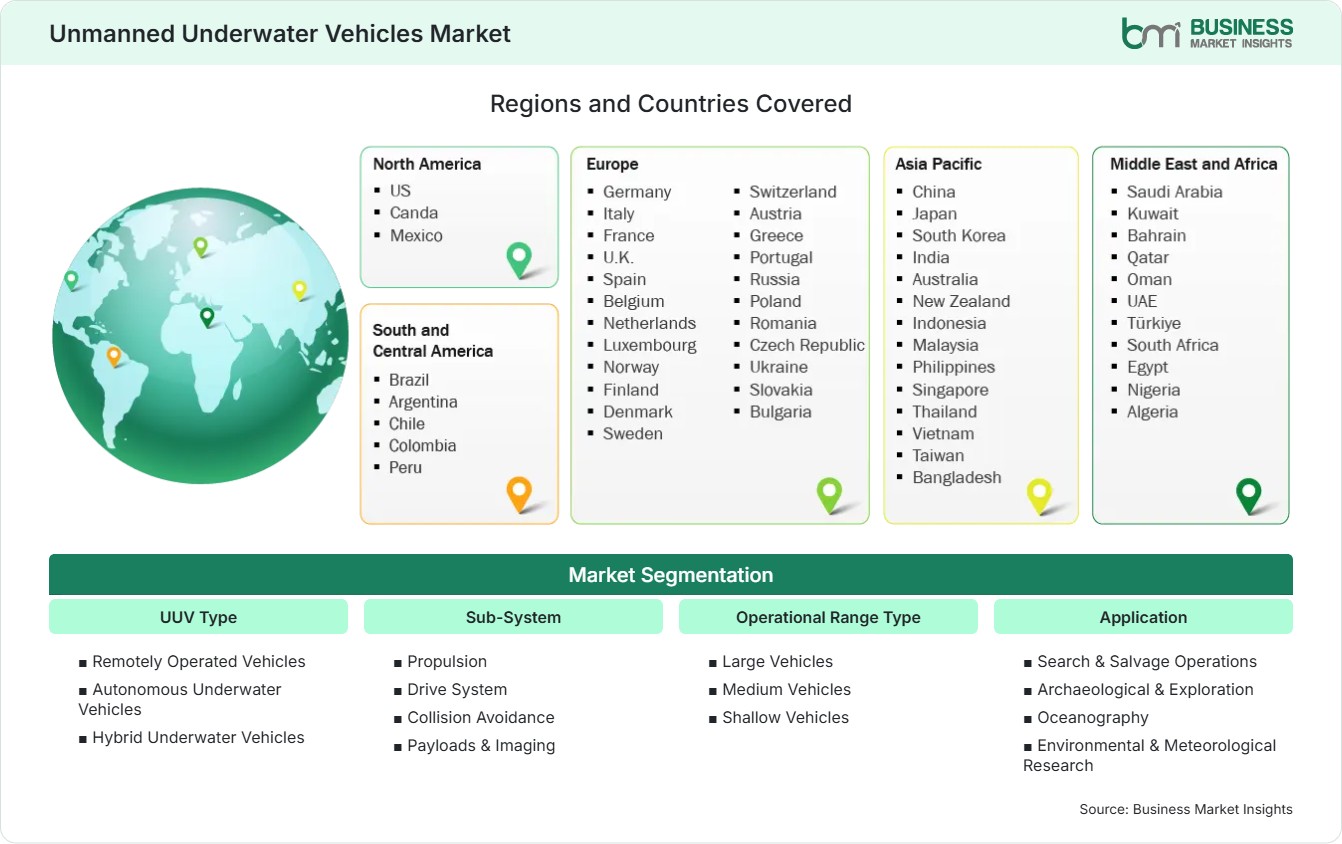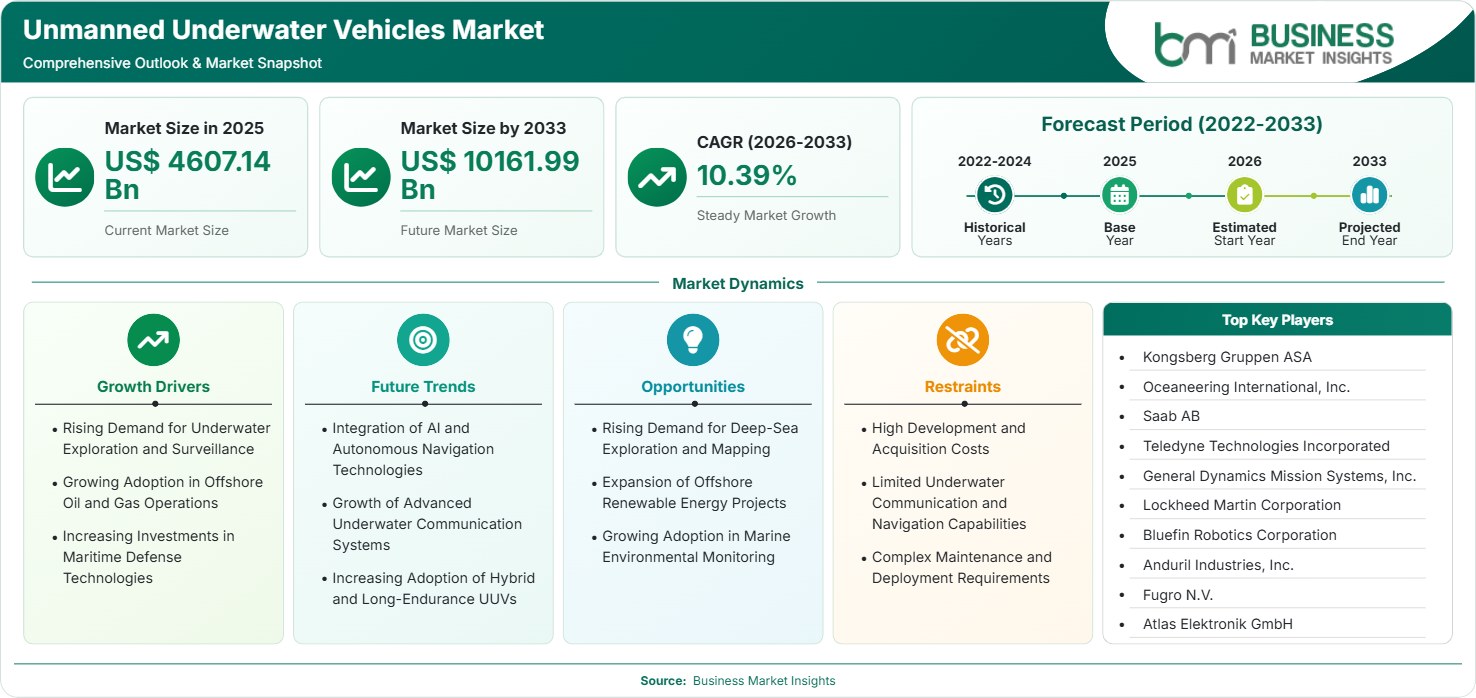
Unmanned Underwater Vehicles Market Regional Highlights
North America Unmanned Underwater Vehicles Market
North America accounts for 34%–37% of global demand in 2025 and is projected to record a CAGR of 9.5%–10.2% through 2033. The region benefits from extensive naval modernization initiatives, offshore energy infrastructure, research institution funding, and advanced robotics development. Unmanned Underwater Vehicles Market share remains strongest in the United States owing to defense spending, large oceanographic programs, and technology commercialization activities. Government agencies continue funding seabed surveillance, mine countermeasure capabilities, and environmental monitoring deployments, strengthening regional competitive positioning.
- U.S. Navy unmanned maritime programs continue accelerating procurement of autonomous seabed mapping, reconnaissance, and mine-hunting platforms across strategic maritime environments.
- Offshore energy operators increasingly deploy robotic systems for asset integrity verification, subsea inspection, and pipeline monitoring to reduce operational risks.
- University research centers are expanding ocean science programs requiring long-endurance autonomous platforms equipped with advanced environmental sensing payloads.
- Marine security concerns continue driving investment in persistent underwater surveillance capabilities across defense and homeland security applications.
US Unmanned Underwater Vehicles Market
The United States holds a market share of 72%–76% in North America in 2025 and is expected to grow at a CAGR of 9.7%–10.4% through 2033. High purchasing power by defense organizations, rising demand for offshore inspection systems, and technological supremacy help propel the Unmanned Underwater Vehicles Market forward. Research establishments are among the early adopters of innovative autonomous vehicles. Financial investments in ocean observation network systems and maritime security solutions continue to drive technological development and strengthen domestic manufacturing capabilities.
- Defense procurement remains the core demand generator, particularly for intelligence, surveillance, reconnaissance, and mine countermeasure operations.
- Offshore infrastructure operators increasingly integrate autonomous survey systems to improve inspection frequency and reduce vessel deployment costs.
- Strong venture investment supports underwater autonomy software, sensor technologies, and advanced maritime analytics development.
- Federal ocean science initiatives continue expanding data collection requirements across coastal and deep-water environments.
Europe Unmanned Underwater Vehicles Market
Europe accounts for 24% to 27% of the global revenue market in 2025 and is expected to grow at a CAGR of 9.8% to 10.6% from 2023 to 2033. The regional market growth is propelled by investments in offshore wind energy infrastructure, underwater cable inspection, marine regulations, and defense upgrades. Norway is at the forefront of implementation, owing to its advanced offshore activities, whereas the United Kingdom ranks among the fastest-growing markets, with a CAGR of 10.5% to 11.2%. Collaborative research programs and maritime technology innovation strengthen deployment across commercial and government applications.
- Offshore wind expansion increases requirements for underwater inspection, maintenance support, and subsea asset monitoring.
- Norway maintains leadership through energy-sector deployments and strong indigenous underwater technology capabilities.
- United Kingdom growth benefits from defense initiatives and large-scale marine research investments.
- European environmental regulations encourage wider adoption of autonomous ocean monitoring platforms.
- Cross-border maritime security programs continue supporting procurement of advanced unmanned underwater systems.
Asia Pacific Unmanned Underwater Vehicles Market
Asia Pacific Unmanned Underwater Vehicles Market represents 26%–29% of global revenue in 2025 and is expected to achieve the fastest CAGR of 11.8%–12.6% through 2033. Increasing maritime security priorities, expanding naval capabilities, and deep-sea resource exploration activities support accelerated growth. China maintains the largest regional presence while India demonstrates a CAGR of 12.5%–13.3%. National ocean programs, indigenous robotics initiatives, and offshore energy development are creating substantial demand for advanced autonomous underwater technologies.
- China continues investing in ocean exploration, underwater surveillance, and indigenous autonomous systems development.
- India benefits from expanding maritime security requirements and government-backed underwater technology research programs.
- Offshore energy activities across regional waters support demand for inspection and monitoring platforms.
- Marine science institutions are increasing procurement of autonomous survey and data collection systems.
- Regional shipbuilders and defense contractors are expanding partnerships with specialized technology providers.
Rest of World Unmanned Underwater Vehicles Market
Rest of World accounts for 11%–14% of global revenue in 2025 and is forecast to grow at a CAGR of 10.4%–11.1% through 2033. South and Central America benefit from offshore energy investments and marine resource assessment activities.
The increasing demand in the Middle East and Africa will be driven by the need to ensure the safety of underwater infrastructure, upgrade ports, expand offshore activities, and meet maritime surveillance needs. Brazil holds the top position among South American nations, while the United Arab Emirates shows the highest growth rate, at 10.8%–11.5%.
- Brazil supports deployment through offshore oilfield inspection and deep-water operational requirements.
- Gulf countries are increasing investment in maritime security and critical underwater infrastructure monitoring.
- Ocean mapping programs are expanding adoption among research organizations and government agencies.
- Growing port modernization projects create new opportunities for inspection and surveillance applications.
- Regional energy transition initiatives support environmental and seabed monitoring activities.