Market Summary
Executive Summary and Global Market Analysis
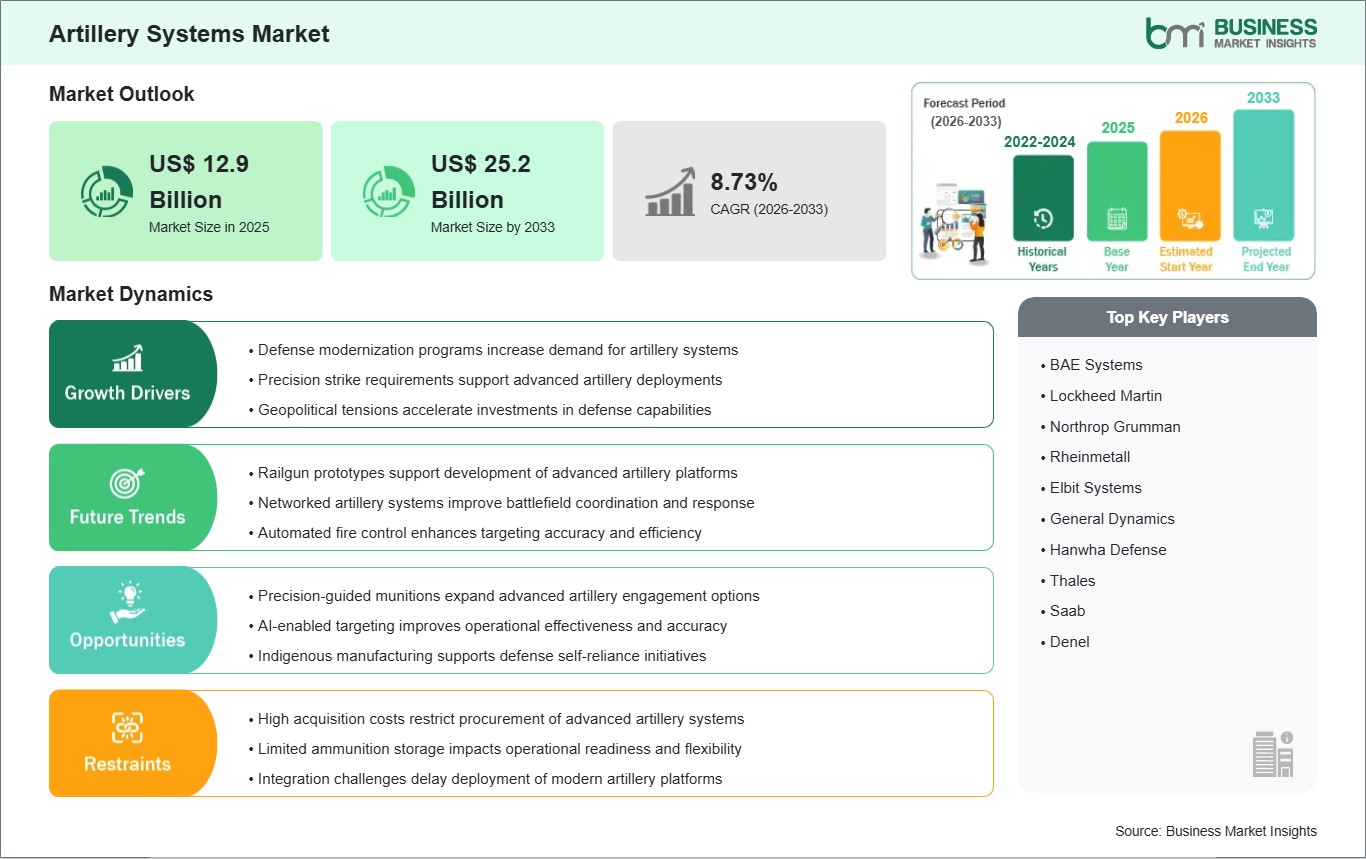
Artillery systems are military weapon platforms designed to deliver indirect fire support across short, medium, and long ranges. Common types include howitzers, mortars, rocket artillery systems, and anti-air artillery. These systems are used for battlefield support, target suppression, area defense, and strategic military operations. Artillery systems play a critical role in modern defense forces by providing long-range precision firepower and supporting ground operations. The market is growing as countries continue to modernize their armed forces, strengthen border security capabilities, and improve battlefield effectiveness. Increasing adoption of advanced fire control technologies, precision-guided ammunition, and network-centric warfare systems is supporting demand for modern artillery platforms.
There are some challenges that could affect market growth. Artillery systems require substantial investment for procurement, deployment, and maintenance, which can place pressure on defense budgets. The integration of advanced targeting systems, digital communication networks, and precision munitions increases development and operational costs. In addition, artillery platforms require extensive training, logistical support, and specialized infrastructure for effective deployment. Regulatory procedures, procurement cycles, and defense approval processes can also delay modernization programs. These factors may increase project timelines and create barriers for some military organizations seeking to upgrade existing artillery capabilities.
Even with these challenges, the market is expected to grow as defense organizations invest in smarter and more effective battlefield systems. New opportunities are emerging through the development of autonomous targeting technologies, artificial intelligence-assisted fire control systems, and advanced precision-guided munitions. There is increasing interest in mobile artillery platforms that offer greater flexibility and rapid deployment capabilities. Research into long-range strike systems, improved battlefield connectivity, and next-generation ammunition technologies is expected to create additional growth opportunities. The continued focus on military modernization, enhanced operational efficiency, and advanced combat readiness is likely to support the long-term growth of the Artillery Systems Market.
Segment Analysis
Artillery Systems Market Segmentation
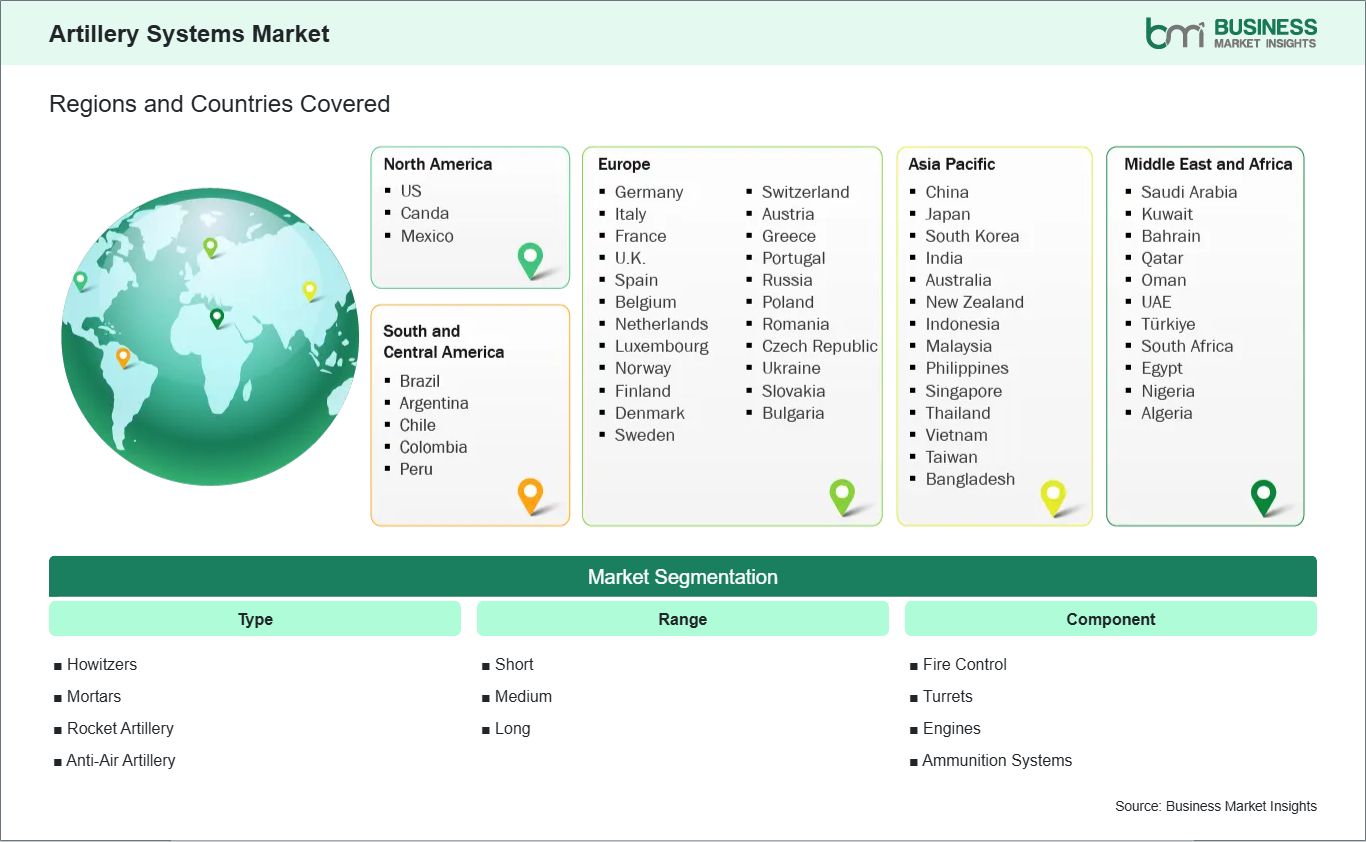
The Artillery Systems Market is segmented based on type, range, and component. These segments support various military requirements related to firepower, mobility, and battlefield effectiveness.
By Type
- Howitzers: Widely used for long-range indirect fire support and precision strike missions.
- Mortars: Provide close-range fire support with high mobility and rapid deployment capabilities.
- Rocket Artillery: Designed for long-range attacks and area saturation missions.
- Anti-Air Artillery: Used to engage and defend against aerial threats.
By Range
- Short: Supports tactical battlefield operations and close-range engagements.
- Medium: Balances operational flexibility with effective strike capability.
- Long: Enables strategic targeting and extended-range fire support missions.
By Component
- Fire Control: Essential for targeting accuracy, navigation, and operational coordination.
- Turrets: Support weapon positioning and firing operations.
- Engines: Provide mobility and operational performance for self-propelled systems.
- Ammunition Systems: Enable effective delivery of conventional and precision-guided munitions.
Market Forces
Artillery Systems Market Drivers and Opportunities
Growing Defense Modernization and Precision Strike Requirements
The Artillery Systems Market is being driven by increasing defense modernization initiatives aimed at improving battlefield effectiveness and operational readiness. Modern military forces require advanced artillery systems capable of delivering accurate and long-range fire support while minimizing collateral damage. As a result, governments are investing in upgraded artillery platforms, advanced fire control technologies, and precision-guided ammunition systems. The growing importance of network-centric warfare is also contributing to market expansion. Artillery systems are increasingly integrated with surveillance assets, command centers, and communication networks to improve situational awareness and target acquisition. This integration enhances operational efficiency and supports faster decision-making during military operations.
In addition, evolving security challenges and changing battlefield requirements are encouraging defense organizations to strengthen long-range strike capabilities. Military modernization programs often prioritize mobility, survivability, and targeting precision, creating sustained demand for advanced artillery platforms. The increasing adoption of digital technologies and automated targeting solutions further supports the development of next-generation artillery systems across global defense forces.
Advancements in Autonomous Fire Control and Smart Ammunition
Emerging technologies are creating significant opportunities for the Artillery Systems Market. Advances in artificial intelligence, sensor integration, and autonomous targeting systems are transforming the way artillery operations are conducted. These technologies help improve targeting accuracy, reduce response times, and increase battlefield effectiveness. Smart ammunition is becoming an important area of development as military organizations seek greater precision and operational efficiency. Precision-guided projectiles can improve mission outcomes while reducing ammunition consumption and minimizing unintended damage. Continuous improvements in navigation systems, targeting sensors, and communication technologies are supporting these advancements.
Another important opportunity comes from the growing adoption of mobile and highly deployable artillery platforms. Military forces increasingly require systems capable of rapid movement and deployment across diverse operational environments. Future developments in digital battlefield connectivity, unmanned support systems, and advanced command-and-control networks are expected to create additional growth opportunities. These innovations are likely to enhance operational flexibility and contribute to the long-term expansion of the Artillery Systems Market.
Size and Share Analysis
Artillery Systems Market Size and Share Analysis
The Artillery Systems Market size is expected to reach US$ 25.2 billion by 2033 from US$ 12.9 billion in 2025. The market is estimated to record a CAGR of 8.73% from 2026 to 2033.
By type, howitzers account for a significant share of the market due to their widespread use in conventional military operations and long-range fire support missions. Rocket artillery systems are also gaining importance because of their ability to deliver rapid and extensive firepower across large operational areas, while mortars continue to serve as essential tactical support systems.
By range, medium- and long-range artillery systems represent substantial demand as defense organizations focus on expanding strike capabilities and improving operational reach. Long-range systems are increasingly valued for strategic targeting and modern combat requirements.
Report Coverage
Artillery Systems Market Report Coverage and Deliverables
The "Artillery Systems Market Size and Forecast (2022-2033)" report provides a detailed analysis of the market covering below areas:
- Market size and forecast at global, regional, and country levels for all the key market segments covered under the scope
- Market trends, as well as market dynamics such as drivers, restraints, and key opportunities
- Market analysis covering key market trends, global and regional framework, major players, regulations, and recent market developments
- Industry landscape and competition analysis covering market concentration, heat map analysis, prominent players, and recent developments for the market
- Detailed company profiles, including SWOT analysis
Geographic Insights
Artillery Systems Market Geographic Insights
The Artillery Systems Market shows diverse regional adoption patterns influenced by defense modernization programs, military readiness requirements, and investments in advanced long-range combat capabilities.
North America, being a developed region, has a well-established defense sector and a high level of investment in advanced military technologies. The region comprises the United States and Canada, where military modernization programs focus on enhancing long-range strike capabilities, precision targeting, and battlefield connectivity. Defense organizations continue to invest in advanced artillery platforms, digital fire control systems, and precision-guided ammunition. The region benefits from strong defense infrastructure, established procurement frameworks, and significant research and development activities that support the adoption of next-generation artillery systems. Continuous efforts to strengthen operational readiness and combat effectiveness are contributing to market growth.
Asia Pacific is growing significantly, driven by increasing defense spending, regional security concerns, and military modernization initiatives. The region comprises countries such as China, India, Japan, and South Korea, where governments are investing in advanced artillery capabilities to strengthen national defense preparedness. Military organizations are focusing on enhancing firepower, mobility, and operational flexibility through modernization programs and infrastructure development. Growing domestic manufacturing capabilities and increasing focus on indigenous defense production are also supporting market expansion. The region continues to witness rising demand for advanced artillery technologies suitable for evolving battlefield requirements.
Both regions are contributing significantly to the growth of the Artillery Systems Market, focusing on military modernization, advanced combat capabilities, and the development of next-generation defense technologies.
Industry Activity
Recent Developments
The Artillery Systems Market is analyzed using a mix of primary and secondary research sources, including corporate publications, industry associations, and verified databases. This approach ensures accurate tracking of innovation trends and strategic developments influencing the market.
- In May 2026, BAE Systems secured a $535.6 million fixed-price-incentive contract from the U.S. Army for the continued production of self-propelled howitzer systems and related support vehicles. The comprehensive agreement provides for the delivery of tracked artillery units alongside total package fielding kits to sustain Armored Brigade Combat Teams through late 2029. The development strengthens the domestic defense industrial base and highlights ongoing investments in advanced mobile fire support architectures to maintain tactical overmatch on modern battlefields.
- In August 2025, Rheinmetall officially opened its newly expanded "Werk Niedersachsen" factory in Germany, initiating the serial production of 155mm artillery shells under a €600 million infrastructure investment. The massive facility is engineered with highly automated lines to ramp up production to 25,000 rounds in 2025 and 140,000 rounds in 2026, eventually reaching a maximum capacity of 350,000 rounds annually by 2027. The development establishes the plant as the largest ammunition manufacturing site in Europe and forms a critical pillar in the company's broader industrial roadmap to produce 1.5 million artillery shells per year worldwide.
Trust & Transparency
Research Methodology
The market analysis combines proprietary research with secondary data from government agencies, company disclosures, regulatory filings, industry databases and expert interviews. Market estimates are validated through data triangulation, cross-market benchmarking and analyst
review.
View Full Research Methodology
Key Sources Referred:
World Bank - Global Trade IndicatorsWorld Trade Organization (WTO)International Monetary Fund (IMF)International Trade Administration (ITA)Company WebsitesCompany Annual ReportsCompany Investor Presentations