
Spaceport Market Outlook: Size, Share, Trends, Growth Analysis, Competitive Landscape & Forecast, 2026-2033

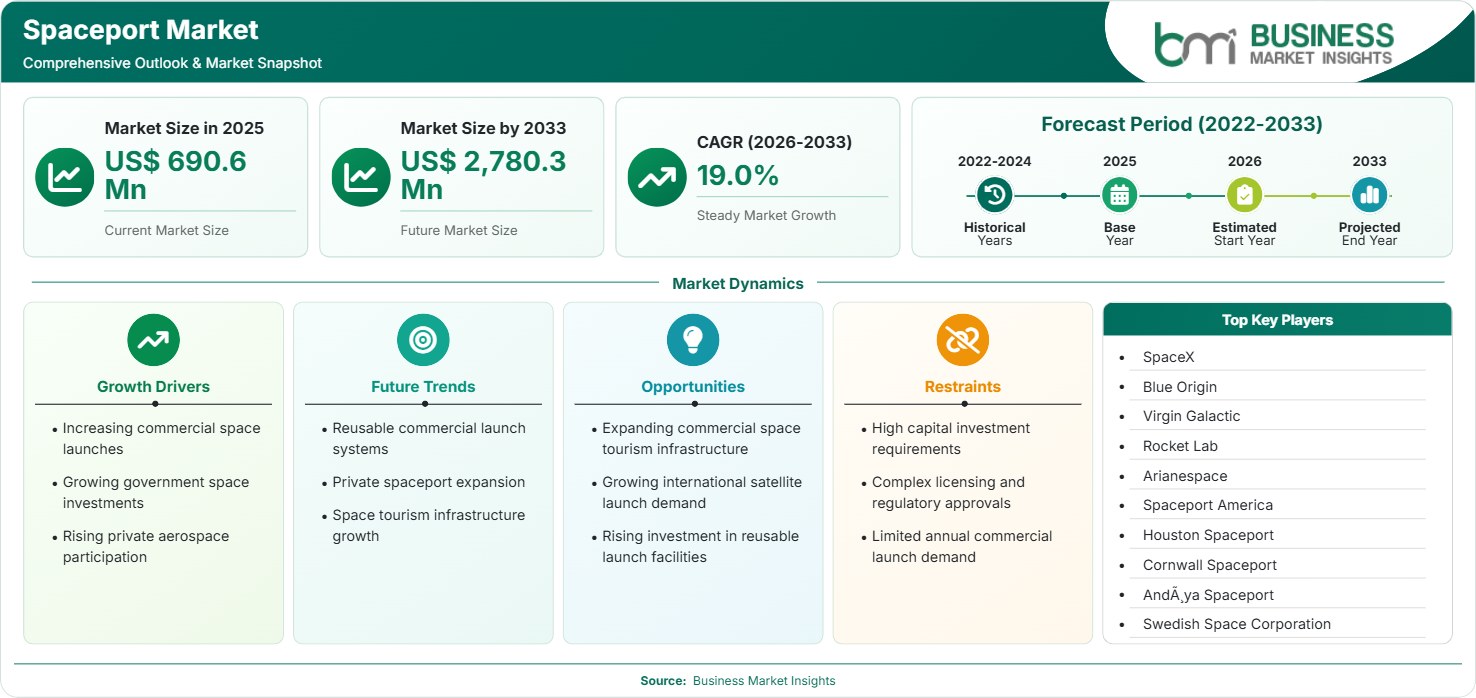
The Spaceport Market size was valued at US$ 690.6 Million in 2025 and is projected to reach US$ 2,780.3 Million by 2033, growing at a CAGR of 19.03% from 2026 to 2033. Increasing commercial space launches, government space investments, private aerospace participation, satellite deployment demand, space tourism infrastructure, and reusable launch facility development are driving market expansion.

Report Coverage
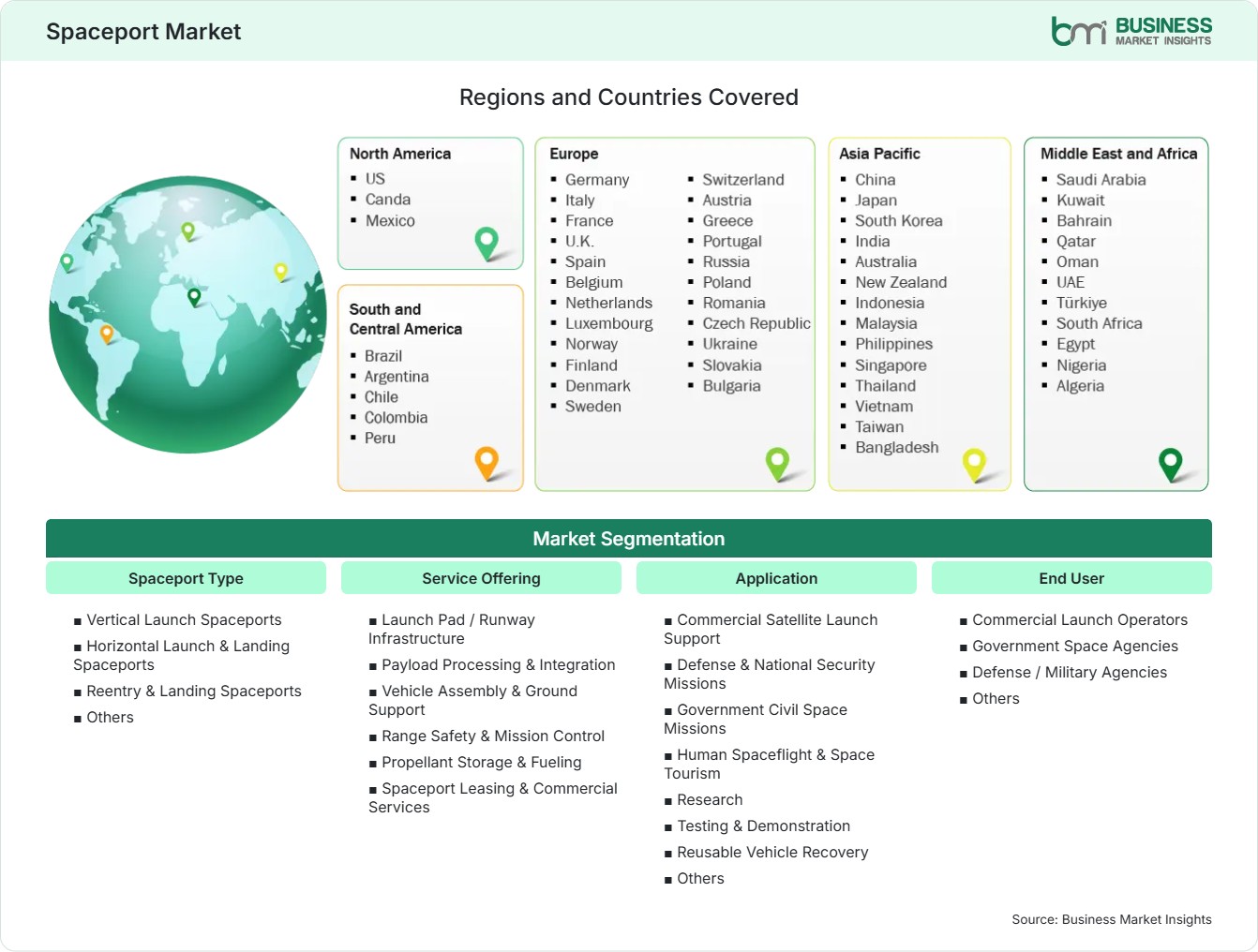
  • Spaceport Type: Vertical Launch Spaceports, Horizontal Launch & Landing Spaceports, Reentry & Landing Spaceports, Others
  • Service Offering: Launch Pad / Runway Infrastructure, Payload Processing & Integration, Vehicle Assembly & Ground Support, Range Safety & Mission Control, Propellant Storage & Fueling, Spaceport Leasing & Commercial Services
  • Application: Commercial Satellite Launch Support, Defense & National Security Missions, Government Civil Space Missions, Human Spaceflight & Space Tourism, Research, Testing & Demonstration, Reusable Vehicle Recovery, Others
  • End User: Commercial Launch Operators, Government Space Agencies, Defense / Military Agencies, Others
US$ 690.6 Mn Market size in 2025
US$ 2,780.3 Mn Market Size by 2033
19.0% CAGR, 2026 - 2033
2026-2033 Forecast Period

AI Overview

Spaceport Market Summary

  • North America Region: North America holds a market share of 42%–45% in 2025 and is projected to grow at a CAGR of 18.5%–19.4% during 2026–2033. Growth is supported by commercial launch activity, government space programs, private aerospace investment, and reusable launch infrastructure development. The US market is expanding at a CAGR of 18.8%–19.7% due to launch operator expansion, defense space initiatives, and commercial spaceflight activities.
  • Fastest Growing Region: Asia Pacific accounts for 24%–27% market share in 2025 and is expected to grow at a CAGR of 20.0%–20.9% during 2026–2033. Growth is driven by expanding satellite programs, national space investments, emerging launch providers, and increasing demand for regional launch capabilities.
  • Leading Segment: Vertical Launch Spaceports represent 55%–58% market share in 2025 and are projected to grow at a CAGR of 19.2%–20.1% during 2026–2033. Adoption is supported by increasing orbital launch missions, satellite deployment requirements, and reusable rocket operations.
  • High Growth Segment: Human Spaceflight & Space Tourism represents 12%–15% share in 2025 and is estimated to grow at a CAGR of 21.0%–21.8% through 2026–2033. Growth is supported by private space tourism initiatives, commercial astronaut programs, and investment in dedicated spaceflight infrastructure.
  • Key Market Opportunity: Expansion of commercial space tourism facilities, international satellite launch demand, reusable vehicle operations, and private space infrastructure investment are creating new growth opportunities.
  • Major Market Players: SpaceX, Blue Origin, Virgin Galactic, Rocket Lab, Arianespace, Spaceport America, Houston Spaceport, Cornwall Spaceport, Andoya Spaceport, Swedish Space Corporation.
Strategic Insights

Spaceport Market: Strategic Insights

Spaceport Market Strategic Framework
FREE PDF
Request your free sample
Request free sample
Stakeholder View

Key Takeaways

  • The market ecosystem includes launch operators, government agencies, infrastructure developers, aerospace suppliers, satellite companies, and space tourism providers.
  • Commercial satellite launches and reusable launch operations represent high-growth opportunities as demand increases for cost-efficient access to space.
  • Innovation priorities include autonomous ground systems, reusable vehicle support infrastructure, advanced mission control technologies, and integrated launch services.
  • North America provides strong investment potential due to established aerospace capabilities, private launch companies, and government-backed space programs.
  • Companies are pursuing partnerships, infrastructure expansion, and technology investments to strengthen positions in commercial space operations.
  • Future competitiveness will depend on operational efficiency, regulatory adaptability, launch frequency capabilities, and infrastructure scalability.
Geographic Outlook

Spaceport Market Regional Highlights

North America Spaceport Market

North America accounted for a 42%–45% share of the Spaceport Market in 2025 and is projected to grow at a CAGR of 18.5%–19.4% during 2026–2033. The region leads due to established aerospace infrastructure, high commercial launch activity, government space programs, and private investment from launch providers. The United States represents the dominant contributor through advanced launch facilities, defense missions, and expanding commercial space operations.

  • The United States drives regional growth through commercial launch operators, reusable rocket programs, and government-backed space initiatives.
  • Canada is developing space capabilities through satellite programs, research missions, and aerospace infrastructure investments.
  • Private launch companies are increasing demand for advanced launch facilities and mission support infrastructure.
  • Government defense programs are supporting investment in secure and reliable spaceport capabilities.

US Spaceport Market

The US represented a 38%–41% share of the Spaceport Market in 2025 and is expected to grow at a CAGR of 18.8%–19.7% during 2026–2033. Market expansion is supported by commercial launch growth, private aerospace participation, defense space activities, and increasing satellite deployment requirements. The country benefits from established launch sites, advanced technology capabilities, and strong collaboration between government and commercial space organizations.

  • Commercial launch operators are expanding infrastructure to support increasing orbital and suborbital missions.
  • Defense agencies are investing in secure launch capabilities for national security space requirements.
  • Private aerospace companies are developing reusable launch support facilities to reduce mission costs.
  • Space tourism initiatives are encouraging development of specialized commercial spaceflight infrastructure.

Europe Spaceport Market

Europe held a 18%–21% share of the Spaceport Market in 2025 and is forecast to grow at a CAGR of 18.0%–18.9% from 2026–2033. The region benefits from government space initiatives, satellite launch programs, and emerging commercial spaceport developments. The United Kingdom, Norway, France, and Sweden are key markets due to investments in regional launch capabilities, aerospace innovation, and space infrastructure development.

  • France supports growth through established aerospace capabilities and government-supported launch programs.
  • Norway is expanding regional launch opportunities through advanced spaceport infrastructure development.
  • Sweden is strengthening commercial launch capabilities through northern European space facilities.
  • The United Kingdom is developing commercial space operations through emerging launch infrastructure investments.

Asia Pacific Spaceport Market

Asia Pacific captured a 24%–27% share of the Spaceport Market in 2025 and is expected to achieve a CAGR of 20.0%–20.9% during 2026–2033. The region represents the fastest-growing market due to increasing satellite demand, national space programs, commercial launch investments, and aerospace technology development. China, India, Japan, and Australia are major contributors supporting regional expansion.

  • China is expanding spaceport capabilities through satellite launches, government missions, and commercial aerospace development.
  • India is increasing launch infrastructure investments through growing commercial and government space activities.
  • Japan supports spaceport development through advanced aerospace technologies and satellite deployment programs.
  • Australia is emerging through commercial launch initiatives and regional space infrastructure projects.

Rest of World Spaceport Market

The rest of the world represented a 9%–12% share of the Spaceport Market in 2025 and is projected to grow at a CAGR of 17.2%–18.1% during 2026–2033. South America and the Middle East & Africa are developing through satellite programs, research missions, and commercial aerospace investments. Brazil, the UAE, and South Africa represent emerging opportunities for space infrastructure development.

South American countries are increasing investments in satellite services and regional aerospace capabilities. Middle Eastern markets are developing space infrastructure through government-led programs and commercial partnerships.

  • Brazil is strengthening space capabilities through satellite programs and aerospace infrastructure development.
  • The United Arab Emirates is investing in space missions, satellite programs, and advanced aerospace initiatives.
  • South Africa is supporting regional space activities through research and satellite technology programs.
  • Emerging markets are developing partnerships to establish commercial launch and mission support capabilities.
Global Market Geography
FREE PDF
Request your free sample
Request free sample
Segment Analysis

Spaceport Market Segmentation

Spaceport Type

Spaceport Type segmentation includes Vertical Launch Spaceports, Horizontal Launch & Landing Spaceports, and Reentry & Landing Spaceports. Vertical Launch Spaceports represented the leading segment in 2025 due to increasing orbital missions, satellite deployment requirements, and demand from commercial launch operators. Horizontal and reentry facilities are gaining adoption with reusable vehicle development and commercial spaceflight activities. The segment is projected to grow at a CAGR of 19.2%–20.1% during 2026–2033, supported by increasing launch frequency, private aerospace participation, and infrastructure modernization.

  • Vertical Launch Spaceports: Vertical launch facilities support orbital missions through dedicated launch pads, mission control systems, and advanced ground infrastructure.
  • Horizontal Launch & Landing Spaceports: Horizontal launch facilities enable aircraft-like operations for reusable spacecraft, supporting commercial missions and flexible launch approaches.
  • Reentry & Landing Spaceports: Reentry and landing facilities support reusable spacecraft recovery through specialized landing zones and operational support systems.

Service Offering

Service Offering segmentation includes Launch Pad / Runway Infrastructure, Payload Processing & Integration, Vehicle Assembly & Ground Support, Range Safety & Mission Control, Propellant Storage & Fueling, and Spaceport Leasing & Commercial Services. Launch Pad / Runway Infrastructure accounted for the largest Spaceport Market share in 2025 due to increasing requirements for reliable mission operations. Commercial services are expanding with private space activity growth. The segment is expected to grow at a CAGR of 18.7%–19.6% during 2026–2033, driven by launch ecosystem expansion and infrastructure investments.

  • Launch Pad / Runway Infrastructure: Launch facilities provide essential operational capabilities including launch preparation areas, runways, and mission-specific infrastructure.
  • Payload Processing & Integration: Payload services support satellite preparation, testing, integration, and mission readiness for commercial and government launches.
  • Vehicle Assembly & Ground Support: Ground support services enable spacecraft preparation, maintenance, assembly, and operational coordination before launch activities.
  • Range Safety & Mission Control: Mission control services provide tracking, communication, safety monitoring, and operational management during launch missions.
  • Propellant Storage & Fueling: Propellant infrastructure supports rocket preparation through secure storage, handling, and fueling operations.
  • Spaceport Leasing & Commercial Services: Commercial services enable private operators to access launch facilities through leasing models and specialized operational support.

Application

Application segmentation includes Commercial Satellite Launch Support, Defense & National Security Missions, Government Civil Space Missions, Human Spaceflight & Space Tourism, Research, Testing & Demonstration, and Reusable Vehicle Recovery. Commercial Satellite Launch Support represented the leading application in 2025 due to increasing satellite deployments and space-based services demand. Human Spaceflight & Space Tourism is expanding rapidly through private initiatives. The application segment is projected to grow at a CAGR of 20.0%–20.8% during 2026–2033, supported by commercial missions and aerospace innovation.

  • Commercial Satellite Launch Support: Supports satellite deployment activities through launch infrastructure, mission services, and operational capabilities.
  • Defense & National Security Missions: Defense applications require secure launch facilities supporting military satellites, surveillance systems, and strategic space operations.
  • Government Civil Space Missions: Civil space programs utilize spaceports for scientific missions, exploration activities, and national space initiatives.
  • Human Spaceflight & Space Tourism: Space tourism applications are expanding through commercial astronaut programs and dedicated passenger spaceflight infrastructure.
  • Research, Testing & Demonstration: Research applications support aerospace testing, technology validation, and experimental space mission activities.
  • Reusable Vehicle Recovery: Recovery applications enable landing operations, refurbishment processes, and cost-efficient reusable launch vehicle missions.

End User

End User segmentation includes Commercial Launch Operators, Government Space Agencies, and Defense / Military Agencies. Commercial Launch Operators represented the leading end-user segment in 2025 due to increasing private space activity and satellite launch demand. Government and defense organizations continue investing in strategic space capabilities and secure infrastructure. The segment is expected to grow at a CAGR of 19.0%–19.8% during 2026–2033, supported by public-private partnerships and expanding mission requirements.

  • Commercial Launch Operators: Commercial operators utilize spaceports for satellite launches, reusable vehicles, and commercial space transportation services.
  • Government Space Agencies: Government agencies use spaceports for exploration programs, scientific missions, and national space development initiatives.
  • Defense / Military Agencies: Defense agencies require secure spaceport facilities for military launches, surveillance missions, and strategic aerospace operations.
Market Forces

Spaceport Market Dynamics

Key Market Drivers

Increasing Commercial Space Launches

The growing frequency of commercial space launches is driving demand for advanced spaceport infrastructure capable of supporting diverse mission requirements. Increasing satellite deployments for communication, Earth observation, navigation, and remote sensing applications are encouraging launch operators to expand operational capacity. The market growth is supported by rising private sector participation, reusable launch vehicle adoption, and increasing demand for cost-efficient access to space. The Spaceport market trends indicate a shift toward commercially operated facilities with flexible services, including payload processing, mission control, and launch support. Spaceport operators are upgrading infrastructure to accommodate higher launch volumes and support next-generation aerospace activities.

Growing Government Space Investments

Investment by governments in the fields of space exploration, national security, and satellites is increasing the demand for up-to-date spaceports. There are government allocations for activities such as launches, missions, defenses, and testing of new technologies. These allocations help in building up and upgrading spaceports in both mature and developing space nations. The government initiatives are also helping in forming collaborations between government and private aerospace firms. Strategic investments in space assets and exploration have increased the demand for spaceports.

Rising Private Aerospace Participation

Private aerospace companies have increased their participation in the development of innovative technologies and commercial activities through the spaceport network. The private launch providers, satellite organizations, and space tourism operators have begun developing infrastructure that provides greater operational flexibility and reduces costs. These companies are creating new launch systems and vehicles and new space services that need unique infrastructure development. These developments by the private sector are encouraging cooperation between technological companies, governments, and infrastructure providers. Increased entrepreneurial activity is contributing to the change of the spaceport role from governmental centers to commercial aerospace complexes.

Key Market Opportunities

Expanding Commercial Space Tourism Infrastructure

The development of infrastructure for commercial space tourism is offering great possibilities as various corporations move towards undertaking suborbital and orbital passenger flights. There has been increased interest in experiential travel and private astronaut missions, and thus, more funding is being allocated to facilities that will enable them.  As private spaceflights become more common, there will be opportunities for infrastructure, technology, and service providers. With the development of space tourism, space facilities capable of supporting regular passenger flights will create new sources of income.

Growing International Satellite Launch Demand

The growing demand for satellite services has created many opportunities for the expansion and upgrade of spaceports around the world. The growing demand for communication, Earth observation, and navigation satellites, as well as constellations of small satellites, has made reliable launch access essential. Emerging space nations are investing in regional launch facilities to support domestic satellite programs and reduce dependency on international providers. Spaceports that have the capacity to schedule and integrate payload as well as conduct multiple missions can appeal to both commercial and government organizations. There will be an increased demand for sophisticated launch services with the increasing applications of satellites in various fields.

Rising Investment in Reusable Launch Facilities

Investment in reusable launch infrastructure is creating opportunities for spaceport operators to support next-generation aerospace technologies. Reusable rockets require specialized landing areas, refurbishment capabilities, tracking systems, and operational facilities to enable rapid mission turnaround. Companies are placing greater emphasis on reducing costs of launching satellites into orbit by adopting the concept of vehicle recovery and reuse, thereby creating the need for spaceports that can support these activities. The continued growth of reusable technology is anticipated to alter the design of spaceports through higher launch frequency, decreased costs, and wider access to space services, according to the Spaceport Market forecasts.

Market Restraints and Challenges

High Capital Investment Requirements

Factor: Spaceport development requires substantial capital investment for launch infrastructure, safety systems, tracking equipment, environmental compliance, and specialized operational facilities.

Impact: High construction and maintenance costs can delay new spaceport projects and limit participation from smaller organizations. Developing commercially viable facilities requires long-term financial planning, government support, and reliable demand for launches. Operators must invest in advanced infrastructure while managing operational expenses for safety, technology upgrades, and regulatory compliance. Although private investment is increasing, the high upfront cost remains a major barrier for new entrants seeking to establish competitive spaceport capabilities.

Complex Licensing and Regulatory Approvals

Factor: Spaceport operations require extensive regulatory approvals for airspace management, launch safety, environmental protection, and national security.

Impact: Complex approval processes can extend project timelines, increase development costs, and create uncertainty for operators. Regulatory frameworks vary across countries, requiring companies to navigate multiple compliance requirements before beginning operations. Spaceport developers must coordinate with aviation authorities, defense agencies, and environmental organizations to achieve operational approval. Improving regulatory clarity and international cooperation can support market expansion, but the complexity of compliance remains a significant challenge for organizations developing new commercial and government-focused space infrastructure.

Company Analysis

Competitive Landscape

The Spaceport Market analysis highlights increasing competition among commercial launch providers, government-backed space infrastructure operators, aerospace technology companies, and specialized launch facility developers. Leading players are focusing on expanding launch capabilities, supporting reusable vehicle operations, improving mission infrastructure, and developing commercial space services. Strategic partnerships, private investments, and government collaborations are shaping the competitive environment as companies seek to support growing satellite deployment, defense missions, and space tourism activities.

Company Name

Overview

Products and Services relevant to this market

SpaceX

Aerospace company focused on commercial launch and space transportation services.

Launch operations, reusable rocket support, launch infrastructure, mission control, and satellite deployment services.

Blue Origin

Aerospace company developing reusable launch systems and space infrastructure.

Launch vehicles, spaceflight services, reusable technology, and commercial space mission support.

Virgin Galactic

Spaceflight company focused on commercial human spaceflight experiences.

Space tourism operations, passenger spaceflight services, and launch facility capabilities.

Rocket Lab

Space company providing satellite launch and aerospace solutions.

Small launch services, launch infrastructure, satellite deployment, and mission support services.

Arianespace

European launch service provider supporting orbital missions.

Satellite launch services, launch operations, mission integration, and aerospace support solutions.

Spaceport America

Commercial spaceport supporting aerospace and spaceflight activities.

Launch facilities, testing infrastructure, commercial space services, and operational support.

Houston Spaceport

Aerospace facility supporting commercial space activities.

Space infrastructure, aerospace operations, testing support, and commercial space services.

Cornwall Spaceport

UK-based commercial spaceport supporting launch activities.

Horizontal launch support, satellite missions, aerospace infrastructure, and operational services.

Andøya Spaceport

Norwegian spaceport supporting orbital launch operations.

Satellite launches, launch facilities, mission services, and aerospace infrastructure.

Swedish Space Corporation

Space services company supporting satellite and ground operations.

Space infrastructure, satellite services, ground stations, and mission support solutions.

Industry Activity

Recent Developments

July 2026

Isar Aerospace signed a long-term agreement with Maritime Launch Services to develop and operate a dedicated launch pad at Spaceport Nova Scotia, Canada, supporting future Spectrum rocket missions and expanding Isar’s global launch infrastructure footprint.

August 2025

The Spaceport Company advanced its sea-based spaceport technology by demonstrating offshore rocket launch capabilities from floating platforms, supporting the development of flexible launch infrastructure for commercial and government missions.

August 2025

Indian Space Research Organization (ISRO) progressed development of the Kulasekarapattinam spaceport in Tamil Nadu, with construction activities underway and commissioning targeted for FY 2026–27 to support future small satellite launch operations.

July 2025

Intuitive Machines expanded its operations at Houston Spaceport by securing additional land and extending its lease agreement, enabling a US$12 million investment in new production, testing, and support facilities for commercial and government space missions.

Trust & Transparency

Research Methodology

The market analysis combines proprietary research with secondary data from government agencies, company disclosures, regulatory filings, industry databases and expert interviews. Market estimates are validated through data triangulation, cross-market benchmarking and analyst review.

View Full Research Methodology

Questions Answered

Frequently Asked Questions

What does the Spaceport Market Report analyze?

The report evaluates market size, segmentation, regional trends, competitive strategies, infrastructure development, and factors influencing future aerospace expansion.

How are private companies influencing spaceport development?

Private aerospace companies are investing in launch infrastructure, commercial space services, reusable technologies, and dedicated facilities to improve access to space.

Why are reusable launch facilities becoming important?

Reusable launch facilities help reduce mission costs, improve launch frequency, and support repeated vehicle operations, making them important for future commercial space activities.

Which spaceport type dominates the market?

Vertical Launch Spaceports represent the leading segment due to increasing orbital missions, rising demand for satellite deployment, and growing requirements from commercial launch operators.

What factors are driving Spaceport Market growth?

Increasing commercial satellite launches, government space investments, private aerospace participation, development of reusable launch vehicles, and growing demand for space tourism infrastructure are driving market expansion.

Access the Full Spaceport Market Report

Get segment-level forecasts, regional estimates, competitive benchmarking, company profiles and downloadable Excel datasets.

Access the full Spaceport Market Report
350 pages PDF & Excel | 2026-07-31