Handgun Market Regional Highlights
North America Handgun Market
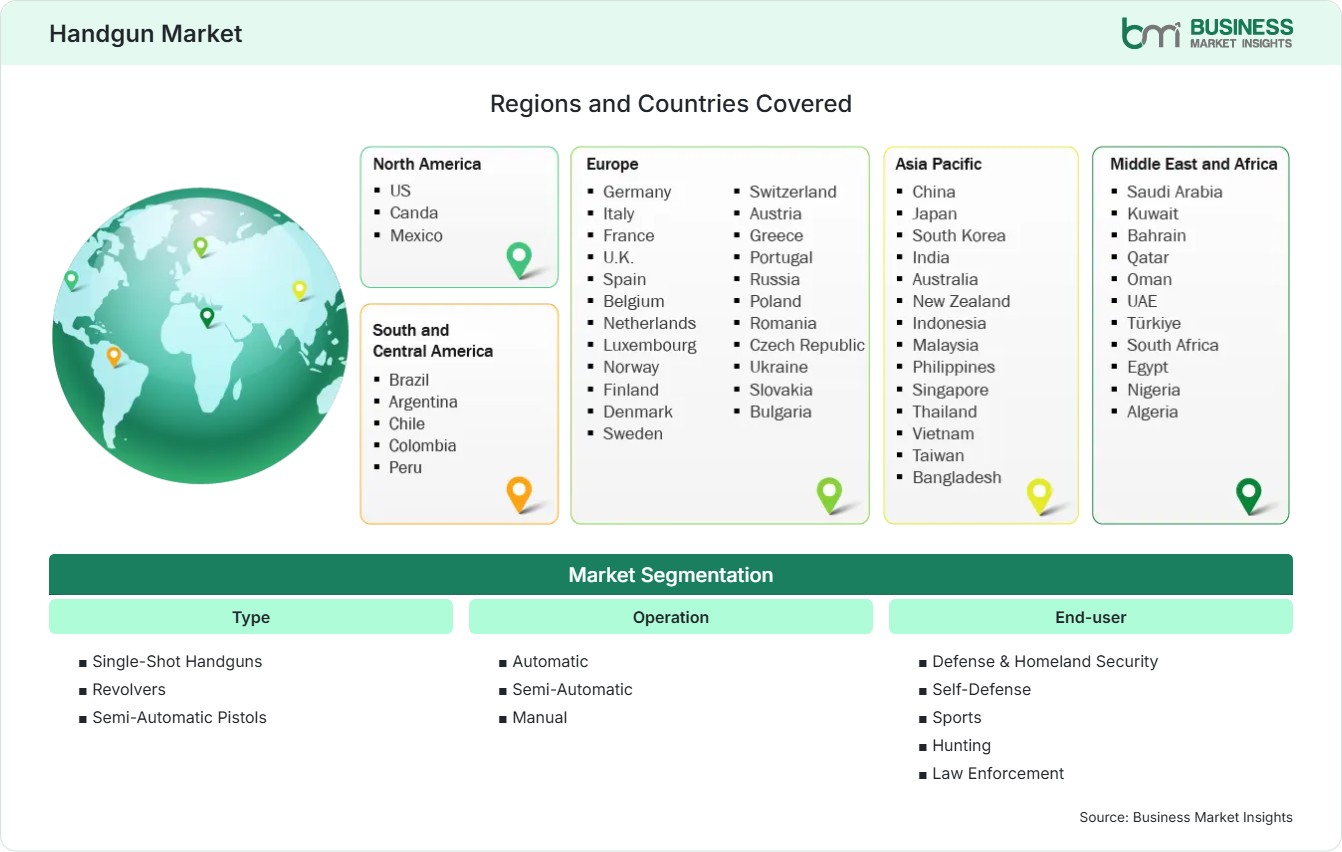
North America maintains a dominant position with a 38%–42% share in 2025 and a CAGR of 6.80%–7.50% through 2026–2033. The region benefits from established manufacturers, defense spending, law enforcement procurement, and advanced distribution networks. The Handgun Market share remains concentrated in the U.S., supported by domestic production and institutional demand. Canada contributes through regulated ownership and training activities, while Mexico presents selective opportunities linked with security requirements and modernization initiatives.
- Defense modernization programs continue supporting demand as military and law enforcement organizations replace aging handgun inventories with advanced platforms featuring improved reliability and ergonomics.
- Established manufacturers benefit from strong domestic supply chains, specialized machining capabilities, and extensive dealer networks supporting professional and civilian customer segments across the region.
- Rising interest in compact firearm designs is encouraging manufacturers to develop lightweight models optimized for portability, professional applications, and controlled-use environments.
- Regulatory compliance remains a key market factor, requiring manufacturers to maintain strict production standards while adapting products to evolving ownership frameworks.
US Handgun Market
The U.S. represents the largest country-level contributor within North America, accounting for a 34%–38% share in 2025 and growing at a CAGR of 6.90%–7.40% during 2026–2033. Strong manufacturing capabilities, defense procurement, law enforcement requirements, and consumer demand influence market development. The country remains a central hub for innovation, distribution, and product launches. The market share in the U.S. is supported by established brands, domestic production facilities, and extensive aftermarket ecosystems.
- Domestic manufacturers continue expanding product portfolios through compact designs, modular configurations, and specialized models targeting professional and recreational users.
- Federal and state-level regulations influence purchasing patterns, creating demand for compliant products designed according to regional requirements and safety standards.
- Law enforcement agencies continue upgrading service weapons, supporting replacement demand and encouraging manufacturers to introduce improved reliability and operational features.
- Training institutions and shooting sports organizations contribute to consistent demand through education programs and equipment requirements.
Europe Handgun Market
Europe holds a 20%–24% share in 2025 with a CAGR of 6.20%–7.00% between 2026–2033. The region is supported by defense modernization, border security initiatives, and professional demand from law enforcement organizations. Germany, France, Italy, and the United Kingdom remain significant markets, while Eastern European countries demonstrate higher growth potential due to security investments. The Handgun Market share across Europe reflects demand for precision-engineered products and regulated procurement channels.
- Germany maintains strong positioning through advanced manufacturing expertise and demand from defense organizations requiring reliable firearm platforms.
- France and the United Kingdom are increasing investments in security capabilities, supporting procurement programs focused on operational efficiency and modernization.
- Eastern European countries are experiencing higher adoption due to regional security concerns and increased defense expenditure commitments.
- European manufacturers emphasize engineering quality, compliance, and export capabilities to strengthen global competitiveness.
- Sports shooting activities continue contributing to demand through regulated recreational applications and professional competitions.
Asia Pacific Handgun Market
Asia Pacific represents a rapidly expanding region with a 24%–28% share in 2025 and a CAGR of 8.00%–8.70% during 2026–2033. Increasing defense modernization, domestic manufacturing initiatives, and rising security requirements support regional expansion. China, India, Japan, South Korea, and Southeast Asian countries are strengthening procurement capabilities. The Handgun Market growth in Asia Pacific is supported by military upgrades, law enforcement expansion, and investments in indigenous defense production programs.
- India is increasing focus on domestic defense manufacturing through localization initiatives, creating opportunities for manufacturers offering advanced production technologies and collaborative partnerships.
- China continues investing in defense modernization programs while strengthening domestic manufacturing capabilities for military and security applications.
- Southeast Asian countries are improving border security infrastructure, encouraging procurement of modern equipment for defense and law enforcement operations.
- South Korea and Japan emphasize advanced engineering standards, supporting demand for precision manufacturing and specialized security applications.
- Regional manufacturers are developing cost-efficient solutions to address expanding requirements from government agencies and professional users.
Rest of World Handgun Market
Rest of World accounts for a 10%–14% share in 2025 and grows at a CAGR of 7.40%–8.10% from 2026–2033. South and Central America are influenced by security modernization and law enforcement requirements, while Middle East and Africa markets benefit from defense investments. Brazil, Saudi Arabia, the UAE, and South Africa represent important markets with improving procurement capabilities. The market share in these regions reflects increasing demand for professional security equipment.
- Brazil contributes through domestic manufacturing capabilities, law enforcement requirements, and growing demand for regulated professional firearm applications.
- Middle Eastern countries are investing in defense modernization programs, creating opportunities for international manufacturers and technology partnerships.
- African markets are gradually expanding security equipment procurement as governments strengthen border protection and internal security infrastructure.
- Regional distributors play an important role by connecting global manufacturers with government agencies and professional users.
- Defense partnerships and technology transfer agreements support long-term market development across emerging economies.