
Sonar System Market Outlook: Size, Share, Trends, Growth Analysis, Competitive Landscape & Forecast, 2026-2033

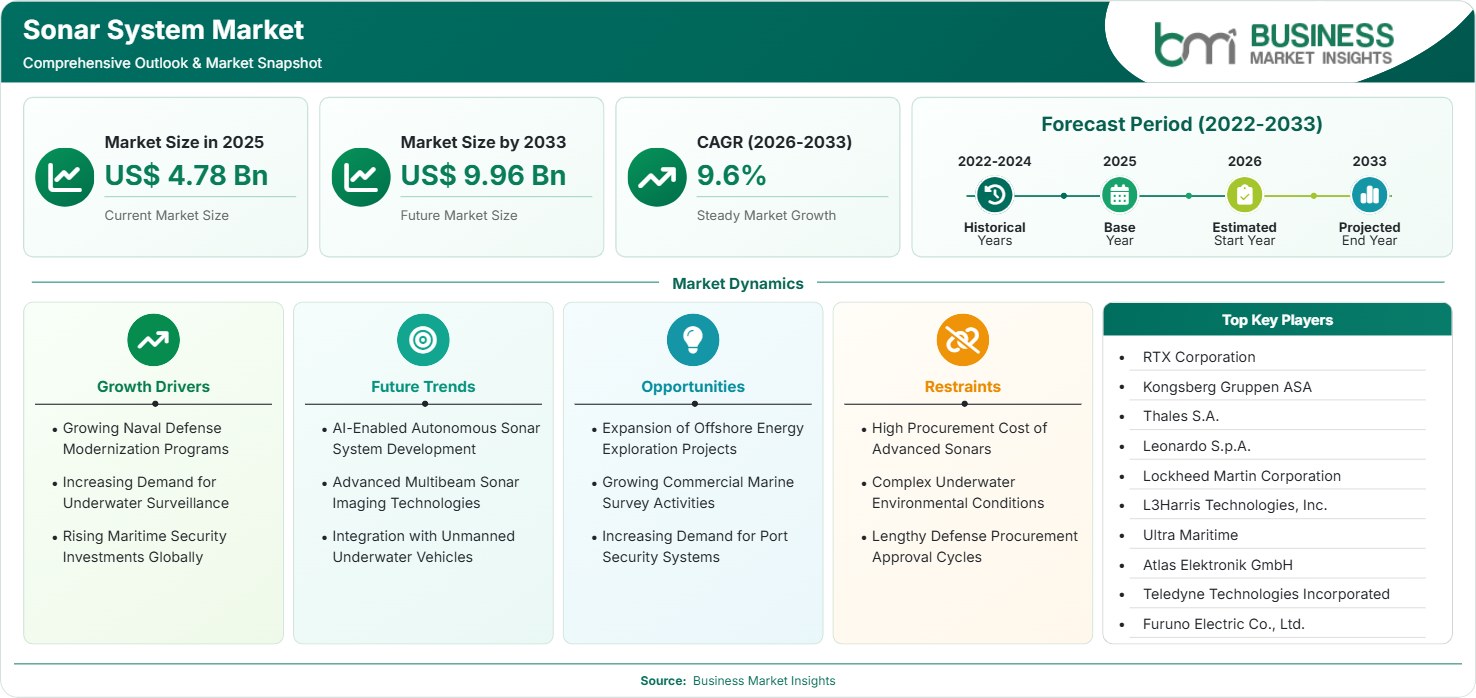
The Sonar System Market size was valued at US$ 4.78 Billion in 2025 and is projected to reach US$ 9.96 Billion by 2033, growing at a CAGR of 9.6% during 2026–2033, driven by naval modernization programs, increasing underwater surveillance requirements, rising maritime security investments, expansion of offshore energy exploration, and growing demand for advanced marine monitoring technologies.

Report Coverage
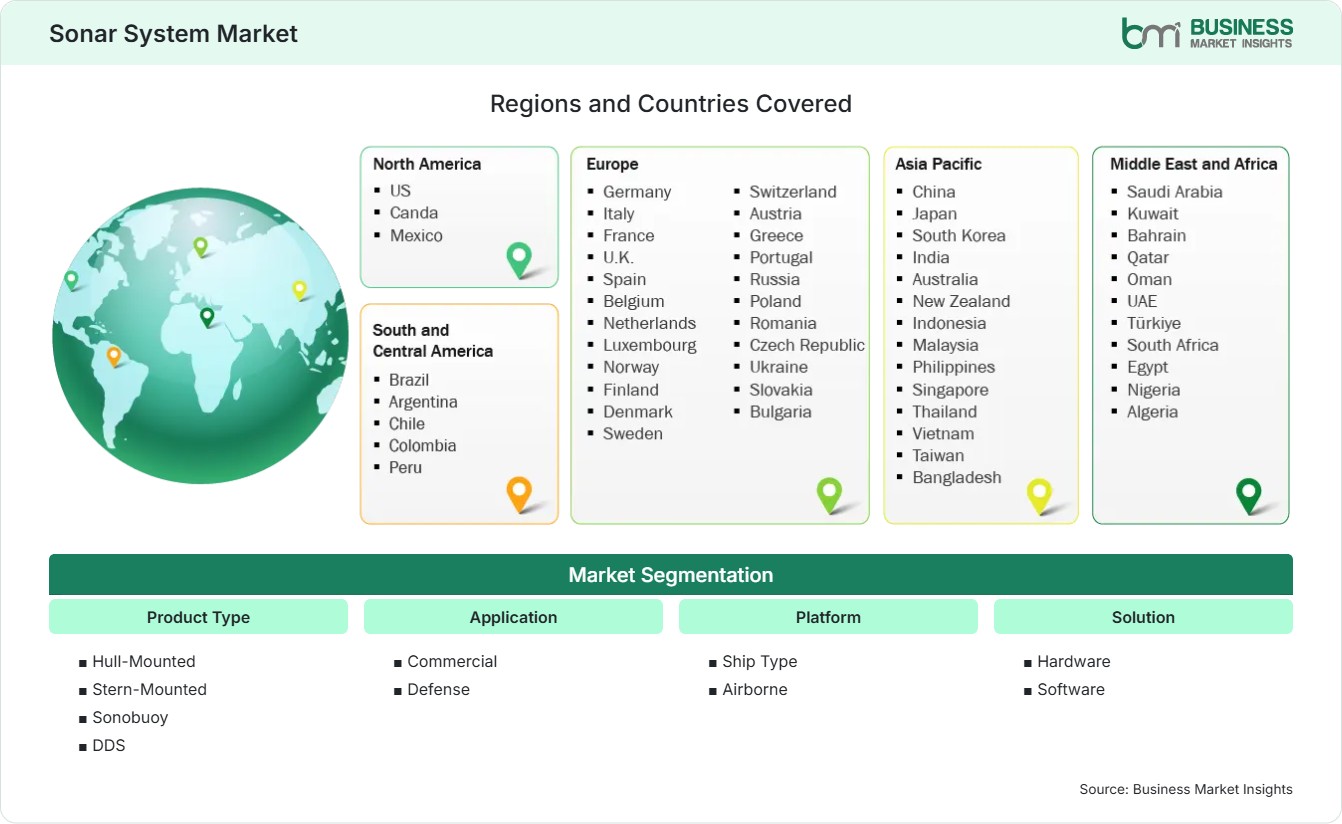
  • Product Type: Hull-Mounted, Stern-Mounted, Sonobuoy, DDS
  • Application: Commercial, Defense
  • Platform: Ship Type, Airborne
  • Solution: Hardware, Software
  • End-User: Line Fit, Retrofit
US$ 4.78 Bn Market size in 2025
US$ 9.96 Bn Market Size by 2033
9.6% CAGR, 2026 - 2033
2026-2033 Forecast Period

AI Overview

Sonar System Market Summary

  • North America Region: North America holds 34%–37% market share in 2025, growing with a CAGR of 9.0%–9.5% during 2026–2033, supported by defense modernization initiatives, naval fleet upgrades, underwater surveillance programs, and advanced maritime security investments. The United States remains the key contributor due to extensive defense spending and is expanding at a CAGR of 9.1%–9.6%.
  • Fastest Growing Region: Asia Pacific accounts for 27%–30% market share in 2025 and is projected to grow at a CAGR of 10.2%–10.7% during 2026–2033, driven by naval expansion programs, maritime boundary protection requirements, offshore exploration activities, and increasing investments in advanced underwater detection systems.
  • Leading Segment: Defense application represents the leading segment with 68%–71% market share in 2025 and is expected to grow at a CAGR of 9.4%–9.9% during the Sonar System Market forecast, supported by submarine detection requirements, naval surveillance modernization, anti-submarine warfare capabilities, and strategic maritime security programs.
  • High Growth Segment: Commercial application represents the high-growth segment with 29%–32% market share in 2025 and is projected to expand at a CAGR of 10.0%–10.5%, supported by offshore energy exploration, marine research activities, port security systems, and commercial vessel monitoring requirements.
  • Key Market Opportunity: Expansion of offshore energy projects, autonomous underwater systems, and advanced maritime surveillance networks creates opportunities for sonar manufacturers to develop integrated solutions with improved detection accuracy and operational efficiency.
  • Major Market Players: RTX Corporation, Kongsberg Gruppen ASA, Thales S.A., Leonardo S.p.A., Lockheed Martin Corporation, L3Harris Technologies, Inc., Ultra Maritime, Atlas Elektronik GmbH, Teledyne Technologies Incorporated, Furuno Electric Co., Ltd.
Strategic Insights

Sonar System Market: Strategic Insights

Sonar System Market Strategic Framework
FREE PDF
Request your free sample
Request free sample
Stakeholder View

Key Takeaways

  • The market ecosystem includes defense contractors, sonar technology developers, naval shipbuilders, marine research organizations, and commercial operators. Companies with integrated hardware and software capabilities are strengthening their positions by providing complete underwater detection.
  • Defense modernization remains the largest demand contributor, while offshore energy exploration, marine surveying, and port security applications provide additional growth avenues. Stakeholders investing in advanced sonar processing, autonomous platform compatibility, and multi-mission systems can capture emerging opportunities across defense and commercial sectors.
  • Innovation is shifting toward artificial intelligence-enabled signal interpretation, autonomous underwater vehicle integration, low-frequency detection technologies, and improved sensor miniaturization. These advancements are enhancing detection accuracy, reducing operator dependency, and improving performance in complex underwater environments.
  • Asia Pacific presents strong investment potential due to expanding naval fleets, maritime security requirements, territorial monitoring needs, and offshore energy development. Countries including China, India, Japan, and South Korea are increasing investments in underwater surveillance and marine defense technologies.
  • Strategic collaborations, defense contracts, and technology partnerships are shaping competitive dynamics as companies seek to strengthen sonar portfolios. Sonar System Market participants are focusing on research investments, acquisition strategies, and development of next-generation underwater sensing technologies.
  • Increasing adoption of unmanned maritime systems is creating demand for compact, efficient sonar solutions capable of supporting autonomous operations, underwater mapping, and extended-duration surveillance missions.
Geographic Outlook

Sonar System Market Regional Highlights

North America Sonar System Market

North America accounted for 34%–37% of the global market share in 2025 and is projected to grow at a CAGR of 9.0%–9.5% during 2026–2033. The region maintains a leading position due to strong defense expenditure, naval modernization initiatives, submarine fleet investments, and advanced maritime surveillance requirements. The Sonar System Market share is supported by established defense technology providers, government contracts, and continuous investment in underwater intelligence capabilities across the US and Canada.

  • The US dominates regional demand due to extensive naval modernization programs, submarine capabilities, and investments in advanced underwater detection technologies.
  • Increasing focus on maritime domain awareness is encouraging adoption of integrated sonar solutions for defense, surveillance, and strategic monitoring missions.
  • Defense agencies are investing in next-generation sonar technologies featuring improved processing capabilities, enhanced detection ranges, and multi-platform compatibility.
  • Commercial marine industries are adopting sonar systems for offshore exploration, underwater mapping, and infrastructure inspection applications.

US Sonar System Market

The United States represented 29%–32% of the global Sonar System market share in 2025 and is expected to expand at a CAGR of 9.1%–9.6% through 2033. The country benefits from large naval budgets, advanced defense manufacturing capabilities, and significant investments in submarine warfare and maritime surveillance programs.

  • Naval fleet modernization programs continue driving demand for advanced sonar systems supporting submarine detection and underwater threat monitoring.
  • Increased investment in autonomous underwater vehicles is creating demand for compact sonar technologies with enhanced processing capabilities.
  • Commercial applications including offshore energy surveys and marine research are supporting additional market opportunities.
  • Defense technology partnerships are accelerating development of integrated underwater sensing and communication solutions.

Europe Sonar System Market

Europe accounted for 22%–25% of the global Sonar System market share in 2025 and is projected to grow at a CAGR of 8.8%–9.3% during 2026–2033. The region benefits from naval modernization programs, maritime security initiatives, submarine capability upgrades, and increasing investments in underwater surveillance infrastructure. Leading markets include Germany, France, the United Kingdom, Italy, and Norway.

  • France remains a significant contributor due to naval modernization programs, submarine capabilities, and development of advanced maritime defense technologies.
  • Germany supports regional growth through established marine technology industries, defense manufacturing expertise, and increasing investment in underwater surveillance solutions.
  • The United Kingdom is strengthening sonar adoption through naval fleet upgrades, maritime security programs, and investments in anti-submarine warfare capabilities.
  • Norway is experiencing rising demand due to offshore energy activities, maritime monitoring requirements, and advanced underwater research applications.
  • European defense organizations are increasing collaboration with technology providers to improve underwater detection, communication, and autonomous maritime capabilities.

Asia Pacific Sonar System Market

Asia Pacific accounted for 27%–30% of the global market share in 2025 and is expected to register the fastest growth with a CAGR of 10.2%–10.7% during 2026–2033. The region is supported by naval expansion programs, maritime security concerns, offshore exploration activities, and increasing investment in underwater surveillance systems.

  • China represents a major regional contributor due to naval fleet expansion, submarine development programs, and increasing investments in maritime surveillance capabilities.
  • India is expanding sonar system adoption through naval modernization initiatives, indigenous defense programs, and increasing focus on maritime security.
  • Japan supports market growth through advanced marine technology capabilities, submarine operations, and investments in underwater detection systems.
  • South Korea is strengthening its position through naval technology development, shipbuilding capabilities, and advanced maritime defense requirements.
  • Southeast Asian countries are increasing investments in coastal security, port protection, and marine monitoring systems to address evolving maritime challenges.

Rest of World Sonar System Market

The Rest of World region accounted for 11%–14% of the global market share in 2025 and is estimated to grow at a CAGR of 8.5%–9.0% during 2026–2033. Growth across Latin America, the Middle East, and Africa is supported by offshore energy exploration, maritime security requirements, naval capability development, and port infrastructure expansion. Brazil, Mexico, Saudi Arabia, and the United Arab Emirates represent important markets due to increasing investments in marine surveillance and defense technologies.

  • Brazil supports regional growth through offshore energy activities, marine research programs, and increasing requirements for underwater survey technologies.
  • Mexico is witnessing demand from offshore exploration projects and marine infrastructure monitoring applications.
  • Saudi Arabia is investing in maritime security and offshore development programs requiring advanced underwater detection capabilities.
  • The United Arab Emirates is strengthening port security infrastructure and adopting advanced marine surveillance solutions.
  • African coastal markets are gradually increasing investment in maritime monitoring systems to improve security and resource management capabilities.
Global Market Geography
FREE PDF
Request your free sample
Request free sample
Segment Analysis

Sonar System Market Segmentation

Product Type

The product Type segment comprises the technical backbone of sonar technology, including hull-mounted, stern-mounted, sonobuoy, and DDS systems utilized in both defense and commercial segments. The hull-mounted segment holds around 38%–41% share of the market and is expected to expand at a CAGR of 9.2%–9.7% during 2026–2033, owing to widespread adoption in naval applications, ongoing vessel integration, and reliable underwater detection capabilities.

  • Hull-Mounted: Hull-mounted sonar systems are widely adopted in naval and commercial vessels due to continuous underwater monitoring capabilities and compatibility with multiple maritime operations.
  • Stern-Mounted: Stern-mounted sonar solutions support specialized underwater detection activities, including anti-submarine warfare missions and marine research applications requiring extended operational flexibility.
  • Sonobuoy: Sonobuoy systems provide airborne and naval forces with remote underwater detection capabilities, supporting surveillance missions, submarine tracking, and maritime intelligence operations.
  • DDS: DDS systems enhance underwater communication and detection capabilities through specialized deployment methods, supporting defense operations and advanced maritime monitoring requirements.

Application

The application segment consists of both business and defense users with diverse needs for detecting, monitoring, navigating, and analyzing marine environments. Defense application held 68% to 71% market share in 2025 and is projected to record 9.4% to 9.9% CAGR from 2026 to 2033 on account of modernization efforts in naval forces, expansion in submarine fleets, and rising investments in maritime security. The Sonar System Market scope continues to grow due to the adoption of sonar technologies by businesses in offshore operations, marine surveys, and port protection.

  • Commercial: Commercial sonar applications support offshore energy exploration, marine research, fisheries monitoring, underwater mapping, and navigation safety requirements across global maritime industries.
  • Defense: Defense applications utilize advanced sonar technologies for submarine detection, underwater surveillance, anti-submarine warfare, and maritime domain awareness operations.

Platform

The Platform segment covers ship-type and airborne platforms utilizing sonar technologies for underwater detection and surveillance missions. Ship-based platforms represented 74%–77% market share in 2025 and are projected to grow at a CAGR of 9.3%–9.8% during 2026–2033 due to increasing naval fleet modernization and commercial vessel integration.

  • Ship Type: Ship-based sonar platforms provide continuous underwater surveillance capabilities for naval vessels, research ships, commercial vessels, and offshore support platforms.
  • Airborne: Airborne sonar platforms, including aircraft and helicopters equipped with sonobuoy systems, support rapid underwater detection and anti-submarine warfare operations.

Solution

The Solution segment includes hardware and software components required for sonar operation, signal processing, detection, and data interpretation. Hardware accounted for 82%–85% market share in 2025 and is projected to grow at a CAGR of 9.0%–9.5% during 2026–2033 due to continued demand for advanced sensors, transmitters, receivers, and control systems.

  • Hardware: Hardware solutions include transmitters, receivers, control units, displays, sensors, and related components supporting sonar detection and operational performance.
    • Transmitter: Transmitters generate acoustic signals required for underwater detection, ranging, and communication across defense and commercial sonar applications.
    • Receiver: Receivers capture reflected acoustic signals and enable processing of underwater information for detection, classification, and monitoring operations.
    • Control Units: Control units manage sonar operations, coordinate system functions, and support integration with vessel-based navigation and surveillance platforms.
    • Displays: Displays provide operators with processed sonar information, visualization capabilities, and real-time underwater monitoring data.
    • Sensors: Sensors enable accurate underwater detection through advanced technologies including ultrasonic diffuse proximity sensors, ultrasonic retro-reflective sensors, ultrasonic through-beam sensors, VME-ADC, and other specialized sensing components.
    • Others: Other hardware components include supporting electronics, connectors, processing modules, and auxiliary systems required for complete sonar deployment.
  • Software: Software solutions provide signal processing, data analytics, automated detection, and visualization capabilities that improve sonar performance and operational decision-making.

End-User

The End-User segment includes line fit and retrofit installations across naval, commercial, and marine platforms. Retrofit installations accounted for 54%–57% market share in 2025 and are projected to grow at a CAGR of 9.8%–10.3% during 2026–2033 due to increasing upgrades of existing fleets and demand for advanced underwater capabilities.

  • Line Fit: Line fit installations involve integrating sonar systems during new vessel construction, supporting optimized system design and advanced platform compatibility.
  • Retrofit: Retrofit installations enable existing vessels to upgrade sonar capabilities, improve surveillance performance, and extend operational service life through advanced technologies.
Market Forces

Sonar System Market Dynamics

Key Market Drivers

Growing Naval Defense Modernization Programs

Naval defense modernization programs are a major driver of sonar adoption, as countries invest in submarine capabilities, fleet upgrades, and advanced maritime surveillance systems. The rising geopolitical tensions and the need for greater awareness of the underwater domain have led defense establishments to consider purchasing the latest-generation sonar systems. The market is being driven by investments made in anti-submarine warfare systems, autonomous underwater vehicles, and naval communication systems. According to the Sonar System Market Trends, there is an increasing trend towards software-enabled sonar systems. These systems offer better intelligence and faster underwater threat detection.

Increasing Demand for Underwater Surveillance

Increasing demand for undersea surveillance systems is driving the adoption of sonar technologies across various industries. There is increased investment in technologies to monitor underwater activities, safeguard critical facilities, and improve maritime situational awareness. Increasing concern about submarine tracking, underwater communication security, and offshore facility protection is prompting the use of advanced sonar systems. Commercial firms are also using sonar technologies for underwater mapping and exploration operations.

Rising Maritime Security Investments Globally

Growing maritime security expenditures are driving increased demand for sonar systems to enhance coastal and port defense and underwater surveillance operations. There is an increase in maritime domain awareness programs to address security challenges, defend economic zones, and ensure naval preparedness. Sonar systems have become very important elements of maritime security systems because of their capability to detect underwater threats and vessel movements. Expanding defense budgets, modernization initiatives, and international security cooperation are supporting the procurement of advanced underwater detection systems.

Key Market Opportunities

Expansion of Offshore Energy Exploration Projects

As offshore energy exploration initiatives expand at a substantial rate, there are many opportunities for sonar providers, as energy firms need sophisticated underwater technology to map the seabed and conduct infrastructure and environmental inspections. With the rising demand for offshore oil and gas and renewable energy initiatives, there is a growing need for marine survey systems that perform well under challenging underwater conditions. The role of sonar technology is to assist in identifying underwater conditions and improving installation processes and safety. Increasing investments in offshore wind developments are further supporting demand for advanced acoustic monitoring technologies.

Growing Commercial Marine Survey Activities

The expansion of marine surveys conducted for business purposes is creating more opportunities for sonar device suppliers, driven by a growing need for underwater surveys and inspections. Companies such as shipping companies, marine engineering firms, researchers, and environmental groups are increasingly using sonar devices to analyze the seafloor, navigate, and survey undersea structures. With growing investments in coastal development, submarine cable installations, and marine exploration, there is a growing need for survey equipment. The increasing use of autonomous marine vehicles is also presenting opportunities for sonar systems.

Increasing Demand for Port Security Systems

Demand for increased use of port security systems is opening doors for sonar companies as port and maritime facilities enhance their underwater threat detection capabilities. Growing concerns about unauthorized underwater activities, infrastructure protection, and maritime security have led to increased use of monitoring technology. Sonar systems offer the capability for round-the-clock monitoring of underwater objects and restricted zones. Technology companies are designing scalable sonar systems to be used alongside larger maritime security systems.

Market Restraints and Challenges

High Procurement Cost of Advanced Sonars

Factor: High procurement costs associated with advanced sonar systems, including sophisticated acoustic sensors, signal processing equipment, and integration requirements, create financial challenges for defense organizations and commercial operators. Impact: Elevated acquisition expenses can limit adoption among budget-constrained users and delay modernization programs, particularly in emerging markets. Advanced sonar solutions require significant research, testing, and customization investments to achieve high detection accuracy and operational reliability. Maintenance, calibration, and lifecycle support requirements further increase total ownership costs. Manufacturers are focusing on modular architectures, scalable solutions, and cost-efficient production methods to improve accessibility while maintaining advanced performance capabilities across different maritime applications.

Complex Underwater Environmental Conditions

Factor: Complex underwater environmental conditions, including temperature variations, salinity differences, and signal distortion, create technical challenges for sonar system performance. Impact: These conditions can reduce detection accuracy, increase system complexity, and require advanced algorithms and calibration methods to maintain operational effectiveness. Underwater environments vary significantly across geographic locations, making universal sonar optimization difficult for manufacturers. Companies must invest in advanced signal processing, artificial intelligence-based analysis, and adaptive sensing technologies to improve reliability.

Company Analysis

Competitive Landscape

The Sonar System Market analysis emphasizes the presence of competition from suppliers of defense technology, marine electronics, and integrated maritime solutions. The major players in the market have been concentrating on acoustic technologies, autonomous underwater systems, AI-based signal processing, and defense alliances.

Company Name

Overview

Products and Services relevant to this market

RTX Corporation

Aerospace and defense technology company providing advanced sensing and mission solutions globally.

Naval sonar systems, underwater detection technologies, acoustic sensors, and defense electronics solutions.

Kongsberg Gruppen ASA

Norwegian technology company specializing in maritime and defense systems.

Sonar solutions, underwater surveillance systems, marine sensors, and autonomous maritime technologies.

Thales S.A.

Global defense and technology company serving aerospace, security, and maritime sectors.

Naval sonar systems, underwater surveillance, acoustic processing, and maritime defense solutions.

Leonardo S.p.A.

Italian aerospace and defense company developing advanced security technologies.

Sonar systems, underwater sensors, naval electronics, and defense monitoring solutions.

Lockheed Martin Corporation

Global defense contractor providing advanced military technologies and systems.

Anti-submarine warfare systems, sonar technologies, underwater sensors, and naval integration solutions.

L3Harris Technologies, Inc.

Technology company delivering communication, sensing, and defense solutions.

Sonar systems, acoustic sensors, underwater communication, and maritime surveillance technologies.

Ultra Maritime

Defense technology provider specializing in underwater warfare solutions.

Sonar systems, submarine detection technologies, underwater sensors, and maritime defense solutions.

Atlas Elektronik GmbH

Marine electronics company focused on naval and underwater systems.

Sonar systems, underwater communication, mine detection, and naval sensor solutions.

Teledyne Technologies Incorporated

Industrial technology company providing advanced sensing and imaging solutions.

Marine sonar systems, acoustic instruments, underwater imaging, and sensor technologies.

Furuno Electric Co., Ltd.

Japanese marine electronics manufacturer serving commercial and maritime industries.

Marine sonar equipment, fish finders, navigation systems, and vessel electronics solutions.

Industry Activity

Recent Developments

January 2026

RTX Corporation announced its 2025 results and 2026 outlook, highlighting continued growth in its defense portfolio, including advanced sensing, surveillance, and naval technologies. RTX’s defense businesses continue to support underwater warfare and sonar-related capabilities through its Raytheon and Collins Aerospace technology portfolios, including sensors and mission systems used in maritime defense applications.

May 2025

Thales Group received a contract through ST Engineering to provide the Republic of Singapore Navy with its Pathmaster mine countermeasure system, incorporating Towed Synthetic Aperture Sonar (TSAS), sonar data analysis tools, and mission management capabilities. The system will support autonomous mine detection, classification, and localization operations.

January 2025

Leonardo S.p.A. completed the sale of its Underwater Armaments & Systems (UAS) business to Fincantieri, transferring capabilities related to submarine defense systems, underwater sensors, countermeasures, and sonar technologies. The transaction supports Leonardo’s portfolio optimization strategy while enabling Fincantieri to expand its naval underwater systems business.

January 2025

Fincantieri S.p.A. completed the acquisition of Leonardo’s Underwater Armaments & Systems (UAS) business through the creation of WASS Submarine Systems S.r.l. The acquisition strengthens Fincantieri’s underwater defense capabilities, including sonar, submarine systems, torpedoes, and acoustic technologies, supporting expansion in the global naval sonar ecosystem.

Trust & Transparency

Research Methodology

The market analysis combines proprietary research with secondary data from government agencies, company disclosures, regulatory filings, industry databases and expert interviews. Market estimates are validated through data triangulation, cross-market benchmarking and analyst review.

View Full Research Methodology

Questions Answered

Frequently Asked Questions

What insights are covered in the Sonar System Market Report?

The market report provides analysis of market size, product segments, applications, platforms, regional developments, competitive strategies, technological trends, growth opportunities, and industry challenges influencing market expansion.

Which region offers significant growth opportunities for sonar manufacturers?

Asia Pacific offers strong growth opportunities due to expanding naval capabilities, maritime security investments, offshore exploration activities, and increasing adoption of advanced underwater monitoring systems.

How are autonomous technologies influencing sonar system development?

Autonomous underwater vehicles and unmanned maritime platforms are increasing demand for compact, efficient sonar solutions with improved signal processing, navigation support, and extended operational capabilities.

Which application segment dominates the sonar system industry?

Defense applications represent the leading segment due to increasing investments in submarine detection, anti-submarine warfare capabilities, maritime security programs, and naval fleet modernization initiatives worldwide.

What factors are driving the Sonar System Market growth?

The market is driven by naval modernization programs, increasing underwater surveillance requirements, rising maritime security investments, offshore energy exploration, commercial marine surveying activities, and adoption of advanced underwater detection technologies.

Access the Full Sonar System Market Report

Get segment-level forecasts, regional estimates, competitive benchmarking, company profiles and downloadable Excel datasets.

Access the full Sonar System Market Report
350 pages PDF & Excel | 2026-08-03