
Helicopter Market Outlook: Size, Share, Trends, Growth Analysis, Competitive Landscape & Forecast, 2026-2033

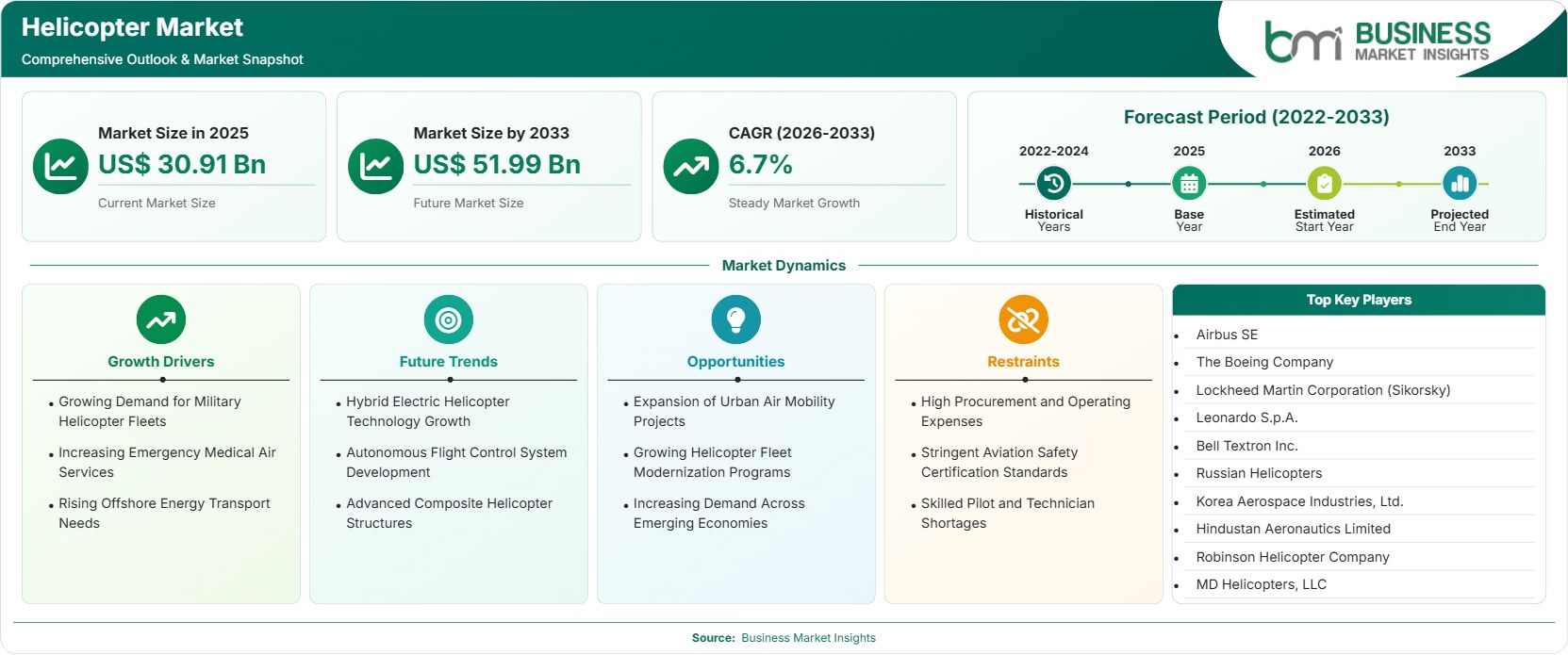
The Helicopter Market size was valued at US$ 30.91 Billion in 2025 and is projected to reach US$ 51.99 Billion by 2033, growing at a CAGR of 6.7% during 2026–2033, driven by military fleet expansion, emergency medical aviation services, offshore energy transportation demand, modernization programs, and increasing adoption across emerging economies.

Report Coverage
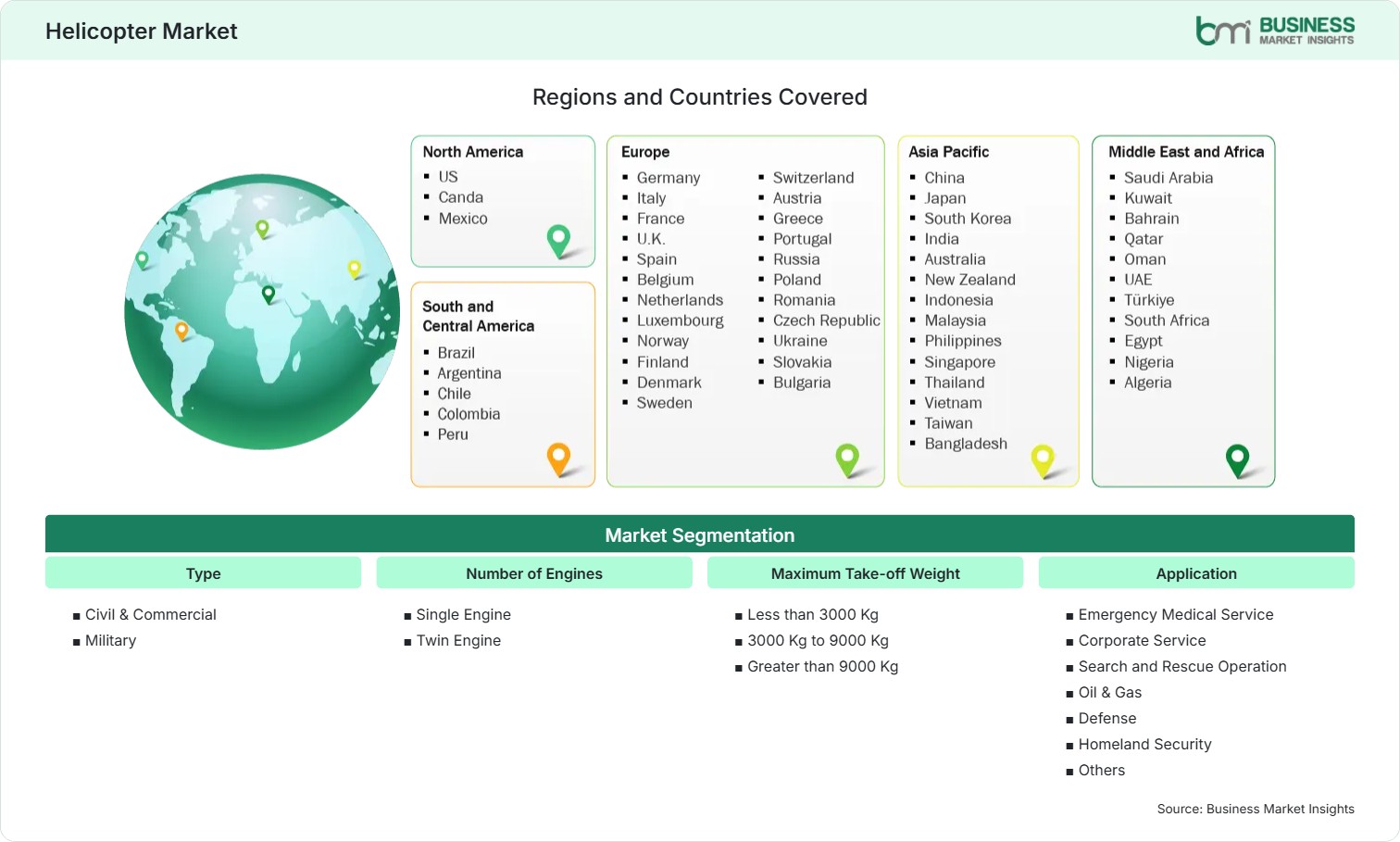
  • Type: Civil & Commercial, Military
  • Number of Engines: Single Engine, Twin Engine
  • Maximum Take-off Weight: Less than 3000 Kg, 3000 Kg to 9000 Kg, Greater than 9000 Kg
  • Application: Emergency Medical Service, Corporate Service, Search and Rescue Operation, Oil & Gas, Defense, Homeland Security, Others
  • Point of Sale: New and Pre-Owned
US$ 30.91 Bn Market size in 2025
US$ 51.99 Bn Market Size by 2033
6.7% CAGR, 2026 - 2033
2026-2033 Forecast Period

AI Overview

Helicopter Market Summary

  • North America Region: North America holds 34%–37% of the Helicopter market share in 2025, growing with a CAGR of 6.1%–6.6% during 2026–2033, supported by defense modernization, emergency medical services, corporate aviation demand, and fleet replacement programs. The United States remains the dominant contributor with a CAGR of 6.2%–6.7% due to military procurement and commercial aviation requirements.
  • Fastest Growing Region: Asia Pacific accounts for 22%–25% market share in 2025 and is projected to grow at a CAGR of 7.2%–7.7% during 2026–2033, driven by defense spending, infrastructure development, offshore energy activities, urban air mobility initiatives, and increasing demand for advanced rotorcraft solutions.
  • Leading Segment: Military helicopters represent the leading segment with 55%–58% market share in 2025 and are expected to grow at a CAGR of 6.8%–7.3%, supported by defense modernization programs, border surveillance requirements, tactical operations, and replacement of aging military fleets.
  • High Growth Segment: Emergency Medical Service applications represent a high-growth segment with 8%–11% of the Helicopter market share in 2025 and are projected to expand at a CAGR of 7.5%–8.0%, supported by increasing air ambulance networks, healthcare accessibility initiatives, and rapid emergency response requirements.
  • Key Market Opportunity: Urban air mobility projects, helicopter fleet modernization programs, and rising aviation investments in emerging economies are creating opportunities for manufacturers developing efficient, digitally connected, and multi-mission rotorcraft.
  • Major Market Players: Airbus SE, The Boeing Company, Lockheed Martin Corporation (Sikorsky), Leonardo S.p.A., Bell Textron Inc., Russian Helicopters, Korea Aerospace Industries, Ltd., Hindustan Aeronautics Limited, Robinson Helicopter Company, MD Helicopters, LLC.
Strategic Insights

Helicopter Market: Strategic Insights

Helicopter Market Strategic Framework
FREE PDF
Request your free sample
Request free sample
Stakeholder View

Key Takeaways

  • The helicopter ecosystem consists of original equipment manufacturers, defense agencies, aviation service providers, component suppliers, maintenance organizations, and leasing companies. Competitive advantage is increasingly influenced by integrated manufacturing capabilities, aftermarket support networks, and advanced avionics expertise.
  • Military rotorcraft modernization and specialized mission applications represent major growth opportunities as governments replace aging fleets with advanced helicopters featuring improved endurance, connectivity, survivability, and multi-role operational capabilities.
  • Technology development is focused on lightweight composite materials, hybrid propulsion research, autonomous flight assistance systems, advanced navigation technologies, and digital maintenance platforms that improve aircraft efficiency and reduce lifecycle costs.
  • Asia Pacific provides attractive investment opportunities due to increasing defense budgets, expanding offshore energy activities, infrastructure development, and rising demand for emergency aviation services. Countries including India, China, South Korea, and Southeast Asian nations are strengthening helicopter capabilities.
  • Strategic collaborations, defense contracts, and fleet modernization partnerships are shaping the competitive environment. Aerospace companies are expanding service capabilities and developing customized solutions to support military, commercial, and specialized helicopter operators.
Geographic Outlook

Helicopter Market Regional Highlights

North America Helicopter Market

North America accounted for 34%–37% of the global market share in 2025 and is projected to grow at a CAGR of 6.1%–6.6% during 2026–2033. The region benefits from strong defense aviation capabilities, mature commercial helicopter operations, emergency medical service networks, and offshore energy activities. The Helicopter Market share is supported by military fleet modernization, corporate transportation requirements, and continued investments in advanced rotorcraft technologies across the United States and Canada.

  • The United States represents the largest regional contributor due to extensive military helicopter programs, defense contracts, and established commercial rotorcraft operations.
  • Defense agencies are investing in next-generation helicopters to enhance operational capabilities, surveillance, transportation, and tactical mission performance.
  • Emergency medical service providers are expanding helicopter ambulance networks to improve rapid healthcare response across remote and urban regions.
  • Offshore energy operators continue adopting helicopters for personnel transportation, platform support, and remote operational activities.

US Helicopter Market

The United States accounted for 30%–33% of the global Helicopter market share in 2025 and is expected to grow at a CAGR of 6.2%–6.7% through 2033. The country remains a key market due to defense modernization programs, extensive military rotorcraft fleets, commercial aviation demand, and established emergency medical aviation infrastructure. Increased investment in aircraft upgrades, maintenance services, and advanced mission systems is supporting long-term market expansion.

  • Military procurement programs are driving demand for advanced helicopters with improved operational range and mission capabilities.
  • Corporate aviation and private operators are supporting demand for premium helicopters used for transportation and executive mobility.
  • Emergency medical aviation networks are expanding due to increasing requirements for rapid patient transport services.
  • Fleet modernization activities are creating opportunities for maintenance, repair, and upgrade providers.

Europe Helicopter Market

Europe accounted for 26%–29% of the global Helicopter market share in 2025 and is projected to grow at a CAGR of 6.3%–6.8% during 2026–2033. The region benefits from defense modernization programs, offshore energy activities, emergency response services, and strong aerospace manufacturing capabilities. France, Germany, Italy, the United Kingdom, and Norway represent important markets. France and Italy maintain strong positions due to indigenous helicopter manufacturing capabilities, while Norway and the United Kingdom benefit from offshore energy transportation requirements.

  • France remains a leading contributor through aerospace manufacturing expertise, military helicopter programs, and civil aviation applications.
  • Germany is increasing adoption through emergency services, industrial transportation, and modernization of aviation infrastructure.
  • The United Kingdom supports market growth through offshore energy operations, defense investments, and search and rescue requirements.
  • Italy benefits from helicopter production capabilities, defense procurement activities, and commercial aviation applications.
  • Norway is witnessing demand from offshore oil and gas transportation and maritime support operations.

Asia Pacific Helicopter Market

Asia Pacific represented 22%–25% of the global Helicopter market share in 2025 and is expected to register the fastest growth with a CAGR of 7.2%–7.7% during 2026–2033. Growth is supported by increasing defense budgets, infrastructure development, offshore energy projects, emergency medical aviation expansion, and rising aviation investments. China, India, Japan, South Korea, and Southeast Asian countries are key markets due to military modernization, domestic aerospace development, and increasing helicopter utilization across multiple applications.

  • China supports regional demand through defense aviation expansion, infrastructure projects, and development of domestic helicopter manufacturing capabilities.
  • India is experiencing increasing adoption through defense modernization programs, emergency services expansion, and offshore energy transportation needs.
  • Japan contributes through advanced aviation infrastructure, disaster response requirements, and commercial helicopter operations.
  • South Korea is strengthening helicopter capabilities through military programs, aerospace manufacturing, and fleet modernization initiatives.
  • Southeast Asian countries are creating opportunities through tourism, offshore activities, and expanding emergency aviation services.

Rest of World Helicopter Market

The Rest of World region accounted for 10%–13% of the global market share in 2025 and is estimated to grow at a CAGR of 6.0%–6.5% during 2026–2033. Growth across Latin America, the Middle East, and Africa is supported by defense investments, offshore energy operations, emergency response requirements, and infrastructure development. Brazil, Mexico, Saudi Arabia, the United Arab Emirates, and South Africa represent key markets due to increasing demand for specialized helicopter applications.

Latin American countries are expanding helicopter usage across energy, defense, law enforcement, and emergency services. Middle Eastern nations are investing in advanced aviation fleets for defense operations, offshore transportation, search and rescue missions, and commercial applications. African Helicopter markets are gradually adopting helicopters for healthcare access, disaster management, and security operations.

  • Brazil contributes through offshore oil operations, defense applications, and emergency aviation service expansion.
  • Mexico supports demand through energy sector transportation, law enforcement operations, and commercial helicopter usage.
  • Saudi Arabia is increasing helicopter adoption through defense programs, infrastructure development, and offshore energy activities.
  • The United Arab Emirates is expanding helicopter operations through tourism, corporate transportation, and emergency response services.
  • South Africa is developing helicopter applications across defense, medical services, and regional transportation operations.
Global Market Geography
FREE PDF
Request your free sample
Request free sample
Segment Analysis

Helicopter Market Segmentation

Type

The Type segment consists of Civil & Commercial and Military helicopters deployed in transportation, military defense, emergency, offshore, and special aircraft purposes. The market share for Military helicopters was estimated at 55%-58% in 2025 and is expected to grow at a compound annual growth rate of 6.8%-7.3% in the 2026-2033 forecast period, owing to defense modernization initiatives, fleet replacement programs, and increased demand for mission capabilities. Civil & Commercial helicopters will also continue to grow in medical, corporate transportation, offshore, and tourism applications.

  • Civil & Commercial: Civil and commercial helicopters support transportation, emergency medical services, corporate mobility, tourism, offshore operations, and specialized aviation activities requiring flexible air mobility solutions.
  • Military: Military helicopters are adopted for combat operations, troop transport, surveillance, search and rescue, and defense missions requiring advanced performance and mission-specific capabilities.

By Number of Engines

The Number of Engines segment consists of single- and twin-engine helicopters, catering to varied needs. Twin-engine helicopters held a market share between 62% and 65% in 2025 and are forecast to grow at a CAGR of 6.9% to 7.4% from 2026 to 2033, owing to their improved reliability and safety standards. The helicopter market is expanding due to an emphasis on aircraft with greater operational capabilities and payload capacity.

  • Single Engine: Single engine helicopters are preferred for cost-effective operations, private aviation, training, utility applications, and missions requiring lower operating expenses.
  • Twin Engine: Twin engine helicopters are utilized in defense, offshore transport, emergency services, and commercial operations where safety, range, and reliability are critical.

Maximum Take-off Weight (MTOW)

The Maximum Take-off Weight (MTOW) segment includes helicopters under 3,000 Kg, helicopters between 3,000 Kg and 9,000 Kg, and helicopters above 9,000 Kg. The segment between 3,000 Kg and 9,000 Kg captured a market share of 45% to 48% in 2025 and is expected to register a CAGR of 6.7% to 7.2% from 2026 to 2033, owing to its widespread applications in commercial transportation, emergency services, offshore operations, and defense. Medium-weight helicopters provide balanced performance, payload capacity, and operational flexibility.

  • Less than 3,000 Kg: Lightweight helicopters support training, personal transportation, surveillance, and utility missions requiring lower acquisition and operating costs.
  • 3,000 Kg to 9,000 Kg: Medium-weight helicopters serve commercial, defense, offshore, and emergency applications requiring versatile performance and higher payload capabilities.
  • Greater than 9,000 Kg: Heavy helicopters are designed for military transport, heavy lifting, offshore support, and specialized missions requiring maximum capacity and endurance.

Application

The Applications segment comprises Emergency Medical Services, Corporate Service, Search and Rescue Operations, Oil and Gas, Defense, Homeland Security, and Others. The defense application segment held a market share of 38% to 41% in 2025 and is expected to register a CAGR of 6.8% to 7.3% between 2026 and 2033, owing to growing military modernization and investments in tactical aviation. The growth of commercial and special applications is also being fueled by the growing need for mobility and offshore operations.

  • Emergency Medical Service: EMS helicopters support rapid patient transportation, critical care access, disaster response, and healthcare delivery in remote and urban areas.
  • Corporate Service: Corporate helicopters provide executive transportation, time-efficient mobility, and flexible travel solutions for businesses and high-net-worth users.
  • Search and Rescue Operation: Search and rescue helicopters enable emergency response, disaster management, maritime rescue, and humanitarian operations requiring rapid deployment capabilities.
  • Oil & Gas: Oil and gas applications utilize helicopters for offshore personnel transport, platform support, and remote energy infrastructure operations.
  • Defense: Defense helicopters support military transportation, combat missions, surveillance, reconnaissance, and specialized operational requirements.
  • Homeland Security: Homeland security applications include border monitoring, law enforcement support, disaster management, and public safety operations.

Point of Sale

The point-of-sale category comprises New & Pre-Owned helicopters, catering to the varied needs of customers across the defense, commercial, and general aviation sectors. The New helicopter market held around 58%-61% market share in 2025 and is forecast to grow at a CAGR of 6.6%-7.1% between 2026 and 2033, driven by modernization, technological improvements, and the growing need for state-of-the-art aircraft. Pre-owned helicopters continue to meet the needs of budget-conscious customers.

  • New: New helicopter purchases are driven by modernization programs, advanced technology integration, improved efficiency, and manufacturer support services.
  • Pre-Owned: Pre-owned helicopters provide economical ownership options for operators requiring reliable aircraft at lower acquisition costs.
Market Forces

Helicopter Market Dynamics

Key Market Drivers

Growing Demand for Military Helicopter Fleets

Expanding military fleet modernization initiatives have proven significant drivers of helicopter procurement worldwide as defense forces upgrade their aging fleets with new-generation rotorcraft. Modern helicopters with superior avionics, survivability, and versatile mission capability are being procured by governments for use in various applications, including transportation, surveillance, and tactical purposes. According to the Helicopter Market Trends, there is increasing demand for helicopter modernization in digital avionics, improved performance, and increased service longevity. Modernization of the defense forces in North America, the Asia-Pacific region, and Europe offers sustained market opportunities for helicopter manufacturers.

Increasing Emergency Medical Air Services

The rising trend in emergency medical air services is driving demand for helicopters, as healthcare organizations are now focusing on providing rapid transport for critical patients and remote medical delivery. Helicopter emergency medical services allow quicker response than traditional means of transportation, especially in difficult geographic regions. Medical helicopters with improved facilities and enhanced safety measures are increasingly becoming popular in both developed and developing countries.

Rising Offshore Energy Transport Needs

Rising offshore energy transport needs are increasing helicopter utilization for personnel movement, platform support, and logistics operations in remote offshore locations. Oil and gas companies rely on helicopters for efficient transportation between coastal facilities and offshore installations where alternative transport methods may be limited. Expanding offshore exploration activities and continued investments in energy infrastructure are supporting demand for reliable aviation solutions. The growth of offshore wind projects is also creating additional opportunities as specialized helicopters support inspection, maintenance, and transportation activities across marine energy facilities.

Key Market Opportunities

Expansion of Urban Air Mobility Projects

Expansion of urban air mobility projects is creating future opportunities for helicopter manufacturers as cities explore advanced aerial transportation solutions. Urban congestion and increasing demand for faster mobility options are encouraging investment in vertical take-off and landing technologies, including next-generation rotorcraft concepts. Existing helicopter technology provides valuable capabilities for urban air mobility development through vertical flight expertise, infrastructure requirements, and operational experience. Growing collaboration between aerospace companies, technology providers, and urban planners is expected to create new applications beyond traditional helicopter operations.

Growing Helicopter Fleet Modernization Programs

Growing helicopter fleet modernization programs are creating opportunities for manufacturers and service providers as operators seek to upgrade aging aircraft with advanced technologies. Modernization efforts can be attributed to avionics modernization, engine upgrades, structural modifications, and mission system integration. Defense departments, private companies, and governmental agencies are planning upgrade programs to reduce replacement costs while still operating effectively. Those firms that provide all-inclusive upgrade solutions and digital maintenance software stand to gain from these programs.

Increasing Demand Across Emerging Economies

The growing demand in emerging nations presents numerous opportunities for growth as they develop their aviation, defense, healthcare, and energy infrastructure. The growing economic activity and infrastructure development will result in greater demand for more flexible air mobility options, especially in nations with difficult terrain and poor transport infrastructure. Government initiatives to develop aviation facilities, disaster management, and security infrastructure are expected to boost helicopter usage in emerging economies during the Helicopter market forecast period.

Market Restraints and Challenges

High Procurement and Operating Expenses

Factor: High procurement and operating expenses associated with helicopters, including aircraft acquisition costs, maintenance requirements, fuel consumption, and specialized workforce needs, create financial challenges for operators. Impact: Elevated ownership costs can limit adoption among budget-sensitive customers and delay fleet expansion decisions, particularly for commercial and public sector operators. Helicopters require regular inspections, component replacements, and technical support to maintain safety and performance standards. Operators must evaluate lifecycle expenses before investing in new aircraft. Manufacturers are addressing cost concerns through improved fuel efficiency, extended maintenance intervals, and service agreements designed to optimize operational economics. However, high overall ownership costs remain a key challenge affecting market accessibility.

Stringent Aviation Safety Certification Standards

Factor: Stringent aviation safety certification standards require extensive testing, regulatory approvals, and compliance procedures before helicopter models can enter commercial operation. Impact: Complex certification requirements increase development timelines, raise research and testing costs, and create challenges for manufacturers introducing new aircraft technologies. Aviation authorities enforce strict standards related to aircraft design, flight performance, maintenance procedures, and operational safety. Manufacturers are adopting advanced simulation tools, testing methodologies, and compliance strategies to manage regulatory requirements efficiently.

Company Analysis

Competitive Landscape

Helicopter Market Analysis reveals a competitive aerospace market, with competition from defense contractors, rotorcraft producers, aviation technology suppliers, and maintenance service providers. Top firms are developing their businesses around avionics solutions, fleet modernization, mission-specific helicopters, and lifecycle management services.

Company Name

Overview

Products and Services relevant to this market

Airbus SE

Global aerospace company producing commercial and military rotorcraft platforms.

Civil helicopters, military helicopters, emergency service aircraft, and maintenance support solutions.

The Boeing Company

Aerospace manufacturer providing defense and commercial aviation solutions.

Military rotorcraft, advanced helicopter systems, defense aviation technologies, and support services.

Lockheed Martin Corporation (Sikorsky)

Aerospace and defense company specializing in advanced military helicopters.

Military helicopters, utility rotorcraft, mission systems, upgrades, and lifecycle services.

Leonardo S.p.A.

Aerospace company offering helicopter solutions for multiple mission applications.

Commercial helicopters, defense rotorcraft, offshore helicopters, and aviation support services.

Bell Textron Inc.

Aerospace manufacturer developing civil and military rotorcraft solutions.

Commercial helicopters, military platforms, tiltrotor technologies, and maintenance services.

Russian Helicopters

Rotorcraft manufacturer serving military and commercial aviation markets.

Transport helicopters, military helicopters, utility aircraft, and maintenance solutions.

Korea Aerospace Industries, Ltd.

Aerospace company developing indigenous aircraft and helicopter platforms.

Military helicopters, aerospace systems, aircraft development, and support services.

Hindustan Aeronautics Limited

Indian aerospace company manufacturing aircraft and helicopter platforms.

Military helicopters, utility rotorcraft, aerospace manufacturing, and maintenance services.

Robinson Helicopter Company

Manufacturer specializing in lightweight civil helicopters.

Personal helicopters, training aircraft, commercial rotorcraft, and support services.

MD Helicopters, LLC

Helicopter manufacturer focused on commercial and military rotorcraft.

Light helicopters, utility platforms, defense aircraft, and aftermarket support solutions.

Industry Activity

Recent Developments

February 2026

Adani Defence & Aerospace and Leonardo S.p.A. announced a strategic partnership to develop, manufacture, and sustain a helicopter ecosystem in India. The collaboration is aimed at building indigenous helicopter manufacturing capabilities and supporting future military helicopter requirements, positioning India as a potential regional hub for rotorcraft production and sustainment.

January 2026

Airbus Helicopters reported strong global helicopter order momentum in 2025, recording 544 gross orders (536 net orders) from 205 customers across 50 countries. The company highlighted demand across its civil and military helicopter portfolio, along with continued growth in uncrewed aerial systems (UAS) activities.

September 2025

Lockheed Martin Sikorsky secured a five-year contract valued at approximately US$10.855 billion to build up to 99 CH-53K King Stallion heavy-lift helicopters for the U.S. Marine Corps. The multi-year agreement supports long-term production stability, supply-chain activity, and continued manufacturing expansion for Sikorsky’s next-generation heavy-lift helicopter program.

August 2025

Airbus Helicopters expanded its global manufacturing supply chain by awarding Mahindra Aerostructures a contract to manufacture and assemble the main fuselage of the H125 helicopter. The agreement strengthens Airbus’ industrial footprint in India and supports localization of helicopter component manufacturing under the country’s aerospace development initiatives.

Trust & Transparency

Research Methodology

The market analysis combines proprietary research with secondary data from government agencies, company disclosures, regulatory filings, industry databases and expert interviews. Market estimates are validated through data triangulation, cross-market benchmarking and analyst review.

View Full Research Methodology

Questions Answered

Frequently Asked Questions

What information is included in the Helicopter Market Report?

The Market Report includes market size analysis, segmentation insights, regional trends, competitive landscape, growth drivers, opportunities, challenges, recent developments, and future industry outlook.

Which region offers strong growth opportunities for helicopter manufacturers?

Asia Pacific offers strong growth opportunities due to increasing defense spending, offshore energy activities, infrastructure development, healthcare aviation expansion, and rising adoption across emerging economies.

How are modernization programs influencing helicopter demand?

Modernization programs are increasing demand for avionics upgrades, improved propulsion systems, digital mission technologies, and lifecycle support services that enhance existing fleet performance and extend aircraft operational life.

Which helicopter segment holds the largest market share?

Military helicopters represent the leading segment due to increasing defense investments, modernization programs, surveillance requirements, and demand for advanced tactical and transport capabilities.

What factors are driving the Helicopter Market growth?

The market is driven by military fleet modernization, increasing emergency medical aviation services, offshore energy transportation requirements, fleet replacement programs, and growing demand for specialized aviation solutions.

Access the Full Helicopter Market Report

Get segment-level forecasts, regional estimates, competitive benchmarking, company profiles and downloadable Excel datasets.

Access the full Helicopter Market Report
350 pages PDF & Excel | 2026-07-29