
Military Helicopters Market Outlook: Size, Share, Trends, Growth Analysis, Competitive Landscape & Forecast, 2026-2033

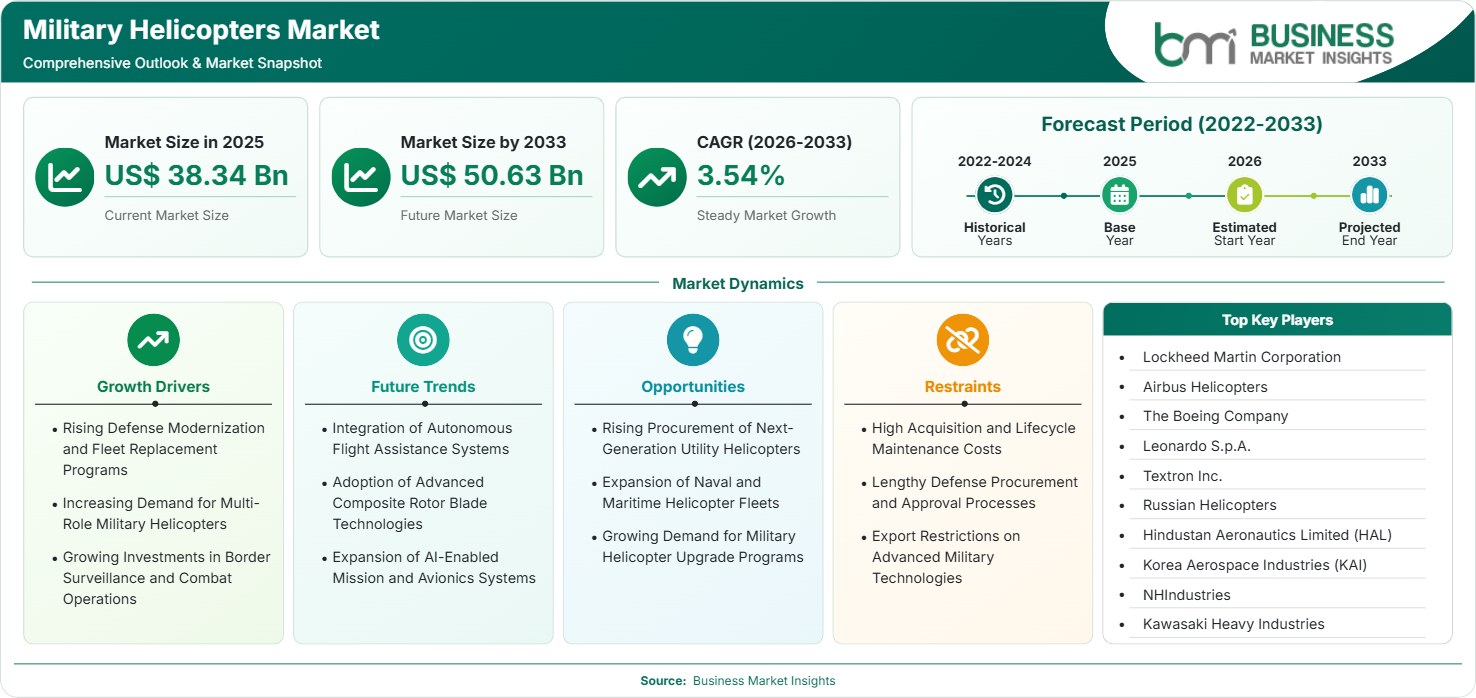
The Military Helicopters Market size was valued at US$ 38.34 Billion in 2025 and is projected to reach US$ 50.63 Billion by 2033, growing at a CAGR of 3.54% during 2026–2033. Rising defense modernization programs, increasing procurement of multi-role rotorcraft, growing focus on border security and tactical mobility, and expanding investments in indigenous military aviation capabilities are supporting market growth worldwide.

Report Coverage
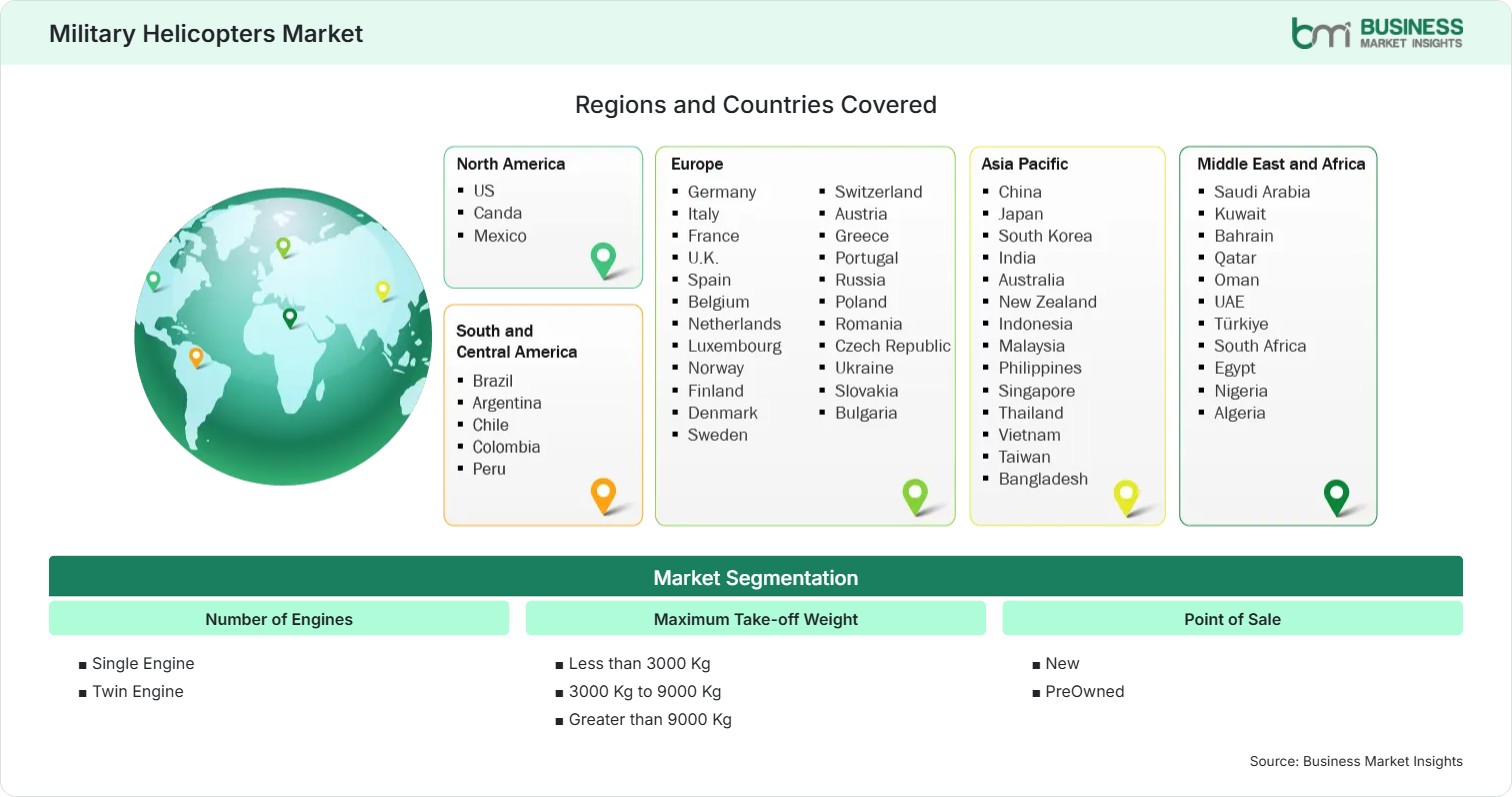
  • Number of Engines: Single Engine, Twin Engine
  • Maximum Take-off Weight: Less than 3000 Kg, 3000 Kg to 9000 Kg, Greater than 9000 Kg
  • Point of Sale: New, PreOwned
US$ 38.34 Bn Market size in 2025
US$ 50.63 Bn Market Size by 2033
3.54% CAGR, 2026 - 2033
2026-2033 Forecast Period

AI Overview

Military Helicopters Market Summary

  • North America Region: North America holds a military helicopters market share of 39%–42% in 2025, growing with a CAGR of 3.2%–3.7% during 2026–2033. Strong defense budgets, extensive military modernization programs, replacement of aging helicopter fleets, and continued investment in advanced rotorcraft technologies continue supporting regional leadership. The U.S. market is expected to register a CAGR of 3.3%–3.8%.
  • Fastest Growing Region: Asia Pacific accounts for 22%–25% share in 2025 and is projected to grow at a CAGR of 4.8%–5.4% through 2033. Growing geopolitical tensions, rising defense expenditures, indigenous manufacturing initiatives, and expanding military aviation programs continue driving regional demand.
  • Leading Segment: Twin Engine helicopters represent 68%–71% share in 2025 and are expected to grow at a CAGR of 3.8%–4.3% through 2033. Superior operational reliability, enhanced payload capacity, improved safety performance, and suitability for complex military missions continue supporting segment dominance.
  • High Growth Segment: Greater than 9,000 Kg MTOW accounts for 29%–32% share in 2025 and is forecast to grow at a CAGR of 4.5%–5.1% during 2026–2033. Growing demand for heavy-lift missions, troop transport operations, combat support activities, and strategic deployment capabilities is supporting segment expansion.
  • Key Market Opportunity: Development of next-generation military helicopters featuring advanced avionics, autonomous capabilities, enhanced survivability systems, and multi-mission operational flexibility is creating new growth opportunities.
  • Major Market Players: Fuji Electric Co., Ltd., Lockheed Martin Corporation (Sikorsky), The Boeing Company, Airbus Helicopters SAS, Leonardo S.p.A., Bell Textron Inc., Hindustan Aeronautics Limited (HAL), Korea Aerospace Industries, Ltd. (KAI), Turkish Aerospace Industries (TAI), AVIC Helicopter Group.
Strategic Insights

Military Helicopters Market: Strategic Insights

Military Helicopters Market Strategic Framework
FREE PDF
Request your free sample
Request free sample
Stakeholder View

Key Takeaways

  • Military helicopters continue serving as vital assets for tactical mobility, combat support, surveillance, rescue operations, and logistics missions.
  • Twin-engine helicopters remain the dominant category due to superior reliability, range, safety, and mission flexibility.
  • Heavy-lift military helicopters are witnessing growing demand as defense forces seek greater transport and deployment capabilities.
  • Asia Pacific military helicopters market presents strong growth opportunities driven by military modernization programs and increasing defense expenditures.
  • Advanced avionics, survivability technologies, and digital mission systems are becoming critical procurement priorities.
  • Indigenous manufacturing initiatives and strategic defense partnerships are reshaping procurement patterns across several nations.
Geographic Outlook

Military Helicopters Market Regional Highlights

North America Military Helicopters Market

North America accounts for 39%–42% Military Helicopters Market share in 2025 and is projected to grow at a CAGR of 3.2%–3.7% through 2033. Strong defense spending, extensive military aviation programs, and ongoing fleet modernization initiatives continue supporting regional leadership. Defense agencies are increasingly investing in advanced rotorcraft designed to support next-generation operational requirements.

  • Military organizations across the region continue replacing aging helicopter fleets with advanced platforms featuring improved survivability, digital connectivity, and enhanced mission capabilities.
  • Investments in multi-role helicopters capable of supporting combat, logistics, surveillance, and humanitarian missions continue driving procurement activity.
  • Advanced training programs and maintenance modernization initiatives are improving operational readiness and fleet availability.
  • Defense agencies are increasingly incorporating network-enabled mission systems and integrated communication capabilities to strengthen battlefield effectiveness.
  • Continued focus on rapid deployment operations and multi-domain warfare is supporting demand for highly versatile helicopter platforms.
  • Long-term procurement contracts and modernization roadmaps continue creating stable opportunities for aerospace manufacturers and suppliers.

US Military Helicopters Market

The United States contributes approximately 85%–89% of North American revenue and is expected to register a CAGR of 3.3%–3.8% through 2033. Large-scale defense programs, advanced military aviation capabilities, and substantial investments in next-generation rotorcraft continue supporting market leadership.

  • Military services continue prioritizing helicopter modernization to enhance operational flexibility and support evolving mission requirements.
  • Significant investments in future vertical lift programs are driving innovation in military rotorcraft technologies.
  • Combat readiness initiatives continue supporting upgrades to mission systems, avionics, sensors, and defensive technologies.
  • Growing emphasis on survivability and operational efficiency is encouraging procurement of advanced helicopter platforms.
  • Strategic investments in aerospace research and development are supporting long-term technological advancement within military aviation.

Europe Military Helicopters Market

Europe represents 26%–29% of global revenue in 2025 and is anticipated to expand at a CAGR of 3.5%–4.1% through 2033. Rising defense budgets, growing focus on military readiness, and increasing investments in advanced aviation capabilities continue supporting regional growth. Germany remains the leading military helicopters market while Poland demonstrates stronger growth momentum.

  • Germany continues leading regional demand through military modernization programs and investments in advanced rotary-wing platforms.
  • Poland is among the fastest-growing markets and is estimated to register a CAGR of 4.6%–5.2% during the forecast period.
  • Defense organizations continue enhancing airborne mobility and rapid deployment capabilities through rotorcraft procurement programs.
  • Governments are increasingly prioritizing operational interoperability and multi-role military aviation assets.
  • Modernization of transport and utility helicopter fleets continues creating procurement opportunities throughout the region.
  • Ongoing collaboration among aerospace and defense organizations is strengthening innovation and technology development.

Asia Pacific Military Helicopters Market

Asia Pacific accounts for 22%–25% of global revenue in 2025 and is expected to achieve the fastest CAGR of 4.8%–5.4% through 2033. Rising regional security concerns, growing defense expenditures, and increasing emphasis on indigenous military aviation manufacturing continue supporting strong market expansion.

  • China remains the largest regional military helicopters market due to substantial defense investments and expanding military aviation capabilities.
  • India is projected to achieve approximately 5.5%–6.1% CAGR, supported by military modernization programs and domestic aerospace manufacturing initiatives.
  • Governments are increasingly investing in transport, utility, reconnaissance, and combat helicopter fleets to strengthen defense preparedness.
  • Expansion of domestic aerospace industries is supporting indigenous design and production capabilities.
  • Border security requirements and disaster response preparedness are creating additional demand for versatile rotorcraft platforms.
  • Regional military forces continue seeking helicopters capable of operating effectively in diverse terrain and climatic conditions.

Rest of World Military Helicopters Market

Rest of World accounts for 8%–11% of global revenue in 2025 and is projected to expand at a CAGR of 3.7%–4.3% through 2033. Growing defense modernization efforts, increasing procurement of advanced military equipment, and expanding security requirements continue supporting market development.

  • Brazil continues generating demand through military capability enhancement and fleet modernization initiatives.
  • The UAE is increasing investments in advanced rotary-wing platforms to strengthen operational readiness and defense effectiveness.
  • Saudi Arabia is expected to achieve approximately 4.5%–5.1% CAGR through 2033, driven by defense modernization and military capability expansion programs.
  • Governments are increasingly seeking multi-role platforms capable of supporting both military and humanitarian operations.
  • Strategic partnerships and technology transfer agreements continue supporting procurement and aerospace industry development.
  • Modern battlefield requirements are encouraging broader adoption of technologically advanced helicopter systems.
Global Market Geography
FREE PDF
Request your free sample
Request free sample
Segment Analysis

Military Helicopters Market Segmentation

Number of Engines

The number of engines segment plays a crucial role in determining operational performance, mission flexibility, payload capacity, safety, and overall survivability of military helicopters. The segment accounts for approximately 68%–71% share in 2025 and is projected to grow at a CAGR of 3.8%–4.3% through 2033. The expanding Military Helicopters Market scope is supported by increasing procurement of multi-role platforms, modernization of aging helicopter fleets, and growing demand for enhanced operational capabilities across military missions.

  • Single Engine: Single-engine military helicopters continue serving important roles in training, reconnaissance, border patrol, light utility transport, and surveillance missions. Their lower acquisition and operational costs make them attractive for specific defense requirements and emerging military aviation programs.
  • Twin Engine: Twin-engine helicopters dominate the market due to superior reliability, increased safety, higher payload capacity, extended operational range, and better performance in challenging combat and mission environments. Armed forces increasingly prefer twin-engine platforms for transport, search and rescue, special operations, naval operations, and combat support missions.

Maximum Take-off Weight (MTOW)

Maximum take-off weight remains an important factor that influences mission range, transport capabilities, payload carrying capacity, and operational deployment flexibility. This segment accounts for approximately 34%–37% share in 2025 and is expected to register a CAGR of 3.9%–4.5% through 2033. Current Military Helicopters Market trends indicate growing demand for heavier and more capable rotorcraft platforms designed to support increasingly complex military missions.

  • Less than 3,000 Kg: These helicopters are primarily utilized for pilot training, light reconnaissance, border patrol, observation missions, and limited utility operations where high maneuverability and cost efficiency are required.
  • 3,000 Kg to 9,000 Kg: Medium-weight helicopters remain widely deployed for troop transport, utility missions, medical evacuation, logistics support, and tactical operations due to their balance between operational flexibility and cost effectiveness.
  • Greater than 9,000 Kg: Heavy-weight military helicopters represent the fastest-growing category because of increasing demand for strategic air mobility, heavy-lift operations, equipment transportation, disaster relief missions, and large-scale troop deployment capabilities.

Point of Sale

Point-of-sale dynamics continue evolving as defense organizations seek cost-effective fleet expansion and modernization strategies. This segment accounts for approximately 46%–49% share in 2025 and is projected to grow at a CAGR of 3.6%–4.2% through 2033. Increasing emphasis on lifecycle management and fleet optimization continues influencing procurement decisions across global defense agencies.

  • New: New military helicopter procurement remains the dominant category due to rising investments in advanced rotorcraft technologies, enhanced survivability features, new-generation avionics, and mission-specific performance requirements.
  • Pre-Owned: Pre-owned helicopter acquisitions continue gaining traction among defense organizations seeking affordable capability enhancement solutions. Refurbished and upgraded platforms provide a cost-effective option for nations looking to strengthen military aviation capabilities without undertaking large-scale procurement expenditures.
Market Forces

Military Helicopters Market Dynamics

Key Market Drivers

Rising Defense Modernization and Fleet Replacement Programs

Worldwide, military organizations are making efforts to modernize their aging fleets by acquiring new aircraft that can meet the demands of modern warfare. Most of the rotary-wing assets are aging and need major upgrades or replacement in order to be maintained. There is an increasing effort to invest in the modernization of the fleet of helicopters in order to increase mission flexibility, survivability, efficiency, and interoperability within the armed forces. The next generation of helicopters has new-generation avionics, mission systems, propulsion technologies, cockpit design, and defensive systems. In addition, there is increasing emphasis on multi-domain platforms and rapidly changing battlefield conditions. With the expansion of modernization programs in the world, the acquisition of new helicopters is likely to be a key growth factor.

Increasing Demand for Multi-Role Military Helicopters

Modern armed forces increasingly prefer multi-role helicopters capable of performing a wide variety of missions using a single platform. These helicopters can support troop transportation, intelligence gathering, surveillance, logistics operations, medical evacuation missions, search and rescue activities, and combat support functions. The ability to perform multiple mission types significantly improves operational efficiency and reduces fleet complexity. Advances in modular mission systems and configurable payload capabilities have further enhanced the versatility of military rotorcraft. Defense agencies are prioritizing investments in helicopters that can be rapidly adapted to changing mission requirements while maintaining high operational performance. As militaries seek greater flexibility and cost efficiency, demand for multi-role military helicopters continues to strengthen across military helicopters market.

Growing Investments in Border Surveillance and Combat Operations

The rise in political conflicts, border security, and other regional challenges are pushing governments to invest more in aerial surveillance and combat support technologies. Military helicopters are still key components when it comes to observing hard-to-reach locations, fast responses, anti-insurgency operations, and national security readiness. The versatility of the helicopters along with their mobility makes them essential assets in current military operations. The armed forces are increasingly using military helicopters that have advanced sensors, surveillance tools, communications systems, and mission management technology. The above-mentioned features enable rapid collection and awareness of intelligence information.

Key Market Opportunities

Rising Procurement of Next-Generation Utility Helicopters

Defense agencies are gradually increasing investment in the latest utility helicopters to offer increased efficiency, versatility, and survivability in operations. The latest utility helicopters feature advanced avionics, digital flight control system, increased payload capacity, and reduced maintenance. The importance of utility helicopters to military missions is attributed to their role in facilitating missions related to transport, logistics, movement of troops, humanitarian aid and disaster response operations. Companies are working on producing advanced rotary-wing aircraft that can address changing needs of the military while offering better economics over the life cycle of the equipment. Growth prospects in the procurement of next-generation utility helicopters will become significant for aerospace companies.

Expansion of Naval and Maritime Helicopter Fleets

Naval forces are increasing investments in specialized helicopters designed for maritime surveillance, anti-submarine warfare, search and rescue, logistics support, and surface combat operations. These rotorcraft play a critical role in extending naval operational reach and enhancing maritime situational awareness. Growing concerns regarding maritime security, territorial waters, offshore asset protection, and naval force readiness are supporting procurement activity. Advanced naval helicopters equipped with sophisticated sensors, sonar systems, and mission-specific technologies are witnessing strong demand. As governments continue strengthening maritime defense capabilities, opportunities associated with naval helicopter programs are expected to expand significantly.

Growing Demand for Military Helicopter Upgrade Programs

A substantial portion of the global military helicopter fleet remains operational but requires modernization to meet contemporary mission requirements. Upgrade programs involving avionics improvements, engine enhancements, survivability systems, communication technologies, mission equipment integration, and structural improvements are becoming increasingly important. These modernization initiatives allow defense organizations to extend service life while avoiding the cost of complete fleet replacement. Aerospace companies are actively developing upgrade packages that improve performance and mission effectiveness. Long-term Military Helicopters Market Forecasts remain favorable as upgrade and sustainment programs continue generating recurring opportunities across the global defense sector.

Market Restraints and Challenges

High Acquisition and Lifecycle Maintenance Costs

Factor: Military helicopters require substantial capital investment due to sophisticated engineering, advanced avionics, specialized materials, and complex mission systems. Beyond procurement costs, operators must manage training expenses, maintenance requirements, spare parts inventories, infrastructure investments, and long-term sustainment activities. These costs can place significant pressure on defense budgets, particularly in developing economies. Impact: High ownership costs may delay procurement decisions, reduce fleet expansion plans, and limit adoption of next-generation platforms. Budget constraints can also encourage governments to prioritize upgrades of existing assets rather than investing in entirely new fleets. Cost-related challenges remain an important consideration influencing market growth and procurement strategies worldwide.

Lengthy Defense Procurement and Approval Processes

Factor: Military helicopter acquisition programs typically involve extensive evaluation procedures, budget approvals, technology assessments, testing requirements, regulatory reviews, and government oversight processes. Procurement cycles often span multiple years before contracts are finalized and production begins. Political changes, budget adjustments, shifting defense priorities, and administrative delays can further extend timelines. Impact: Lengthy procurement processes may delay revenue realization for manufacturers, create uncertainty within supply chains, and slow deployment of new military capabilities. These challenges can affect production planning and complicate long-term market forecasting. Nevertheless, ongoing modernization requirements continue sustaining demand despite procurement-related complexities.

Company Analysis

Competitive Landscape

The Military Helicopters Market analysis is characterized by competition among global aerospace manufacturers, defense contractors, military aviation specialists, and government-backed aerospace organizations. Market participants are focusing on next-generation rotorcraft development, survivability enhancement technologies, mission system integration, advanced avionics, multi-role platform capabilities, and lifecycle support solutions. Modernization programs, indigenous manufacturing initiatives, long-term defense contracts, and technology partnerships continue shaping competitive dynamics across the military helicopter industry.

Company Name

Overview

Products and Services relevant to this market

Fuji Electric Co., Ltd.

Technology company supporting industrial and defense-related systems with expertise in electronics and control technologies.

Aerospace-related electronic systems, control technologies, power solutions, and defense support systems.

Lockheed Martin Corporation (Sikorsky)

Global defense contractor and leading manufacturer of military helicopter platforms for combat, transport, and special operations missions.

Military helicopters, utility helicopters, combat rotorcraft, naval helicopters, aerospace technologies, and lifecycle support services.

The Boeing Company

Aerospace and defense company offering advanced military aviation platforms and mission systems.

Attack helicopters, transport helicopters, military aviation solutions, defense systems, and integrated mission technologies.

Airbus Helicopters SAS

Rotorcraft manufacturer serving military, governmental, and security applications worldwide.

Military transport helicopters, multi-role rotorcraft, naval helicopters, mission support solutions, and aviation services.

Leonardo S.p.A.

Aerospace and defense company specializing in advanced helicopter technologies and military aviation programs.

Multi-role military helicopters, naval rotorcraft, mission systems, avionics solutions, and defense aviation technologies.

Bell Textron Inc.

Aerospace manufacturer focused on military and commercial rotorcraft innovation.

Utility helicopters, military rotorcraft, reconnaissance platforms, advanced flight technologies, and mission support systems.

Hindustan Aeronautics Limited (HAL)

Government-owned aerospace company supporting military aviation and indigenous helicopter development programs.

Utility helicopters, light combat helicopters, military aviation systems, indigenous rotorcraft programs, and aerospace engineering services.

Korea Aerospace Industries, Ltd. (KAI)

Aerospace manufacturer engaged in military aircraft and helicopter development.

Military helicopters, utility rotorcraft, aerospace manufacturing services, defense aviation technologies, and military support systems.

Turkish Aerospace Industries (TAI)

Defense and aerospace company developing indigenous military aviation platforms and advanced rotorcraft technologies.

Military helicopters, utility aircraft, aerospace engineering solutions, defense modernization programs, and aviation support services.

AVIC Helicopter Group

Aerospace manufacturer specializing in helicopter development and military aviation technologies.

Military helicopters, transport rotorcraft, reconnaissance helicopters, aviation systems, and defense aerospace solutions.

Trust & Transparency

Research Methodology

The market analysis combines proprietary research with secondary data from government agencies, company disclosures, regulatory filings, industry databases and expert interviews. Market estimates are validated through data triangulation, cross-market benchmarking and analyst review.

View Full Research Methodology

Questions Answered

Frequently Asked Questions

How are modernization programs influencing military helicopter procurement?

Defense organizations are increasingly replacing legacy fleets with advanced platforms featuring digital avionics, survivability systems, integrated mission management technologies, enhanced payload capabilities, and improved operational performance.

What does this Military Helicopters Market Report cover?

This report covers number of engines analysis, maximum take-off weight segmentation, point-of-sale evaluation, regional insights, competitive landscape assessment, market dynamics, and future growth opportunities through 2033.

Why is the greater than 9,000 kg MTOW segment growing rapidly?

Heavy-lift helicopters are witnessing strong demand because of their ability to transport troops, military equipment, vehicles, supplies, and support strategic deployment operations across challenging environments.

Which engine category dominates the market?

Twin-engine helicopters represent the dominant segment due to superior safety, operational reliability, greater payload capacity, longer range, and suitability for complex military missions.

What factors are driving growth in the market?

Rising defense modernization programs, growing fleet replacement initiatives, increasing demand for multi-role helicopters, and expanding investments in border surveillance and combat operations are the major factors driving market growth.

Access the Full Military Helicopters Market Report

Get segment-level forecasts, regional estimates, competitive benchmarking, company profiles and downloadable Excel datasets.

Access the full Military Helicopters Market Report
350 pages PDF & Excel | 2026-08-12
Similar Research

Related Market Reports