
Military Satellite Market Outlook: Size, Share, Trends, Growth Analysis, Competitive Landscape & Forecast, 2026–2033

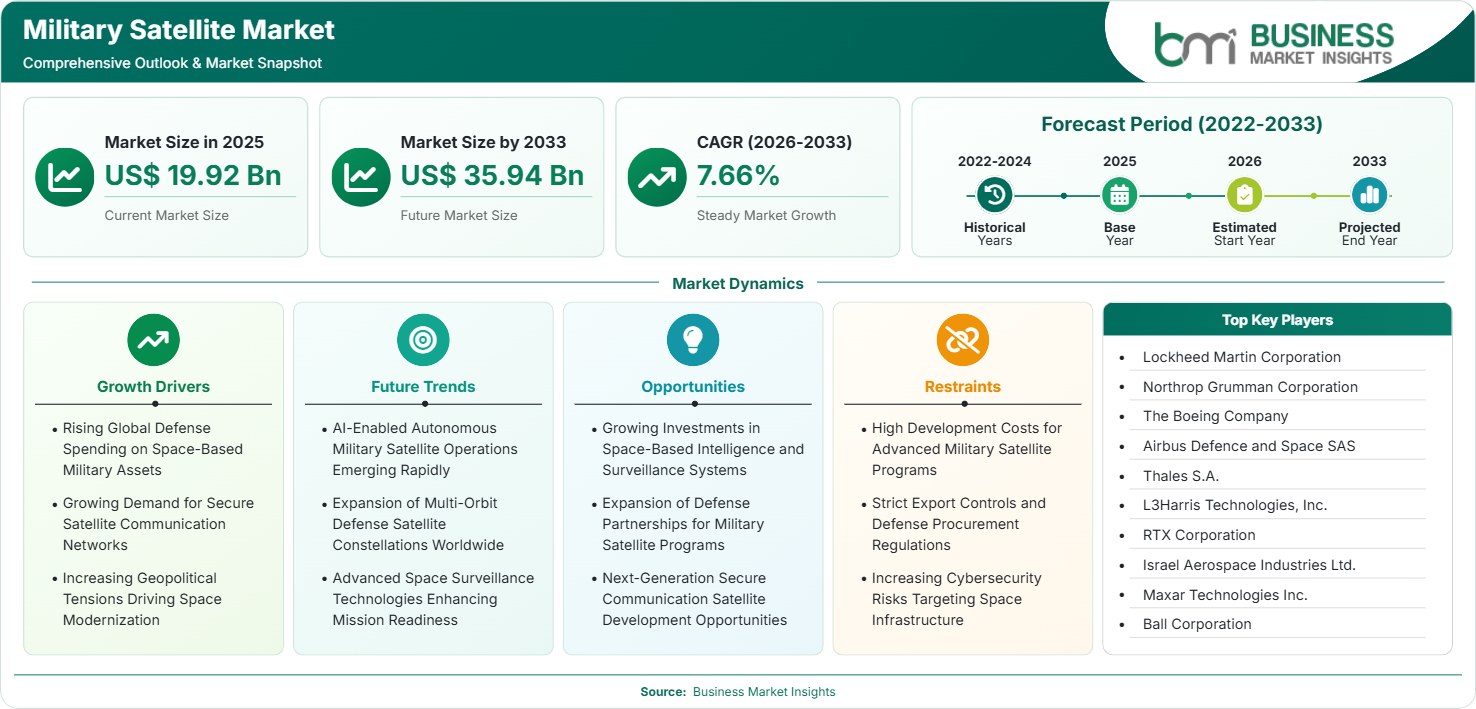
The Military Satellite Market size was valued at US$ 19.92 Billion in 2025 and is projected to reach US$ 35.94 Billion by 2033, growing at a CAGR of 7.66% during 2026–2033. Rising defense investments in space assets, and modernization of military space infrastructure are creating significant long-term opportunities across global defense organizations.

Report Coverage
  • Orbit Type: LEO, MEO, GEO
  • Offering: Satellite Manufacturing, Launch Services, Operational Services
  • Type: Nano-Micro Satellite, Small Satellite, Medium Satellite, Heavy Satellite
  • Application: ISR, Communication, Navigation
  • Satellite Component: Structures, Payload, Electric Power System, Instrument Control Unit, Propulsion System, Thermal Control Subsystem, Communication System, Others
US$ 19.92 Bn Market size in 2025
US$ 35.94 Bn Market Size by 2033
7.66% CAGR, 2026 - 2033
2026-2033 Forecast Period

01 AI Overview

Military Satellite Market Summary

  • North America Region: North America holds 40%–43% market share in 2025 and is projected to grow at a 7.2%–7.7% CAGR during 2026–2033. Strong defense budgets, and increasing investments in resilient communication infrastructure continue supporting regional expansion. The U.S. dominates the regional landscape through sustained defense space investments and next-generation military satellite deployments, advancing at approximately 7.3%–7.8% CAGR during the forecast period.
  • Fastest Growing Region: Asia Pacific accounts for 24%–27% market share in 2025 and is expected to register a 9.0%–9.5% CAGR during 2026–2033. Rising geopolitical tensions, expanding indigenous satellite manufacturing, modernization of defense communication networks, and increasing investment in ISR capabilities continue accelerating regional growth.
  • Leading Segment: Communication accounts for 37%–41% market share in 2025 while expanding at a 7.5%–8.0% CAGR through 2033. Growing requirements for encrypted communications, secure battlefield connectivity, network-centric warfare, and beyond-line-of-sight communication continue strengthening demand across modern armed forces.
  • High Growth Segment: LEO accounts for 29%–33% market share in 2025 and is anticipated to register a 9.1%–9.6% CAGR during 2026–2033. Lower latency, rapid deployment, enhanced resilience, proliferated constellations, and improved tactical communication capabilities continue driving investments in low Earth orbit defense satellites.
  • Key Market Opportunity: Expanding deployment of AI-enabled satellite analytics, multi-orbit defense architectures, software-defined payloads, cyber-resilient communication networks, and autonomous space operations is creating substantial opportunities for next-generation military satellite programs worldwide.
  • Major Market Players: Lockheed Martin Corporation, Northrop Grumman Corporation, The Boeing Company, Airbus Defence and Space SAS, Thales S.A., L3Harris Technologies, Inc., RTX Corporation, Israel Aerospace Industries Ltd., Maxar Technologies Inc., and Ball Corporation.
02 Strategic Insights

Military Satellite Market: Strategic Insights

Military Satellite Market Strategic Framework
FREE PDF
Request your free sample
Request free sample
03 Stakeholder View

Key Takeaways

  • The military satellite ecosystem is evolving toward integrated space defense architectures where satellite manufacturers, and software developers collaborate to deliver resilient multi-domain military capabilities.
  • Communication and ISR applications continue offering the strongest long-term revenue opportunities as defense agencies prioritize secure connectivity, and real-time battlefield awareness across increasingly contested operational environments.
  • Artificial intelligence, software-defined payloads, onboard edge computing, autonomous mission planning, and cyber-resilient satellite systems are becoming strategic differentiators.
  • Asia Pacific presents one of the most attractive investment destinations owing to expanding defense modernization programs, and increasing geopolitical competition driving rapid capability development.
  • Strategic alliances between defense agencies, commercial space companies, launch providers, and satellite manufacturers continue accelerating technology transfer, reducing deployment timelines, and strengthening domestic space industrial capabilities.
  • Increasing deployment of proliferated LEO constellations, hybrid orbit architectures, and quantum-resistant communication technologies is expected to redefine future military space operations.
04 Geographic Outlook

Military Satellite Market Regional Highlights

North America Military Satellite Market

North America accounted for approximately 40%–43% of the Military Satellite Market share in 2025 and is projected to expand at a CAGR of 7.2%–7.7% through 2033. The region benefits from the world's largest defense budgets, advanced satellite manufacturing capabilities, established launch infrastructure, and continuous modernization of military space assets.

  • The US is continuing to develop advanced military satellite constellations for secure communications, missile warning, navigation, and intelligence gathering in more than one theater of operations.
  • Defense organizations are deploying low Earth orbit constellations in order to provide greater resistance against anti-satellite weapons and improved tactical communications and surveillance.
  • Public-private partnerships between defense organizations and commercial aerospace companies continue accelerating innovation in satellite manufacturing, launch technologies, and advanced onboard processing capabilities.
  • Growing emphasis on cyber-secure space infrastructure is encouraging investments in encrypted communication payloads, autonomous satellite operations, and AI-driven mission management platforms supporting future defense requirements.

US Military Satellite Market

The United States represents the dominant contributor within North America, accounting for approximately 81%–84% of regional revenue while expanding at a CAGR of 7.3%–7.8% during the forecast period. Continuous investments by the U.S. Department of Defense and the U.S. Space Force, coupled with advanced domestic manufacturing capabilities, continue driving deployment of secure communication, ISR, navigation, and missile warning satellite systems supporting global military operations.

  • Modernization of protected satellite communication networks continues improving command-and-control capabilities while ensuring resilient connectivity across joint military operations.
  • Increasing procurement of next-generation ISR satellites enables faster intelligence gathering, improved target tracking, and enhanced battlefield awareness across diverse operational environments.
  • Significant investments in launch infrastructure and reusable launch technologies continue reducing deployment timelines while increasing responsiveness for defense satellite missions.

Europe Military Satellite Market

Europe Military Satellite Market represented 24%–27% market share in 2025 and is anticipated to grow at a CAGR of 7.6%–8.1% through 2033. Increasing regional security priorities, expanding defense cooperation, and investments in sovereign space capabilities continue driving demand. France remains the leading market owing to strong military space programs, while Germany demonstrates one of the fastest growth rates supported by increasing defense modernization and satellite communication investments.

  • France continues leading regional military satellite deployment through advanced defense space programs, secure communication initiatives, and strategic investments in sovereign satellite capabilities.
  • Germany records robust growth as increased defense spending supports modernization of intelligence, surveillance, navigation, and protected communication infrastructure.
  • European collaborative defense programs continue strengthening satellite interoperability while improving regional resilience through shared space surveillance and communication initiatives.
  • Public funding for next-generation defense innovation continues encouraging development of AI-enabled satellite platforms capable of supporting future multi-domain military operations.

Asia Pacific Military Satellite Market

Asia Pacific Military Satellite Market accounted for 24%–27% of global revenue in 2025 and is projected to register the highest CAGR of 9.0%–9.5% during 2026–2033. China leads regional deployment through extensive investment in military space assets, while India demonstrates the fastest expansion supported by increasing defense space initiatives.

  • China continues investing heavily in communication, navigation, ISR, and electronic intelligence satellite constellations supporting long-term strategic military objectives.
  • India records the fastest regional growth as defense modernization programs strengthen indigenous satellite manufacturing, launch capabilities, and secure military communication infrastructure.
  • Japan and South Korea continue expanding investments in resilient space-based defense systems supporting regional security, maritime surveillance, and missile warning capabilities.
  • Growing collaboration between government agencies and domestic aerospace companies continues accelerating innovation across military satellite manufacturing and launch technologies.
  • Rising emphasis on multi-orbit defense architectures improves operational resilience while supporting integrated command-and-control capabilities across the region.

Rest of World Military Satellite Market

The Rest of the World contributed 8%–10% of global revenue in 2025 and is expected to expand at a CAGR of 8.0%–8.5% through 2033. South & Central America is witnessing gradual adoption of military satellite capabilities to improve border monitoring, maritime surveillance, and secure defense communications. The Middle East & Africa continue increasing investments in sovereign space capabilities, intelligence gathering, and strategic communication systems to strengthen national security and regional defense preparedness.

  • Brazil leads South & Central America through expanding investments in satellite-enabled defense communication and surveillance capabilities, while Chile continues strengthening strategic space partnerships.
  • Saudi Arabia and the United Arab Emirates continue investing in sovereign satellite programs supporting defense modernization, secure communications, and national security objectives.
  • Border security, maritime monitoring, and disaster response remain important applications encouraging deployment of advanced military satellite technologies across emerging defense markets.
  • Increasing collaboration with international aerospace companies continues strengthening regional technical capabilities while supporting indigenous defense space development programs.
  • Rising investment in secure communication infrastructure and ISR capabilities continues improving operational readiness across defense organizations throughout emerging economies.
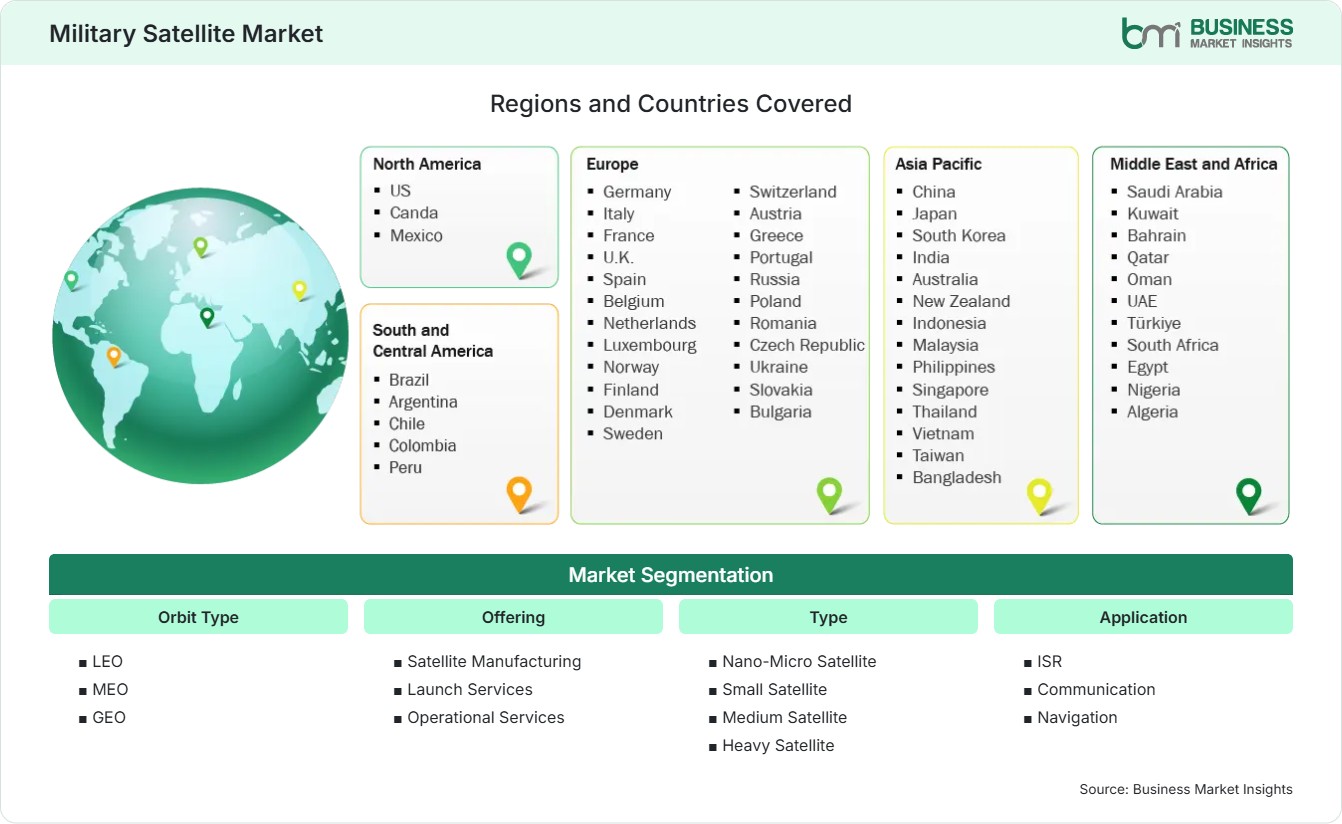
Global Market Geography
FREE PDF
Request your free sample
Request free sample
05 Segment Analysis

Military Satellite Market Segmentation

Orbit Type

Orbit selection significantly influences coverage area, latency, mission duration, survivability, and operational effectiveness across defense space missions. This segment accounted for nearly 29%–33% market share in 2025 and is projected to register a CAGR of 9.1%–9.6% during 2026–2033. The Military Satellite Market scope continues expanding as defense agencies increasingly deploy multi-orbit architectures that enhance resilience, mission flexibility, secure communications, and persistent global surveillance capabilities.

  • LEO: Low Earth Orbit satellites are witnessing rapid deployment owing to lower latency, improved revisit frequency, resilient proliferated constellations, and enhanced tactical communication, intelligence gathering, and real-time battlefield awareness.
  • MEO: Medium Earth Orbit satellites remain essential for secure navigation, positioning, timing services, and selected communication missions requiring balanced orbital coverage, operational efficiency, and extended service life.
  • GEO: Geostationary satellites continue supporting strategic military communication, missile warning, and wide-area surveillance applications through continuous regional coverage and high-capacity communication payloads.

Offering

The offering segment reflects the complete military satellite value chain from spacecraft production to launch execution and long-term mission support. It represented approximately 42%–46% market share in 2025 while advancing at a CAGR of 7.8%–8.3% through the forecast period. Continuous procurement of advanced defense satellites and modernization of operational infrastructure continue strengthening the Military Satellite Market trends across global defense organizations.

  • Satellite Manufacturing: Represents the largest revenue contributor as governments continue investing in secure communication satellites, ISR payloads, electronic intelligence platforms, and advanced spacecraft technologies supporting strategic defense objectives.
  • Launch Services: Demand continues increasing with rising deployment of dedicated military launches, responsive launch capabilities, reusable launch vehicles, and rapid constellation expansion supporting national security requirements.
  • Operational Services: Long-term mission management, satellite health monitoring, cybersecurity, orbit control, software updates, and ground station operations continue becoming increasingly important throughout satellite operational lifecycles.

Type

Satellite size determines payload capacity, launch economics, mission endurance, operational flexibility, and deployment strategy. The segment accounted for nearly 35%–39% market share in 2025 and is expected to expand at a CAGR of 7.9%–8.4% during the forecast period.

  • Nano-Micro Satellite: Increasingly deployed for tactical surveillance, responsive military missions, technology demonstrations, and distributed constellation architectures offering lower deployment costs and rapid replacement capability.
  • Small Satellite: Experiences strong adoption because of favorable cost-performance balance, improved launch flexibility, advanced onboard processing, and suitability for communication, ISR, and electronic intelligence missions.
  • Medium Satellite: Supports high-performance military communication, Earth observation, and navigation missions requiring enhanced payload capability, operational reliability, and longer service life.
  • Heavy Satellite: Continues serving strategic communication, missile warning, and large-scale intelligence missions demanding high-capacity payloads, extensive power generation, and long-duration operational capability.

Application

Application diversity continues expanding as modern armed forces rely on space-based infrastructure for secure communication, surveillance, navigation, and real-time operational awareness. This segment represented approximately 37%–41% Military Satellite Market share in 2025 and is projected to register a CAGR of 7.5%–8.0% through 2033.

  • ISR: Intelligence, Surveillance, and Reconnaissance satellites provide persistent monitoring, target identification, threat assessment, border surveillance, and battlefield intelligence supporting informed military decision-making across diverse operational environments.
  • Communication: Continues dominating defense investments through encrypted communication networks, protected command-and-control systems, beyond-line-of-sight connectivity, and secure data transmission supporting modern joint military operations.
  • Navigation: Military navigation satellites deliver precise positioning, timing synchronization, guided weapon support, troop movement coordination, and mission planning capabilities essential for integrated multi-domain defense operations.

Satellite Component

Satellite subsystem innovation continues enhancing mission reliability, payload performance, power efficiency, and operational longevity across increasingly sophisticated defense spacecraft. This segment accounted for approximately 31%–35% market share in 2025 and is anticipated to grow at a CAGR of 8.1%–8.6% during 2026–2033.

  • Structures: Advanced lightweight structural materials improve launch efficiency, mechanical stability, radiation resistance, and long-term durability under demanding space operating conditions.
  • Payload: Payload systems remain the mission-critical element supporting communication, ISR, electronic intelligence, navigation, imaging, and signal processing across defense satellite operations.
  • Electric Power System: High-efficiency solar arrays, batteries, and power management technologies ensure uninterrupted satellite functionality during extended operational missions.
  • Instrument Control Unit: Sophisticated onboard control systems coordinate satellite operations, mission execution, subsystem monitoring, and autonomous decision-making capabilities.
  • Propulsion System: Modern propulsion technologies enable orbital maneuvering, station keeping, collision avoidance, mission extension, and enhanced operational flexibility.
  • Thermal Control Subsystem: Advanced thermal management solutions maintain stable operating temperatures, protecting sensitive onboard electronics and payload systems from extreme space environments.
  • Communication System: Secure communication subsystems support encrypted data transmission, command uplinks, telemetry, inter-satellite connectivity, and resilient military communication networks.
06 Market Forces

Military Satellite Market Dynamics

Key Market Drivers

Rising Global Defense Spending on Space-Based Military Assets

The increasing competition in geopolitics and the strategic significance of the space domain have resulted in higher investments in military satellite systems. The defense authorities are focusing on building robust space architectures for secure communication, missile early warning, intelligence gathering, and precise navigation in multi-domain operations. Investments in new generation satellite systems, space situation awareness, and robust space infrastructure are contributing to the Military Satellite Market growth.

Growing Demand for Secure Satellite Communication Networks

Military operations depend more on encrypted, uninterrupted, and high-bandwidth communications which can provide control and command facilities for militarily located forces. Secure communications through satellites ensure coordination, intelligence distribution, unmanned aircrafts operation, and joint operations among forces in difficult environment. Such technological innovations keep influencing Military Satellite Market trend, prompting defense sectors to upgrade their existing communication systems to secure satellite communication systems.

Increasing Geopolitical Tensions Driving Space Modernization

Increased regional conflicts, border security threats, and competitive activities between major nations keep pushing for further modernization of military space capabilities in the world. Investments are being made into ISR satellites, missile detection systems, electronic intelligence satellites, and autonomous space operations in order to enhance strategic deterrence. Development is also being done into multi-orbit constellations that will maintain operations during hostile environments.

Key Market Opportunities

Growing Investments in Space-Based Intelligence and Surveillance Systems

Governments are increasing investments in ISR satellites which will be able to provide persistent surveillance capabilities, signals intelligence, and situational awareness on the battlefield. The integration of artificial intelligence, hyperspectral sensors, synthetic aperture radar, and data analysis allows the acceleration of intelligence analysis and enhances decision-making processes within military operations. Military Satellite Market Forecasts reveal constant investment opportunities in the development of imaging technology, secure on-board processing, and unmanned satellites.

Expansion of Defense Partnerships for Military Satellite Programs

Collaboration by governments, defense contractors, launch organizations, and commercial aerospace firms is continuously speeding up the development of military satellites with advanced capabilities. The efforts of joint procurement programs, defense cooperation, and public-private partnerships have been aiding in achieving fast integration of secure communication networks and building the capacities of industries within the country.

Next-Generation Secure Communication Satellite Development Opportunities

Military communications architecture in the future will be requiring satellites that are not only highly secure but also software-defined and cyber-resilient. The need for satellite systems with anti-jamming capabilities, quantum-safe cryptography, optical inter-satellite links, and AI-powered network management is providing ample opportunities for technologists. All of these are anticipated to improve operational agility as well as secure connectivity in the contested electromagnetic environment.

Market Restraints and Challenges

High Development Costs for Advanced Military Satellite Programs

Factor: Satellite systems for military purposes have significant financial implications in terms of designing the space vehicle, the development of its payloads, launch capabilities, cyber security measures, testing, and mission operation in the long term. Impact: The large amount of money involved reduces procurement flexibility for many countries and leads to prolonged acquisition processes because of budgetary considerations. Cost overruns, delayed projects, and changing mission requirements can raise additional financial risks.

Strict Export Controls and Defense Procurement Regulations

Factor: Military satellite technologies are subject to strict export controls, security policies, licensing rules, and defense acquisition procedures in the aerospace industry. Impact: The regulatory constraints may cause delays in international cooperation, prevent the exchange of technology, prolong the contract approval process, and result in higher compliance costs for producers. Complicated acquisition processes may hinder innovation adoption, while complicating market access for new players wishing to enter the defense satellite program arena.

07 Company Analysis

Competitive Landscape

The competitive landscape is marked by steady improvements in terms of investments made in secure communication payloads, ISR technologies, software-defined satellites, and resilient space systems. The Military Satellite Market analysis indicates that the top aerospace and defense players have been enhancing their indigenous manufacturing capacities, forging new strategic partnerships for defense purposes, and developing orbital systems of the future.

Company Name

Overview (20–30 words)

Products and Services Relevant to this Market (20–30 words)

Lockheed Martin Corporation

Leading global defense contractor specializing in advanced military space systems, strategic satellite programs, and integrated national security solutions.

Military satellites, missile warning systems, protected communication payloads, space vehicles, mission integration, spacecraft engineering, and lifecycle support services.

Northrop Grumman Corporation

Major aerospace and defense company delivering advanced satellite technologies supporting intelligence, communication, and strategic defense missions globally.

Military spacecraft, ISR satellites, satellite buses, mission payloads, space electronics, integration services, and mission operations support.

The Boeing Company

Global aerospace manufacturer providing advanced defense space systems, satellite technologies, and secure military communication infrastructure.

Military communication satellites, satellite manufacturing, payload integration, launch support, and defense space engineering services.

Airbus Defence and Space SAS

European defense and aerospace company delivering sovereign satellite capabilities and secure government space solutions.

Military communication satellites, Earth observation systems, secure payloads, spacecraft integration, and mission support services.

Thales S.A.

International technology company offering advanced defense electronics and secure military satellite communication solutions.

Secure communication payloads, satellite electronics, navigation technologies, mission systems, and cybersecurity solutions.

L3Harris Technologies, Inc.

Defense technology provider specializing in resilient communication systems and advanced space payload technologies.

Space payloads, communication equipment, ISR technologies, mission electronics, and secure satellite communication solutions.

RTX Corporation

Global aerospace and defense company supporting advanced military sensing, communication, and space technologies.

Defense electronics, satellite subsystems, sensors, secure communication technologies, and mission-critical aerospace solutions.

Israel Aerospace Industries Ltd.

Leading aerospace organization developing advanced defense satellites supporting intelligence and secure communication missions.

Reconnaissance satellites, communication satellites, spacecraft integration, mission payloads, and satellite support services.

Maxar Technologies Inc.

Space technology company delivering advanced satellite platforms and geospatial intelligence capabilities for defense organizations.

Earth observation satellites, geospatial intelligence, satellite platforms, imagery analytics, and mission support services.

Ball Corporation

Aerospace manufacturer supplying high-performance spacecraft components and defense satellite technologies.

Satellite structures, payload systems, spacecraft components, optical instruments, and advanced defense space technologies.

10 Trust & Transparency

Research Methodology

The market analysis combines proprietary research with secondary data from government agencies, company disclosures, regulatory filings, industry databases and expert interviews. Market estimates are validated through data triangulation, cross-market benchmarking and analyst review.

View Full Research Methodology

11 Questions Answered

Frequently Asked Questions

What factors may restrict market expansion?

High development costs, complex procurement procedures, export control regulations, cybersecurity requirements, and lengthy defense acquisition cycles remain major challenges affecting program implementation and international collaboration.

How is artificial intelligence influencing military satellite systems?

AI enables autonomous satellite operations, onboard image processing, predictive maintenance, threat detection, and faster intelligence analysis, significantly improving operational efficiency and mission responsiveness.

Which region dominates in the Military Satellite Market report?

North America remains the leading regional market due to high defense spending, advanced aerospace manufacturing capabilities, strong government investments, and continuous modernization of military space infrastructure.

"Why are LEO satellites witnessing the fastest growth?"

LEO satellites provide lower communication latency, faster revisit rates, improved resilience through distributed constellations, and enhanced tactical support, making them increasingly attractive for modern military operations.

"What are the primary applications of military satellites?"

Military satellites are primarily used for intelligence, surveillance and reconnaissance (ISR), secure communications, navigation, missile warning, electronic intelligence, weather monitoring, and strategic command-and-control operations.

Access the Full Military Satellite Market Report

Get segment-level forecasts, regional estimates, competitive benchmarking, company profiles and downloadable Excel datasets.

Access the full Military Satellite Market Report
350 pages PDF & Excel | 2026-08-20