
Geo Satellite Market Outlook: Size, Share, Trends, Growth Analysis, Competitive Landscape & Forecast, 2026-2033

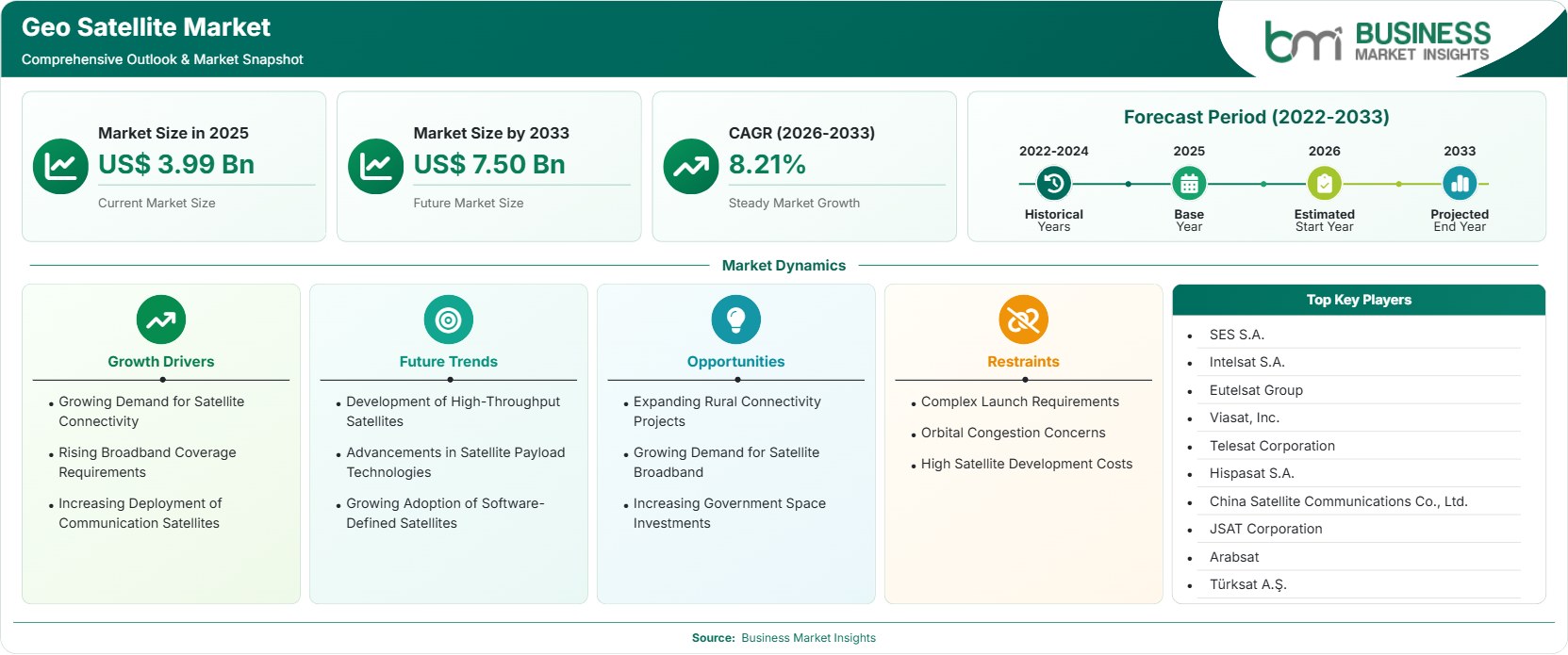
The GEO Satellite Market size was valued at US$ 3.99 Billion in 2025 and is projected to reach US$ 7.50 Billion by 2033, growing at a CAGR of 8.21% during 2026–2033, supported by satellite broadband demand, resilient communications, government programs, multi-orbit architectures, and expanding defense connectivity requirements.

Report Coverage
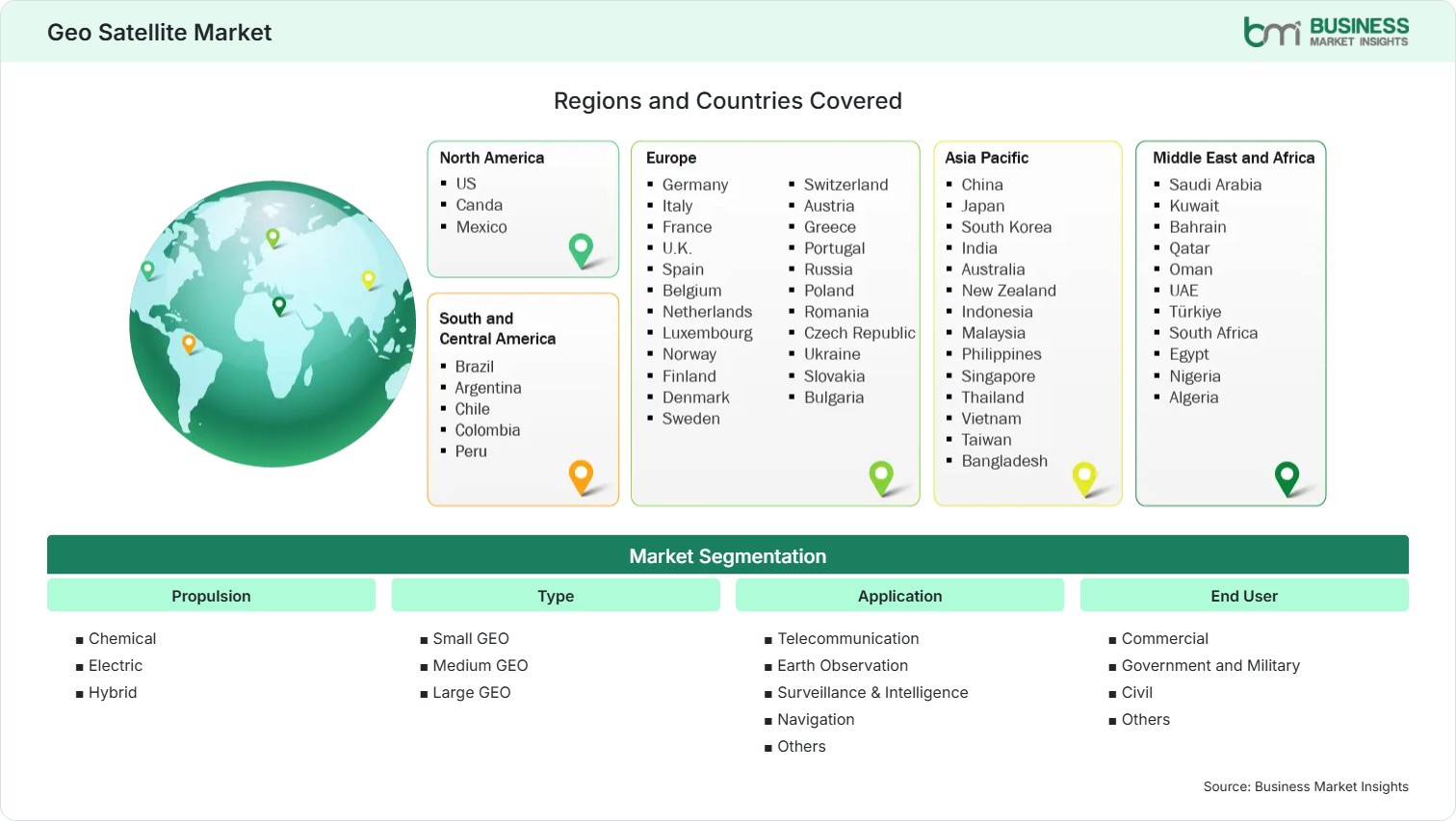
  • Propulsion: Chemical, Electric, Hybrid
  • Type: Small GEO , Medium GEO , Large GEO
  • Application: Telecommunication, Earth Observation, Surveillance & Intelligence, Navigation, Others
  • End User: Commercial, Government and Military, Civil, Others
US$ 3.99 Bn Market size in 2025
US$ 7.50 Bn Market Size by 2033
8.21% CAGR, 2026 - 2033
2026-2033 Forecast Period

AI Overview

Geo Satellite Market Summary

  • North America Region: North America holds a 28%–31% share in 2025, growing at a 7.4%–7.9% CAGR during 2026–2033, influenced by defense SATCOM procurement, broadband modernization, spectrum optimization, commercial connectivity demand, and resilient communications investments. The US market is expanding at a 7.5%–8.0% CAGR, supported by military connectivity modernization, high-throughput satellite capacity, and commercial-government partnerships.
  • Fastest Growing Region: Asia Pacific holds a 31%–35% share in 2025 and is advancing at a 9.0%–9.6% CAGR, driven by broadband expansion, maritime connectivity, national satellite programs, digital inclusion initiatives, defense modernization, and growing demand across geographically dispersed populations.
  • Leading Segment: Telecommunication holds a 58%–62% share in 2025 and records a 7.8%–8.3% CAGR, supported by broadband backhaul, enterprise connectivity, mobility services, broadcasting requirements, network resilience, and increasing integration between satellite and terrestrial communications infrastructure.
  • High Growth Segment: Government and Military represents a 22%–26% share in 2025 and is projected to advance at a 9.2%–9.8% CAGR, driven by secure communications, sovereign connectivity, contested-environment requirements, strategic autonomy, intelligence applications, and modernization of defense satellite infrastructure.
  • Key Market Opportunity: Multi-orbit integration creates an attractive opportunity as operators combine GEO capacity with LEO and MEO networks, improving resilience, coverage, latency management, service flexibility, and government connectivity procurement.
  • Major Market Players: SES S.A.; Intelsat S.A.; Eutelsat Group; Viasat, Inc.; Telesat Corporation; Hispasat S.A.; China Satellite Communications Co., Ltd.; JSAT Corporation; Arabsat; Türksat A.Ş.
Strategic Insights

Geo Satellite Market: Strategic Insights

Geo Satellite Market Strategic Framework
FREE PDF
Request your free sample
Request free sample
Stakeholder View

Key Takeaways

  • The value chain is moving toward integrated space-and-ground ecosystems, making satellite operators increasingly dependent on spacecraft manufacturers, launch providers, ground infrastructure suppliers, spectrum rights, software platforms, and specialized network-management capabilities.
  • Telecommunications remain the principal revenue pool, while government and military applications provide stronger incremental upside because secure connectivity requirements increasingly demand dedicated capacity, maneuverability, anti-jamming capabilities, and sovereign network control.
  • Software-defined payloads, electric propulsion, digital beamforming, automated network orchestration, and multi-orbit interoperability are changing spacecraft economics by enabling capacity to be reassigned according to geography, traffic conditions, and mission priorities.
  • Asia Pacific provides a compelling investment case because broadband gaps, archipelagic geography, maritime traffic, national security requirements, and government-backed space programs create simultaneous demand across commercial and institutional customers.
  • Investment is increasingly directed toward consolidation, constellation modernization, spectrum repositioning, and hybrid architectures. SES’s acquisition of Intelsat and subsequent integration strategy illustrate the strategic value placed on scale and multi-orbit capability.
Geographic Outlook

Geo Satellite Market Regional Highlights

North America GEO Satellite Market

North America represents a 28%–31% share in 2025 and is projected to expand at a 7.4%–7.9% CAGR through 2033. GEO Satellite Market share is supported by defense procurement, enterprise connectivity, broadcasting, aviation communications, and spectrum restructuring. The United States remains the dominant national contributor because government agencies and commercial operators maintain substantial satellite infrastructure. Canada contributes through broadband, government connectivity, and Arctic communications requirements.

  • Defense agencies are prioritizing resilient SATCOM, protected communications, and flexible capacity, strengthening demand for advanced GEO platforms and associated ground infrastructure.
  • Spectrum restructuring is creating financial and strategic incentives for operators to optimize orbital assets while supporting terrestrial wireless expansion and future network capacity.
  • Aviation, maritime, and enterprise users increasingly require continuous connectivity, encouraging operators to combine GEO coverage with complementary multi-orbit services.
  • Software-defined payloads and digital ground systems are improving capacity utilization, allowing operators to allocate bandwidth dynamically across customer groups and geographic markets.

US GEO Satellite Market

The United States accounts for 70%–74% of North American share in 2025 and records a 7.5%–8.0% CAGR during 2026–2033. GEO Satellite Market share reflects substantial defense, communications, aviation, and government demand. Federal procurement is strengthening the strategic role of commercial satellite operators in secure connectivity. Commercial operators are also investing in high-throughput capacity and multi-orbit services. US-based innovation remains influential in satellite payload design, ground systems, spectrum management, and network automation, supporting sustained technology leadership.

  • Military communications modernization is accelerating demand for maneuverable and resilient GEO architectures. Viasat’s 2026 PTS-G production award demonstrates continued procurement of smaller, agile GEO satellites for protected tactical communications.
  • Commercial broadband providers are increasing capacity over underserved regions, while satellite operators increasingly integrate GEO services with lower-orbit networks to improve responsiveness and resilience.

Europe GEO Satellite Market

Europe holds a 22%–25% share in 2025 and is advancing at an 8.0%–8.5% CAGR. GEO Satellite Market share benefits from secure communications programs, broadcasting, mobility connectivity, and European strategic-autonomy objectives. France, Germany, Spain, and Luxembourg remain important market contributors. Spain demonstrates strong government and commercial participation through Hispasat, while France is strengthening sovereign satellite capabilities. The region’s growth is increasingly linked to secure multi-orbit connectivity, public procurement, and European space-industry coordination.

  • European governments are increasing emphasis on sovereign connectivity and secure communications as geopolitical conditions elevate the importance of independent satellite infrastructure.
  • France remains a major strategic market, with public participation in Eutelsat strengthening the operator’s financial capacity and supporting European communications autonomy.
  • Spain provides an important growth platform through government-backed communications infrastructure and participation in European satellite connectivity initiatives.
  • European operators are also investing in optical ground infrastructure and advanced satellite networking to improve secure data transmission and reduce dependence on legacy architectures.

Asia Pacific GEO Satellite Market

Asia Pacific commands a 31%–35% share in 2025 and records the fastest regional expansion at a 9.0%–9.6% CAGR. GEO Satellite Market share is supported by broadband gaps, maritime connectivity, remote geography, defense modernization, and national space strategies. China, Japan, India, South Korea, and Australia are major contributors. Japan has a mature commercial satellite ecosystem, while India and Southeast Asian markets offer stronger incremental connectivity opportunities. Government programs increasingly complement private-sector capacity deployment.

  • Broadband expansion across island and rural economies is strengthening demand for wide-area satellite coverage where terrestrial fiber deployment remains commercially difficult.
  • Maritime connectivity represents a substantial opportunity because Asia Pacific contains major shipping corridors and geographically dispersed island populations requiring reliable communications.
  • National satellite programs are increasing local procurement, creating opportunities for domestic operators, ground-system suppliers, payload developers, and network-management providers.
  • Defense modernization is increasing demand for secure communications and surveillance capabilities, particularly across countries with expanding maritime security requirements.

Rest of World GEO Satellite Market

South and Central America represent a growing portion of demand as rural broadband, enterprise communications, maritime connectivity, and government networks expand. Brazil, Mexico, Chile, and Colombia provide strong commercial opportunities, while remote communities create persistent demand for satellite-enabled connectivity. GEO Satellite Market share across the broader Rest of World region remains diversified because individual national markets are smaller than North America, Europe, or Asia Pacific.

  • South American operators are increasing ground infrastructure and satellite connectivity services, with equatorial locations offering strategic value for regional communications networks.
  • Middle Eastern governments are investing in sovereign digital infrastructure, creating demand for secure satellite capacity, government communications, and resilient network architectures.
  • African markets offer strong structural opportunities where terrestrial infrastructure gaps make satellite connectivity economically relevant for remote communities and institutional users.
  • Turkiye and the Gulf region provide opportunities through national satellite programs, defense communications, broadcasting, and government connectivity initiatives.
Global Market Geography
FREE PDF
Request your free sample
Request free sample
Segment Analysis

Geo Satellite Market Segmentation

Propulsion

Propulsion technology influences spacecraft lifetime, station keeping, payload flexibility, and total mission economics. Propulsion represents a critical technology layer as operators seek longer operational periods and efficient orbital control. Chemical propulsion remains established, while electric propulsion gains adoption through efficiency advantages. The segment holds a 100%–100% structural share and a 8.21% CAGR as propulsion requirements remain integral to every spacecraft configuration.

  • Chemical: Chemical propulsion provides high thrust for launch-phase maneuvers, orbit raising, and rapid attitude corrections, supporting established spacecraft architectures requiring immediate maneuvering capability.
  • Electric: Electric propulsion offers high specific impulse and reduced propellant consumption, improving spacecraft mass efficiency and supporting longer operational lifetimes and flexible orbital management.
  • Hybrid: Hybrid propulsion combines high-thrust chemical systems with efficient electric propulsion, balancing maneuverability and fuel economy for missions requiring diverse orbital operations.

Type

Spacecraft size influences payload capacity, launch economics, power availability, and mission complexity. Small GEO platforms are gaining attention for distributed architectures, while medium and large spacecraft remain important for high-capacity missions. The Type segment maintains a 100%–100% structural share and follows an 8.21% CAGR, reflecting continued diversification in spacecraft design and mission requirements across commercial and institutional customers.

  • Small GEO (<2000 kg): Small GEO satellites enable lower-cost deployment, faster production cycles, and distributed capacity, making them increasingly relevant for defense, regional communications, and flexible constellation strategies.
  • Medium GEO (2000-4000 kg): Medium GEO platforms balance payload capacity and launch economics, supporting broadband, broadcasting, enterprise connectivity, and government missions requiring substantial regional coverage.
  • Large GEO (>4000 kg): Large GEO satellites provide high power, extensive payload capacity, and broad coverage, supporting high-throughput communications and complex missions requiring substantial onboard resources.

Application

Telecommunication remains the leading application, supported by broadband, broadcasting, enterprise networks, and mobile connectivity. The application segment is led by Telecommunication at 58%–62% share in 2025 with a 7.8%–8.3% CAGR. GEO Satellite Market scope is expanding as satellite capacity becomes integrated with terrestrial networks and government communications systems, while observation and intelligence applications diversify revenue opportunities.

  • Telecommunication: Telecommunication dominates demand through broadband backhaul, broadcasting, enterprise networking, mobility connectivity, and resilient communications services requiring broad geographic coverage.
  • Earth Observation: Earth Observation uses satellite platforms for environmental monitoring, agriculture, mapping, disaster management, infrastructure assessment, and climate-related intelligence.
  • Surveillance & Intelligence: Surveillance & Intelligence applications support defense, border monitoring, maritime awareness, strategic intelligence, and secure government missions requiring persistent wide-area coverage.
  • Navigation: Navigation applications support positioning, timing, and augmentation services, strengthening satellite infrastructure requirements for transportation, logistics, defense, and critical infrastructure.

End User

Commercial customers remain central to capacity utilization, while government and military users provide high-value demand for secure and resilient connectivity. Government and Military represent 22%–26% share in 2025 and is advancing at a 9.2%–9.8% CAGR. GEO Satellite Market trends increasingly favor institutional procurement where mission assurance, sovereignty, encryption, and continuity requirements justify specialized capacity and network configurations.

  • Commercial: Commercial users include telecom operators, broadcasters, enterprises, aviation providers, maritime companies, and connectivity platforms requiring scalable satellite bandwidth and service continuity.
  • Government and Military: Government and Military users require protected communications, surveillance support, strategic connectivity, anti-jamming capabilities, and resilient networks for defense and public-sector operations.
  • Civil: Civil users encompass public institutions, emergency services, research organizations, and infrastructure operators requiring reliable satellite communications and information services.
Market Forces

Geo Satellite Market Dynamics

Key Market Drivers

Growing Demand for Satellite Connectivity

Growing digital dependence is increasing demand for satellite connectivity across telecom, mobility, government, and enterprise networks. GEO Satellite Market growth can be attributed to the GEO satellites as they offer constant regional coverage and efficient multicast abilities. As a result, operators are keeping their GEO capabilities intact while complementing it with other low orbit satellite networks. There is a growing trend towards flexible capacity, software-defined payload, and network orchestration in the market. With these features, operators can adapt to different traffic flows without overhauling the whole spacecraft system.

Rising Broadband Coverage Requirements

Broadband coverage requirements are expanding as governments and telecommunications providers seek to reduce connectivity gaps. Satellite technologies have an advantage in terms of being able to provide coverage in remote regions without the need for massive constructions on the earth’s surface, thereby becoming pertinent to applications in the countryside, sea, air, and even emergencies. In this regard, the GEO Satellite Market trend is facilitated by the demand for high-throughput regional capacity and reliable backhaul. There is now an increase in the development of hybrid systems in which the coverage provided by GEO is combined with LEO and MEO technologies.

Increasing Deployment of Communication Satellites

Communication satellite deployment is evolving toward higher throughput, flexible payloads, smaller spacecraft, and diversified orbital architectures. Satellite operators have now been found to focus on those satellites which are capable of serving a variety of customers and zones during their entire lifetime. This requirement of versatility is driving the need for digital payloads, electric propulsion, efficient power generation, and automation in ground stations. The Geo Satellite Market trends are therefore changing from the fixed capacity transponder systems to the dynamic connectivity systems.

Key Market Opportunities

Expanding Rural Connectivity Projects

Rural connectivity programs provide a substantial opportunity because terrestrial network deployment remains economically challenging across sparsely populated and geographically isolated areas. Satellite operators will be able to offer coverage without investing in extensive fiber network build-out, while hybrid networks will enable integration of satellite services into terrestrial mobile networks. This potential opportunity will become even more important for developing nations where the government is striving towards digital inclusion. The GEO Satellite Market Forecasts will become even stronger with the help of public purchasing, universal service initiatives, and collaboration between satellite operators and telecom operators.

Growing Demand for Satellite Broadband

Satellite broadband demand is broadening beyond conventional fixed broadband into aviation, maritime, enterprise, emergency response, and mobile connectivity. Commercially, the challenge comes in combining GEO capabilities with other orbiting capabilities while ensuring a high level of service. There could be more opportunities for monetization of the capabilities offered by orbital constellations by utilizing flexible capacity management and direct partnerships with telecoms firms. Higher bandwidth demands create room for investment in new and improved ground stations and digital payloads. There is strategic potential where coverage and reliability are valued along with low latency. Multi-orbit approaches will ensure that GEO capabilities do not have to compete only on latency.

Increasing Government Space Investments

Government space investments are creating opportunities for satellite operators through secure communications, strategic autonomy, surveillance, disaster response, and national connectivity programs. Public sector procurement can offer long-term contracts as well as reliable capacity requirements, making satellite infrastructure providers aware of investments. The European efforts prove the rise of sovereign communication policies, and US defense procurement indicates the rising use of commercial satellite capabilities for secure communication. It also includes the potential for emerging markets that have their own national space strategies and require local governance of their important connectivity infrastructure. Satellite operators that have experience with space-based assets, terrestrial infrastructure, cybersecurity, and international regulations are best suited to enter.

Market Restraints and Challenges

Complex Launch Requirements

Factor: Launching GEO spacecraft requires sophisticated launch vehicles, orbital insertion procedures, regulatory coordination, insurance coverage, and precise spacecraft commissioning. Impact: Failure or delayed launches will postpone earning revenues, raise costs, affect planning, and even delay replacement cycles due to aging satellites. Even though the cost-effectiveness of reusable space launches is improving through advances in technology, missions to geosynchronous orbits still need unique techniques for transferring into those orbits and extensive tests post-launch. Electric propulsion can reduce propellant requirements but generally increases the time required for final orbit raising.

Orbital Congestion Concerns

Factor: Increasing spacecraft populations and debris accumulation are raising the operational complexity of satellite missions and increasing the importance of collision avoidance, tracking, and end-of-life disposal. Impact: Higher monitoring standards, more maneuver coordination, and potential increases in regulatory costs and insurance are all challenges faced by operators. This makes it even more essential to have responsible space management and space traffic services. The Geo Satellite Market analysis has to take into account orbital sustainability when fleet planning, spacecraft design, disposal procedures, and long-term asset management.

Company Analysis

Competitive Landscape

GEO Satellite Market analysis indicates that competition is shifting from conventional satellite capacity toward integrated connectivity platforms combining orbital assets, ground networks, managed services, cybersecurity, and government solutions.

Company Name

Overview

Products and Services relevant to this market

SES S.A.

Global satellite operator with extensive GEO and MEO capabilities, serving commercial, government, mobility, and connectivity customers.

GEO satellite capacity, O3b mPOWER services, multi-orbit connectivity, government SATCOM, managed networks, and mobility connectivity.

Intelsat S.A.

Major satellite communications operator with extensive GEO infrastructure and broad enterprise, media, mobility, and government relationships.

GEO broadband, media distribution, enterprise connectivity, government SATCOM, mobility services, and managed network solutions.

Eutelsat Group

European satellite operator combining GEO and LEO capabilities through its broader multi-orbit connectivity strategy.

GEO communications, OneWeb LEO connectivity, broadband, enterprise services, government communications, and network infrastructure.

Viasat, Inc.

Integrated satellite communications company operating high-capacity satellites and advanced government connectivity systems.

GEO broadband, ViaSat-3 systems, defense SATCOM, mobility connectivity, satellite terminals, and managed communications.

Telesat Corporation

Canadian satellite operator focused on GEO services and development of advanced satellite connectivity infrastructure.

GEO capacity, enterprise connectivity, government services, managed networks, and satellite communications solutions.

Hispasat S.A.

Spanish satellite operator serving Europe, the Americas, government institutions, and commercial communications markets.

GEO broadband, audiovisual distribution, corporate communications, government connectivity, and satellite capacity services.

China Satellite Communications Co., Ltd.

Major Chinese satellite communications operator supporting national and commercial connectivity requirements.

GEO satellite communications, broadcasting, broadband, government communications, and satellite network services.

JSAT Corporation

Japanese satellite operator serving telecommunications, broadcasting, mobility, government, and regional Asian markets.

GEO satellite capacity, broadcasting, maritime connectivity, enterprise services, and government communications.

Arabsat

Arab regional satellite operator providing communications infrastructure across the Middle East, Africa, and surrounding markets.

GEO broadcasting, broadband, enterprise communications, government connectivity, and satellite capacity services.

Türksat A.Ş.

Turkish satellite operator supporting national communications, broadcasting, broadband, and strategic connectivity services.

GEO satellite communications, broadcasting, broadband, government services, and satellite network infrastructure.

Trust & Transparency

Research Methodology

The market analysis combines proprietary research with secondary data from government agencies, company disclosures, regulatory filings, industry databases and expert interviews. Market estimates are validated through data triangulation, cross-market benchmarking and analyst review.

View Full Research Methodology

Questions Answered

Frequently Asked Questions

Why is this GEO Satellite Market Report useful for strategic planning?

The report provides structured intelligence on regional demand, propulsion technologies, spacecraft categories, competitive positioning, investment drivers, technology developments, and constraints influencing satellite infrastructure decisions.

How is orbital congestion affecting satellite investment decisions?

Operators must increasingly incorporate space sustainability requirements into satellite design, insurance planning, fleet management, and operational budgets.

Why is spectrum management strategically important for satellite operators?

Spectrum repurposing can create financial opportunities for established operators while requiring coordinated migration, regulatory compliance, and efficient use of remaining satellite resources.

How are defense requirements changing GEO satellite design?

Defense customers increasingly require maneuverability, anti-jamming protection, secure payloads, resilient ground infrastructure, and rapid capacity allocation.

What role will multi-orbit networks play in future satellite connectivity?

Multi-orbit networks will allow operators to combine GEO’s wide-area coverage with lower-orbit systems offering lower latency and additional capacity.

Access the Full Geo Satellite Market Report

Get segment-level forecasts, regional estimates, competitive benchmarking, company profiles and downloadable Excel datasets.

Access the full Geo Satellite Market Report
350 pages PDF & Excel | 2026-08-21