
Satellite-Based Augmentation System Market Outlook: Size, Share, Trends, Growth Analysis, Competitive Landscape & Forecast, 2026-2033

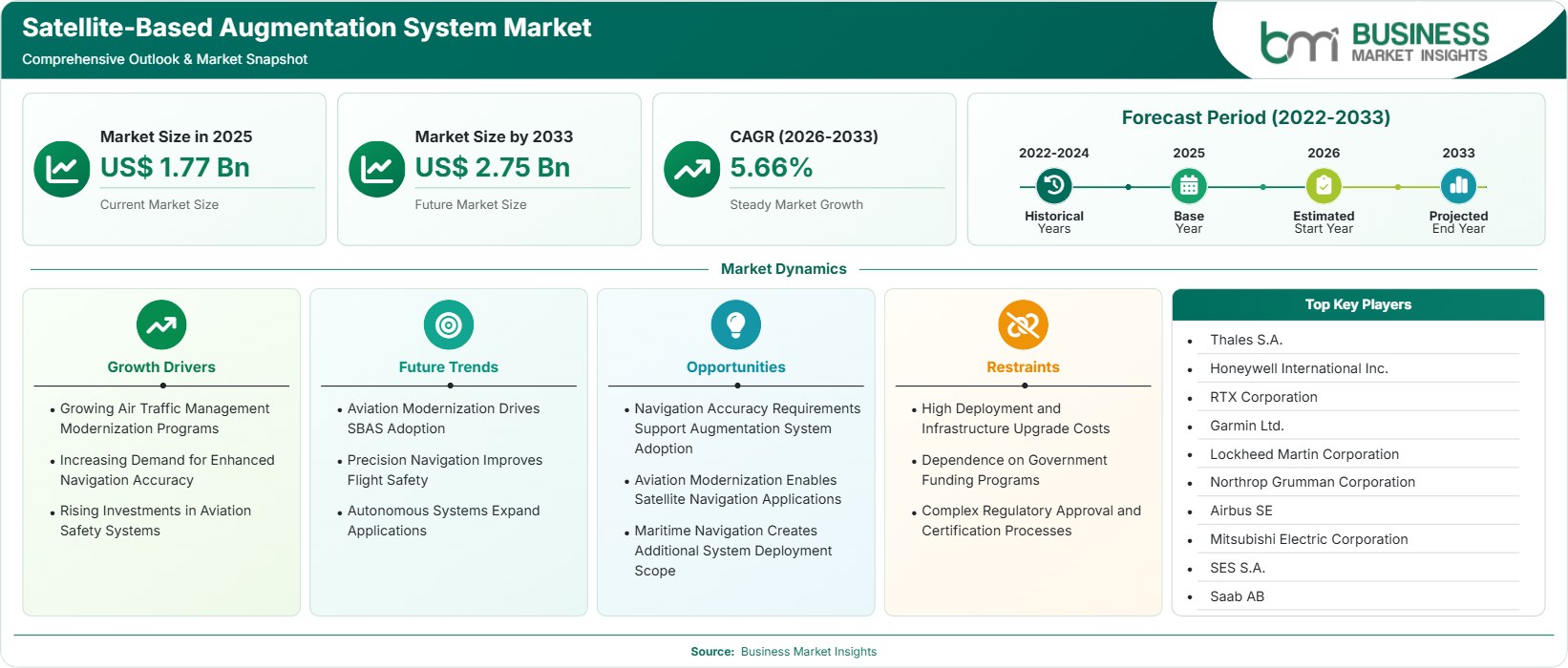
The Satellite-Based Augmentation System Market size was valued at US$ 1.77 Billion in 2025 and is projected to reach US$ 2.75 Billion by 2033, growing at a CAGR of 5.66% during 2026–2033, supported by aviation navigation modernization, increasing GNSS accuracy requirements, autonomous mobility applications, and expanding maritime safety infrastructure.

Report Coverage
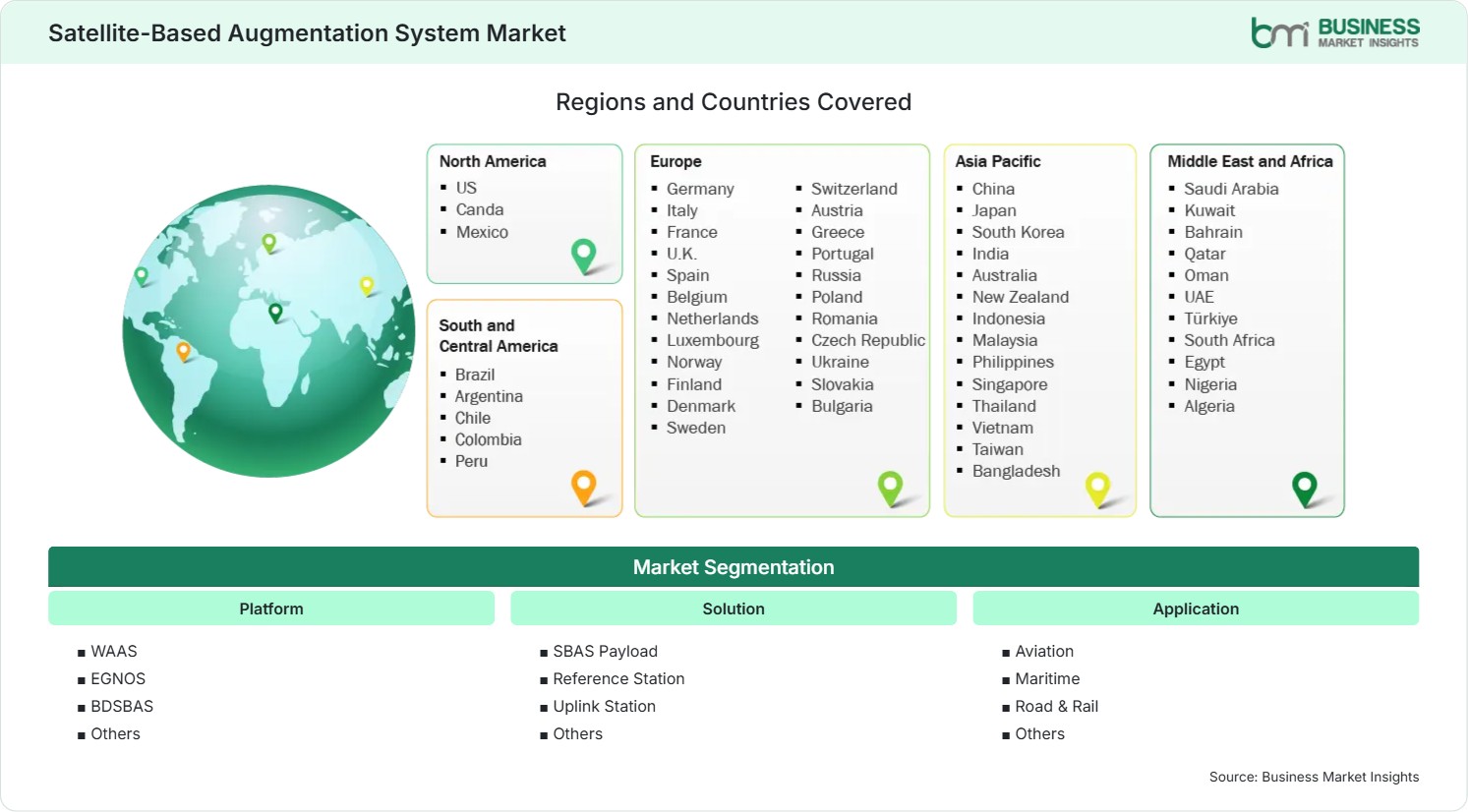
  • Platform: WAAS, EGNOS, BDSBAS, Others
  • Solution: SBAS Payload, Reference Station, Uplink Station, Others
  • Application: Aviation, Maritime, Road & Rail, Others
US$ 1.77 Bn Market size in 2025
US$ 2.75 Bn Market Size by 2033
5.66% CAGR, 2026 - 2033
2026-2033 Forecast Period

AI Overview

Satellite-Based Augmentation System Market Summary

  • North America Region: North America holds a market share of 36%–39% in 2025, growing at a CAGR of 5.0%–5.4% during 2026–2033. Demand is driven by WAAS upgrades, aviation precision approaches, defense navigation programs, unmanned systems deployment, geospatial applications, and growing maritime route optimization investments across commercial transportation networks globally. US market remains dominant through FAA-backed WAAS modernization programs and commercial aviation navigation upgrades, expanding at 5.1%–5.5% CAGR.
  • Fastest Growing Region: Asia Pacific accounts for 26%–29% share in 2025 and advances at 6.8%–7.3% CAGR during 2026–2033. Growth benefits from airport expansion programs, regional SBAS deployments, smart mobility initiatives, maritime infrastructure enhancement, and rising demand for precision positioning across transportation and logistics ecosystems.
  • Leading Segment: Aviation commands 44%–47% share in 2025 and expands at 5.8%–6.2% CAGR through 2033. Adoption is supported by navigation safety requirements, increasing LPV procedures, operational efficiency targets, regulatory compliance initiatives, and modernization of airport infrastructure across developed and emerging economies.
  • High Growth Segment: BDSBAS represents 18%–21% share in 2025 and records 7.2%–7.8% CAGR during 2026–2033. Expansion is encouraged by BeiDou ecosystem growth, regional navigation independence objectives, transportation digitization, infrastructure investments, and broader precision-services adoption throughout Asian markets and adjacent regions.
  • Key Market Opportunity: Commercial deployment of high-precision augmentation services for autonomous mobility, digital rail systems, intelligent ports, and advanced logistics creates scalable recurring revenue opportunities beyond traditional aviation-focused demand environments worldwide.
  • Major Market Players: Thales S.A., Honeywell International Inc., RTX Corporation, Garmin Ltd., Lockheed Martin Corporation, Northrop Grumman Corporation, Airbus SE, Mitsubishi Electric Corporation, SES S.A., and Saab AB.
Strategic Insights

Satellite-Based Augmentation System Market: Strategic Insights

Satellite-Based Augmentation System Market Strategic Framework
FREE PDF
Request your free sample
Request free sample
Stakeholder View

Key Takeaways

  • The industry value chain increasingly combines satellite operators, augmentation service providers, avionics manufacturers, geospatial software vendors, and infrastructure agencies, creating a highly collaborative ecosystem with long-term service contracts.
  • Aviation remains the largest revenue contributor, while road and rail digitization presents the strongest incremental opportunity as intelligent transportation systems require reliable positioning accuracy and integrity.
  • Innovation is shifting toward multi-frequency, multi-constellation augmentation architectures capable of supporting GPS, Galileo, BeiDou, and regional navigation systems within a unified framework.
  • Asia Pacific offers a compelling investment case due to airport construction pipelines, expanding logistics corridors, and national navigation sovereignty initiatives supporting local augmentation networks.
  • Strategic partnerships between aerospace firms, navigation technology developers, and satellite operators are becoming more common as organizations seek broader service portfolios and regional coverage.
  • Future competitiveness will depend on cybersecurity resilience, service continuity, and integration with autonomous mobility ecosystems rather than accuracy improvements alone.
Geographic Outlook

Satellite-Based Augmentation System Market Regional Highlights

North America Satellite-Based Augmentation System Market

North America accounts for approximately 36%–39% of global revenue in 2025 and expands at a 5.0%–5.4% CAGR through 2033. The region benefits from mature WAAS infrastructure, advanced aviation networks, widespread adoption of precision approaches, and strong defense expenditures. The Satellite-Based Augmentation System Market share remains highest in this region due to established regulatory standards and broad commercial aviation utilization. Continued modernization of transportation infrastructure and geospatial services sustains consistent demand for augmentation technologies.

  • WAAS modernization programs support broader operational coverage and enhanced navigation accuracy for commercial and general aviation users.
  • Defense agencies increasingly deploy resilient positioning solutions to strengthen operational continuity and navigation assurance capabilities.
  • Growing unmanned aerial vehicle operations require high-integrity navigation correction services for safe airspace integration.
  • Precision agriculture and surveying applications contribute additional demand beyond aviation-centered deployments.
  • Maritime route optimization initiatives support wider adoption of satellite-assisted navigation services.

US Satellite-Based Augmentation System Market

The United States represents 74%–78% of North American Satellite-Based Augmentation System Market revenue and grows at a 5.1%–5.5% CAGR through 2033. FAA support for WAAS upgrades, extensive aviation infrastructure, and sophisticated geospatial applications reinforce demand. Strong investments in air traffic modernization and navigation safety technologies maintain leadership in deployment scale and operational maturity across global augmentation environments.

  • Extensive airport networks continue adopting advanced precision navigation procedures enabled through augmentation services.
  • Commercial drone regulations encourage investment in reliable positioning and integrity monitoring solutions.
  • Defense modernization programs prioritize alternative positioning technologies for resilient navigation environments.
  • Geospatial and surveying industries increasingly utilize augmentation-supported precision applications.

Europe Satellite-Based Augmentation System Market

Europe captures 28%–31% Satellite-Based Augmentation System Market share in 2025 and records a 5.4%–5.8% CAGR during 2026–2033. EGNOS remains central to regional deployment strategies, supporting aviation safety and multimodal transportation initiatives. Germany and France lead revenue generation, while Eastern European markets register faster adoption. Regulatory alignment and digital transportation programs strengthen commercial utilization across aviation, rail, and maritime sectors.

  • EGNOS modernization initiatives improve positioning accuracy and support broader transport applications.
  • Germany leads regional revenue generation through aerospace capabilities and advanced navigation infrastructure.
  • Poland and Romania demonstrate stronger growth trajectories, exceeding regional averages through infrastructure investments.
  • Rail digitization programs create new commercial opportunities for augmentation-enabled positioning.
  • Cross-border transport integration encourages harmonized navigation technology deployment.

Asia Pacific Satellite-Based Augmentation System Market

Asia Pacific represents 26%–29% share in 2025 and is the fastest expanding region with a 6.8%–7.3% CAGR. China, Japan, India, and South Korea account for the majority of deployments. Satellite-Based Augmentation System Market growth is supported by airport expansion, BDSBAS development, logistics modernization, and smart transportation investments. Growing navigation sovereignty objectives further strengthen regional adoption momentum.

  • China remains the leading revenue contributor through BeiDou ecosystem development initiatives.
  • India benefits from navigation infrastructure expansion and transportation modernization priorities.
  • Southeast Asian aviation growth supports wider implementation of satellite navigation technologies.
  • Maritime logistics operators increasingly use augmentation services for route efficiency improvements.
  • Smart city and intelligent mobility investments generate new commercial positioning requirements.

Rest of World Satellite-Based Augmentation System Market

Rest of World holds 8%–11% share in 2025 and advances at a 5.8%–6.3% CAGR through 2033. South America benefits from aviation connectivity programs and transportation upgrades. Middle East and Africa markets gain traction through airport investments, logistics expansion, and digital infrastructure projects. Brazil and the UAE lead adoption, while Saudi Arabia and South Africa exhibit higher growth potential.

  • Brazil remains the largest South American market due to aviation modernization priorities.
  • UAE investments in smart mobility and aviation create strong augmentation demand.
  • Saudi Arabia’s infrastructure transformation programs support navigation technology deployment.
  • Logistics corridor development increases positioning accuracy requirements across transportation networks.
  • Regional governments continue evaluating augmentation services for public infrastructure optimization.
Global Market Geography
FREE PDF
Request your free sample
Request free sample
Segment Analysis

Satellite-Based Augmentation System Market Segmentation

Platform

The Platform segment accounts for approximately 34%–37% market share in 2025 and is expected to grow at a 5.9%–6.3% CAGR. The Satellite-Based Augmentation System Market scope continues expanding through deployment of regional augmentation architectures supporting aviation, transportation, and geospatial industries. Investments in next-generation systems and multi-constellation compatibility support long-term adoption.

  • WAAS: Widely adopted across North America due to aviation precision approach requirements, mature infrastructure, and strong regulatory support for safety-critical navigation operations.
  • EGNOS: Supports aviation and transportation modernization across Europe through enhanced integrity monitoring and regional correction capabilities.
  • BDSBAS: Benefits from broader BeiDou utilization, national navigation initiatives, and increasing deployment across transportation and infrastructure sectors.

Solution

The Solution segment contributes 31%–34% market share in 2025 and advances at a 5.5%–5.9% CAGR. Demand is driven by infrastructure upgrades, service reliability requirements, and integration with evolving augmentation architectures. Continuous expansion of reference networks and communication systems underpins segment performance.

  • SBAS Payload: Enables transmission of correction and integrity information through geostationary satellites supporting regional service coverage.
  • Reference Station: Forms the foundation of monitoring networks by collecting navigation data used to generate precise corrections.
  • Uplink Station: Facilitates communication between ground infrastructure and satellites, ensuring timely delivery of augmentation messages.

Application

The Application segment is led by aviation, holding 44%–47% share in 2025 and growing at a 5.8%–6.2% CAGR. The Satellite-Based Augmentation System Market trends indicate increasing diversification toward maritime, rail, and intelligent transportation systems as high-accuracy positioning becomes essential for operational efficiency and safety.

  • Aviation: Remains the largest adoption area due to safety regulations, precision approaches, and ongoing air traffic modernization programs.
  • Maritime: Gains momentum through port optimization initiatives, vessel tracking technologies, and navigation efficiency requirements.
  • Road & Rail: Expands rapidly as intelligent transportation networks demand reliable positioning and route management capabilities.
Market Forces

Satellite-Based Augmentation System Market Dynamics

Key Market Drivers

Expansion of Aviation Navigation Modernization Programs

Civil aviation authorities worldwide continue prioritizing satellite navigation modernization. Greater adoption of LPV techniques, efficiency objectives at airports and in airspace management, and other related improvements ensure continued augmentation service demand. International aviation bodies advocate for performance-based navigation standards that need improved integrity of position information. Commercial aviation companies are concentrating on fuel savings and flight path planning, adding to the importance of navigation systems. The increasing number of flights with passengers and cargo justifies the necessity for infrastructure development. All of these elements contribute to dependence on augmentation systems and further procurement of avionics and other infrastructure for developed and developing aviation regions.

Rising Demand for High-Integrity Positioning Across Transport Networks

Transportation operators are increasingly adopting precision navigation tools to improve safety, efficiency, and operational reliability. Maritime agencies employ state-of-the-art navigation techniques to manage routes and decrease dangers. Railways modernization projects make use of digital signaling with location-based technologies. The greater use of integrated logistics ecosystems leads to a higher reliance on positioning services. Satellites have integrity and continuity benefits that can be used for mission-critical transportation purposes. The increased automation and integration of transportation systems lead to a growing need for correction services. All these structural developments contribute to further technology deployment.

Growth of Multi-Constellation GNSS Ecosystems

The availability of GPS, Galileo, BeiDou, and regional navigation systems is transforming positioning architectures. Organizations are beginning to look for augmenting devices that would fit into several constellations so as to increase their resiliency and reliability. Manufacturers of devices are now working on highly sophisticated receivers that can receive multiple signals at the same time. The greater level of interoperability enhances the system’s performance in harsh environments and helps meet new application requirements, which call for continuous coverage. More industry investment is being made towards developing integrated systems of augmentations that will work for all sorts of industries.

Key Market Opportunities

Autonomous Mobility and Intelligent Transport Integration

Accuracy in positioning is of great importance to self-driving cars, connected transportation, and logistics. It can provide integrity information that cannot be gained through traditional navigation methods. Governments are starting to become more favorable towards intelligent transportation schemes that involve real-time navigation services. Integration opportunities exist in the areas of transportation of passengers, cargo management, smart infrastructure, and automation of processes. Business models are under evaluation by investors. Long-term Satellite-Based Augmentation System Market Forecasts continue to be bolstered through the implementation of digital mobility ecosystems that need accurate navigation data for many applications in the commercial and government sectors.

Commercial Augmentation Services Beyond Aviation

Historically concentrated within aviation, augmentation technologies now address growing needs in agriculture, surveying, mining, utilities, and infrastructure management. Positioning accuracy is highly valued in the location intelligence solutions organizations need. Providers can provide services that are designed for certain industries according to their needs. The digital transformation initiatives in various sectors create an increasing demand for such solutions. Subscription-based models make it easier for providers to see how much money they make and also for customers to deploy them.

Infrastructure Development Across Emerging Economies

Large-scale transportation modernization initiatives across Asia, the Middle East, and Latin America are driving investment in advanced navigation systems. Resilient positioning infrastructure has become more valued by governments as a means of helping them meet their economic development targets. Infrastructure development projects like airport construction, logistics network development, and smart city initiatives have provided favorable conditions for their deployment. Financing avenues through public-private partnerships have also made their implementation possible. Navigation sovereignty within regions has also helped facilitate its localized augmentation capability.

Market Restraints and Challenges

High Infrastructure Costs and Long Deployment Cycles

Factor: Establishing augmentation systems requires substantial capital investment across satellites, reference stations, communication networks, and operational facilities. Impact: High costs incurred at the initial stage will lead to delayed decision-making and will restrict implementation due to budget constraints. The government will need extensive planning, technical evaluation, and regulatory work before the implementation phase. Extended implementation timelines will delay the realization of revenues for the supplier and infrastructure provider. The financial constraint is very important, especially in developing countries, due to priorities.

Regulatory Complexity and Cybersecurity Risks

Factor: Navigation services supporting safety-critical applications operate within highly regulated environments requiring rigorous certification and performance verification. Impact: Compliance requirements might result in higher development expenses and delays in commercialization periods. On the other hand, reliance on digital infrastructure raises concerns about cyber risks, signal interference, and service interruptions. It is important to allocate resources permanently to increase resistance, monitor activities, and enhance security. Otherwise, there will be a negative impact on stakeholder trust and the industry's willingness to use technology.

Company Analysis

Competitive Landscape

The competitive environment is characterized by technology specialization, government partnerships, and long-duration infrastructure contracts. Recent Satellite-Based Augmentation System Market analysis indicates that avionics leaders, aerospace manufacturers, and satellite operators continue expanding capabilities through modernization programs and integrated navigation solutions.

Company Name

Overview

Products and Services relevant to this market

Thales S.A.

Global aerospace and defense provider with strong navigation and air traffic management capabilities.

GNSS augmentation solutions, avionics systems, navigation technologies, air traffic management platforms.

Honeywell International Inc.

Major avionics and aerospace systems supplier serving commercial and defense sectors.

WAAS-enabled avionics, navigation systems, flight management technologies, positioning solutions.

RTX Corporation

Aerospace and defense leader supporting advanced navigation infrastructure and communications.

Precision navigation systems, aerospace electronics, integrated positioning technologies.

Garmin Ltd.

Leading provider of navigation equipment across aviation and transportation markets.

WAAS-capable receivers, avionics products, navigation devices, geospatial solutions.

Lockheed Martin Corporation

Defense and aerospace company with satellite and mission-critical technology expertise.

Satellite systems, navigation infrastructure, defense positioning services.

Northrop Grumman Corporation

Advanced aerospace technology company supporting government navigation initiatives.

Navigation architectures, space systems, mission assurance technologies.

Airbus SE

Global aerospace manufacturer active in satellite and transportation technologies.

Satellite payloads, aerospace platforms, navigation integration solutions.

Mitsubishi Electric Corporation

Technology company involved in satellite and space infrastructure programs.

Satellite communication systems, positioning technologies, space electronics.

SES S.A.

Satellite operator supporting global communications and navigation ecosystems.

Satellite capacity, network connectivity, space-based service infrastructure.

Saab AB

Defense and aerospace specialist with transportation and navigation competencies.

Navigation support systems, surveillance technologies, transportation solutions.

Trust & Transparency

Research Methodology

The market analysis combines proprietary research with secondary data from government agencies, company disclosures, regulatory filings, industry databases and expert interviews. Market estimates are validated through data triangulation, cross-market benchmarking and analyst review.

View Full Research Methodology

Questions Answered

Frequently Asked Questions

What does this Satellite-Based Augmentation System Market Report help stakeholders understand?

It helps stakeholders evaluate regional demand patterns, competitive positioning, growth opportunities, segment performance, investment priorities, and long-term industry developments.

Which technologies are shaping future market development?

Multi-constellation GNSS integration, advanced integrity monitoring, autonomous mobility support, and cloud-enabled correction services are among the most influential technology developments.

How do augmentation systems improve GNSS performance?

They enhance accuracy, integrity, continuity, and availability by transmitting correction data and alert information that helps users identify potential navigation signal issues.

What factors make Asia Pacific the fastest-growing region?

Airport expansion, BeiDou ecosystem development, transportation modernization, smart mobility investments, and increasing demand for positioning accuracy are accelerating adoption throughout the region.

Which application generates the largest revenue in this industry?

Aviation remains the dominant application because augmentation systems are essential for precision approaches, navigation integrity, and regulatory compliance across commercial and general aviation operations worldwide.

Access the Full Satellite-Based Augmentation System Market Report

Get segment-level forecasts, regional estimates, competitive benchmarking, company profiles and downloadable Excel datasets.

Access the full Satellite-Based Augmentation System Market Report
350 pages PDF & Excel | 2026-09-04