
Satellite Launch Vehicle Market Outlook: Size, Share, Trends, Growth Analysis, Competitive Landscape & Forecast, 2026-2033

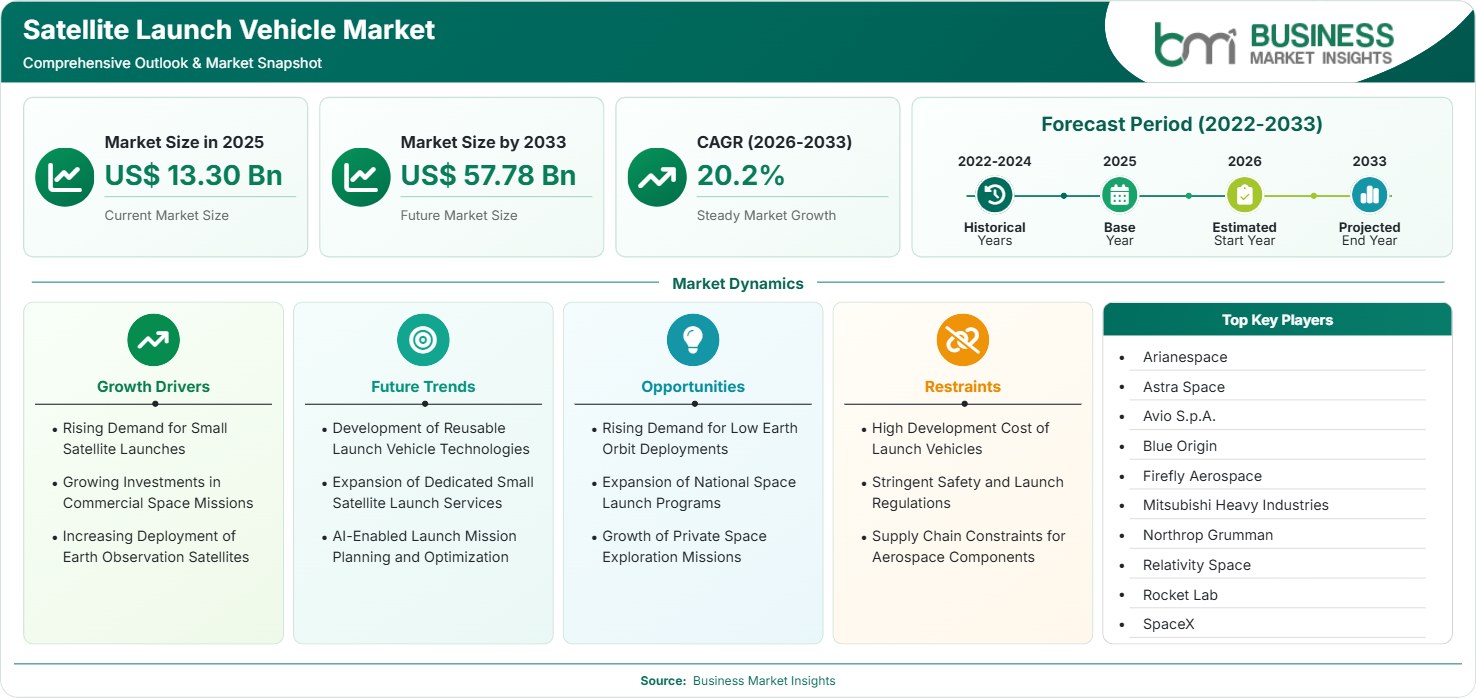
The Satellite Launch Vehicle Market size was valued at USD 13.30 Billion in 2025 and is projected to reach USD 57.78 Billion by 2033, growing at a CAGR of 20.2% during 2026–2033. Growth is driven by increasing satellite deployments, rising demand for low Earth orbit (LEO) constellations, growing investments in commercial space programs, expanding government space exploration initiatives, and advancements in reusable launch technologies.

Report Coverage
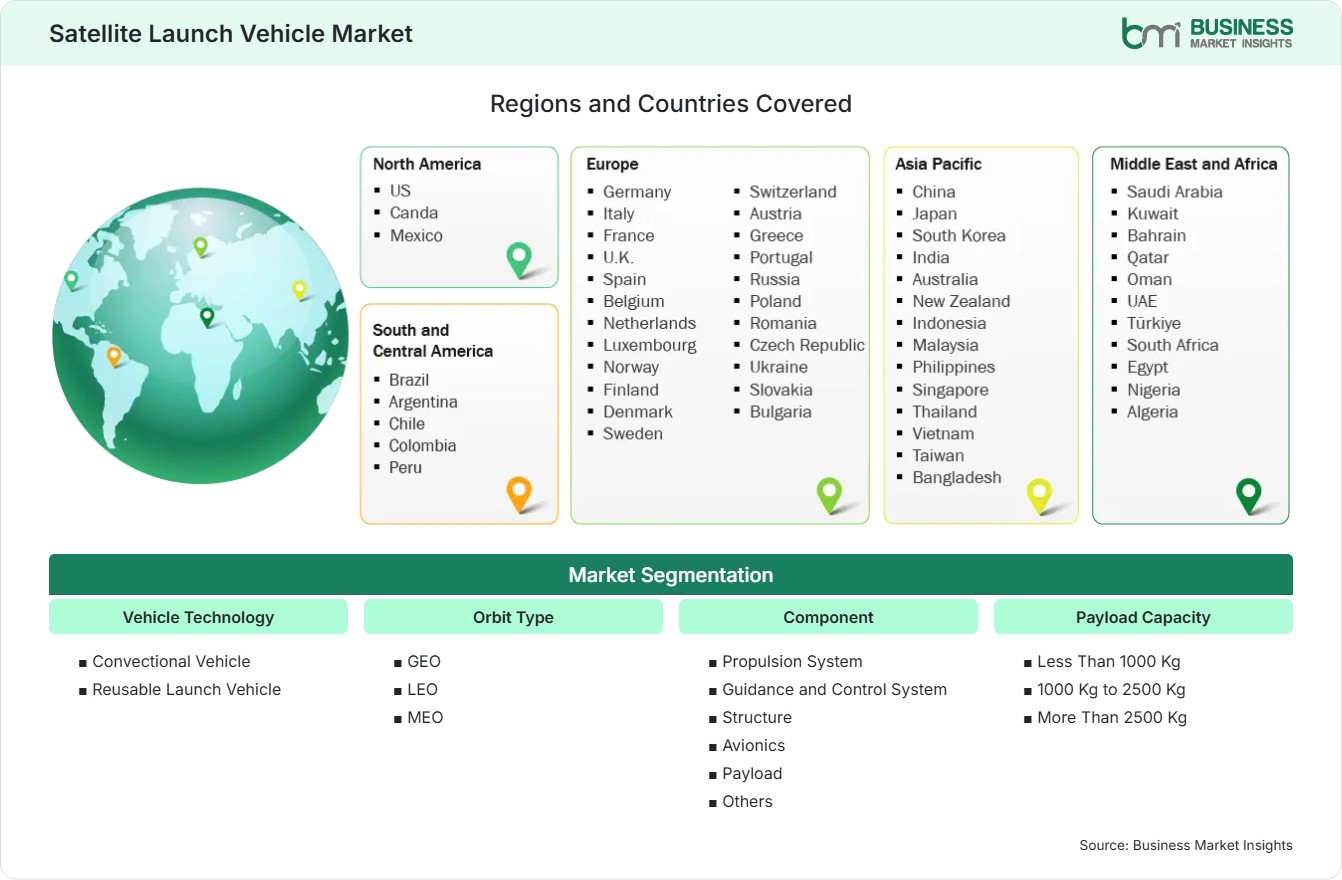
  • Vehicle Technology: Convectional Vehicle, Reusable Launch Vehicle
  • Orbit Type: GEO, LEO, MEO
  • Component: Propulsion System, Guidance and Control System, Structure, Avionics, Payload, Others
  • Payload Capacity: Less Than 1000 Kg, 1000 Kg to 2500 Kg, More Than 2500 Kg
  • End User: Commercial, Military, Civil & Government
US$ 13.30 Bn Market size in 2025
US$ 57.78 Bn Market Size by 2033
20.2% CAGR, 2026 - 2033
2026-2033 Forecast Period

AI Overview

Satellite Launch Vehicle Market Summary

  • North America Region: North America holds a satellite launch vehicle market share of 41%–44% in 2025, growing at a CAGR of 19.4%–20.1% during 2026–2033. Demand is supported by strong commercial space activity, increasing defense-related satellite launches, and substantial investments in reusable launch systems. The U.S. remains the dominant market, advancing at a CAGR of 19.6%–20.3%.
  • Fastest Growing Region: Asia Pacific accounts for 24%–27% of revenue in 2025 and is projected to register a CAGR of 21.8%–22.6% through 2033. Expanding satellite programs, increasing government investments, and growing commercial space activities continue supporting market development.
  • Leading Segment: Conventional Launch Vehicles hold a satellite launch vehicle share of 58%–62% in 2025 and are expected to grow at a CAGR of 18.8%–19.5%. Demand is driven by established reliability, operational maturity, and extensive deployment across government and commercial missions.
  • High Growth Segment: Reusable Launch Vehicles account for 38%–42% of satellite launch vehicle revenue in 2025 and are projected to register a CAGR of 23.5%–24.3% during the forecast period. Growing emphasis on launch cost reduction and mission frequency continues supporting expansion.
  • Key Market Opportunity: Growing deployment of satellite constellations, commercialization of space activities, and development of reusable launch technologies are creating significant opportunities for launch service providers.
  • Major Market Players: Arianespace, Astra Space, Avio S.p.A., Blue Origin, Firefly Aerospace, Mitsubishi Heavy Industries, Northrop Grumman, Relativity Space, Rocket Lab, and SpaceX.
Strategic Insights

Satellite Launch Vehicle Market: Strategic Insights

Satellite Launch Vehicle Market Strategic Framework
FREE PDF
Request your free sample
Request free sample
Stakeholder View

Key Takeaways

  • The market ecosystem includes launch service providers, satellite manufacturers, space agencies, defense organizations, commercial satellite operators, component suppliers, and technology developers.
  • Conventional launch vehicles continue to generate substantial revenue due to their extensive mission heritage and broad usage across commercial and government programs.
  • Reusable launch vehicle technologies are transforming industry economics by improving launch frequency and reducing operational costs.
  • Asia Pacific represents a significant growth opportunity driven by increasing space investments, satellite deployment initiatives, and expanding commercial space ecosystems.
  • Commercial satellite constellations, Earth observation programs, navigation services, and defense applications remain major demand drivers.
  • Investments in advanced propulsion systems, lightweight materials, automated manufacturing, and reusable launch architectures are key satellite launch vehicle market trends.
Geographic Outlook

Satellite Launch Vehicle Market Regional Highlights

North America Satellite Launch Vehicle Market

North America accounted for 41%–44% of global revenue in 2025 and is projected to expand at a CAGR of 19.4%–20.1% through 2033. Growth is supported by strong commercial launch activity, expanding satellite constellation deployments, increasing defense investments, and continuous advancements in reusable launch vehicle technologies. The Satellite Launch Vehicle Market share in the region continues benefiting from a mature aerospace ecosystem and significant government support for space initiatives.

  • Commercial satellite operators continue increasing launch demand to support broadband connectivity, Earth observation, and communication services.
  • Reusable launch technologies are reducing mission costs and improving launch frequency across commercial and government programs.
  • Defense agencies are strengthening space-based capabilities through increased investment in launch services and satellite infrastructure.
  • Private sector participation continues accelerating innovation in launch vehicle design and manufacturing processes.
  • Growing deployment of small satellite constellations is creating sustained demand for frequent and flexible launch services.

US Satellite Launch Vehicle Market

The United States represented 37%–40% of global revenue in 2025 and is anticipated to register a CAGR of 19.6%–20.3% during the forecast period. Demand is driven by increasing commercial space missions, military satellite launches, and investments in reusable launch architectures. Continued innovation by private space companies supports Satellite Launch Vehicle Market growth.

  • Commercial space companies continue expanding launch operations for global satellite deployment projects.
  • Government agencies increasingly rely on private launch providers for cost-efficient mission execution.
  • Rising demand for LEO satellite constellations continues supporting launch vehicle utilization.
  • Investments in next-generation propulsion and manufacturing technologies are enhancing operational efficiency.

Europe Satellite Launch Vehicle Market

Europe held 23%–26% of global revenue in 2025 and is projected to grow at a CAGR of 19.8%–20.5% through 2033. Increasing investments in independent launch capabilities, Earth observation programs, and commercial satellite services continue supporting satellite launch vehicle market expansion. Germany remains the leading market with a CAGR of 19.9%–20.6%, while the United Kingdom is the fastest-growing country, expanding at a CAGR of 20.6%–21.3%.

  • Governments are increasing investments in space access capabilities and satellite infrastructure development.
  • Commercial launch providers are focusing on improving operational flexibility and launch availability.
  • Germany maintains leadership through strong aerospace manufacturing and technological expertise.
  • Demand for Earth observation and communication satellites continues supporting launch activity.
  • Public-private collaborations are accelerating innovation across the regional space industry.

Asia Pacific Satellite Launch Vehicle Market

Asia Pacific accounted for 24%–27% of global revenue in 2025 and is expected to remain the fastest-growing region, registering a CAGR of 21.8%–22.6% through 2033. Expanding national space programs, increasing commercial satellite deployments, and rising investments in launch infrastructure continue driving market growth. China remains the largest regional market with a CAGR of 21.5%–22.3%, while India records the highest growth at 22.3%–23.1%.

  • Growing government investment in satellite communication, navigation, and Earth observation missions continues driving launch demand.
  • China benefits from extensive space program expansion and increasing commercial space activities.
  • India is witnessing rapid growth in launch services, satellite manufacturing, and private-sector participation.
  • Rising deployment of small satellites is creating opportunities for flexible and cost-effective launch solutions.
  • Increasing focus on space-based connectivity and national security programs continues supporting market expansion.

Rest of World Satellite Launch Vehicle Market

The Rest of World region accounted for 6%–9% of global revenue in 2025 and is expected to register a CAGR of 19.2%–19.9% through 2033. Market growth is supported by increasing investment in space research, satellite communications, and regional launch capabilities. Demand remains particularly strong across government, defense, and commercial satellite applications.

Brazil is the leading market in South & Central America and is forecast to grow at a CAGR of 19.4%–20.1%. In the Middle East & Africa, the United Arab Emirates is expected to be the fastest-growing country with a CAGR of 20.0%–20.7%.

  • Brazil continues benefiting from investments in satellite communication and aerospace development initiatives.
  • The United Arab Emirates is witnessing increased activity in satellite deployment and space exploration programs.
  • Governments are strengthening domestic space capabilities to support economic and strategic objectives.
  • Growing participation in international space collaborations is improving market opportunities.
  • Rising demand for satellite-based services continues supporting long-term launch vehicle demand.
Global Market Geography
FREE PDF
Request your free sample
Request free sample
Segment Analysis

Satellite Launch Vehicle Market Segmentation

Vehicle Technology

Vehicle technology remains a key differentiator in the launch services industry as operators seek higher launch efficiency, lower operational costs, and improved mission flexibility. Conventional Launch Vehicles lead the segment with 58%–62% share in 2025 and are projected to grow at a CAGR of 18.8%–19.5% through 2033. The Satellite Launch Vehicle Market forecast continues expanding as governments and commercial operators increase satellite deployment activities across communication, navigation, Earth observation, and defense applications.

  • Conventional Vehicle: Maintains leadership due to proven reliability, extensive operational history, and broad deployment across commercial and government missions.
  • Reusable Launch Vehicle: Represents the fastest-growing category owing to its ability to significantly reduce launch costs, increase mission frequency, and improve operational efficiency.

Orbit Type

Orbit requirements continue shaping launch vehicle demand as satellite operators deploy spacecraft for increasingly diverse applications.

  • GEO: Supports communication, broadcasting, and weather-monitoring satellites requiring continuous regional coverage.
  • LEO: Represents the largest and fastest-growing segment driven by broadband constellations, Earth observation missions, remote sensing applications, and defense programs.
  • MEO: Utilized primarily for navigation systems, communication services, and specialized satellite operations.

Component

Component innovation remains essential to improving launch performance, payload capacity, and mission reliability.

  • Propulsion System: Represents the most critical component due to its direct influence on launch capability, efficiency, and mission success.
  • Guidance and Control System: Ensures accurate navigation, flight stability, and payload deployment.
  • Structure: Provides mechanical integrity while minimizing vehicle weight.
  • Avionics: Supports communication, navigation, monitoring, and onboard control operations.
  • Payload: Includes satellite deployment interfaces and mission-specific equipment.
  • Others: Includes thermal management systems, stage separation components, and support subsystems.

Payload Capacity

Payload capacity requirements are becoming increasingly diverse as satellite deployments range from small CubeSats to large communications satellites.

  • Less Than 1000 Kg: Driven by growing deployment of small satellites and commercial constellation programs.
  • 1000 Kg to 2500 Kg: Serves medium-class missions supporting communication, Earth observation, and scientific applications.
  • More Than 2500 Kg: Supports heavy commercial, military, and government satellite launches requiring significant payload capability.

End User

End-user demand continues expanding as space activities become increasingly commercialized and strategically important.

  • Commercial: Represents the largest segment due to growing broadband constellations, satellite communications, and Earth observation programs.
  • Military: Witnesses strong growth driven by surveillance, intelligence, navigation, and national security requirements.
  • Civil & Government: Includes scientific research, space exploration, environmental monitoring, and public-sector satellite programs.
Market Forces

Satellite Launch Vehicle Market Dynamics

Key Market Drivers

Rising Demand for Small Satellite Launches

The rapid growth of small satellite deployments is creating substantial demand for launch services worldwide. Satellite operators are increasingly utilizing compact and cost-effective spacecraft for communication, Earth observation, navigation, and scientific missions. The expansion of large satellite constellations designed to provide global broadband connectivity is further accelerating launch activity. Launch providers are responding by developing vehicles capable of delivering multiple small satellites in a single mission while maintaining cost efficiency. As small satellite adoption continues expanding across commercial and government sectors, demand for launch vehicles is expected to increase significantly.

Growing Investments in Commercial Space Missions

Commercial participation in the space industry continues to grow as private companies pursue opportunities in telecommunications, Earth observation, space exploration, and satellite-based services. Investors are directing substantial capital toward launch providers, satellite manufacturers, and space infrastructure developers. Increasing commercialization is encouraging innovation in launch vehicle technology, manufacturing processes, and mission operations. The growing number of private-sector missions is helping create a more dynamic and competitive launch services ecosystem. This trend remains a major contributor to market growth.

Increasing Deployment of Earth Observation Satellites

Earth observation satellites are increasingly utilized for environmental monitoring, agriculture, climate analysis, disaster management, infrastructure planning, and resource management. Governments, research organizations, and commercial operators continue investing in satellite programs to obtain high-quality geospatial data and analytics. The increasing value of space-based intelligence is driving demand for reliable launch capabilities. As Earth observation applications continue expanding, launch vehicle utilization is expected to rise steadily throughout the forecast period.

Key Market Opportunities

Rising Demand for Low Earth Orbit Deployments

Low Earth Orbit deployments represent one of the most attractive opportunities within the space industry. Satellite operators are increasingly launching large constellations into LEO to provide broadband internet services, Earth observation capabilities, and global communication coverage. Compared with higher orbits, LEO offers lower latency and improved service performance for many applications. Growing investments in connectivity infrastructure and autonomous technologies are further accelerating deployment activities. As commercial and government organizations continue expanding LEO-based programs, demand for reliable and cost-effective launch services is expected to increase substantially.

Expansion of National Space Launch Programs

Governments worldwide are strengthening domestic space capabilities through investments in independent launch systems, satellite infrastructure, and strategic space programs. Many countries view access to space as critical for national security, communication resilience, scientific advancement, and economic development. As a result, public-sector investments in launch vehicles and launch infrastructure continue to increase. National space agencies are also collaborating with private companies to accelerate technology development and reduce mission costs. This trend is creating significant opportunities for launch vehicle manufacturers, aerospace suppliers, and space technology providers.

Growth of Private Space Exploration Missions

Private-sector involvement in space exploration is expanding beyond traditional satellite deployment activities. Companies are investing in lunar missions, deep-space exploration initiatives, cargo transportation systems, and advanced space infrastructure projects. These activities require increasingly sophisticated launch capabilities capable of supporting complex and high-value missions. Technological advancements and growing investor interest continue strengthening the commercial viability of private space exploration. As commercial exploration programs mature, demand for advanced launch vehicles and related services is expected to generate substantial long-term market opportunities.

Market Restraints and Challenges

High Development Cost of Launch Vehicles

Factor: Launch vehicle development requires significant investments in research, engineering, testing, manufacturing facilities, launch infrastructure, and regulatory compliance. The complexity of rocket systems further increases capital requirements.

Impact: High development costs can create substantial barriers to entry and increase financial risks for market participants. Companies often require long development timelines and significant funding before achieving commercial operations. These factors may limit participation by smaller organizations and affect profitability during early growth phases.

Stringent Safety and Launch Regulations

Factor: Launch operations are subject to strict safety, environmental, and regulatory requirements designed to ensure mission reliability and protect public safety.

Impact: Compliance requirements can increase operational complexity, extend approval timelines, and raise overall program costs. Launch providers must invest heavily in testing, certification, quality assurance, and risk management systems. Regulatory obligations may also influence launch schedules and mission planning, creating additional challenges for industry participants.

Company Analysis

Competitive Landscape

The market remains highly competitive with the presence of commercial launch providers, aerospace manufacturers, government-supported space organizations, and emerging private space companies. Market participants are focusing on reusable launch systems, advanced propulsion technologies, lightweight vehicle structures, rapid launch capabilities, and cost-efficient satellite deployment services. Increasing demand for satellite constellations, defense space programs, and commercial space missions continues shaping Satellite Launch Vehicle Market analysis and competitive strategies across the global space launch industry.

Company Name

Overview

Products and Services Relevant to this Market

Arianespace

Commercial launch service provider supporting institutional and commercial satellite missions.

Satellite launch services, heavy-lift launch vehicles, space transportation solutions.

Astra Space

Space technology company focused on frequent and cost-efficient launch services.

Small satellite launch vehicles, commercial launch services, launch infrastructure.

Avio S.p.A.

Aerospace company developing launch systems and propulsion technologies.

Launch vehicles, propulsion systems, satellite deployment services.

Blue Origin

Private aerospace company developing reusable launch systems and space transportation solutions.

Reusable launch vehicles, orbital launch services, space transportation technologies.

Firefly Aerospace

Space launch company serving commercial, defense, and government customers.

Small and medium satellite launch vehicles, launch services, space mission solutions.

Mitsubishi Heavy Industries

Industrial and aerospace company supporting satellite launch operations and space infrastructure.

Launch vehicles, aerospace systems, satellite deployment services.

Northrop Grumman

Defense and aerospace company providing launch solutions and space systems.

Satellite launch vehicles, propulsion systems, space mission services.

Relativity Space

Aerospace company utilizing advanced manufacturing technologies for launch vehicle production.

Reusable launch vehicles, commercial launch services, rocket manufacturing solutions.

Rocket Lab

Launch provider specializing in small satellite deployment missions.

Orbital launch services, launch vehicles, satellite deployment platforms.

SpaceX

Commercial space company focused on reusable launch technology and satellite deployment.

Reusable launch vehicles, launch services, satellite transportation solutions.

Industry Activity

Recent Developments

July 2026

Skyroot Aerospace prepared to launch Vikram‑1, India’s first privately developed orbital rocket, marking a major milestone in opening the country’s space sector to private players and advancing commercial satellite launch capabilities.

July 2026

Rocket Lab Corporation announced full mission success for its role in the U.S. Space Force's VICTUS HAZE Tactically Responsive Space mission, achieving a record-breaking responsive launch and completing complex on-orbit satellite tracking and proximity operations ahead of schedule.

January 2026

NewSpace India Limited (NSIL) launched the PSLV-C62 / EOS-N1 mission, carrying an earth observation satellite and 15 co-passenger payloads, which subsequently encountered an operational anomaly during the tail-end of its PS3 stage.

November 2025

ISRO successfully launched the CMS‑03 multi-band communication satellite aboard the LVM3-M5 rocket, marking the fifth operational flight of LVM3 and deploying India’s heaviest communication satellite to geosynchronous transfer orbit.

Trust & Transparency

Research Methodology

The market analysis combines proprietary research with secondary data from government agencies, company disclosures, regulatory filings, industry databases and expert interviews. Market estimates are validated through data triangulation, cross-market benchmarking and analyst review.

View Full Research Methodology

Questions Answered

Frequently Asked Questions

What challenge has the greatest long-term impact on the industry?

High development costs remain a major challenge because launch vehicle design, testing, manufacturing, and regulatory compliance require substantial long-term investments and technical resources.

How are reusable launch vehicles influencing Satellite Launch Vehicle market growth?

Reusable launch vehicles help lower launch costs, improve mission frequency, enhance operational efficiency, and support the growing demand for commercial satellite deployment services.

Why is Asia Pacific the fastest-growing region?

The region benefits from expanding national space programs, increasing commercial launch activities, rising investments in satellite infrastructure, and growing private-sector participation in space technologies.

Which vehicle technology segment leads the market?

Conventional Launch Vehicles lead the market due to established operational reliability, extensive deployment history, and broad utilization across government and commercial missions.

What is driving growth in the Satellite Launch Vehicle Market report?

Rising demand for small satellite launches, growing investments in commercial space missions, increasing deployment of Earth observation satellites, and expanding satellite constellation programs are the primary growth drivers.

Access the Full Satellite Launch Vehicle Market Report

Get segment-level forecasts, regional estimates, competitive benchmarking, company profiles and downloadable Excel datasets.

Access the full Satellite Launch Vehicle Market Report
350 pages PDF & Excel | 2026-08-03
Similar Research

Related Market Reports