
Small Launch Vehicle (SLV) Market Outlook: Size, Share, Trends, Growth Analysis, Competitive Landscape & Forecast, 2026-2033

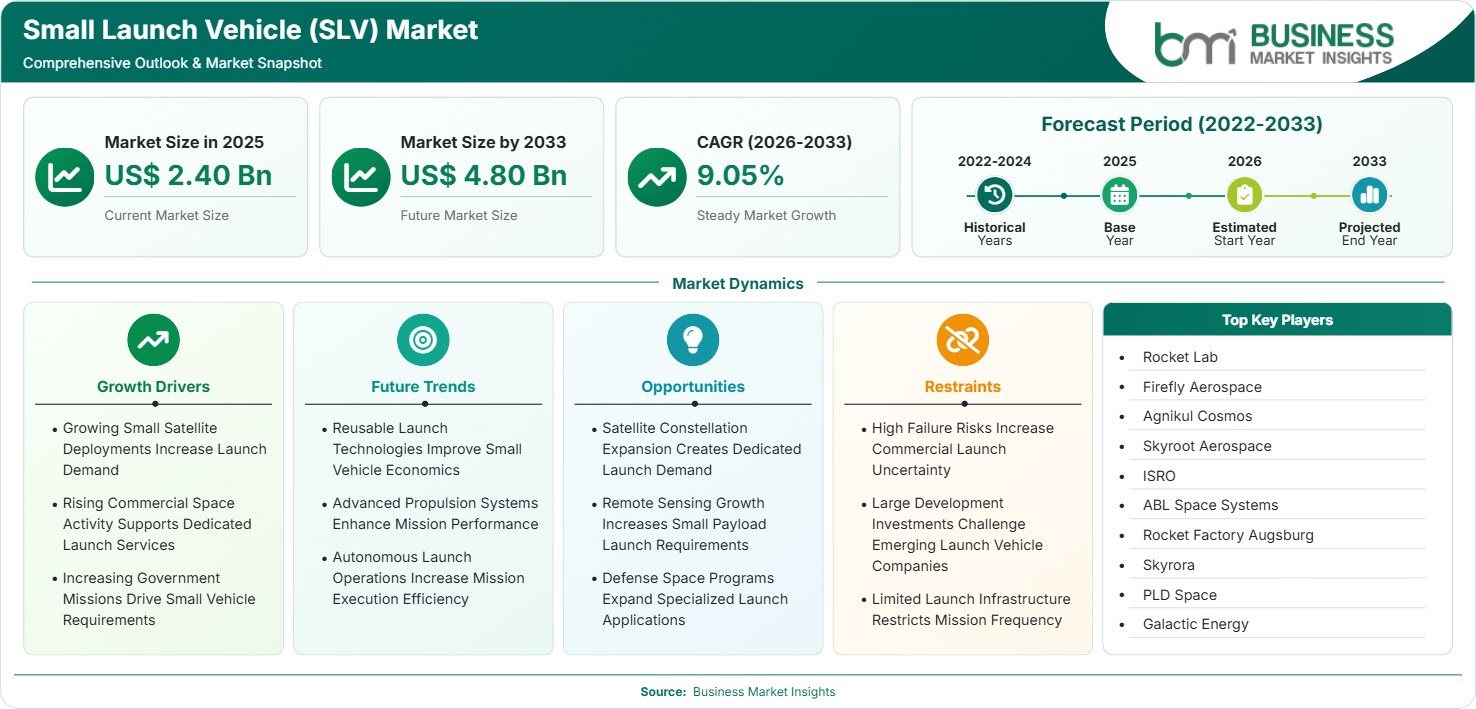
The Small Launch Vehicle (SLV) Market size was valued at US$ 2.40 billion in 2025 and is projected to reach US$ 4.80 billion by 2033, growing at a CAGR of 9.05% during 2026–2033. Increasing small satellite deployments, commercial space activity, government missions, and demand for dedicated orbital access are creating new opportunities for launch service providers worldwide.

Report Coverage
  • Propulsion: Solid, Liquid, Hybrid
  • Capacity: Up to 100 kg, 100-500 kg, 500-1000 kg, 1000 -2000 kg
  • Launch Platform: Land, Air, Sea
  • End User: Government, Commercial, Military
US$ 2.40 Bn Market size in 2025
US$ 4.80 Bn Market Size by 2033
9.05% CAGR, 2026 - 2033
2026-2033 Forecast Period

AI Overview

Small Launch Vehicle (SLV) Market Summary

  • North America Region: North America holds a leading position with a share ranging between 38%–41% in 2025 and is projected to grow at a CAGR of 8.7%–9.3% through 2033. Commercial space investments, private launch capabilities, and satellite deployment programs support regional expansion. The U.S. Small Launch Vehicle (SLV) Market benefits from private aerospace innovation, defense contracts, and increasing small satellite missions, supporting a CAGR of 8.9%–9.5%.
  • Fastest Growing Region: Asia Pacific represents the fastest-growing region with a share of 24%–27% in 2025 and is expected to expand at a CAGR of 10.2%–10.8%. Growing space programs, emerging launch companies, and increasing satellite applications are accelerating regional small launch vehicle adoption.
  • Leading Segment: Liquid propulsion represents the leading segment with a share of 45%–48% in 2025 and is projected to grow at a CAGR of 9.4%–10.0%. Reusability potential, operational flexibility, and performance advantages support adoption across commercial and government missions.
  • High Growth Segment: Commercial end users demonstrate strong expansion with a share of 35%–38% in 2025 and a CAGR of 10.0%–10.6%. Growing private satellite constellations, Earth observation demand, and dedicated launch requirements are supporting segment development.
  • Key Market Opportunity: Expansion of satellite constellations, increasing defense space requirements, and demand for flexible orbital access are creating opportunities for specialized launch providers offering reliable small payload deployment services.
  • Major Market Players: Rocket Lab, Firefly Aerospace, Agnikul Cosmos, Skyroot Aerospace, Indian Space Research Organisation (ISRO), ABL Space Systems, Rocket Factory Augsburg, Skyrora, PLD Space, and Galactic Energy.
Strategic Insights

Small Launch Vehicle (SLV) Market: Strategic Insights

Small Launch Vehicle (SLV) Market Strategic Framework
FREE PDF
Request your free sample
Request free sample
Stakeholder View

Key Takeaways

  • The launch ecosystem is evolving through increased participation from private companies, satellite operators, component suppliers, and government space agencies developing specialized orbital access capabilities.
  • Commercial satellite constellations and Earth observation applications are creating strong opportunities for launch providers offering dedicated and flexible small payload deployment services.
  • Propulsion innovation, lightweight materials, automation, and reusable technologies are shaping future vehicle development strategies and improving mission economics.
  • Asia Pacific presents attractive investment potential due to expanding national space programs, private aerospace startups, and increasing satellite launch requirements.
  • Strategic partnerships, funding activities, and collaborations between aerospace companies and government organizations are strengthening the competitive landscape.
  • Growing demand for responsive space capabilities is encouraging development of launch vehicles designed for faster deployment, specialized missions, and operational flexibility.
Geographic Outlook

Small Launch Vehicle (SLV) Market Regional Highlights

North America Small Launch Vehicle (SLV) Market

North America accounted for approximately 38%–41% of global revenue in 2025 and is expected to expand at a CAGR of 8.7%–9.3% through 2033. The region maintains leadership due to strong private space activity, advanced aerospace infrastructure, and increasing demand from commercial and government satellite missions.

  • The United States represents the major contributor due to private launch investments, defense programs, and increasing small satellite deployment activities.
  • Commercial launch companies are developing dedicated vehicles to address growing demand for flexible orbital access and frequent missions.
  • Government agencies are supporting innovation through contracts, technology programs, and space infrastructure investments.
  • Advanced manufacturing and propulsion development are improving vehicle performance and operational efficiency.

US Small Launch Vehicle (SLV) Market

The United States represents the largest country-level contributor within North America, supported by established aerospace companies, government missions, and commercial satellite activities. The market is projected to grow at a CAGR of 8.9%–9.5% through 2033, driven by increasing demand for dedicated launch services and responsive space capabilities.

  • Private aerospace companies are expanding launch capacity to support commercial satellite operators and government requirements.
  • Defense organizations are increasing interest in flexible launch solutions for strategic space applications.
  • Venture investments are supporting development of innovative launch technologies and new market entrants.

Europe Small Launch Vehicle (SLV) Market

Europe represented approximately 22%–25% of global revenue in 2025 and is projected to grow at a CAGR of 8.5%–9.1% through 2033. Germany leads regional adoption through emerging launch companies, while the United Kingdom and Spain demonstrate increasing activity through commercial space development programs.

  • Germany is advancing small launch capabilities through private aerospace initiatives and dedicated orbital access projects.
  • The United Kingdom is supporting commercial launch development through space technology investments and infrastructure programs.
  • Spain is emerging as a growing market through startup-led launch vehicle innovation.
  • European space initiatives are encouraging independent launch capabilities and commercial participation.

Asia Pacific Small Launch Vehicle (SLV) Market

Asia Pacific accounted for approximately 24%–27% of global revenue in 2025 and is expected to register the fastest CAGR of 10.2%–10.8% through 2033. China leads regional demand, while India demonstrates rapid growth through private space startups and expanding satellite mission requirements.

  • China continues developing commercial launch capabilities through private aerospace companies and national space initiatives.
  • India is witnessing increasing private participation alongside government-supported space programs and satellite deployment activities.
  • Japan and South Korea are investing in advanced space technologies and commercial launch capabilities.
  • Regional satellite growth is increasing demand for cost-effective and dedicated launch solutions.

Rest of World Small Launch Vehicle (SLV) Market

Rest of World regions contribute approximately 8%–11% of global revenue in 2025 and are projected to grow at a CAGR of 9.2%–9.8% through 2033. Latin America and Middle East markets are developing through satellite programs, defense requirements, and increasing interest in commercial space activities.

  • Middle Eastern countries are investing in space programs and satellite capabilities, creating opportunities for specialized launch services.
  • Latin American nations are expanding satellite applications for communication, agriculture, and environmental monitoring.
  • Emerging space economies are seeking affordable access to orbit through commercial launch partnerships.
  • International collaborations are supporting technology transfer and regional aerospace development.
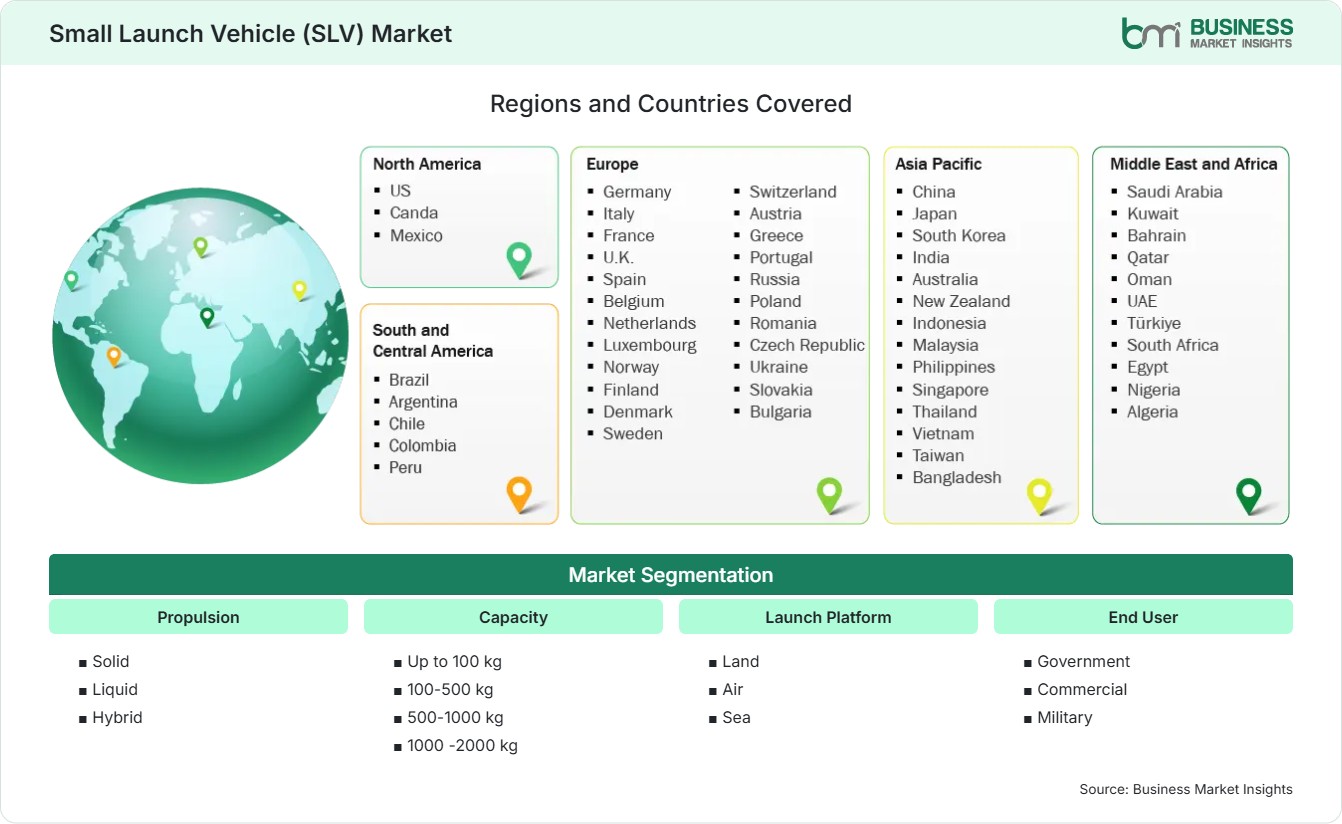
Global Market Geography
FREE PDF
Request your free sample
Request free sample
Segment Analysis

Small Launch Vehicle (SLV) Market Segmentation

Propulsion

The Propulsion segment determines vehicle performance, mission flexibility, and operational efficiency, with Liquid propulsion accounting for 45%–48% share in 2025 and expanding at a CAGR of 9.4%–10.0% through 2033. Increasing demand for precise orbital placement, reusable technologies, and improved mission control is supporting advanced propulsion development across launch providers.

  • Solid: Provides reliability, simplified storage, and lower operational complexity, supporting missions requiring rapid deployment and cost-effective launch capabilities.
  • Liquid: Enables higher efficiency, controllability, and performance optimization, making it suitable for commercial missions, satellite deployments, and complex orbital requirements.
  • Hybrid: Combines solid and liquid propulsion advantages, supporting innovation through improved safety, flexibility, and cost-efficient launch vehicle development.

Capacity

The Capacity segment reflects payload requirements across commercial, government, and defense missions. Vehicles supporting 100–500 kg payloads represent a significant segment due to increasing small satellite constellation deployments and commercial Earth observation applications. The Small Launch Vehicle (SLV) Market scope continues expanding as operators seek dedicated solutions for flexible payload delivery.

  • Up to 100 kg: Supports nanosatellite and small payload missions requiring affordable and responsive launch opportunities for research and commercial applications.
  • 100-500 kg: Addresses growing demand from satellite operators requiring dedicated launches for constellation deployment and Earth observation missions.
  • 500-1000 kg: Supports larger small satellite missions requiring increased payload capability and improved orbital delivery performance.
  • 1000-2000 kg: Serves advanced missions requiring higher payload capacity while maintaining dedicated launch flexibility compared with traditional launch systems.

Launch Platform

The Launch Platform segment highlights different operational approaches for small launch vehicles, with Land-based launches maintaining a strong position due to established infrastructure and operational maturity. Increasing demand for flexible mission scheduling is encouraging investment across multiple launch platforms supporting diverse orbital requirements.

  • Land: Provides established launch infrastructure, mission reliability, and operational support for commercial and government satellite deployment programs.
  • Air: Enables flexible launch locations, reduced atmospheric limitations, and potential operational advantages for specialized missions requiring responsive deployment.
  • Sea: Supports expanded launch flexibility through mobile platforms and access to advantageous orbital trajectories for specific mission requirements.

End User

The End User segment demonstrates increasing participation from government, commercial, and military organizations. Commercial users represent a growing adoption area with 35%–38% Small Launch Vehicle (SLV) Market share in 2025 and a CAGR of 10.0%–10.6% through 2033. The segment benefits from satellite constellation expansion, private space investment, and demand for dedicated launch services.

  • Government: Utilizes small launch vehicles for scientific missions, technology demonstrations, Earth observation programs, and national space initiatives.
  • Commercial: Drives demand through satellite constellations, communication services, remote sensing applications, and private space ventures requiring dedicated orbital access.
  • Military: Adopts specialized launch capabilities for responsive space operations, surveillance missions, and strategic satellite deployment requirements.
Market Forces

Small Launch Vehicle (SLV) Market Dynamics

Key Market Drivers

Growing Small Satellite Deployments Increase Launch Demand

The increasing deployment of small satellites is creating demand for dedicated launch vehicles capable of providing flexible orbital access. Satellite operators are seeking solutions that reduce dependence on larger launch systems and enable scheduled deployment opportunities. Growth in communication, Earth observation, and scientific satellite applications is supporting launch service expansion. The Small Launch Vehicle (SLV) Market trend reflects increasing preference for specialized vehicles offering faster mission preparation, cost efficiency, and operational flexibility. Launch providers are improving vehicle designs through lightweight structures, advanced propulsion systems, and streamlined manufacturing processes to address evolving satellite deployment requirements.

Rising Commercial Space Activity Supports Dedicated Launch Services

With the rise in commercial space activity driven by the growing satellite services and space applications offered by the private sector, there is an increasing need for launchers that can meet specific requirements for dedicated missions. Commercial organizations seek reliability in their mission schedule and cost-effective means of reaching orbit. Small launch vehicles are meeting these demands by providing dedicated mission opportunities to new satellite ventures. Growth in private funding for aerospace technologies is helping advance developments in the field.

Increasing Government Missions Drive Small Vehicle Requirements

Government space efforts have begun to contribute to the growing need for small launch vehicles through their science projects, technology tests, and national security efforts. There has been a growing evaluation of responsive launchers to adapt to new mission requirements. Small launch vehicles are beneficial for launching specific payloads and maintaining readiness. The government-led space projects are facilitating cooperation with the aerospace industry and the development of technology. Growing emphasis on self-sufficiency in space access is translating into investments in launch facilities, propulsion technologies, and mission capabilities.

Key Market Opportunities

Satellite Constellation Expansion Creates Dedicated Launch Demand

The development of the satellite constellations has created new potential for small launch vehicles due to the need for frequent launches. There is an increased need for launch capacity to support communications networks, Earth observation missions, and commercial satellite operations. Small launch vehicles enable the organization of a launch schedule and reduce dependence on joint launches. Small launch providers that can develop a scalable, reliable vehicle will be able to take advantage of new opportunities created by increased constellation activity. The rising number of small satellites is expected to drive demand for customized launches.

Remote Sensing Growth Increases Small Payload Launch Requirements

The rising popularity of remote sensing applications is creating new opportunities for launch service providers serving small-payload launch missions. Sectors such as agriculture, climate observation, infrastructure monitoring, and environmental monitoring are driving the need for satellites. Small launchers offer companies the opportunity to launch payloads tailored to specific sensing needs. The provision of affordable launch services could spur the adoption of these applications by commercial and research players. Service providers capable of effective mission planning and launch will find a niche in these growing applications.

Defense Space Programs Expand Specialized Launch Applications

Initiatives in the defense space have created opportunities for small launch systems that offer responsive and unique services. There is a desire among military organizations to deploy systems that meet the needs of surveillance, communication, and strategic purposes. Small launch systems can enable rapid access to space and enhance operational resilience by deploying satellites in a distributed manner. The increasing investment in space by defense organizations has created working relationships with launch providers. The companies providing safe, reliable, and flexible space launch services stand to gain from the growing demand for military space applications.

Market Restraints and Challenges

High Failure Risks Increase Commercial Launch Uncertainty

Factor: Small launch vehicles involve complex engineering, testing, and mission execution requirements that create operational risks. Impact: Launch failures can result in financial losses, customer confidence challenges, and delays in future mission opportunities. Companies must invest heavily in reliability improvements, testing procedures, and quality assurance systems to minimize risks. Emerging launch providers face additional pressure as they establish market credibility. Continuous technology improvement and operational experience are essential for reducing uncertainty and improving long-term commercial viability.

Large Development Investments Challenge Emerging Launch Vehicle Companies

Factor: Developing launch vehicles requires substantial investment in research, manufacturing facilities, testing infrastructure, and launch operations. Impact: High capital requirements can create financial challenges for emerging companies seeking to compete with established aerospace organizations. Access to funding, government partnerships, and commercial contracts remains important for sustaining development programs. Companies must balance innovation with cost management to achieve competitive positioning. Investment requirements continue influencing market entry, expansion strategies, and long-term sustainability within the small launch vehicle sector.

Company Analysis

Competitive Landscape

The competitive environment is shaped by launch technology innovation, propulsion advancements, satellite deployment demand, and increasing participation from private aerospace companies. The Small Launch Vehicle (SLV) Market analysis highlights that key players are focusing on vehicle reliability, cost optimization, flexible mission capabilities, and expanded launch infrastructure to address growing commercial and government requirements.

Company Name

Overview

Products and Services relevant to this market

Rocket Lab

Aerospace company specializing in small launch services, satellite systems, and space solutions for commercial and government customers.

Electron small launch vehicle, dedicated satellite launches, spacecraft components, satellite deployment services, and space systems solutions.

Firefly Aerospace

Space transportation company developing launch vehicles and lunar technologies for commercial, government, and defense missions.

Alpha small launch vehicle, orbital launch services, spacecraft technologies, and payload deployment solutions.

Agnikul Cosmos

Indian space startup focused on developing customizable small launch vehicles for dedicated satellite missions.

Agnibaan launch vehicle, private launch services, customizable orbital delivery solutions, and space transportation technologies.

Skyroot Aerospace

Indian aerospace company developing privately built launch vehicles for small satellite deployment.

Vikram series launch vehicles, dedicated satellite launch services, propulsion technologies, and orbital transportation solutions.

Indian Space Research Organisation (ISRO)

National space agency providing launch capabilities, satellite programs, and space technology development initiatives.

Small Satellite Launch Vehicle (SSLV), satellite launch services, space mission support, and launch infrastructure capabilities.

ABL Space Systems

Aerospace company developing flexible launch systems for small satellite and defense payload missions.

RS1 launch vehicle, responsive launch services, payload integration, and commercial satellite deployment capabilities.

Rocket Factory Augsburg

European aerospace company developing small launch vehicles for commercial satellite missions.

RFA ONE launch vehicle, orbital launch services, propulsion systems, and satellite deployment solutions.

Skyrora

United Kingdom-based space company focused on sustainable small launch vehicle technologies and orbital access.

Skyrora XL launch vehicle, propulsion systems, launch services, and sustainable aerospace technologies.

PLD Space

Spanish aerospace company developing reusable launch technologies and commercial space transportation solutions.

MIURA launch vehicles, orbital launch services, reusable rocket technologies, and payload transportation services.

Galactic Energy

Chinese commercial aerospace company developing launch vehicles for small satellite missions.

Ceres launch vehicles, commercial launch services, satellite deployment solutions, and space transportation technologies.

Trust & Transparency

Research Methodology

The market analysis combines proprietary research with secondary data from government agencies, company disclosures, regulatory filings, industry databases and expert interviews. Market estimates are validated through data triangulation, cross-market benchmarking and analyst review.

View Full Research Methodology

Questions Answered

Frequently Asked Questions

What opportunities exist for small launch vehicle companies?

According to the Small Launch Vehicle (SLV) Market forecasts, opportunities are emerging through satellite constellation growth, remote sensing applications, defense space programs, commercial space investments, and increasing demand for responsive launch services.

What does this Small Launch Vehicle (SLV) Market report provide?

This Small Launch Vehicle (SLV) Market report provides insights into market dynamics, technology developments, segmentation analysis, regional opportunities, competitive strategies, and factors influencing future industry growth.

Which technologies are improving small launch vehicle capabilities?

Advanced propulsion systems, lightweight materials, reusable technologies, automated manufacturing, and improved launch operations are enhancing vehicle performance, reliability, and cost efficiency.

How are small launch vehicles different from traditional launch systems?

Small launch vehicles are designed for lower payload capacities and provide dedicated deployment options, enabling satellite operators to achieve greater scheduling flexibility and reduced dependence on larger shared launch missions.

What factors are increasing demand for small launch vehicles?

Growing small satellite deployments, commercial space expansion, government missions, and demand for dedicated orbital access are increasing the need for flexible launch solutions capable of supporting specialized payload requirements.

Access the Full Small Launch Vehicle (SLV) Market Report

Get segment-level forecasts, regional estimates, competitive benchmarking, company profiles and downloadable Excel datasets.

Access the full Small Launch Vehicle (SLV) Market Report
350 pages PDF & Excel | 2026-08-07
Similar Research

Related Market Reports