Market Summary
Executive Summary and Global Market Analysis
Multiple launch rocket systems are artillery platforms engineered to fire salvos of unguided or guided rockets from a single launcher assembly. They combine mobility, concentrated firepower, and rapid shoot-and-scoot capability, allowing forces to engage area targets, suppression missions, and deep-strike objectives across changing battlefield conditions.
Procurement priorities are shifting toward systems that deliver longer reach, faster deployment, and better interoperability with digital fire-control networks. Armed forces are expanding deployment of launchers that can support precision munitions, dispersed operations, and responsive fires under contested environments where mobility and survivability carry equal importance.
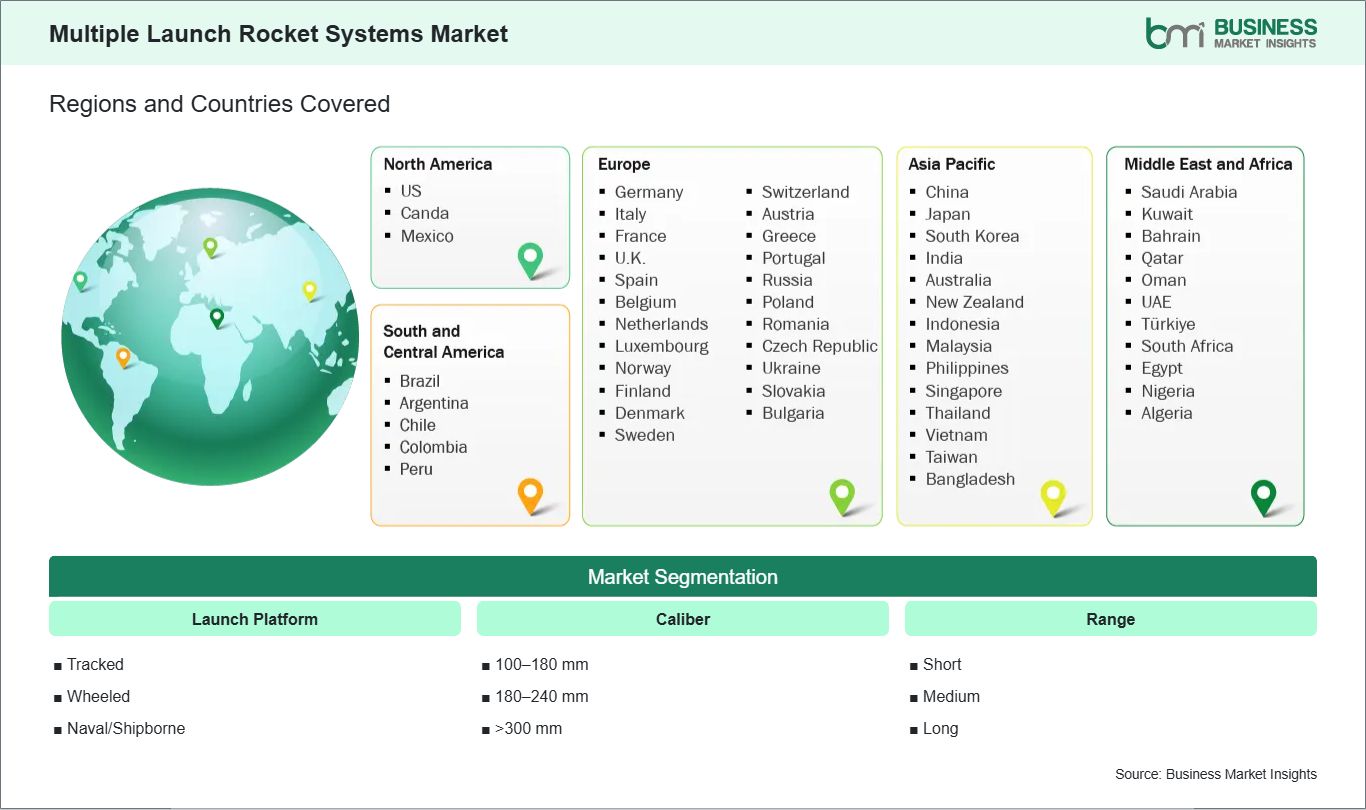
Segmentation reveals distinct operational preferences across launch platform, caliber, and range profiles. Tracked systems align with heavy maneuver formations, wheeled variants suit expeditionary mobility, and naval or shipborne configurations extend rocket artillery utility into littoral missions. Caliber and range categories further differentiate payload flexibility, saturation effect, and mission depth.
Technology progression is centered on modular launch pods, automated targeting interfaces, precision-guided rockets, and compatibility with extended-range munitions. These developments are refining firing accuracy, reload efficiency, and command connectivity, while also enabling operators to transition from legacy saturation roles toward more discriminating and networked strike functions.
The competitive environment reflects emphasis on launcher adaptability, munitions integration, industrial readiness, and lifecycle support. Suppliers are positioning through configurable platform families, digital fire systems, and alignment with national modernization agendas, while procurement decisions increasingly consider domestic production, interoperability, and upgrade pathways.
Segment Analysis
Multiple Launch Rocket Systems Market Segmentation
The multi launch rocket systems market is segmented by launch platform, caliber, and range across evolving long-range fire support requirements.
By Launch Platform
- Tracked: Supports armored formations with protected mobility and sustained battlefield presence.
- Wheeled: Enables faster road movement and flexible deployment across dispersed operational theatres.
- Naval/Shipborne: Extends rocket fire support into coastal and maritime engagement scenarios.
By Caliber
- 100-180 mm: Favored for tactical salvos requiring lighter launch loads and rapid firing.
- 180-240 mm: Balances destructive effect with adaptable mission planning requirements.
- >300 mm mm: Serves deep-strike roles demanding heavier payloads and longer stand-off reach.
By Range
- Short: Selected for close support, suppression, and localized battlefield shaping missions.
- Medium: Matches operational fires requiring reach beyond frontline engagement envelopes.
- Long: Addresses strategic strike needs against rear-area and high-value targets.
Market Forces
Multiple Launch Rocket Systems Market Drivers and Opportunities
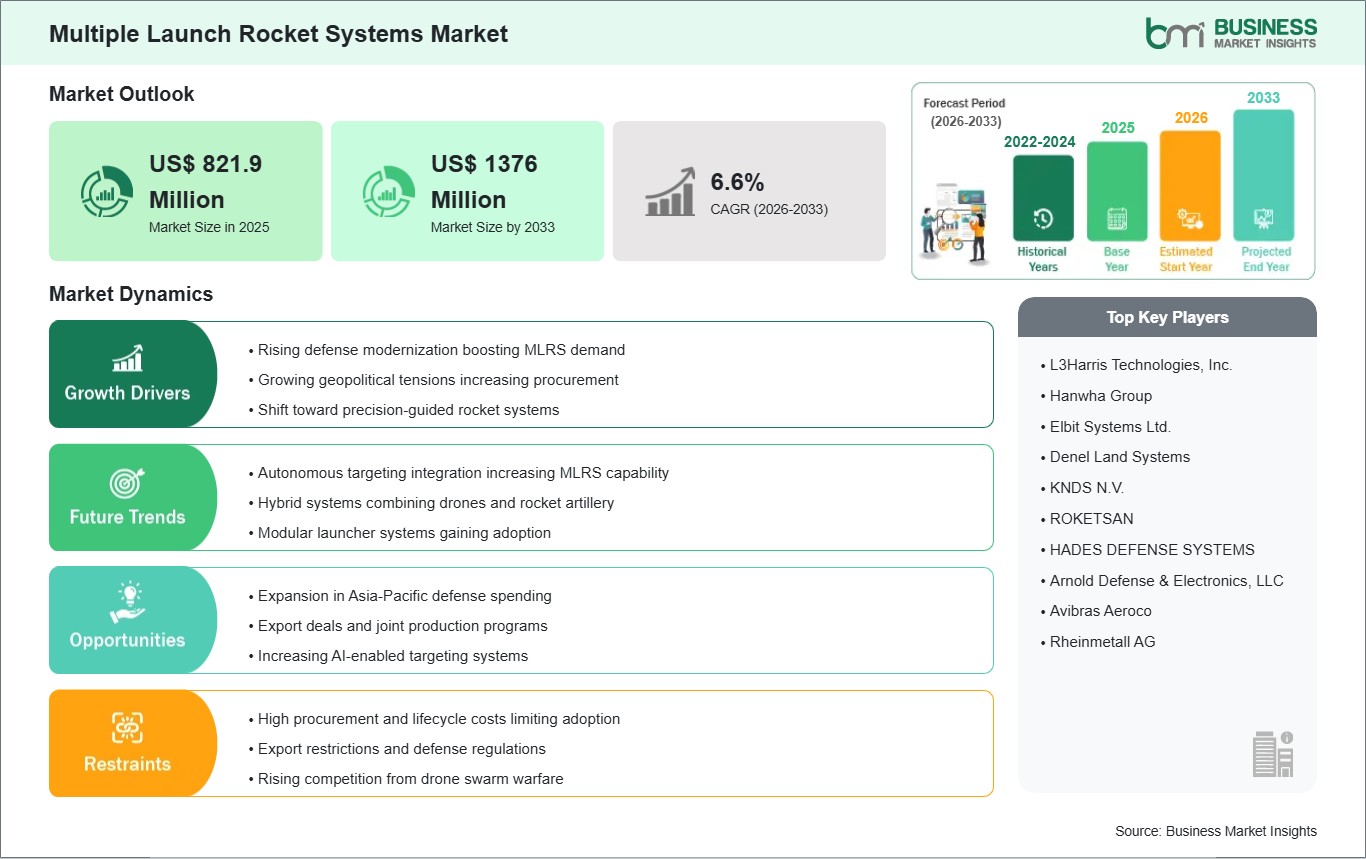
Rising defense modernization boosting MLRS demand
Operational planning now places greater emphasis on deep fires, rapid repositioning, and synchronized targeting across land forces. That requirement is prompting defense ministries to procure launch systems capable of delivering concentrated rocket effects with shorter response cycles, stronger mobility profiles, and better compatibility with modern command networks supporting high-tempo operations.
The effect reaches beyond launcher acquisition into training, doctrine, munitions planning, and sustainment structures. As armed forces refine battlefield concepts around dispersion and precision engagement, these systems gain greater relevance. Their importance rises in programs seeking responsive strike options that can operate across conventional deterrence, counter-battery fire, and border defense requirements.
Precision-Guided Rockets and Modular Launch Architectures Expanding Upgrade Potential
An important opportunity is emerging from the shift toward modular launchers paired with guided and extended-range munitions. This transition supports use cases where operators need flexible strike packages, scalable launcher configurations, and digital targeting workflows that can adapt to changing mission conditions without redesigning the full fire support architecture.
Future scope lies in upgrade programs that combine new fire-control suites, interoperable munitions pods, and platform-specific mobility enhancements. As procurement strategies favor adaptable systems over fixed configurations, suppliers can widen participation across fresh acquisitions and modernization cycles. That progression can strengthen market depth while raising the strategic value of long-range fires portfolios.
Size and Share Analysis
Multiple Launch Rocket Systems Market Size and Share Analysis
The Multi Launch Rocket Systems market size is expected to reach US$ 1.37 Billion by 2033 from US$ 0.82 Billion in 2025. The market is estimated to record a CAGR of 6.6% from 2026 to 2033. This growth profile indicates sustained procurement interest in mobile rocket artillery, supported by modernization programs, platform upgrades, and the need for launch systems that combine reach, survivability, and networked fire coordination.
By segment, wheeled platforms retain strong visibility because they align with fast deployment doctrines and simplified transport across broad operating areas. Mid-caliber systems also hold an important position by balancing launcher compatibility, payload flexibility, and mission adaptability. Medium-range categories remain central where forces seek operational depth without shifting entirely into strategic missile systems.
Application dominance is concentrated in land-based force modernization, where rocket artillery supports suppression, counter-battery missions, and deep-fire planning. Tactical formations continue to account for broad system relevance, while coastal and expeditionary roles are extending usage patterns. Naval or shipborne concepts add further interest where standoff fires are being integrated into maritime deterrence frameworks.
Report Coverage
Multiple Launch Rocket Systems Market Report Coverage and Deliverables
The " Multi Launch Rocket Systems Market Size and Forecast (2022-2033)" report provides a detailed analysis of the market covering below areas:
- Market size and forecast at global, regional, and country levels for all the key market segments covered under the scope
- Market trends, as well as market dynamics such as drivers, restraints, and key opportunities
- Market analysis covering key market trends, global and regional framework, major players, regulations, and recent market developments
- Industry landscape and competition analysis covering market concentration, heat map analysis, prominent players, and recent developments for the market
- Detailed company profiles, including SWOT analysis
Geographic Insights
Multiple Launch Rocket Systems Market Geographic Insights
The Multi Launch Rocket Systems market shows diverse regional adoption patterns influenced by defense doctrine, procurement cycles, platform mobility needs, and munitions integration priorities. Across the wider global landscape, governments are reassessing artillery depth and responsiveness, which is reinforcing interest in launcher families that can support both conventional area fires and more selective long-range strike concepts.
North America maintains a prominent position through established industrial capability, structured modernization pathways, and strong emphasis on interoperable precision fires. Procurement activity in the region favors launch systems with digital targeting support, flexible munitions compatibility, and mobility suited to rapid deployment, reinforcing the role of both legacy platform upgrades and next-generation launcher integration.
Asia Pacific reflects expanding strategic interest as regional security planning increasingly values stand-off firepower and transportable artillery assets. Countries across the region are aligning acquisitions with mobility, terrain adaptability, and deterrence needs, encouraging demand for wheeled and tracked systems that can operate across varied geographies while integrating with broader battlefield surveillance and command structures.
Europe continues to prioritize artillery renewal through alliance coordination, ammunition compatibility, and readiness-oriented force restructuring. Beyond Europe, emerging markets in the Middle East and Africa and South and Central America are evaluating rocket artillery through border security, deterrence, and coastal defense requirements. This mix is widening the sector's regional opportunity set across both replacement programs and first-time capability development.
Industry Activity
Recent Developments
The multi launch rocket systems market is evaluated by gathering qualitative and quantitative data post primary and secondary research, which includes important corporate publications, association data, and databases. Recent developments and news in the market include:
- May 2026: Hanwha Aerospace announced that it will supply three additional Chunmoo multiple rocket launcher systems to the Estonian Defence Forces. The supply follows a government-to-government (G2G) contract signed on May 11 between the Korea Trade-Investment Promotion Agency (KOTRA) and the Estonian Centre for Defence Investments (ECDI).
- December 2025: L3Harris Technologies has been awarded a follow-on production contract valued up to $200 million to manufacture Guided Multiple Launch Rocket System (GMLRS) Insensitive Munition (IM) propulsion units.
Trust & Transparency
Research Methodology
The market analysis combines proprietary research with secondary data from government agencies, company disclosures, regulatory filings, industry databases and expert interviews. Market estimates are validated through data triangulation, cross-market benchmarking and analyst
review.
View Full Research Methodology
Key Sources Referred:
US Department of DefenseDefense Advanced Research Projects Agency (DARPA)Defence Research and Development Organisation (DRDO)China Academy of Launch Vehicle Technology (CALT)Ministry of Defence of the Russian FederationNATO Support and Procurement Agency (NSPA)Company filingsTechnical and defense journalsAcademic studiesRegulatory and strategic policy documents