Market Summary
Executive Summary and Global Market Analysis
Military vehicle sustainment refers to the comprehensive lifecycle support, maintenance, repair, overhaul, modernization, and operational readiness management of defense vehicle fleets used across land-based military operations. Sustainment activities are essential for ensuring the long-term operational efficiency, survivability, mobility, and combat readiness of military vehicles operating in diverse and demanding battlefield conditions. These services support a broad range of military platforms including tanks, infantry fighting vehicles (IFVs), armored personnel carriers (APCs), reconnaissance vehicles, utility trucks, transport trucks, and recovery vehicles deployed by defense forces worldwide.
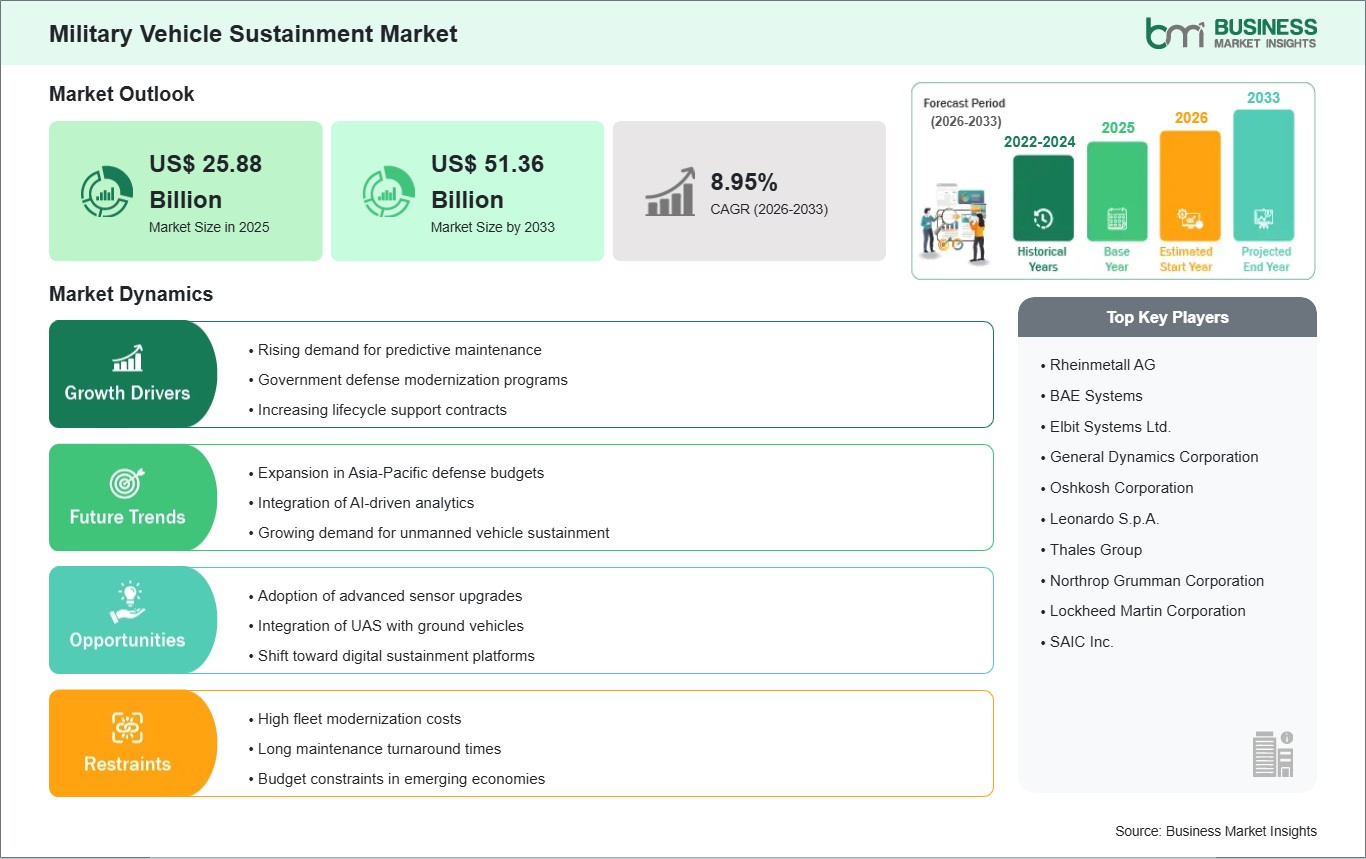
The market is experiencing strong growth due to increasing global defense expenditures, rising geopolitical tensions, and continuous military modernization initiatives across developed and emerging economies. Governments and defense agencies are focusing on extending the operational lifespan of existing armored and tactical vehicle fleets through advanced maintenance programs, modernization upgrades, predictive diagnostics, and integrated fleet management systems. The increasing deployment of military vehicles in border security operations, peacekeeping missions, counterinsurgency operations, and high-intensity combat environments is significantly driving demand for sustainment services globally.
In addition, rapid technological advancements in vehicle electronics, autonomous mobility systems, AI-based predictive maintenance, condition-based monitoring systems, and digital battlefield integration are transforming the military vehicle sustainment landscape. Defense organizations are increasingly adopting advanced maintenance solutions supported by data analytics, digital twins, IoT-enabled diagnostics, and simulation-based training systems to improve operational availability and reduce lifecycle costs. The growing focus on fleet readiness and mission reliability is accelerating investments in overhaul programs, armored vehicle upgrades, and supply chain optimization.
However, the market faces several operational and technological challenges. Military vehicle sustainment requires highly specialized infrastructure, skilled workforce availability, and complex logistics coordination to maintain vehicle readiness under harsh operating conditions. Rising maintenance costs associated with aging vehicle fleets, supply chain disruptions for critical spare parts, and increasing cybersecurity concerns linked to connected vehicle systems may hinder market growth. In addition, lengthy procurement cycles, budget constraints in certain defense sectors, and regulatory restrictions on defense technology transfers can create challenges for sustainment providers and military contractors.
Despite these challenges, the market outlook remains highly positive due to increasing defense modernization programs and the growing importance of operational readiness in modern warfare. Significant opportunities are emerging through the integration of AI-enabled predictive maintenance systems, autonomous logistics support platforms, smart diagnostics technologies, and modular vehicle modernization programs. The increasing adoption of hybrid military vehicles, next-generation armored platforms, and digitally connected combat systems is expected to create sustained long-term demand for military vehicle sustainment services globally. Furthermore, rising investments in military mobility, rapid deployment capabilities, and battlefield resilience are strengthening the importance of comprehensive sustainment ecosystems across global defense operations.
Segment Analysis
Military Vehicle Sustainment Market Segmentation
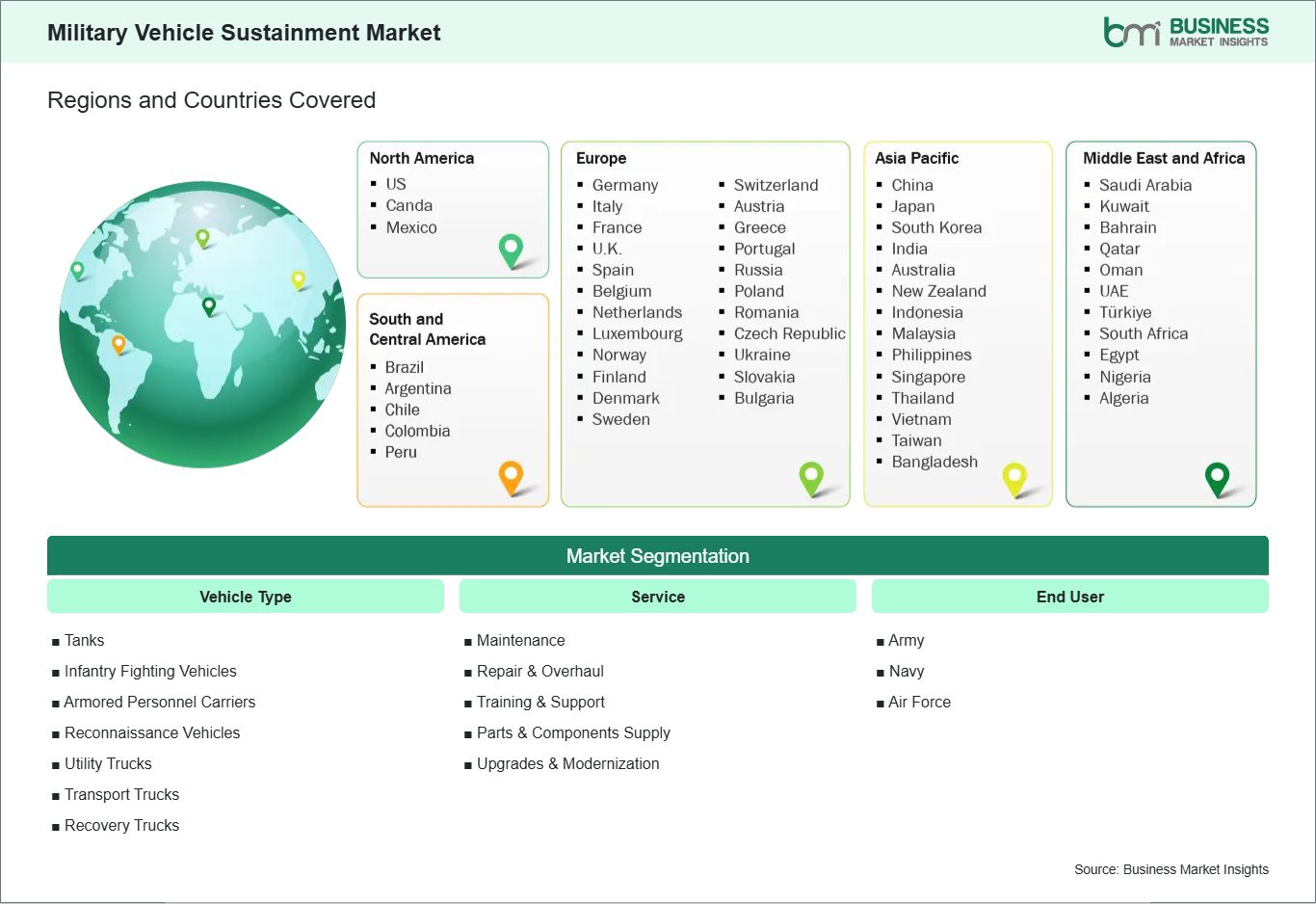
The military vehicle sustainment market is segmented based on vehicle type, service, and end user, reflecting the increasing need for lifecycle support and modernization of defense vehicle fleets across military organizations.
By Vehicle Type
- Tanks: Sustainment services supporting main battle tanks through overhaul programs, engine upgrades, armor modernization, weapon system integration, and mobility enhancement initiatives
- Infantry Fighting Vehicles (IFVs): Maintenance and modernization solutions for infantry combat vehicles focused on survivability, firepower enhancement, communication systems, and battlefield mobility
- Armored Personnel Carriers (APCs): Sustainment activities including structural repairs, drivetrain maintenance, electronic system upgrades, and operational readiness management for troop transport vehicles
- Reconnaissance Vehicles: Support services for surveillance and reconnaissance platforms including sensor integration, mobility upgrades, and tactical communication enhancements
- Utility Trucks: Maintenance and logistical support solutions for military utility vehicles used in transportation, troop movement, and operational support missions
- Transport Trucks: Sustainment services for heavy military transport vehicles supporting logistics operations, supply chain mobility, and battlefield cargo transportation
- Recovery Trucks: Maintenance and operational support services for recovery and battlefield assistance vehicles designed for towing, repair, and vehicle extraction operations
By Service
- Maintenance, Repair & Overhaul (MRO): Comprehensive inspection, diagnostics, preventive maintenance, repair, refurbishment, and overhaul solutions for military vehicle fleets
- Training & Support: Technical training, operational support, simulation-based maintenance training, and fleet readiness management services for defense personnel
- Parts & Components Supply: Procurement and supply chain management of spare parts, engines, transmissions, armor systems, suspension systems, and electronic vehicle components
- Upgrades & Modernization: Vehicle modernization initiatives including digital battlefield integration, weapon system upgrades, armor enhancement, autonomous capabilities, and communication system integration
By End User
- Army: Sustainment services supporting armored combat vehicles, tactical mobility platforms, and land warfare vehicle fleets used by army forces globally
- Navy: Maintenance and support solutions for amphibious assault vehicles, naval transport platforms, and expeditionary military vehicles used in naval operations
- Air Force: Sustainment support for airbase operational vehicles, runway support equipment, tactical transport fleets, and airfield logistics vehicles
Market Forces
Military Vehicle Sustainment Market Drivers and Opportunities
Increasing Demand for Fleet Readiness and Lifecycle Extension Programs
The military vehicle sustainment market is witnessing substantial growth due to the increasing focus on fleet readiness, operational availability, and lifecycle extension of military vehicles across global defense organizations. Many countries continue to operate aging armored and tactical vehicle fleets that require regular maintenance, repair, and modernization to maintain combat effectiveness and operational reliability. Defense agencies are increasingly prioritizing sustainment solutions to optimize operational performance while reducing the costs associated with complete fleet replacement programs.
The growing deployment of military vehicles in border security missions, peacekeeping operations, rapid response deployments, and asymmetric warfare scenarios is accelerating demand for advanced sustainment services. Governments worldwide are investing heavily in predictive maintenance systems, digital fleet management technologies, and modernization programs to improve mission readiness and reduce equipment downtime. In addition, increasing emphasis on multi-domain operations and integrated battlefield mobility is creating strong demand for enhanced sustainment infrastructure and logistics support capabilities.
Expansion of Digital Maintenance Technologies and Vehicle Modernization Programs
Significant opportunities are emerging in the military vehicle sustainment market through the adoption of AI-enabled diagnostics, predictive maintenance technologies, and advanced vehicle modernization initiatives. Defense organizations are increasingly integrating digital maintenance platforms, IoT-enabled sensors, and condition-based monitoring systems to improve maintenance efficiency and extend vehicle operational life cycles. These technologies support real-time fault detection, predictive analytics, and optimized maintenance scheduling, reducing operational disruptions and improving fleet sustainability.
The growing focus on battlefield digitization, autonomous mobility systems, hybrid propulsion technologies, and smart armored vehicle platforms is creating new growth opportunities for sustainment providers and defense contractors. Furthermore, increasing investments in modular upgrade programs, electronic warfare integration, cybersecurity protection systems, and advanced communication technologies are supporting the development of next-generation military vehicle sustainment ecosystems. Vendors offering integrated lifecycle management solutions, advanced spare parts logistics, and digital sustainment platforms are expected to gain a competitive advantage as military organizations continue to modernize land combat capabilities globally.
Size and Share Analysis
Military Vehicle Sustainment Market Size and Share Analysis
The Military Vehicle Sustainment Market is projected to grow from US$ 25.88 Billion in 2025 to US$ 51.36 Billion by 2033 , registering a CAGR of 8.95% from 2026 to 2033.
By vehicle type, tanks account for a significant market share due to rising investments in armored vehicle modernization, survivability enhancement, and battlefield mobility upgrades. Infantry fighting vehicles and armored personnel carriers are witnessing strong demand driven by increasing military mobility requirements and modernization of mechanized infantry fleets. Transport trucks and utility vehicles continue to experience steady growth owing to rising demand for military logistics support and rapid deployment capabilities.
By service, the maintenance, repair & overhaul (MRO) segment dominates the market due to the continuous need for fleet maintenance, operational readiness, and lifecycle extension of military vehicles. Upgrades & modernization services are expected to witness strong growth driven by increasing integration of digital battlefield technologies, communication systems, and advanced protection solutions. Parts & components supply services also maintain strong demand due to growing requirements for spare parts availability and supply chain resilience.
By end user, the army segment holds the largest market share owing to the extensive deployment of armored vehicles, tactical combat platforms, and logistics fleets across land warfare operations. Naval forces are increasingly investing in sustainment services for amphibious and expeditionary vehicles, while air forces continue to expand support requirements for tactical transport and airbase operational vehicles.
Report Coverage
Military Vehicle Sustainment Market Report Coverage and Deliverables
The "Military Vehicle Sustainment market Size and Forecast (2022–2033)" report provides a detailed analysis of the market covering below areas:
- Military vehicle sustainment market size and forecast at global, regional, and country levels for all market segments covered under the scope
- Military vehicle sustainment market trends, as well as drivers, restraints, and opportunities
- Military vehicle sustainment market analysis covering key trends, global and regional framework, major players, regulations, and recent developments
- Industry landscape and competition analysis covering market concentration, heat map analysis, prominent players, and recent developments for the military vehicle sustainment market
- Detailed company profiles, including SWOT analysis
Geographic Insights
Military Vehicle Sustainment Market Geographic Insights
The military vehicle sustainment market demonstrates diverse regional adoption patterns influenced by defense modernization initiatives, operational readiness requirements, and increasing investments in armored vehicle lifecycle management programs.
North America holds a dominant position in the market due to high defense spending, extensive armored vehicle fleets, and advanced military maintenance infrastructure. The United States continues to invest heavily in combat vehicle modernization programs, predictive maintenance systems, tactical mobility enhancement, and next-generation armored vehicle platforms. Increasing focus on operational readiness, battlefield mobility, and integrated logistics support systems is further supporting market growth across the region. Canada is also strengthening investments in military mobility platforms, Arctic defense operations, and vehicle sustainment capabilities to improve national defense preparedness.
Asia Pacific is witnessing substantial market growth driven by rising geopolitical tensions, increasing military modernization activities, and expanding indigenous defense manufacturing capabilities. Countries such as China, India, Japan, and South Korea are heavily investing in armored vehicle upgrades, tactical mobility enhancement, military logistics systems, and advanced battlefield technologies. The region is increasingly focusing on fleet modernization, operational sustainability, and integrated combat readiness programs to strengthen strategic defense capabilities. Rising investments in armored personnel carriers, infantry combat vehicles, transport fleets, and military infrastructure are further accelerating market expansion across Asia Pacific.
Europe is also experiencing notable market growth due to rising NATO defense spending, increasing armored vehicle procurement programs, and modernization of military logistics capabilities. Meanwhile, Middle East and Africa countries are strengthening military mobility and battlefield readiness programs, contributing to increasing demand for military vehicle sustainment services across the region.
Industry Activity
Recent Developments
The military vehicle sustainment market is evaluated by gathering qualitative and quantitative data post primary and secondary research, which includes important corporate publications, association data, and databases. A few of the key developments in the military vehicle sustainment market are:
- In May 2026, The U.S. Department of State has made a determination approving a possible Foreign Military Sale to the Government of Ukraine for Hawk Missile System Sustainment and related equipment. The estimated total cost is US$108.1 million.
- In March 2026, Oshkosh Defense LLC is exhibiting at the Association of the U.S. Army Global Force Symposium, March 24–26, highlighting how commercial manufacturing strength, rapid integration, and lifecycle sustainment accelerate the fielding of integrated fires and multi-domain capability. Oshkosh Defense is showcasing integration-enabled platforms that bring power, autonomy, and mission systems together—advancing operational speed and reducing program risk for the U.S. Army.
Trust & Transparency
Research Methodology
The market analysis combines proprietary research with secondary data from government agencies, company disclosures, regulatory filings, industry databases and expert interviews. Market estimates are validated through data triangulation, cross-market benchmarking and analyst
review.
View Full Research Methodology
Key Sources Referred:
Stockholm International Peace Research Institute (SIPRI)
North Atlantic Treaty Organization (NATO)
International Institute for Strategic Studies (IISS)
S. Department of Defense (DoD)
Company Websites
Company Annual Reports
Company Investor Presentations