
Military Drone Market Outlook: Size, Share, Trends, Growth Analysis, Competitive Landscape & Forecast, 2026–2033

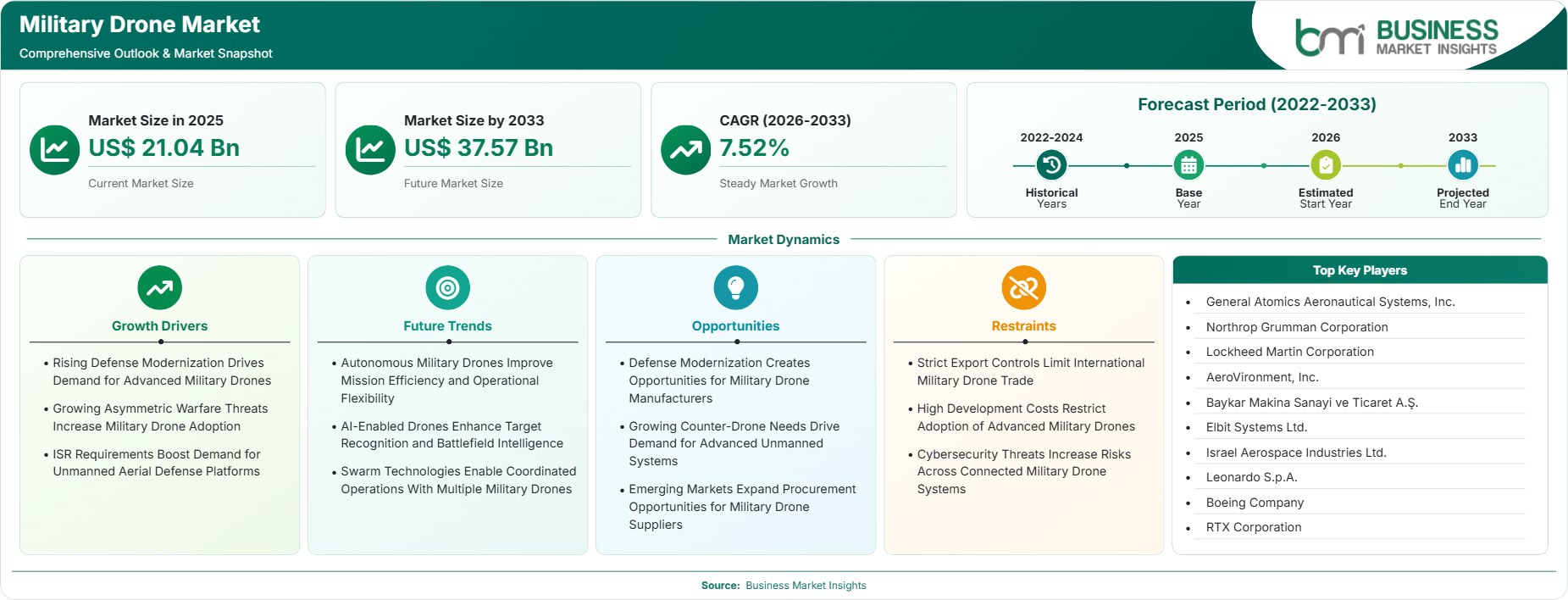
The Military Drone Market size was valued at US$ 21.04 Billion in 2025 and is projected to reach US$ 37.57 Billion by 2033, growing at a CAGR of 7.52% during 2026–2033, driven by defense modernization, ISR requirements, asymmetric warfare, counter-drone capabilities, and expanding procurement across emerging markets.

Report Coverage
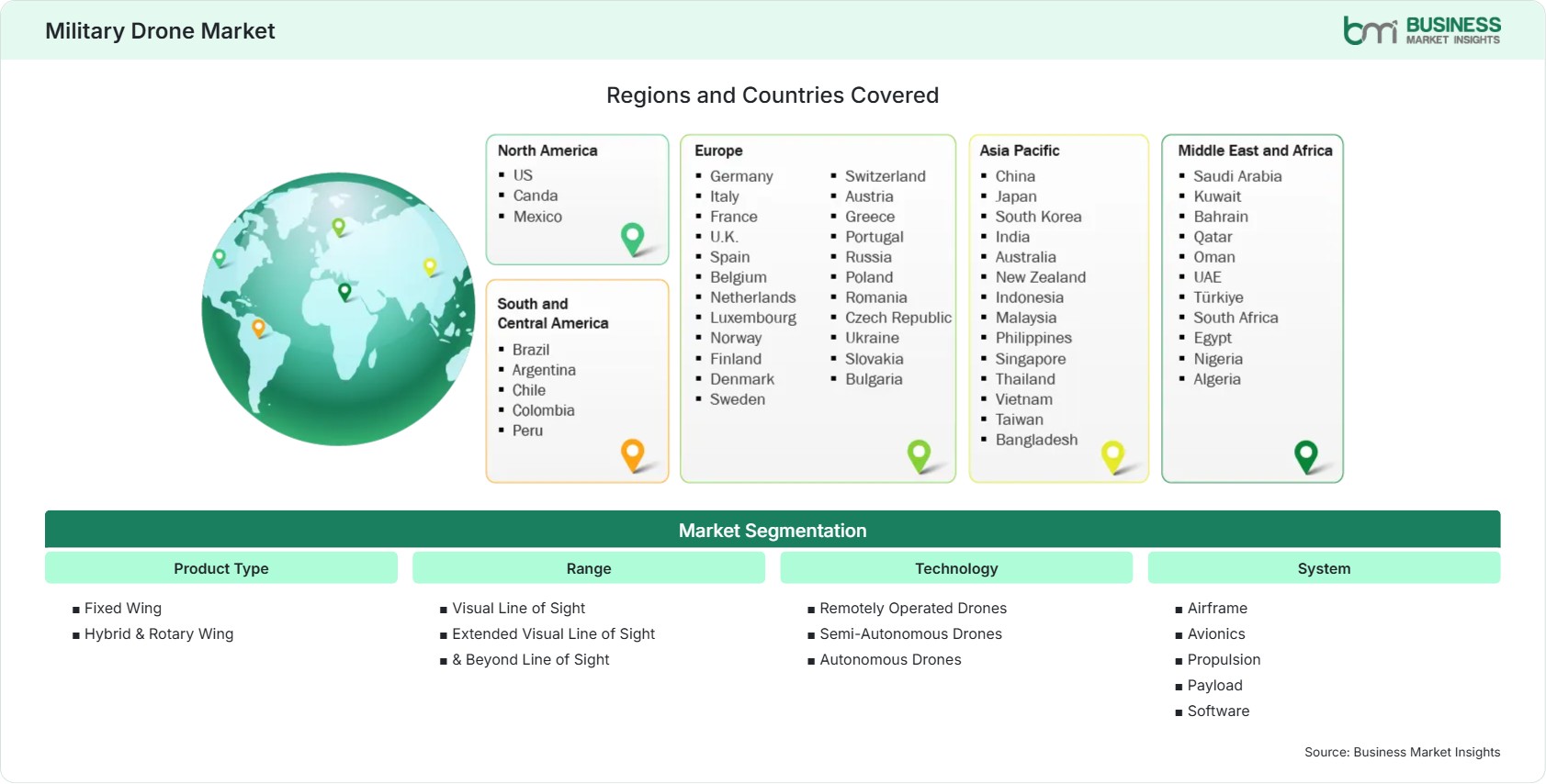
  • Product Type: Fixed Wing, Hybrid & Rotary Wing
  • Range: Visual Line of Sight, Extended Visual Line of Sight,& Beyond Line of Sight
  • Technology: Remotely Operated Drones, Semi-Autonomous Drones, Autonomous Drones
  • System: Airframe, Avionics, Propulsion, Payload, Software
  • Application: Intelligence, Surveillance Reconnaissance,& Targeting, Combat Operations, Battle Damage Management
US$ 21.04 Bn Market size in 2025
US$ 37.57 Bn Market Size by 2033
7.52% CAGR, 2026 - 2033
2026-2033 Forecast Period

AI Overview

Military Drone Market Summary

  • North America Region: North America holds a share of 35%–40% in 2025, growing at a CAGR of 6%–8% during 2026–2033, supported by defense modernization, autonomous systems development, ISR requirements, counter-drone investments, and sustained procurement by the US Department of Defense. The US market remains dominant, with a CAGR of 6%–8% during 2026–2033, supported by modernization programs, autonomous platforms, long-range ISR, precision targeting, and increased counter-UAS spending.
  • Fastest Growing Region: Asia Pacific holds a share of 24%–29% in 2025, expanding at a CAGR of 9%–11% through 2033, driven by territorial tensions, military modernization, indigenous defense manufacturing, border surveillance, ISR requirements, and increasing investments in autonomous and long-range unmanned systems.
  • Leading Segment: Fixed Wing holds a share of 50%–55% in 2025, growing at a CAGR of 6%–8% through 2033, supported by long endurance, extended operational range, persistent surveillance capabilities, strategic reconnaissance requirements, and growing demand for intelligence and targeting missions.
  • High Growth Segment: Autonomous Drones represent a share of 15%–20% in 2025 and are projected to grow at a CAGR of 11%–14% through 2033, supported by artificial intelligence, autonomous navigation, reduced operator dependence, swarm operations, and evolving battlefield requirements.
  • Key Market Opportunity: Defense agencies are prioritizing autonomous, networked, and counter-drone capabilities, creating opportunities for suppliers offering integrated platforms combining advanced sensors, secure communications, artificial intelligence, electronic warfare, and precision payloads.
  • Major Market Players: General Atomics Aeronautical Systems, Inc., Northrop Grumman Corporation, Lockheed Martin Corporation, AeroVironment, Inc., Baykar Makina Sanayi ve Ticaret A.Ş., Elbit Systems Ltd., Israel Aerospace Industries Ltd., Leonardo S.p.A., Boeing Company, RTX Corporation.
Strategic Insights

Military Drone Market: Strategic Insights

Military Drone Market Strategic Framework
FREE PDF
Request your free sample
Request free sample
Stakeholder View

Key Takeaways

  • The value chain is moving toward vertically integrated unmanned ecosystems where airframes, avionics, propulsion, payloads, software, communications, and ground-control infrastructure are increasingly developed as interoperable systems.
  • Autonomous drones offer the strongest technological upside as defense forces seek persistent surveillance, coordinated missions, reduced operator workload, and greater operational resilience in contested environments.
  • Artificial intelligence, edge computing, multisensor fusion, and secure communications are becoming central innovation priorities, shifting competitive advantage toward software and mission-system capabilities.
  • Asia Pacific presents a compelling investment case due to territorial security requirements, military modernization programs, domestic defense manufacturing initiatives, and increasing demand for persistent surveillance.
  • Defense suppliers are pursuing partnerships, acquisitions, and domestic production agreements to strengthen capabilities across autonomy, propulsion, sensors, electronic warfare, and counter-UAS technologies.
  • Counter-drone capabilities are becoming a parallel investment priority as widespread unmanned system deployment increases demand for detection, tracking, identification, jamming, and defeat technologies.
Geographic Outlook

Military Drone Market Regional Highlights

North America Military Drone Market

North America accounted for a Military Drone Market share of 35%–40% in 2025 and is projected to grow at a CAGR of 6%–8% through 2033. The US dominates regional demand through defense modernization, ISR programs, autonomous systems development, and counter-UAS investments. Canada also contributes to regional demand through Arctic surveillance and defense modernization priorities, while domestic manufacturing and technology development strengthen the broader unmanned systems ecosystem.

  • US defense procurement supports demand for long-endurance ISR platforms, autonomous systems, advanced sensors, and networked unmanned capabilities across multiple military services and mission environments.
  • Counter-UAS investments are expanding as defense agencies seek integrated solutions capable of detecting, tracking, identifying, and defeating hostile unmanned platforms.
  • Artificial intelligence and autonomous navigation are becoming central technology priorities, enabling reduced operator workload and improved mission effectiveness in complex operational environments.
  • Domestic manufacturing initiatives are strengthening supply chain resilience for critical components including avionics, sensors, propulsion systems, secure communications, and specialized payloads.

US Military Drone Market

The US represented 82%–87% of North America's Military Drone Market share in 2025 and is projected to grow at a CAGR of 6%–8% through 2033. The market benefits from substantial defense spending, advanced unmanned aircraft programs, and increasing emphasis on autonomous systems. The US also remains a major technology exporter, although export controls influence international sales opportunities and supplier strategies.

  • Defense modernization programs are increasing demand for advanced unmanned systems capable of supporting ISR, targeting, electronic warfare, logistics, and other operational missions.
  • Counter-UAS investments are expanding as military planners address the growing proliferation of commercially available and purpose-built hostile drones.
  • AI-enabled autonomy and collaborative unmanned operations are receiving increased attention as forces seek scalable capabilities for contested and communications-degraded environments.

Europe Military Drone Market

Europe held a Military Drone Market share of 20%–24% in 2025 and is projected to grow at a CAGR of 7%–9% through 2033. Germany, France, the UK, and Poland represent important markets supported by defense modernization and increased security requirements. Poland is projected to grow at a CAGR of 9%–11%, while Germany is expected to expand at 7%–9%. European procurement increasingly emphasizes sovereign capabilities, interoperability, persistent ISR, and counter-UAS technologies.

  • Germany is strengthening defense capabilities and expanding interest in unmanned systems for surveillance, reconnaissance, and operational support missions.
  • Poland offers strong growth potential due to defense modernization, regional security concerns, and increasing investments in unmanned and counter-UAS capabilities.
  • France and the UK continue developing advanced unmanned technologies while emphasizing sovereign industrial capabilities and integration with broader defense networks.
  • European suppliers are increasingly pursuing multinational partnerships to distribute development costs and establish interoperable platforms for allied defense forces.

Asia Pacific Military Drone Market

Asia Pacific accounted for a Military Drone Market share of 24%–29% in 2025 and is projected to grow at a CAGR of 9%–11% through 2033. China, India, Japan, South Korea, and Australia represent key markets, with India projected to grow at a CAGR of 10%–12%.

  • India is expanding domestic unmanned aircraft manufacturing and procurement to strengthen border surveillance, ISR capabilities, and defense technology self-reliance.
  • China maintains extensive unmanned system development capabilities across surveillance, reconnaissance, combat, and autonomous technologies, supporting a broad domestic ecosystem.
  • Japan and South Korea are increasing investments in unmanned systems as part of broader defense modernization and regional security strategies.
  • Australia is strengthening long-range surveillance and autonomous capabilities to support maritime security and operations across geographically dispersed areas.

Rest of World Military Drone Market

South and Central America represented a Military Drone Market share of 5%–8% in 2025 and are projected to grow at a CAGR of 5%–7%. Brazil, Colombia, and Mexico are leading markets, supported by border surveillance, maritime security, counter-narcotics operations, and defense modernization. Brazil provides opportunities for domestic aerospace development, while Colombia and Mexico prioritize persistent surveillance and security applications. The Middle East and Africa accounted for a 7%–10% share in 2025 and are projected to grow at a CAGR of 8%–10%. Saudi Arabia, the UAE, Israel, and Türkiye represent major markets. Saudi Arabia is projected to grow at a CAGR of 9%–11%, supported by defense modernization and localization initiatives.

  • Brazil offers opportunities through border monitoring, maritime surveillance, and domestic aerospace capabilities, although procurement cycles remain sensitive to defense budget availability.
  • Mexico and Colombia continue evaluating unmanned systems for border security, surveillance, counter-narcotics operations, and maritime monitoring requirements.
  • Saudi Arabia is expanding defense localization and technology partnerships, creating opportunities for domestic manufacturing and advanced unmanned system development.
  • The UAE remains an important regional market for sophisticated unmanned platforms, autonomous technologies, ISR capabilities, and integrated defense systems.
  • Israel and Türkiye continue influencing regional procurement through advanced unmanned technologies, combat-proven platforms, indigenous production, and growing international export activities.
Global Market Geography
FREE PDF
Request your free sample
Request free sample
Segment Analysis

Military Drone Market Segmentation

Product Type

Fixed Wing represented a 50%–55% share in 2025 and is projected to grow at a CAGR of 6%–8% through 2033. Long endurance, extended range, persistent ISR, and strategic surveillance requirements sustain demand, while hybrid and rotary-wing platforms provide complementary operational flexibility.

  • Fixed Wing: Fixed-wing drones provide long endurance and extended range, making them suitable for persistent ISR, border monitoring, maritime surveillance, and strategic reconnaissance missions.
  • Hybrid & Rotary Wing: Hybrid and rotary-wing platforms offer vertical takeoff, hovering, and flexible deployment capabilities, supporting tactical surveillance, targeting, logistics, and operations in constrained environments.

Range

Beyond Line of Sight represented a 45%–50% share in 2025 and is projected to grow at a CAGR of 8%–10% through 2033. Demand is supported by long-range ISR, secure satellite communications, strategic surveillance, and operations requiring extended geographic coverage.

  • Visual Line of Sight: Visual line-of-sight operations remain relevant for localized surveillance and tactical missions where direct operator control provides operational simplicity and lower communications requirements.
  • Extended Visual Line of Sight: Extended visual line-of-sight capabilities expand operational coverage beyond immediate control zones while maintaining relatively manageable communication and mission-control requirements.
  • Beyond Line of Sight: Beyond-line-of-sight systems enable long-distance operations using satellite or advanced communication links, supporting persistent ISR, strategic surveillance, and geographically dispersed military missions.

Technology

Remotely Operated Drones represented a 55%–60% share in 2025 and are projected to grow at a CAGR of 5%–7% through 2033. Mature operating models and established military training structures support adoption, while autonomous systems deliver faster growth through AI integration.

  • Remotely Operated Drones: Remotely operated systems provide established human control, enabling predictable mission execution across ISR, targeting, surveillance, and combat operations with mature operational procedures.
  • Semi-Autonomous Drones: Semi-autonomous systems combine human oversight with automated navigation and mission functions, improving operator efficiency while maintaining direct control over critical operational decisions.
  • Autonomous Drones: Autonomous platforms use AI, machine learning, and onboard decision capabilities to perform complex missions with reduced operator dependence and increased operational scalability.

System

Payload represented a 25%–30% share in 2025 and is projected to grow at a CAGR of 8%–10% through 2033. Sensor sophistication, precision targeting, electronic warfare, and mission-specific equipment are increasing payload value and influencing platform differentiation.

  • Airframe: Airframe design determines endurance, maneuverability, payload capacity, survivability, and operational range, with modular architectures increasingly supporting diverse mission requirements.
  • Avionics: Advanced avionics integrate navigation, flight control, communications, and mission management systems, improving reliability and enabling sophisticated autonomous and networked operations.
  • Propulsion: Propulsion technologies influence endurance, speed, payload capacity, and operational range, encouraging development of efficient engines and hybrid systems for extended missions.
  • Payload: Payload systems include electro-optical sensors, infrared cameras, radar, electronic warfare equipment, and precision systems supporting ISR, targeting, and combat missions.
  • Software: Mission software enables autonomous navigation, data processing, sensor fusion, fleet management, and decision support, increasing the strategic importance of software-defined capabilities.

Application

Intelligence, Surveillance Reconnaissance, & Targeting represented a 50%–55% share in 2025 and is projected to grow at a CAGR of 7%–9% through 2033. Persistent surveillance, battlefield awareness, and precision targeting requirements continue supporting application demand.

  • Intelligence, Surveillance Reconnaissance, & Targeting: ISR and targeting missions drive demand for persistent platforms equipped with advanced sensors, secure communications, real-time data processing, and precision targeting capabilities.
  • Combat Operations: Combat drones support strike missions and tactical operations, with demand influenced by precision engagement, reduced personnel exposure, and increasing integration of autonomous capabilities.
  • Battle Damage Management: Unmanned platforms provide post-strike assessment through high-resolution imaging and persistent surveillance, helping military forces evaluate effects and improve operational decision-making.
Market Forces

Military Drone Market Dynamics

Key Market Drivers

Rising Defense Modernization Drives Demand for Advanced Military Drones

Modernization efforts of governments are raising demands for unmanned systems that can provide multi-domain operations, constant surveillance, precise targeting capabilities, and autonomous operations. Governments are focusing on systems that not only increase situational awareness but also minimize any risks for their troops. The trend towards modernization is also resulting in procurement of network-centric platforms with state-of-the-art sensors, communication systems, artificial intelligence tools, and electronic warfare capabilities. The military drone market growth is becoming increasingly dependent on the defense technology sector rather than on aircraft acquisition.

Growing Asymmetric Warfare Threats Increase Military Drone Adoption

The rise in asymmetric warfare is driving demand for unmanned systems with the capability for surveillance, precision attacks, and flexible operations while reducing the risk to personnel. Military forces have been assessing the use of drones for a variety of missions, from tactical reconnaissance to combat engagements especially where traditional aircraft will be costly or more vulnerable. This has been further driven by the development of unmanned vehicles which cost less than their traditional counterparts and this has brought about the need to perform in dynamic battlefield situations.

ISR Requirements Boost Demand for Unmanned Aerial Defense Platforms

The need for intelligence, surveillance and reconnaissance continues to be one of the major factors driving the adoption of drones in the military. Drones have the capability to stay aloft for long periods of time while collecting intelligence from electro-optical sensors, infrared sensors, radar sensors and signals intelligence sensors to give commanders real-time visibility on the battlefield. The application base is widening from classic reconnaissance to target identification, border surveillance, sea surface surveillance and battle damage assessment. Improvements in on-board processing capability enable selection and analysis of some collected data closer to where it was acquired without relying on centralized processing systems. Military Drone Market trends increasingly favor multi-sensor platforms that can integrate information from different sources into unified operational pictures.

Key Market Opportunities

Defense Modernization Creates Opportunities for Military Drone Manufacturers

The defense modernization initiatives provide potential for manufacturers who can provide modular and interoperable unmanned systems. The need for systems that can easily be integrated with new sensors, software, communication, and mission payloads without the need for full system replacement creates potential for manufacturers that can provide an open architecture. In addition to the demand for systems that can easily be integrated with other components, there is also a trend for using local production and technology transfer as a way of increasing the supply chain resilience.

Growing Counter-Drone Needs Drive Demand for Advanced Unmanned Systems

The rapid proliferation of unmanned systems is creating a parallel market for counter-drone capabilities, generating opportunities for suppliers across detection, tracking, identification, electronic warfare, and kinetic defeat technologies. Military forces require layered systems capable of addressing diverse threats ranging from small commercial drones to sophisticated autonomous platforms. This demand is encouraging investment in radar, electro-optical sensors, radio-frequency detection, jamming, directed energy, and integrated command systems. Counter-UAS technologies also create opportunities for software companies developing AI-enabled threat classification and automated response management.

Emerging Markets Expand Procurement Opportunities for Military Drone Suppliers

Developing defense markets provide new procurement opportunities for governments in search of cost-effective means of enhancing surveillance, border protection, maritime awareness, and defense capabilities. Countries in Asia Pacific, Middle East, Latin America, and Africa are considering the use of unmanned systems in their modernization efforts. Military Drone Market Forecast dependent on procurement outside defense markets in which there are opportunities available to suppliers through direct selling, partnerships, local assembly, technology transfers, and training. Entry into such markets necessitates familiarity with export restrictions, offset requirements, local content rules, and geopolitics.

Market Restraints and Challenges

Strict Export Controls Limit International Military Drone Trade

Factor: Military drones use highly sophisticated technologies, such as sensors, encryption, autonomy, propulsion systems, and precision technology. Impact: The export restrictions imposed on them may narrow down their market and elongate the sales cycle as they may not be exported to some customers. The regulations governing the export of such drones may differ depending on the jurisdiction, and the need for them may vary depending on geopolitics.

High Development Costs Restrict Adoption of Advanced Military Drones

Factor: Development of modern military drones is a capital-intensive process that involves significant investments in aerospace engineering, automation software, sensors, communications security, propulsion, and certification before deployment. Impact: High development costs may hinder adoption by military organizations with limited budget capabilities, increasing financial risks to manufacturers of new models. Systems of automation and high-tech payload equipment need comprehensive testing in realistic working environments, as well as cybersecurity and EW resistance.

Company Analysis

Competitive Landscape

The military drone market analysis reveals that the defense technology sector is extremely competitive, comprising leading aerospace companies, unmanned systems developers, electronics firms, and integrated defense manufacturers. Competitive positioning is increasingly dependent on autonomy, endurance, sensor integration, secure communications, payload versatility, survivability, and lifecycle management.

Company Name

Overview

Products and Services relevant to this market

General Atomics Aeronautical Systems, Inc.

Specialized aerospace company recognized for advanced unmanned aircraft systems serving intelligence, surveillance, reconnaissance, and defense missions.

MQ-9-series remotely piloted aircraft, unmanned systems, ground control stations, sensors, and mission support solutions.

Northrop Grumman Corporation

Major defense technology company developing advanced autonomous, aerospace, surveillance, and mission systems for government customers.

Unmanned aircraft, autonomous systems, ISR platforms, sensors, command systems, and integrated defense technologies.

Lockheed Martin Corporation

Global aerospace and defense company providing advanced aircraft, autonomous systems, sensors, and mission technologies.

Unmanned platforms, autonomous technologies, ISR systems, advanced sensors, mission software, and defense integration services.

AeroVironment, Inc.

Specialized unmanned systems company focused on small and medium unmanned aircraft and autonomous defense technologies.

Tactical drones, loitering munitions, unmanned aircraft, autonomous systems, and integrated intelligence solutions.

Baykar Makina Sanayi ve Ticaret A.Ş.

Turkish aerospace and defense manufacturer specializing in unmanned aerial systems and advanced autonomous technologies.

Bayraktar unmanned aircraft systems, combat UAVs, autonomous technologies, sensors, and integrated mission capabilities.

Elbit Systems Ltd.

Defense electronics company providing unmanned systems, sensors, intelligence technologies, and integrated mission solutions.

Unmanned aerial systems, ISR platforms, electro-optical systems, payloads, communications, and mission management technologies.

Israel Aerospace Industries Ltd.

Aerospace and defense company offering extensive capabilities across unmanned aircraft, intelligence, surveillance, and defense systems.

Heron-series UAVs, unmanned systems, ISR technologies, sensors, communications, and integrated mission solutions.

Leonardo S.p.A.

Global aerospace and defense company developing aircraft, electronics, sensors, and unmanned technologies for military customers.

Unmanned systems, surveillance technologies, airborne sensors, avionics, mission systems, and defense electronics.

Boeing Company

Major aerospace and defense manufacturer developing advanced autonomous aircraft and integrated unmanned systems.

MQ-25 unmanned aircraft, autonomous systems, advanced aerospace technologies, mission systems, and defense integration.

RTX Corporation

Defense and aerospace technology company providing sensors, propulsion, communications, and integrated systems supporting unmanned operations.

Advanced sensors, radar, propulsion, electronic warfare, communications, counter-UAS technologies, and defense systems.

Trust & Transparency

Research Methodology

The market analysis combines proprietary research with secondary data from government agencies, company disclosures, regulatory filings, industry databases and expert interviews. Market estimates are validated through data triangulation, cross-market benchmarking and analyst review.

View Full Research Methodology

Questions Answered

Frequently Asked Questions

What is the main challenge for military drone exporters?

Strict export controls and licensing requirements can restrict international sales, extend procurement timelines, and limit access to sensitive defense markets.

What role do counter-drone systems play?

Counter-drone systems provide detection, tracking, identification, and defeat capabilities against increasingly widespread unmanned aerial threats.

Which region offers the strongest growth opportunity in military drone market report?

Asia Pacific offers strong growth potential due to territorial security concerns, military modernization, and increasing domestic defense manufacturing.

Which military drone technology is growing fastest?

Autonomous drones are gaining momentum because AI, autonomous navigation, and improved onboard processing are enabling more complex missions.

What is driving military drone demand?

Defense modernization, ISR requirements, asymmetric warfare, border surveillance, and the need to reduce personnel exposure are driving procurement.

Access the Full Military Drone Market Report

Get segment-level forecasts, regional estimates, competitive benchmarking, company profiles and downloadable Excel datasets.

Access the full Military Drone Market Report
350 pages PDF & Excel | 2026-08-31
Similar Research

Related Market Reports