
Drone Motor Market Outlook: Size, Share, Trends, Growth Analysis, Competitive Landscape & Forecast, 2026-2033

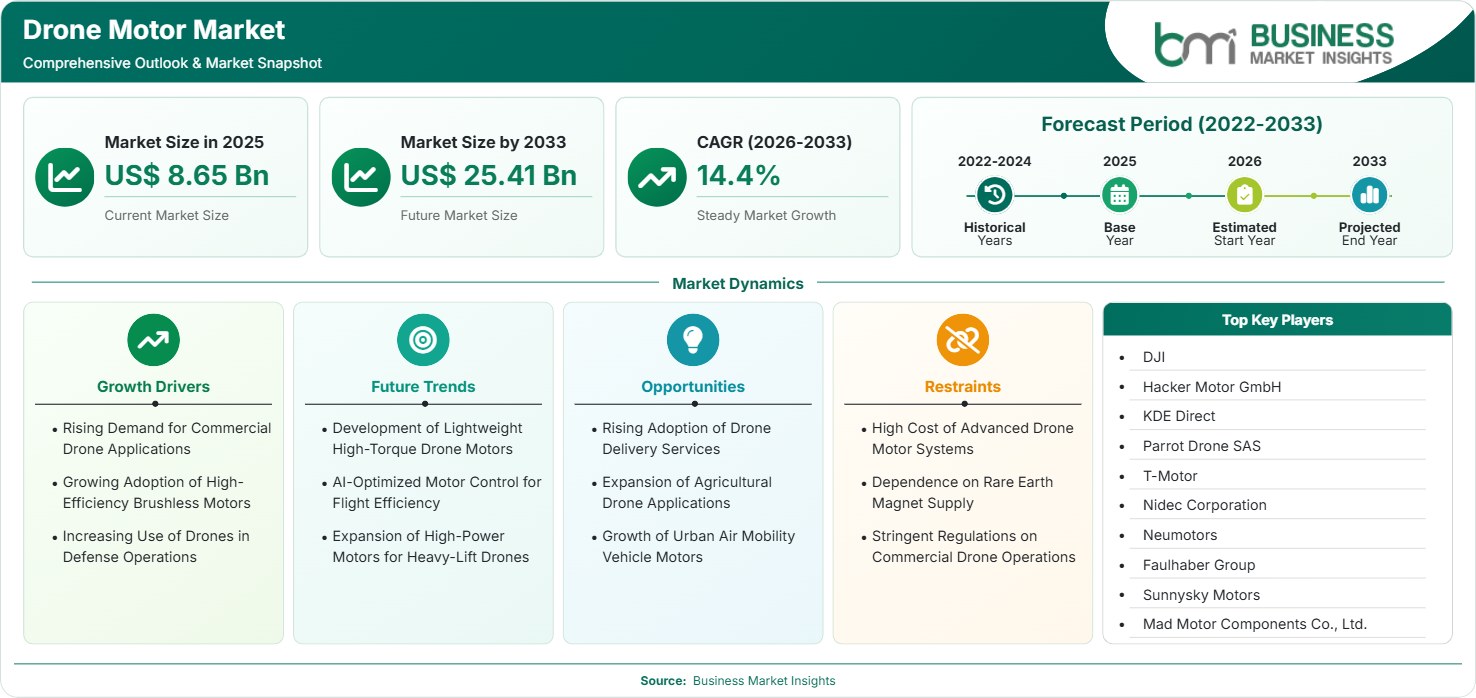
The Drone Motor Market size was valued at USD 8.65 Billion in 2025 and is projected to reach USD 25.41 Billion by 2033, growing at a CAGR of 14.4% during 2026–2033. Growth is driven by increasing adoption of drones across commercial and military applications, rising demand for aerial imaging and surveillance, expanding use of drones in precision agriculture, growing investments in unmanned aerial vehicle technologies, and advancements in lightweight high-performance motor systems.

Report Coverage
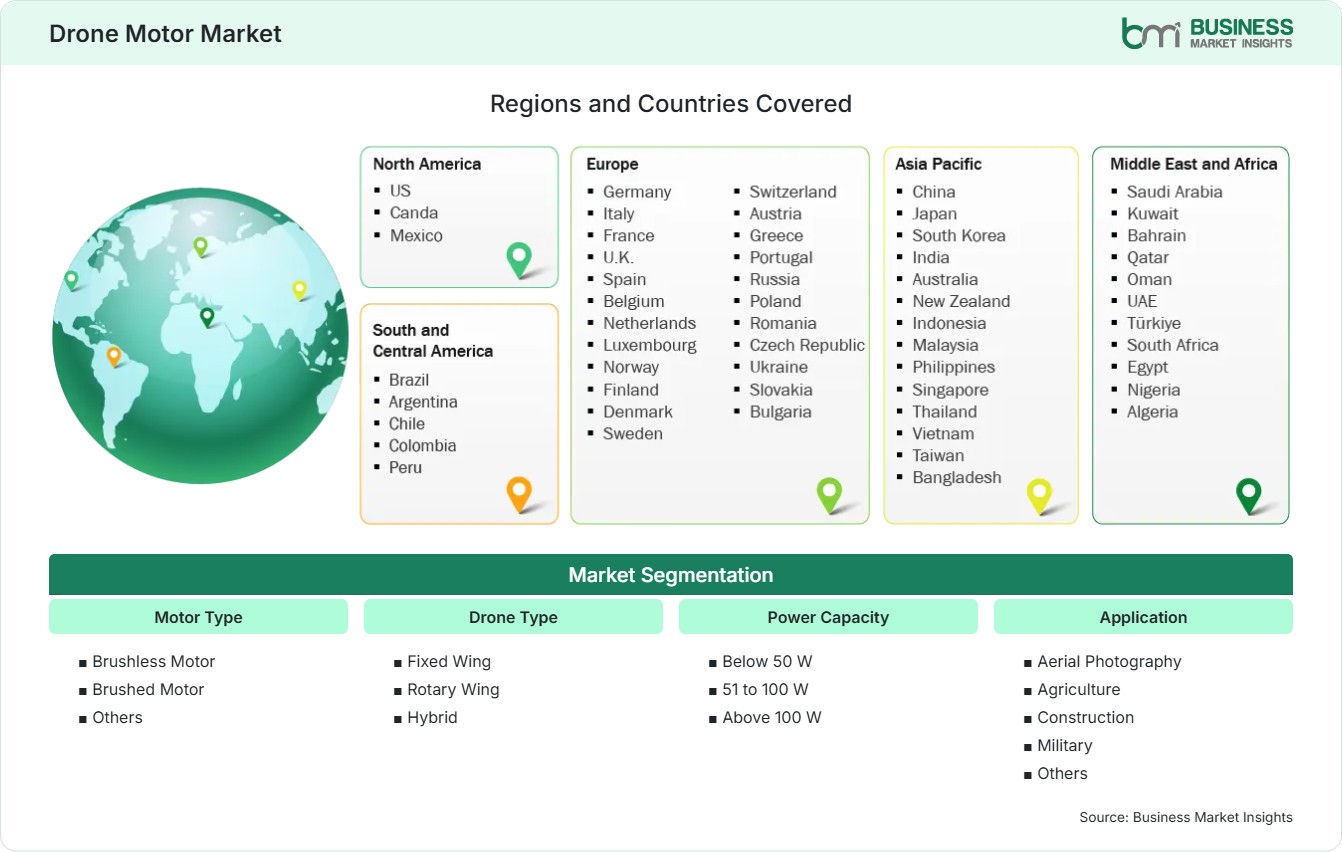
  • Motor Type: Brushless Motor, Brushed Motor, Others
  • Drone Type: Fixed Wing, Rotary Wing, Hybrid
  • Power Capacity: Below 50 W, 51 to 100 W, Above 100 W
  • Application: Aerial Photography, Agriculture, Construction, Military, Others
US$ 8.65 Bn Market size in 2025
US$ 25.41 Bn Market Size by 2033
14.4% CAGR, 2026 - 2033
2026-2033 Forecast Period

AI Overview

Drone Motor Market Summary

North America Region: North America holds a market share of 29%–32% in 2025, growing at a CAGR of 13.6%–14.2% during 2026–2033. Demand is supported by strong defense spending, commercial drone deployment, and increasing adoption of industrial UAV solutions. The U.S. remains the dominant market, advancing at a CAGR of 13.8%–14.4%.

Fastest Growing Region: Asia Pacific accounts for 36%–39% of revenue in 2025 and is projected to register a CAGR of 15.2%–15.9% through 2033. Expanding drone manufacturing, increasing agricultural drone usage, and rising investments in UAV technologies continue supporting market development.

Leading Segment: Brushless Motors hold a market share of 67%–71% in 2025 and are expected to grow at a CAGR of 14.7%–15.3%. Demand is driven by superior efficiency, durability, power output, and reduced maintenance requirements.

High Growth Segment: Military Applications account for 23%–27% of market revenue in 2025 and are projected to register a CAGR of 15.6%–16.3% during the forecast period. Growing deployment of drones for reconnaissance, surveillance, and tactical missions continues supporting expansion.

Key Market Opportunity: Growing adoption of autonomous drones, advanced aerial mobility solutions, and next-generation UAV platforms is creating significant opportunities for motor manufacturers.

Major Market Players: DJI, Hacker Motor GmbH, KDE Direct, Parrot Drone SAS, T-Motor, Nidec Corporation, Neumotors, Faulhaber Group, Sunnysky Motors, and Mad Motor Components Co., Ltd.

Strategic Insights

Drone Motor Market: Strategic Insights

Drone Motor Market Strategic Framework
FREE PDF
Request your free sample
Request free sample
Stakeholder View

Key Takeaways

  • The market ecosystem includes drone manufacturers, motor suppliers, component manufacturers, defense organizations, agricultural operators, technology providers, and commercial UAV service companies.
  • Brushless motors remain the most attractive segment due to higher efficiency, superior durability, lower maintenance requirements, and compatibility with advanced UAV systems.
  • Product innovation increasingly focuses on lightweight construction, enhanced power-to-weight ratios, thermal management, and longer operational lifespans.
  • Asia Pacific provides the strongest growth potential supported by extensive drone manufacturing activity, rising agricultural drone adoption, and expanding commercial UAV deployments.
  • Military and defense applications continue driving demand for high-performance motors capable of supporting surveillance, reconnaissance, and tactical missions.
  • Emerging applications such as drone delivery, infrastructure inspection, autonomous flight systems, and urban air mobility are expected to generate significant future opportunities throughout the value chain.
Geographic Outlook

Drone Motor Market Regional Highlights

North America Drone Motor Market

North America accounted for 29%–32% of global revenue in 2025 and is projected to expand at a CAGR of 13.6%–14.2% through 2033. Growth is supported by increasing deployment of commercial drones, rising defense expenditure, expanding infrastructure inspection activities, and strong adoption of UAV technologies across multiple industries. The Drone Motor Market share in the region continues benefiting from technological innovation and growing demand for high-performance propulsion systems.

  • Defense organizations continue increasing procurement of advanced UAV systems for surveillance, intelligence gathering, border security, and tactical missions.
  • Commercial drone operators are expanding applications in infrastructure inspection, mapping, construction monitoring, and utility asset management.
  • Manufacturers are increasingly focusing on lightweight and energy-efficient motor technologies to improve flight endurance and payload capacity.
  • Regulatory developments supporting commercial drone operations continue creating favorable conditions for broader UAV adoption.
  • Growing investments in autonomous drone technologies are increasing demand for reliable and high-performance motor systems.

US Drone Motor Market

The United States represented 24%–27% of global revenue in 2025 and is anticipated to register a CAGR of 13.8%–14.4% during the forecast period. Demand is driven by expanding military drone programs, rising commercial UAV deployments, and increasing investment in autonomous aviation technologies. Continued innovation in drone applications supports Drone Motor Market growth.

  • Defense and security applications remain major contributors to market demand.
  • Agricultural operators are increasingly utilizing drones for crop monitoring and precision farming activities.
  • Logistics and delivery service providers are exploring UAV deployment to improve operational efficiency.
  • Technology developers continue investing in advanced propulsion solutions and autonomous flight systems.

Europe Drone Motor Market

Europe held 23%–26% of global revenue in 2025 and is projected to grow at a CAGR of 13.9%–14.5% through 2033. Increasing adoption of drones in industrial inspections, agriculture, environmental monitoring, and defense applications continues supporting market expansion. Germany remains the leading market with a CAGR of 14.0%–14.6%, while Poland is the fastest-growing country, expanding at a CAGR of 14.7%–15.3%.

  • Industrial inspection activities are increasingly utilizing drones to improve operational efficiency and reduce costs.
  • Agricultural drone deployment continues expanding across precision farming and crop management applications.
  • Germany maintains leadership through advanced engineering capabilities and growing UAV technology investments.
  • European defense modernization initiatives continue supporting demand for high-performance drone motors.
  • Regulatory frameworks supporting commercial drone operations are encouraging wider market adoption.

Asia Pacific Drone Motor Market

Asia Pacific accounted for 36%–39% of global revenue in 2025 and is expected to remain the fastest-growing region, registering a CAGR of 15.2%–15.9% through 2033. Expanding drone manufacturing ecosystems, increasing commercial UAV adoption, and rising investments in agriculture and surveillance technologies continue driving market growth. China remains the largest regional market with a CAGR of 15.0%–15.7%, while India records the highest growth at 15.8%–16.5%.

  • Strong drone manufacturing activity continues generating substantial demand for advanced motor systems and propulsion components.
  • China benefits from extensive UAV production capabilities and growing commercial drone utilization across multiple sectors.
  • India is witnessing increasing adoption of agricultural drones for crop monitoring, spraying, and farm productivity enhancement.
  • Infrastructure development projects are creating demand for aerial surveying, mapping, and inspection services powered by UAV technologies.
  • Rising investments in defense modernization and border surveillance continue supporting long-term market growth.

Rest of World Drone Motor Market

The Rest of World region accounted for 7%–10% of global revenue in 2025 and is expected to register a CAGR of 13.5%–14.1% through 2033. Market growth is supported by increasing drone adoption across commercial, industrial, and government applications. Demand remains particularly strong in security, agriculture, and infrastructure monitoring sectors.

Brazil is the leading market in South & Central America and is forecast to grow at a CAGR of 13.8%–14.4%. In the Middle East & Africa, the United Arab Emirates is expected to be the fastest-growing country with a CAGR of 14.2%–14.8%.

  • Brazil continues benefiting from increasing use of drones in agriculture and environmental monitoring.
  • The United Arab Emirates is witnessing growing investments in smart technologies, security systems, and UAV innovation.
  • Mining and energy companies are increasingly adopting drones for inspection and surveying activities.
  • Government agencies continue utilizing UAV technologies for public safety and infrastructure monitoring purposes.
  • Expanding commercial awareness of drone capabilities is creating additional opportunities for motor manufacturers.
Global Market Geography
FREE PDF
Request your free sample
Request free sample
Segment Analysis

Drone Motor Market Segmentation

Motor Type

Motor technology remains one of the most critical performance determinants in drone design, directly influencing flight stability, payload capacity, efficiency, and operational lifespan. Brushless Motors lead the segment with 67%–71% share in 2025 and are projected to grow at a CAGR of 14.7%–15.3% through 2033. The Drone Motor Market scope continues expanding as drone manufacturers increasingly prioritize lightweight, energy-efficient, and durable propulsion systems capable of supporting both commercial and defense applications.

  • Brushless Motor: Dominates market demand due to superior efficiency, longer operational life, higher power output, reduced maintenance requirements, and enhanced reliability.
  • Brushed Motor: Continues to be utilized in entry-level and cost-sensitive drone platforms where affordability remains an important purchasing factor.
  • Others: Include specialized motor technologies designed for niche UAV applications, experimental aerial platforms, and advanced autonomous systems.

Drone Type

Drone type significantly influences motor selection, power requirements, endurance characteristics, and overall operational performance. Market demand continues diversifying as commercial and military users adopt drones tailored to specific mission requirements.

  • Fixed Wing: Utilized for long-range missions, large-area surveillance, mapping, and agricultural monitoring due to superior flight endurance and efficiency.
  • Rotary Wing: Represents the most widely adopted category owing to vertical takeoff and landing capabilities, maneuverability, and suitability for photography, inspection, and surveillance tasks.
  • Hybrid: Experiences growing adoption by combining the endurance advantages of fixed-wing platforms with the flexibility of rotary-wing systems.

Power Capacity

Power capacity remains a key differentiator influencing flight duration, payload handling, and mission capability. Demand for higher-capacity motors is increasing as UAV applications become more complex and payload-intensive.

  • Below 50 W: Commonly used in lightweight consumer drones, recreational UAVs, and small aerial photography platforms.
  • 51 to 100 W: Widely utilized across commercial drones requiring balanced performance, efficiency, and payload capacity.
  • Above 100 W: Increasingly adopted in industrial, defense, logistics, and heavy-lift drone platforms where higher power output is essential.

Application

Application diversity continues driving innovation in motor technologies as drones become integral tools across numerous industries. Military Applications account for 23%–27% market share in 2025 and are projected to register the fastest growth at a CAGR of 15.6%–16.3% through 2033.

  • Aerial Photography: Benefits from increasing demand for high-quality imaging, content creation, surveying, and cinematography applications.
  • Agriculture: Utilizes drones for crop monitoring, spraying, field analysis, and precision farming operations.
  • Construction: Increasingly adopts UAVs for site inspection, progress monitoring, mapping, and project planning.
  • Military: Drives strong demand for advanced motors capable of supporting surveillance, reconnaissance, intelligence gathering, and tactical missions.
  • Others: Include logistics, environmental monitoring, disaster management, energy inspection, and public safety applications.
Market Forces

Drone Motor Market Dynamics

Key Market Drivers

Rising Demand for Commercial Drone Applications

Commercial drone adoption is expanding rapidly across industries including agriculture, construction, logistics, real estate, infrastructure inspection, and media production. Organizations are utilizing drones to improve operational efficiency, reduce labor costs, and enhance data collection capabilities. As commercial applications become increasingly sophisticated, demand for high-performance motors capable of supporting longer flight durations and heavier payloads continues to increase. Manufacturers are developing optimized propulsion systems designed to meet the growing requirements of professional UAV operators. This expanding commercial ecosystem remains a major contributor to market growth.

Growing Adoption of High-Efficiency Brushless Motors

Brushless motor technology has become the preferred choice for modern drones due to its superior energy efficiency, reliability, and durability. These motors provide greater power output while minimizing energy losses, helping improve flight performance and battery utilization. Drone manufacturers increasingly prioritize brushless designs to meet growing expectations for endurance, payload capacity, and operational reliability. Continuous advancements in motor control systems and lightweight materials are further enhancing performance. The drone motor market trends growing adoption of brushless technologies remains a key factor supporting long-term market expansion.

Increasing Use of Drones in Defense Operations

Defense organizations worldwide are investing heavily in drone capabilities to support surveillance, reconnaissance, intelligence gathering, border monitoring, and tactical operations. Military UAVs often require advanced motor systems capable of delivering high reliability under demanding operational conditions. Increasing defense modernization initiatives and growing emphasis on unmanned systems continue driving procurement activity. As military applications become more sophisticated and mission-critical, demand for durable and high-efficiency drone motors is expected to strengthen substantially throughout the forecast period.

Key Market Opportunities

Rising Adoption of Drone Delivery Services

Drone delivery services are emerging as a significant growth opportunity as logistics providers, retailers, healthcare organizations, and e-commerce companies explore faster and more efficient delivery methods. These operations require motors capable of supporting stable flight, reliable payload transport, and extended operational ranges. Technological improvements in autonomous navigation and battery performance are accelerating pilot programs and commercial deployments. As regulatory frameworks evolve and delivery networks expand, manufacturers of advanced drone motors are expected to benefit from rising demand across urban, rural, and specialized delivery applications.

Expansion of Agricultural Drone Applications

Agricultural drones are becoming increasingly important tools for precision farming, crop monitoring, spraying, and field analysis. Farmers and agribusinesses are adopting UAV technologies to improve productivity, optimize resource utilization, and support data-driven decision-making. These applications require reliable motor systems capable of operating efficiently across large agricultural areas and varying environmental conditions. Growing focus on food security, farm automation, and sustainable agricultural practices continues supporting drone adoption. The Drone Motor market forecast and expanding role of UAVs in agriculture present a significant opportunity for motor manufacturers and technology suppliers.

Growth of Urban Air Mobility Vehicle Motors

Urban air mobility initiatives are creating new opportunities for advanced electric propulsion technologies. Emerging aerial mobility platforms require highly efficient motors capable of supporting passenger transport, cargo movement, and autonomous flight operations. Companies developing next-generation air mobility solutions are investing heavily in high-performance motor systems that deliver safety, reliability, and energy efficiency. Increased investment in advanced aviation technologies and smart transportation ecosystems is supporting market development. As urban air mobility progresses toward commercialization, demand for sophisticated motor technologies is expected to increase significantly.

Market Restraints and Challenges

High Cost of Advanced Drone Motor Systems

Factor: High-performance drone motors often require precision engineering, advanced materials, specialized manufacturing processes, and sophisticated electronic control systems.

Impact: Elevated product costs can limit adoption among small-scale operators and cost-sensitive buyers. Manufacturers must balance performance improvements with affordability to remain competitive across varying market segments. Cost considerations may also influence purchasing decisions in emerging commercial applications.

Dependence on Rare Earth Magnet Supply

Factor: Many advanced brushless motors rely on rare earth magnets for efficient performance and high power density characteristics.

Impact: Supply chain disruptions, price volatility, and sourcing challenges associated with rare earth materials can affect manufacturing costs and production planning. Companies may face increased procurement risks and operational uncertainties when securing critical raw materials. These challenges continue encouraging research into alternative materials and supply chain diversification strategies.

Company Analysis

Competitive Landscape

The market remains competitive with the presence of drone manufacturers, electric motor specialists, propulsion technology providers, and precision engineering companies. Market participants are focusing on lightweight motor designs, enhanced power efficiency, higher thrust capabilities, advanced thermal management, and integration with autonomous drone platforms. Growing demand for commercial UAV operations and defense applications continues shaping Drone Motor Market analysis and competitive strategies across the global unmanned aerial vehicle ecosystem.

Company Name

Overview

Products and Services Relevant to this Market

DJI

Leading drone manufacturer with extensive expertise in commercial and consumer UAV technologies.

Drone propulsion systems, UAV motors, aerial platform technologies.

Hacker Motor GmbH

Specialist manufacturer of high-performance electric motors for aerospace and drone applications.

Brushless motors, UAV propulsion solutions, electric drive systems.

KDE Direct

Developer of advanced propulsion systems for commercial and industrial drones.

Brushless motors, propulsion kits, drone power systems.

Parrot Drone SAS

Drone technology company serving commercial, security, and enterprise markets.

Drone motors, UAV solutions, aerial imaging platforms.

T-Motor

Manufacturer specializing in propulsion systems for professional UAV applications.

Brushless drone motors, ESCs, propulsion technologies.

Nidec Corporation

Global electric motor manufacturer serving industrial, automotive, and aerospace sectors.

Precision motors, drone propulsion systems, electric drive solutions.

Neumotors

Producer of high-efficiency electric motors for advanced aerospace and UAV applications.

UAV motors, high-performance electric propulsion systems.

Faulhaber Group

Precision drive technology company serving aerospace and industrial markets.

Miniature motors, drone propulsion systems, motion control solutions.

Sunnysky Motors

Manufacturer of brushless motors for UAV and aerial platform applications.

Drone motors, propulsion components, UAV drive systems.

Mad Motor Components Co., Ltd.

Supplier of motor technologies for commercial and industrial drone applications.

Brushless motors, UAV propulsion components, power systems.

Industry Activity

Recent Developments

July 2026

Vector Technics announced that it expanded the production capacity of its Shamshabad manufacturing facility to 300,000 units annually to design and build fully integrated drone propulsion stacks in-house

July 2026

DEUTZ AG announced that it launched industrial series production of the GEREON unmanned ground system at its Ulm plant under a strategic partnership with ARX Robotics, with initial deliveries scheduled for Ukraine starting in late summer.

June 2026

Schaeffler, along with French manufacturer Delair, entered into a new strategic partnership to support the industrial ramp-up of drone production in France and strengthen Europe's sovereign unmanned aerial systems.

March 2025

Tsubakimoto Chain Co. entered the engine-powered drone market by signing an exclusive license agreement with Aizawa Concrete Corporation to manufacture and sell the AZ-250 Engine-powered Drone.

Trust & Transparency

Research Methodology

The market analysis combines proprietary research with secondary data from government agencies, company disclosures, regulatory filings, industry databases and expert interviews. Market estimates are validated through data triangulation, cross-market benchmarking and analyst review.

View Full Research Methodology

Questions Answered

Frequently Asked Questions

What challenge has the greatest long-term impact on the industry?

Dependence on rare earth magnet supplies remains a significant challenge because material availability and price fluctuations can affect manufacturing costs and supply chain stability.

How are agricultural drones influencing market growth?

Agricultural drones are increasing demand for reliable propulsion systems used in crop monitoring, precision spraying, field mapping, and farm productivity optimization applications.

Why is Asia Pacific the fastest-growing region?

The region benefits from extensive drone manufacturing activity, increasing agricultural drone adoption, rising defense investments, and expanding commercial UAV applications.

Which motor type segment leads the market?

Brushless Motors lead the market due to their superior efficiency, durability, power output, longer lifespan, and lower maintenance requirements compared with brushed motors.

What is driving growth in the Drone Motor Market?

Rising demand for commercial drone applications, growing adoption of high-efficiency brushless motors, increasing use of drones in defense operations, and expanding UAV deployment across industries are the primary growth drivers.

Access the Full Drone Motor Market Report

Get segment-level forecasts, regional estimates, competitive benchmarking, company profiles and downloadable Excel datasets.

Access the full Drone Motor Market Report
350 pages PDF & Excel | 2026-08-04
Similar Research

Related Market Reports