
Medical Drone Market Outlook: Size, Share, Trends, Growth Analysis, Competitive Landscape & Forecast, 2026–2033

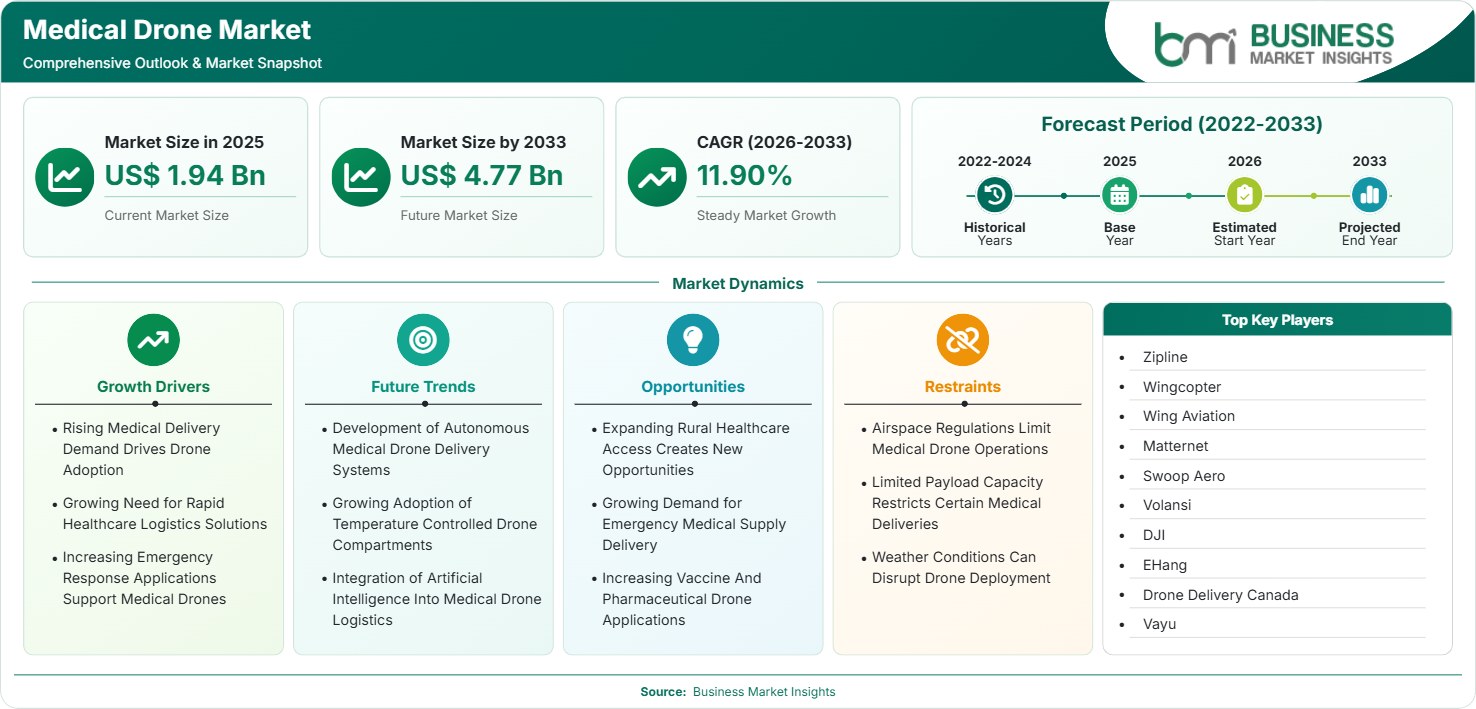
The Medical Drone Market size was valued at US$ 1.94 billion in 2025 and is projected to reach US$ 4.77 billion by 2033, growing at a CAGR of 11.90% during 2026–2033, driven by faster healthcare logistics, rural access, emergency response, vaccine delivery, and specialized medical transportation.

Report Coverage
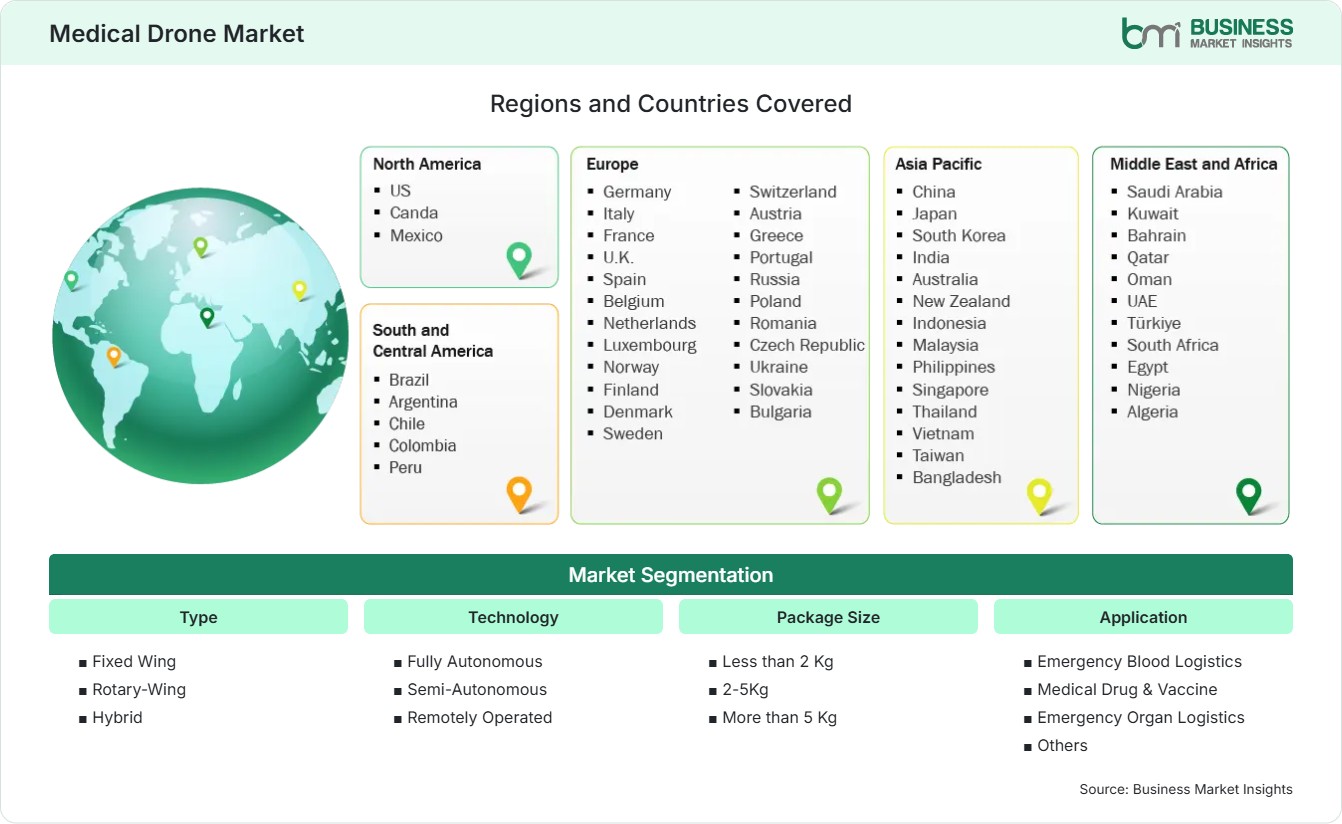
  • Type: Fixed Wing, Rotary-Wing, Hybrid
  • Technology: Fully Autonomous, Semi-Autonomous, Remotely Operated
  • Package Size: Less than 2 Kg, 2-5Kg, More than 5 Kg
  • Application: Emergency Blood Logistics, Medical Drug & Vaccine, Emergency Organ Logistics, Others
US$ 1.94 Bn Market size in 2025
US$ 4.77 Bn Market Size by 2033
11.90% CAGR, 2026 - 2033
2026-2033 Forecast Period

AI Overview

Medical Drone Market Summary

  • North America: North America holds 29%-33% share in 2025, growing at a CAGR of 10.4%-11.3%, supported by healthcare logistics modernization, emergency response requirements, drone infrastructure development, and growing acceptance of unmanned medical delivery systems. The U.S. represents 80%-85% of regional demand, supported by healthcare-network integration, emergency logistics, rural delivery programs, and expanding operational frameworks for commercial drone services.
  • Fastest Growing Region: Asia Pacific holds 24%-28% share in 2025 and grows at a CAGR of 13.1%-14.4%, driven by rural healthcare gaps, large dispersed populations, pharmaceutical distribution requirements, emergency response, and increasing investment in autonomous delivery infrastructure.
  • Leading Segment: Rotary-Wing holds 38%-42% share in 2025 and grows at a CAGR of 10.8%-11.7%, supported by vertical takeoff capabilities, flexible deployment, urban operations, hospital logistics, and suitability for short-distance medical transportation.
  • High Growth Segment: Fully Autonomous technology holds 24%-28% share in 2025 and expands at a CAGR of 14.1%-15.3%, supported by automated routing, remote fleet management, reduced operating intervention, and demand for scalable medical delivery networks.
  • Key Market Opportunity: Rural healthcare, emergency blood logistics, pharmaceutical distribution, vaccine delivery, and autonomous hospital-to-hospital transportation offer attractive opportunities as healthcare systems seek faster and more resilient supply chains.
  • Major Market Players: Zipline, Wingcopter, Wing Aviation, Matternet, Swoop Aero, Volansi, DJI, EHang, Drone Delivery Canada, Vayu.
Strategic Insights

Medical Drone Market: Strategic Insights

Medical Drone Market Strategic Framework
FREE PDF
Request your free sample
Request free sample
Stakeholder View

Key Takeaways

  • The value chain is evolving from standalone aircraft toward integrated delivery ecosystems combining drones, payload containers, flight management, healthcare software, charging infrastructure, and regulatory compliance capabilities.
  • Emergency blood logistics and pharmaceutical delivery provide strong application potential because shipment urgency can justify dedicated aerial transportation where conventional road-based delivery introduces operational delays.
  • Product development is moving toward autonomous navigation, improved obstacle avoidance, temperature-controlled payload compartments, longer operational endurance, and software-enabled fleet coordination.
  • Asia Pacific presents an attractive expansion case because dispersed populations, rural healthcare requirements, island geographies, and developing medical infrastructure create clear use cases for aerial logistics.
  • Investment opportunities increasingly center on delivery networks, healthcare partnerships, fleet management software, maintenance infrastructure, and regulatory capabilities rather than aircraft hardware alone.
  • Successful deployment will depend on demonstrating reliable delivery performance, safe integration with existing healthcare workflows, scalable operating models, and consistent compliance across different airspace environments.
Geographic Outlook

Medical Drone Market Regional Highlights

North America Medical Drone Market

North America represents 29%-33% share in 2025 and grows at a CAGR of 10.4%-11.3%. The region benefits from healthcare logistics modernization, emergency transportation requirements, rural access initiatives, and increasing integration of unmanned aircraft into commercial delivery networks.

  • Healthcare providers increasingly evaluate drones for time-sensitive transportation between hospitals, laboratories, pharmacies, and distribution facilities where direct aerial routes can complement conventional logistics.
  • Rural and remote communities create opportunities for medical deliveries because aerial transportation can bypass road limitations and reduce dependence on geographically concentrated healthcare infrastructure.
  • Emergency response applications are expanding interest in drones capable of transporting blood products, medicines, diagnostic samples, and other lightweight healthcare materials.
  • Regulatory development remains important because scalable commercial operations require predictable flight permissions, operational standards, safety procedures, and coordination with existing aviation systems.

US Medical Drone Market

The U.S. represents 80%-85% of North American demand in 2025 and grows at a CAGR of 10.1%-11.1%. Healthcare-network scale, rural delivery needs, emergency logistics, and commercial drone infrastructure support continued adoption.

  • Hospital networks can use aerial logistics to connect facilities and laboratories, particularly when urgent specimens or medical products need transportation within tightly controlled time windows.
  • Rural healthcare remains a compelling application because drones can supplement road transportation and improve access to essential supplies across geographically dispersed communities.
  • Emergency response programs can benefit from dedicated aerial delivery capabilities for blood, medicines, diagnostic materials, and other lightweight healthcare supplies.

Europe Medical Drone Market

Europe holds 21%-25% Medical Drone Market share in 2025 and grows at a CAGR of 10.2%-11.2%. Germany leads regional demand, while the United Kingdom, France, and the Netherlands provide attractive opportunities through healthcare logistics modernization and drone integration.

  • Germany benefits from advanced healthcare infrastructure, pharmaceutical logistics, laboratory networks, and increasing interest in digitally enabled transportation solutions.
  • The United Kingdom provides opportunities for hospital connectivity, rural healthcare logistics, emergency delivery, and medical supply transportation across geographically diverse service areas.
  • France is positioned for adoption through healthcare modernization, pharmaceutical distribution, emergency response, and drone-enabled logistics applications requiring reliable point-to-point transportation.
  • The Netherlands offers favorable conditions for specialized logistics innovation, healthcare connectivity, urban technology deployment, and integration of drones with established transportation networks.

Asia Pacific Medical Drone Market

Asia Pacific represents 24%-28% share in 2025 and expands at a CAGR of 13.1%-14.4%. China leads regional demand, while India, Japan, and Australia offer significant opportunities from healthcare access and logistics modernization.

  • China provides opportunities through large-scale healthcare networks, technology development, pharmaceutical logistics, and increasing deployment of unmanned systems across commercial applications.
  • India has strong potential because rural healthcare access, dispersed populations, emergency medical requirements, and pharmaceutical distribution create practical use cases for aerial logistics.
  • Japan offers opportunities through aging-population healthcare requirements, island connectivity, advanced logistics infrastructure, and demand for dependable transportation technologies.
  • Australia benefits from geographically dispersed communities and remote healthcare requirements, creating use cases for drone delivery of medicines, blood products, and diagnostic materials.

Rest of World Medical Drone Market

Rest of World represents 18%-22% share in 2025 and grows at a CAGR of 10.7%-11.8%. Latin America provides leading opportunities, while Middle Eastern and African markets offer applications linked to remote healthcare access.

South and Central America Medical Drone Market can benefit from aerial healthcare logistics where difficult terrain, road limitations, and dispersed communities complicate conventional medical transportation. Brazil, Mexico, Colombia, and Chile provide opportunities for specialized delivery networks.

  • Brazil offers opportunities across rural healthcare, emergency medical logistics, pharmaceutical distribution, and transportation to geographically dispersed communities.
  • Mexico can apply drones to healthcare delivery across remote areas while complementing established road-based pharmaceutical and medical supply networks.
  • Saudi Arabia provides opportunities through healthcare modernization, remote-area access, emergency response, and technology-enabled logistics infrastructure.
  • South Africa offers applications across rural healthcare, emergency delivery, blood transportation, and medical supply distribution where distance can affect conventional logistics.
Global Market Geography
FREE PDF
Request your free sample
Request free sample
Segment Analysis

Medical Drone Market Segmentation

Type

Rotary-Wing holds 38%-42% share in 2025 and grows at a CAGR of 10.8%-11.7% through 2033, supported by vertical takeoff, flexible landing, and short-distance delivery. The Medical Drone Market scope therefore covers diverse aircraft configurations tailored to distance, payload, terrain, and healthcare delivery requirements.

  • Fixed Wing: Fixed-wing drones support longer medical routes and efficient transportation between distant healthcare facilities, making them suitable for regional logistics networks.
  • Rotary-Wing: Rotary-wing drones provide vertical takeoff and landing, supporting hospital, urban, rural, and emergency deliveries where flexible operating locations are important.
  • Hybrid: Hybrid drones combine vertical takeoff capabilities with efficient forward flight, supporting applications requiring longer range without conventional runway infrastructure.

Technology

Fully Autonomous systems hold 24%-28% share in 2025 and grow at a CAGR of 14.1%-15.3% through 2033, making autonomy the fastest-evolving technology category. Semi-autonomous systems retain relevance where human supervision remains necessary, while remotely operated platforms support applications requiring direct control.

  • Fully Autonomous: Fully autonomous drones use automated navigation and mission management to reduce direct intervention and support scalable healthcare delivery networks.
  • Semi-Autonomous: Semi-autonomous systems combine automated flight functions with human oversight, offering a balance between operational efficiency and supervisory control.
  • Remotely Operated: Remotely operated drones provide direct human control and remain relevant for specialized missions requiring flexible decision-making during medical transportation.

Package Size

Less than 2 Kg represents 52%-56% share in 2025 and grows at a CAGR of 11.8%-12.7% through 2033, supported by blood products, medicines, vaccines, diagnostic samples, and lightweight emergency supplies. Larger payload categories serve broader logistics requirements but require greater aircraft capacity, energy consumption, and operational planning.

  • Less than 2 Kg: Small payloads suit blood products, medicines, vaccines, diagnostic samples, and urgent supplies where speed and flexible deployment provide meaningful logistics advantages.
  • 2-5Kg: Medium payload systems support larger medical shipments while balancing aircraft endurance, payload capacity, operating cost, and route requirements.
  • More than 5 Kg: Larger payload platforms address higher-volume medical logistics but require greater lift capacity, energy management, infrastructure, and operational planning.

Application

Emergency Blood Logistics represents 34%-38% share in 2025 and grows at a CAGR of 12.2%-13.1% through 2033, supported by the urgency and time sensitivity of blood transportation. Medical drug and vaccine delivery provides broad recurring demand, while emergency organ logistics requires specialized handling.

  • Emergency Blood Logistics: Blood transportation benefits from rapid delivery, predictable routing, and reduced exposure to road congestion during urgent healthcare requirements.
  • Medical Drug & Vaccine: Medicines and vaccines can be transported to healthcare facilities and remote communities where conventional distribution may face distance or infrastructure constraints.
  • Emergency Organ Logistics: Organ transportation requires tightly controlled timing and handling, creating specialized opportunities for reliable aerial logistics and secure payload systems.
  • Others: Other applications include diagnostic samples, medical equipment, laboratory materials, emergency supplies, and specialized healthcare logistics requiring rapid transportation.
Market Forces

Medical Drone Market Dynamics

Key Market Drivers

Rising Medical Delivery Demand Drives Drone Adoption

Healthcare systems are trying to get quick transport services of products where there is a connection between delivery speed and service quality. There are some products, such as blood products, medicines, vaccines, testing materials, and emergency products, that could benefit from flying in the air and avoiding the challenges associated with traffic and terrain. Hence, the Medical Drone Market growth would be driven by logistics, where urgency and reliability make it necessary to have specialized transportation channels. Hospitals and healthcare providers will be able to use drones as an additional means of transport instead of the regular one.

Growing Need for Rapid Healthcare Logistics Solutions

Healthcare logistics is becoming increasingly dependent on reliable means of transportation among facilities that need to adhere to strict service criteria. Traditional modes of transportation may be hindered by congestion, geographical obstacles, adverse weather conditions, as well as lack of presence in distant places. The Medical Drone Market Trend is becoming increasingly driven by the demand for efficient and convenient transportation of healthcare shipments that are urgent and lightweight healthcare shipments. Drones provide an alternative path for the delivery of certain shipments, especially when shipment urgency makes it economically unfeasible to transport goods via traditional methods. Companies are increasingly assessing drones as an element of logistics rather than a means of transportation alone.

Increasing Emergency Response Applications Support Medical Drones

The provision of medical assistance has strict requirements regarding transportation means that can respond promptly to the situation in case of any restrictions in the functioning of the usual transport system. Drones will help deliver blood, medication, testing equipment, and any other lightweight cargo in cases where the distances are too long, there is heavy traffic, restrictions from the side of the infrastructure, and emergencies are factors restricting the delivery. The Medical Drone Market forecast development depends nowadays increasingly upon the availability of opportunities for creating reliable emergency delivery systems instead of making one-time deliveries. These systems should have dispatch, security, communication, authorization, and personnel training systems.

Key Market Opportunities

Expanding Rural Healthcare Access Creates New Opportunities

An opportunity presented by rural and remote areas is that traditional transport mechanisms may be less efficient over long distances and difficult terrains. Drones will help in linking regional hospitals with other facilities such as clinics, pharmacies, laboratories, and community health centers, while also being less reliant on the existence of roads. Routes can be planned according to the routine demands of healthcare needs, which will lead to a reliable schedule for the delivery of medicines, blood samples, and other diagnostics. Opportunities may arise in situations where the current logistical system operates infrequently or with longer delivery times.

Growing Demand for Emergency Medical Supply Delivery

There is potential in emergency medical supply deliveries for developing dedicated drones with secure payload storage compartments, safe navigation, and quick deployment capabilities. Medical institutions and emergency responders may use drone-based logistics as a means of supplementing existing forms of transport in times of need. Examples of the items that could be transported include blood products, pharmaceuticals, tests, emergency kits, and other light cargo. This is an opportunity not only for aircraft but also for systems to manage a fleet, charge, maintain, load, and service aircraft. Suppliers may create dedicated systems tailored to certain shipping needs and distances. Mission planning can become automated, making the process more efficient due to reduced coordination efforts.

Increasing Vaccine And Pharmaceutical Drone Applications

Distribution of vaccines and pharmaceuticals creates repeated use cases for medical drones when temperature, timing, and accessibility are important factors. Specific payload containers can be used to ensure the safety of the items being delivered, and automated monitoring could add more information about the conditions of shipment. The use of drones is able to complement the centralized distribution of pharmaceuticals as they can deliver goods to small facilities without the regular sending of vehicles. This use case is especially relevant for areas where people are scattered or there is poor transport infrastructure. It is possible to create delivery schedules that would optimize the utilization of resources rather than using emergencies only.

Market Restraints and Challenges

Airspace Regulations Limit Medical Drone Operations

Factor: Medical drone deliveries have to meet all aviation requirements pertaining to flight permissions, airworthiness of aircraft, remote identification, operational areas, communication, and interface with other airspace users. Impact: Regulatory difficulties may hinder the implementation of the program and impose limitations on the routes that can be used and the level of operation planning required. Special permissions may be required by healthcare organizations before implementing any recurrent system of deliveries. Regulatory regimes also vary by region, which makes it hard to implement a proven model elsewhere. The suppliers have to have regulatory know-how along with aircraft design and healthcare logistics expertise.

Limited Payload Capacity Restricts Certain Medical Deliveries

Factor: Most medical drones are designed to carry lightweight payloads; some medical packages, on the other hand, demand more space or have unique packaging, temperature, or protective equipment requirements. Impact: Payload restrictions can limit the type of goods that can be shipped cost-effectively and might lead to multiple deliveries for large shipments. Higher payload capacities, at the same time, might increase aircraft size, energy usage, infrastructure needs, and operational complexity. Thus, manufacturers are faced with a challenge balancing payload capability, range, operational efficiency, and aircraft portability.

Company Analysis

Competitive Landscape

The Medical Drone Market analysis covers companies spanning dedicated healthcare delivery platforms, unmanned aircraft manufacturers, autonomous-flight developers, and specialized logistics providers. Competitive differentiation increasingly depends on aircraft reliability, autonomy, payload handling, regulatory capability, software integration, fleet management, and healthcare partnerships.

Company Name

Overview

Products and Services relevant to this market

Zipline

Healthcare logistics specialist focused on autonomous delivery networks for time-sensitive medical supplies.

Autonomous delivery drones, healthcare logistics platforms, distribution services, fleet management, and medical payload solutions.

Wingcopter

Drone technology company developing aircraft designed for efficient long-distance commercial delivery applications.

Fixed-wing and vertical-takeoff aircraft, delivery systems, flight software, payload integration, and logistics solutions.

Wing Aviation

Drone delivery technology company focused on autonomous aerial transportation for commercial and community applications.

Autonomous delivery drones, flight management technology, delivery infrastructure, and aerial logistics services.

Matternet

Drone logistics company focused on healthcare and on-demand transportation between medical facilities.

Medical delivery drones, autonomous flight platforms, landing stations, fleet management, and healthcare logistics networks.

Swoop Aero

Healthcare-focused drone logistics company developing aerial delivery networks for essential medical supplies.

Autonomous aircraft, medical delivery platforms, logistics operations, fleet management, and healthcare delivery services.

Volansi

Drone technology company focused on autonomous transportation of critical payloads across commercial applications.

Autonomous delivery aircraft, payload systems, flight management, remote operations, and specialized logistics services.

DJI

Drone technology manufacturer offering aircraft and systems used across commercial and professional applications.

Commercial drones, payload platforms, flight-control systems, imaging technologies, accessories, and enterprise drone solutions.

EHang

Autonomous aerial vehicle technology company developing unmanned and autonomous aviation systems.

Autonomous aerial vehicles, flight-control technologies, command systems, and aerial mobility infrastructure.

Drone Delivery Canada

Drone logistics company focused on commercial cargo delivery and automated aerial transportation networks.

Cargo delivery drones, route-management software, ground infrastructure, remote operations, and logistics solutions.

Vayu

Drone technology company focused on autonomous medical and commercial delivery applications.

Autonomous delivery aircraft, medical logistics systems, payload solutions, remote monitoring, and aerial delivery services.

Trust & Transparency

Research Methodology

The market analysis combines proprietary research with secondary data from government agencies, company disclosures, regulatory filings, industry databases and expert interviews. Market estimates are validated through data triangulation, cross-market benchmarking and analyst review.

View Full Research Methodology

Questions Answered

Frequently Asked Questions

What does the Medical Drone Market report indicate about future competition?

The report indicates that competition will increasingly focus on autonomous flight reliability, payload protection, regulatory expertise, fleet management, healthcare integration, operating economics, and network scalability. Companies capable of combining aircraft technology with complete delivery infrastructure are positioned to strengthen their market presence.

Why are rural healthcare networks creating new opportunities for medical drones?

Rural healthcare networks often face long distances, limited transportation frequency, difficult terrain, and restricted access to specialized facilities. Drones can supplement existing logistics by providing direct aerial transportation for medicines, blood products, vaccines, and diagnostic materials.

How are autonomous technologies influencing medical drone adoption?

Autonomous technologies can reduce manual flight intervention, improve route consistency, enable centralized fleet supervision, and support scheduled delivery networks. Improved navigation, obstacle avoidance, communications, and automated mission management are helping operators develop scalable healthcare logistics models.

Which applications present the strongest opportunity in the market?

Emergency blood logistics, medical drug and vaccine transportation, diagnostic sample delivery, and urgent pharmaceutical distribution present strong opportunities. These applications benefit from speed, predictable routing, lightweight payload requirements, and the ability to serve locations where conventional transportation can be inefficient.

What factors are improving Medical Drone Market return on investment?

Faster healthcare delivery, rural access requirements, emergency response needs, pharmaceutical distribution, and logistics-network resilience are improving return on investment. Drones can reduce transportation delays for high-priority shipments while complementing conventional road logistics for routine healthcare distribution.

Access the Full Medical Drone Market Report

Get segment-level forecasts, regional estimates, competitive benchmarking, company profiles and downloadable Excel datasets.

Access the full Medical Drone Market Report
350 pages PDF & Excel | 2026-08-19
Similar Research

Related Market Reports