
Target Drone Market Outlook: Size, Share, Trends, Growth Analysis, Competitive Landscape & Forecast, 2026-2033

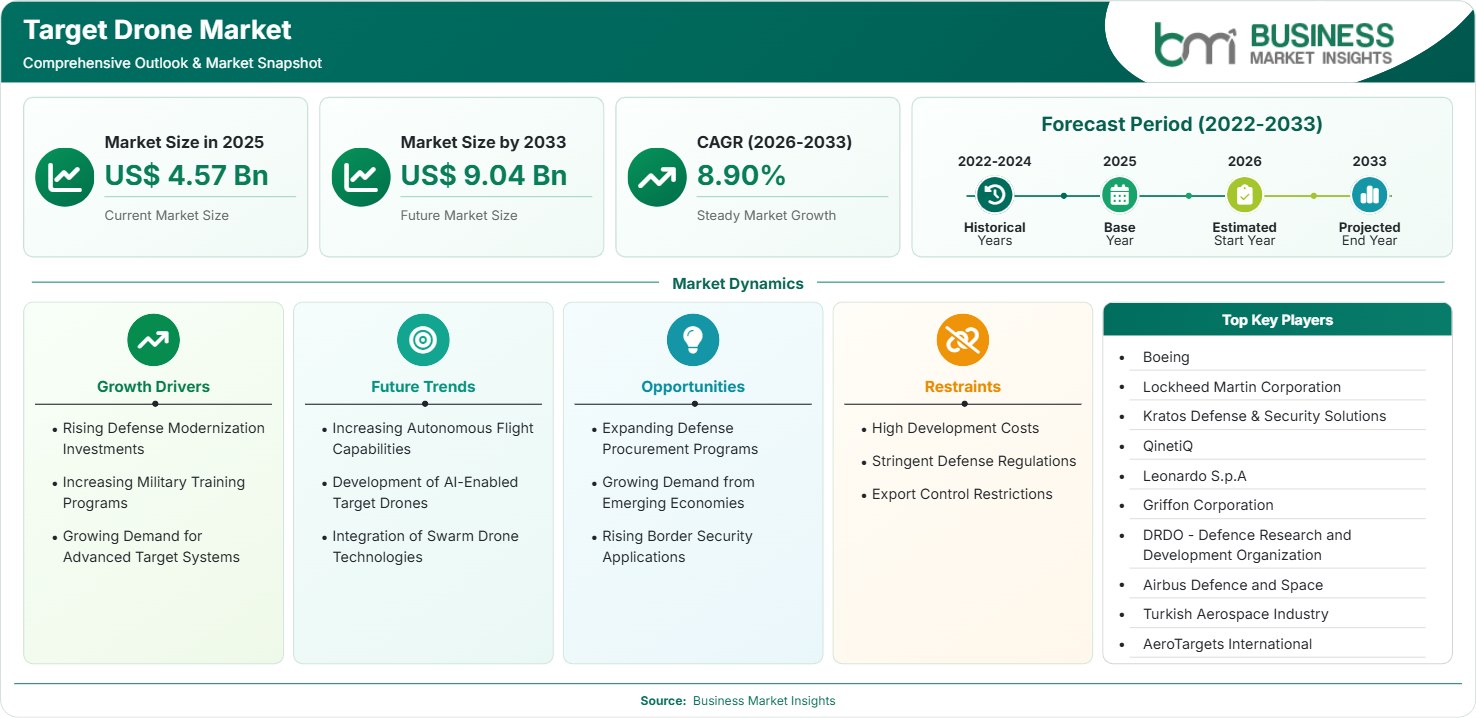
The Target Drone Market size was valued at US$ 4.57 Billion in 2025 and is projected to reach US$ 9.04 Billion by 2033, growing at a CAGR of 8.90% during 2026–2033, driven by defense modernization, advanced combat training, and rising demand for realistic aerial threat simulation solutions.

Report Coverage
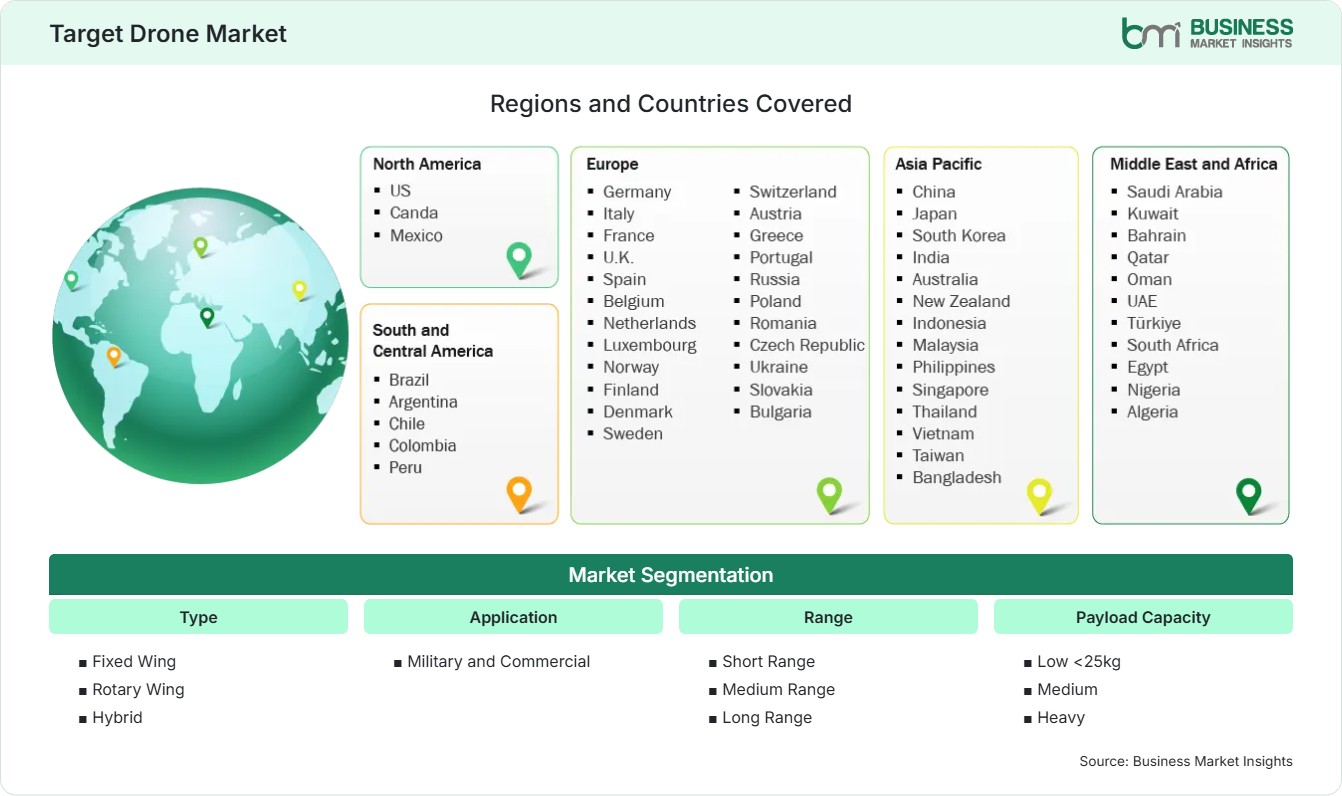
  • Type: Fixed Wing, Rotary Wing, Hybrid
  • Application: Military and Commercial
  • Range: Short Range, Medium Range, Long Range
  • Payload Capacity: Low <25kg, Medium, Heavy
  • Autonomous Level: Remotely Piloted, Autonomous, Semi-Autonomous
US$ 4.57 Bn Market size in 2025
US$ 9.04 Bn Market Size by 2033
8.90% CAGR, 2026 - 2033
2026-2033 Forecast Period

AI Overview

Target Drone Market Summary

  • North America Region: North America holds 34%–37% share in 2025, growing at a CAGR of 8.40%–9.10%, driven by military modernization, missile testing, and advanced training programs. Opportunities arise from autonomous target platforms and next-generation defense procurement. The U.S. market analysis indicates steady adoption with a CAGR of 8.50%–9.20% between 2026–2033 supported by defense investments.
  • Fastest Growing Region: Asia Pacific accounts for 27%–30% share in 2025, expanding at a CAGR of 9.20%–10.00%, driven by increasing defense expenditure, indigenous aerospace programs, and border security requirements. Emerging economies are investing in advanced aerial simulation systems and military readiness infrastructure.
  • Leading Segment: Fixed Wing type holds 45%–48% share in 2025, growing at a CAGR of 8.70%–9.30%, supported by long endurance missions, realistic aircraft simulation, and demand for complex aerial combat training environments.
  • High Growth Segment: Autonomous level systems represent 24%–27% share in 2025, expanding at a CAGR of 10.00%–10.80%, driven by artificial intelligence integration, reduced operator dependency, and advanced threat replication capabilities.
  • Key Market Opportunity: Expansion of unmanned defense ecosystems, electronic warfare training requirements, and emerging military modernization initiatives create opportunities for manufacturers developing autonomous, reusable, and cost-efficient target platforms.
  • Major Market Players: Boeing, Lockheed Martin Corporation, Kratos Defense & Security Solutions, QinetiQ, Leonardo S.p.A., Griffon Corporation, Defence Research and Development Organisation, Airbus Defence and Space, Turkish Aerospace Industries, and AeroTargets International.
Strategic Insights

Target Drone Market: Strategic Insights

Target Drone Market Strategic Framework
FREE PDF
Request your free sample
Request free sample
Stakeholder View

Key Takeaways

  • Defense value chains are shifting toward integrated unmanned training ecosystems, where target drone manufacturers collaborate with sensor developers, propulsion suppliers, software providers, and military agencies to deliver complete simulation solutions.
  • Growth opportunities are strongest in autonomous target systems, advanced payload integration, and extended-range platforms designed for missile testing, electronic warfare exercises, and multi-domain military training applications.
  • Innovation is centered around artificial intelligence-based navigation, reusable drone architectures, enhanced communication links, and adaptive flight technologies that replicate complex aerial threats with higher accuracy.
  • Asia Pacific presents an attractive investment opportunity due to increasing defense budgets, domestic aerospace manufacturing programs, and demand for indigenous training platforms across major military economies.
  • Investment activity is focusing on defense technology partnerships, strategic collaborations, and capability expansion as established aerospace companies strengthen their unmanned systems portfolios.
  • Dual-purpose applications are creating additional opportunities by enabling platforms to support military training, research programs, and commercial testing requirements.
Geographic Outlook

Target Drone Market Regional Highlights

North America Target Drone Market

North America represents the largest regional contributor with a 34%–37% share in 2025 and is projected to expand at a CAGR of 8.40%–9.10% during 2026–2033. The region benefits from strong defense budgets, advanced aerospace capabilities, and continuous military testing requirements. The Target Drone Market share remains supported by the United States and Canada, where armed forces increasingly adopt unmanned platforms for missile evaluation, combat preparation, and air defense training exercises.

  • The United States dominates regional demand due to extensive defense procurement programs, advanced weapons testing facilities, and continuous investments in realistic aerial target simulation technologies.
  • Canada is strengthening unmanned defense capabilities through modernization initiatives, supporting demand for specialized training platforms and aerospace technology partnerships across military applications.
  • Defense contractors are integrating artificial intelligence, autonomous controls, and advanced communication systems to improve operational accuracy and mission reliability.
  • Increasing focus on cost-efficient military exercises is encouraging adoption of reusable target platforms instead of conventional aircraft-based training methods.

US Target Drone Market

The U.S. accounts for approximately 29%–32% of the global Target Drone Market share in 2025, growing at a CAGR of 8.50%–9.20% through 2033. The country maintains leadership due to substantial defense spending, extensive testing infrastructure, and demand from the Army, Navy, and Air Force. Procurement programs emphasize advanced aerial targets capable of simulating modern threats, including unmanned systems and high-speed airborne platforms.

  • The U.S. military continues expanding target drone usage for missile testing, electronic warfare exercises, and integrated air defense training scenarios.
  • Aerospace manufacturers are developing autonomous systems with improved endurance, precision navigation, and mission adaptability for complex operational environments.
  • Government support for domestic defense manufacturing strengthens supply chains and accelerates innovation among established and emerging technology providers.

Europe Target Drone Market

Europe holds a 22%–25% share in 2025 and is estimated to register a CAGR of 8.00%–8.70% during 2026–2033. The region is supported by increasing defense modernization programs, NATO capability enhancement initiatives, and rising demand for advanced training systems. Countries including Germany, France, the United Kingdom, and Italy are investing in aerospace technologies. The Target Drone Market growth across Europe is influenced by military readiness requirements and modernization of defense testing infrastructure.

  • Germany is expanding defense technology investments, creating demand for advanced aerial simulation systems and unmanned training platforms.
  • France supports domestic aerospace innovation through defense programs focused on autonomous technologies and next-generation military equipment.
  • The United Kingdom is increasing adoption of unmanned systems for testing, evaluation, and operational preparedness applications.
  • European manufacturers are emphasizing reusable designs and environmentally efficient propulsion systems for sustainable defense operations.

Asia Pacific Target Drone Market

Asia Pacific represents 27%–30% share in 2025 and is projected to achieve the fastest CAGR of 9.20%–10.00% between 2026–2033. Rising geopolitical tensions, border security concerns, and increasing military modernization programs are accelerating regional adoption. China, India, Japan, South Korea, and Australia are strengthening indigenous aerospace capabilities.

  • China is investing in unmanned aerial technologies and domestic defense manufacturing capabilities to support military readiness programs.
  • India is expanding indigenous aerospace development through government-backed defense research initiatives and local production capabilities.
  • Japan and South Korea are adopting advanced simulation systems to improve air defense preparation and operational training efficiency.
  • Australia is increasing investment in unmanned defense technologies to strengthen regional security capabilities and military exercises.

Rest of World Target Drone Market

Rest of World contributes 10%–13% share in 2025 and is expected to grow at a CAGR of 8.70%–9.40% during 2026–2033. South America and Middle East & Africa markets are developing through defense modernization initiatives, border security requirements, and military capability upgrades. Countries such as Brazil, Saudi Arabia, the United Arab Emirates, and Israel are increasing investments in advanced defense systems and training infrastructure.

  • Middle Eastern countries are adopting target drone technologies to support missile testing, air defense exercises, and regional security preparedness.
  • Saudi Arabia and the UAE are strengthening aerospace partnerships to develop localized defense capabilities and reduce dependence on imported systems.
  • Brazil is improving military training infrastructure through investments in unmanned technologies and advanced simulation platforms.
  • African defense organizations are exploring cost-effective target solutions for surveillance preparation and operational readiness programs.
Global Market Geography
FREE PDF
Request your free sample
Request free sample
Segment Analysis

Target Drone Market Segmentation

Type

The Type segment includes Fixed Wing, Rotary Wing, and Hybrid platforms, with Fixed Wing systems leading adoption due to long endurance and realistic aircraft simulation capabilities. The segment holds approximately 45%–48% share in 2025 and is expected to grow at a CAGR of 8.70%–9.30% between 2026–2033. Increasing military training requirements and missile testing programs support segment expansion.

  • Fixed Wing: Fixed wing systems provide extended flight duration, higher speeds, and realistic aircraft replication for advanced military exercises and weapons testing applications.
  • Rotary Wing: Rotary wing targets support low-altitude training, helicopter simulation exercises, and specialized operational scenarios requiring vertical maneuverability.
  • Hybrid: Hybrid platforms combine fixed wing endurance with rotary wing flexibility, enabling versatile missions across defense testing and training environments.

Application

The Application segment covers Military and Commercial uses, with military applications representing the dominant category due to defense testing and combat training requirements. The segment maintains approximately 80%–83% share in 2025 and is projected to grow at a CAGR of 8.80%–9.40% during 2026–2033. The Target Drone Market scope continues expanding as armed forces seek advanced simulation solutions.

  • Military: Military users deploy target drones for missile trials, air defense training, naval exercises, and battlefield simulation activities requiring realistic aerial threats.
  • Commercial: Commercial applications include aerospace testing, research activities, and technology validation programs requiring controlled unmanned aerial platforms.

Range

The Range segment includes Short Range, Medium Range, and Long Range systems. Medium Range platforms maintain strong adoption due to balanced operational capability and cost efficiency. The segment accounts for 35%–38% share in 2025 and grows at a CAGR of 8.90%–9.50% through 2033.

  • Short Range (Up to 100 km): Short-range platforms support localized training missions, cost-efficient operations, and tactical exercises requiring rapid deployment capabilities.
  • Medium Range (101 km – 400 km): Medium-range systems provide extended operational flexibility for missile testing, surveillance simulation, and advanced military training applications.
  • Long Range (Above 400 km): Long-range platforms enable complex strategic exercises, high-altitude missions, and advanced threat simulation scenarios.

Payload Capacity

The Payload Capacity segment covers Low, Medium, and Heavy payload systems designed for different testing and simulation requirements. Medium payload platforms maintain strong adoption because they balance operational capability, endurance, and mission flexibility. The segment accounts for approximately 38%–41% share in 2025 and is projected to expand at a CAGR of 8.80%–9.40% during 2026–2033. Increasing integration of sensors, electronic warfare equipment, and advanced simulation payloads supports segment development.

  • Low <25kg: Low payload target drones are widely used for basic training missions, short-duration exercises, and cost-efficient defense simulation requirements.
  • Medium (25kg to 50Kg): Medium payload platforms support advanced military applications by enabling integration of tracking systems, communication equipment, and specialized testing components.
  • Heavy (>50kg): Heavy payload systems are designed for complex missions requiring advanced sensors, larger equipment integration, and high-performance operational capabilities.

Autonomous Level

The Autonomous Level segment includes Remotely Piloted, Autonomous, and Semi-Autonomous systems. Semi-Autonomous platforms are gaining adoption due to their combination of operational control and automated functionality. The segment represents approximately 24%–27% share in 2025 and is expected to grow at a CAGR of 10.00%–10.80% between 2026–2033. The Target Drone Market trends indicate increasing investment in artificial intelligence, autonomous navigation, and adaptive mission capabilities.

  • Remotely Piloted: Remotely piloted systems remain widely deployed due to established operational reliability, human control capabilities, and compatibility with existing defense training infrastructure.
  • Autonomous: Autonomous platforms are advancing through AI-based navigation, automated mission execution, and reduced operator dependency for complex military simulation activities.
  • Semi-Autonomous: Semi-autonomous systems provide flexible control options by combining automated flight functions with human decision-making during critical mission stages.

Use

The Use segment consists of Conventional and Advanced Dual-Purpose Use applications. Conventional systems maintain significant adoption due to established defense training programs, while advanced dual-purpose platforms are expanding through technology innovation. The segment holds approximately 30%–33% share in 2025 and is estimated to grow at a CAGR of 9.00%–9.70% during 2026–2033. Emerging applications across research, testing, and defense support activities are improving adoption potential.

  • Conventional: Conventional target drones support missile testing, combat training, and standard military exercises requiring dependable aerial simulation platforms.
  • Advanced Dual-Purpose Use: Advanced dual-purpose systems enable broader applications through enhanced sensors, autonomous capabilities, and adaptability across defense and specialized commercial testing environments.
Market Forces

Target Drone Market Dynamics

Key Market Drivers

Rising Defense Modernization Investments

Modernization programs in defense will lead to faster purchases of high-end target systems owing to the improvement in training and testing facilities in military units. Growth in the market will be driven by investments in missile testing, air defense preparations, and unmanned systems integration. Contemporary military units are using autonomous drones instead of old-fashioned means for their training purposes. Target Drone Market trends point to the use of better sensors, communications, and autonomous solutions.

Increasing Military Training Programs

The increase in training programs for the military has created an ongoing need for target drones that can emulate sophisticated aerial threats. There is a greater need for live fire training, weapon evaluation tests, and combat preparedness programs that need realistic targets. The current environment demands platforms that can emulate airplanes, missiles, and unmanned aerial threats. Target drone makers are coming up with solutions that are reusable and have more endurance, with customizable payloads.

Growing Demand for Advanced Target Systems

Demand for advanced target systems is increasing as military forces require accurate threat simulation for next-generation weapons testing. Target drones incorporating technology like electronic warfare system, autonomous navigation system, and sensors create a realistic operating environment. Defense organizations are investing in platforms that mimic the emerging threats such as fast flying air platforms and unmanned combat aircrafts. The Target Drone Market is gaining from advancements in areas of artificial intelligence, communications and modular payload.

Key Market Opportunities

Expanding Defense Procurement Programs

Expansion of defense procurement programs creates opportunities for target drone suppliers as governments increase investments in military modernization. Budgets for the provision of advanced training systems, indigenous aircraft manufacturing, and unmanned defense equipment are being planned by nations. The Target Drone market forecast suggests increasing prospects due to the implementation of replacement plans and other defense initiatives that will require simulation solutions. Companies should work towards designing flexible target systems, enhancing lifetime support for products, and forging regional collaborations.

Growing Demand from Emerging Economies

Developing economies are raising their defense budgets and setting up aerospace industries at home, thus offering fresh grounds for target drone suppliers. Nations from the Asia-Pacific region, Middle East and Latin America are working on building infrastructure for their military training and equipping it with unmanned systems. Such markets need to be supplied with cost-effective and flexible systems that could assist in conducting missile trials, border patrol training and tactical training sessions. The entry into such markets is getting easier due to joint ventures, transfer of technologies and local production programs.

Rising Border Security Applications

Rising demands for border security have led to an increase in the number of areas where target drone technology can be utilized aside from conventional military training programs. Unmanned technologies are being considered by security organizations for their use in surveillance training, threat simulation, and operational testing tasks. Modern systems which incorporate autonomous capabilities along with custom payloads may prove useful in conducting security exercises that involve the use of aerial threats. Increased emphasis on securing national security infrastructure is leading to increased investments in flexible drone technologies.

Market Restraints and Challenges

High Development Costs

Factor: Complex engineering requirements, advanced propulsion systems, autonomous technologies, and specialized testing capabilities increase research and development expenses for target drone manufacturers. Impact: High development costs can limit participation from smaller companies and increase product pricing for defense customers. Companies have to make significant investments in terms of simulation technologies, flight testing, certification, and manufacturing. Advanced materials, electronics, and software add to the difficulty of production. Some defense organizations might be operating on tight budgets, and this could affect procurement decision-making.

Stringent Defense Regulations

Factor: Strict export controls, defense procurement regulations, and security requirements create compliance challenges for companies operating in international target drone markets. Impact: Regulatory complexity can extend approval timelines, restrict cross-border sales, and increase operational costs. Manufacturers must comply with government authorization processes, technology transfer rules, and military standards before supplying advanced systems. Different regulatory frameworks across countries require customized approaches for market entry. Effective regulatory management remains essential for companies seeking international contracts and long-term defense partnerships.

Company Analysis

Competitive Landscape

The Target Drone Market analysis highlights competition among aerospace manufacturers, defense technology providers, and specialized unmanned system developers. Companies are focusing on autonomous capabilities, advanced flight systems, modular payload integration, and expanded defense partnerships to strengthen their positions in military training, weapons testing, and threat simulation applications.

Company Name

Overview

Products and Services relevant to this market

Boeing

Boeing is a leading aerospace and defense company providing advanced aviation and unmanned technology solutions for global military customers.

Develops unmanned aerial platforms, defense systems, and target simulation technologies supporting military testing and training requirements.

Lockheed Martin Corporation

Lockheed Martin is a major defense technology company specializing in aerospace systems, missile solutions, and advanced military platforms.

Provides unmanned systems, aerial target solutions, missile testing support, and integrated defense technologies for armed forces.

Kratos Defense & Security Solutions

Kratos specializes in affordable tactical systems and unmanned aerial technologies for defense and security applications.

Offers high-performance target drones, unmanned combat aerial systems, and autonomous platforms for military training missions.

QinetiQ

QinetiQ delivers defense technology solutions focused on testing, evaluation, and advanced engineering services.

Provides aerial target systems, autonomous technologies, and military test support solutions for defense organizations.

Leonardo S.p.A.

Leonardo is a global aerospace and defense company offering aircraft, electronics, and security technologies.

Supplies unmanned aerial systems, defense electronics, and specialized technologies for military simulation and operational testing.

Griffon Corporation

Griffon Corporation develops defense-related technology solutions and specialized aerospace products.

Provides unmanned platforms and defense solutions supporting military operational training and testing applications.

Defence Research and Development Organisation

Defence Research and Development Organisation develops indigenous defense technologies for national security applications.

Designs aerial target systems, unmanned platforms, and testing solutions for military training and weapon evaluation.

Airbus Defence and Space

Airbus Defence and Space provides aerospace solutions including military aircraft, space systems, and unmanned technologies.

Develops unmanned aerial solutions, defense platforms, and advanced technologies supporting military training requirements.

Turkish Aerospace Industries

Turkish Aerospace Industries manufactures aerospace systems and develops indigenous defense capabilities.

Provides unmanned aerial vehicles, aerospace platforms, and defense technologies supporting training and operational missions.

AeroTargets International

AeroTargets International specializes in aerial target systems and simulation solutions for defense applications.

Offers target drones, aerial threat simulation platforms, and customized solutions for weapons testing and military exercises.

Trust & Transparency

Research Methodology

The market analysis combines proprietary research with secondary data from government agencies, company disclosures, regulatory filings, industry databases and expert interviews. Market estimates are validated through data triangulation, cross-market benchmarking and analyst review.

View Full Research Methodology

Questions Answered

Frequently Asked Questions

How can companies benefit from the Target Drone Market Report?

The report provides insights into segmentation trends, regional opportunities, competitive developments, technology advancements, and investment areas supporting strategic decisions for defense manufacturers, suppliers, and aerospace stakeholders.

What role does autonomous technology play in target drone development?

Autonomous navigation, artificial intelligence-based control systems, and advanced communication technologies improve mission flexibility, operational reliability, and threat simulation capabilities. These innovations enable target drones to perform complex scenarios with reduced operator intervention.

Which segment dominates target drone utilization?

Fixed-wing target drones represent a leading segment due to their ability to replicate high-speed aerial threats, support extended flight missions, and provide effective platforms for missile testing, radar evaluation, and advanced military training applications.

How does the Target Drone Market support military preparedness?

Target drones provide realistic aerial threat simulation, enabling defense organizations to evaluate weapon systems, improve tactical training, and enhance combat readiness. These platforms help reduce risks associated with live aircraft exercises while improving testing accuracy and operational efficiency.

What factors are driving target drone adoption?

Increasing defense modernization investments, expanding military training programs, rising demand for realistic combat simulation, and advancements in autonomous flight technologies are encouraging armed forces to deploy target drones for weapons testing, air defense exercises, and operational readiness improvement.

Access the Full Target Drone Market Report

Get segment-level forecasts, regional estimates, competitive benchmarking, company profiles and downloadable Excel datasets.

Access the full Target Drone Market Report
350 pages PDF & Excel | 2026-08-07