
Autonomous Drone Systems Market Outlook: Size, Share, Trends, Growth Analysis, Competitive Landscape & Forecast, 2022-2033

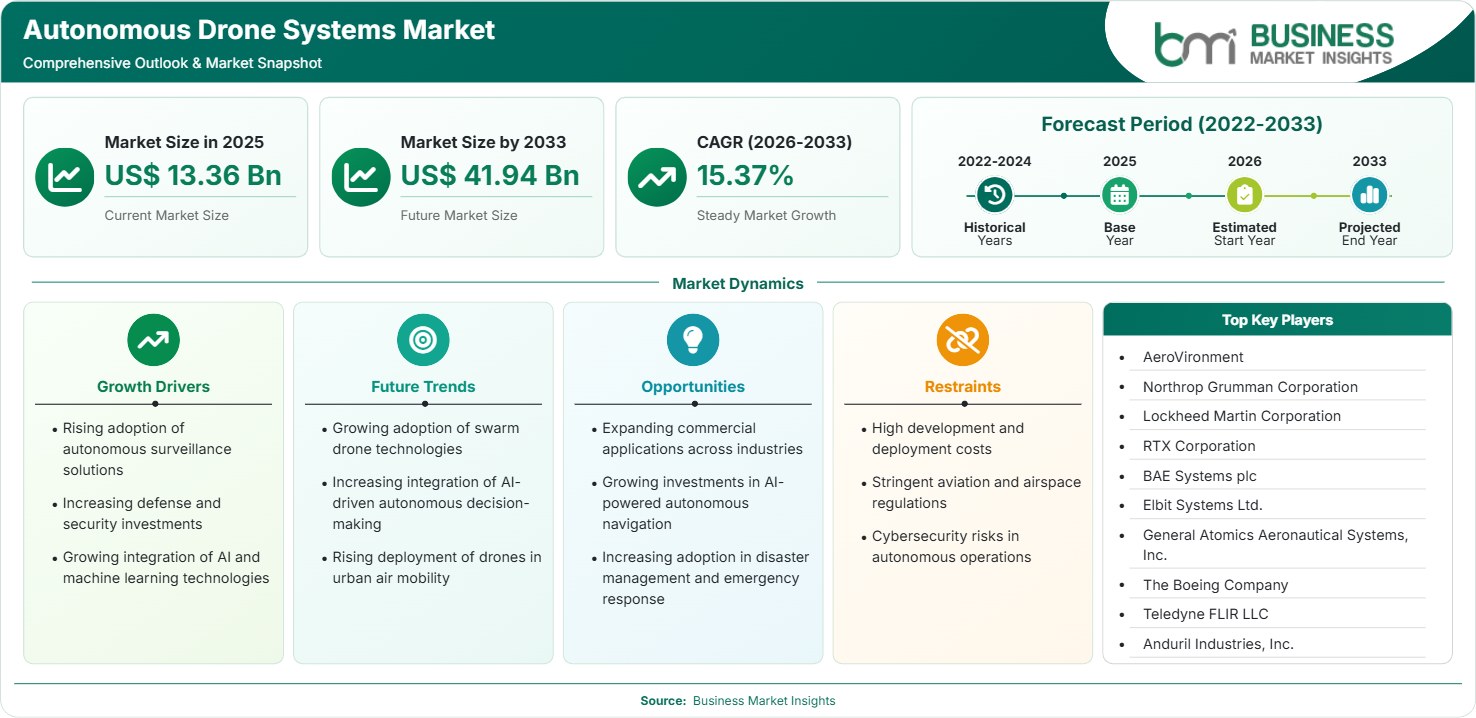
The Autonomous Drone Systems Market size was valued at US$ 13.36 Billion in 2025 and is projected to reach US$ 41.94 Billion by 2033, growing at a CAGR of 15.37% during 2026–2033. Increasing defense modernization, rising demand for autonomous surveillance, AI-powered navigation, commercial drone applications, and disaster response requirements are accelerating adoption, while regulatory advancements and technological innovation create new opportunities.

Report Coverage
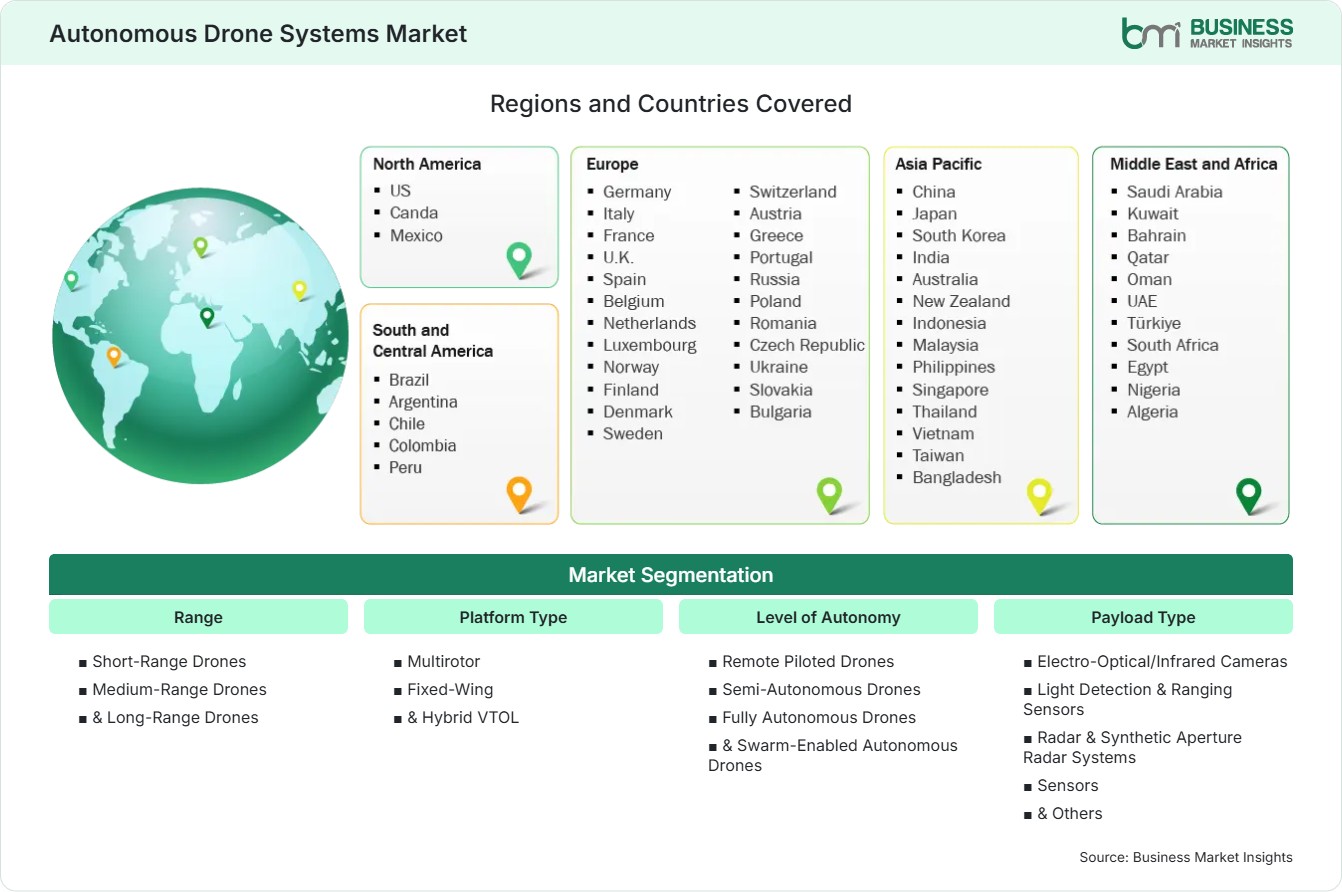
  • Range: Short-Range Drones, Medium-Range Drones, & Long-Range Drones
  • Platform Type: Multirotor, Fixed-Wing, & Hybrid VTOL
  • Level of Autonomy: Remote Piloted Drones, Semi-Autonomous Drones, Fully Autonomous Drones, & Swarm-Enabled Autonomous Drones
  • Payload Type: Electro-Optical/Infrared Cameras, Light Detection & Ranging Sensors, Radar & Synthetic Aperture Radar Systems, Sensors, & Others
  • Application: Inspection & Monitoring, Surveying & Mapping, & Others
US$ 13.36 Bn Market size in 2025
US$ 41.94 Bn Market Size by 2033
15.37% CAGR, 2026 - 2033
2026-2033 Forecast Period

01 AI Overview

Autonomous Drone Systems Market Summary

  • North America Region: North America accounts for 38%–41% of the market share in 2025 and is projected to grow at a 14.8%–15.6% CAGR during 2026–2033, supported by defense investments, adoption of autonomous surveillance, and advanced AI capabilities. The United States market is expanding at a 15.2%–16.0% CAGR due to military modernization programs, security applications, and commercial drone deployment.
  • Fastest Growing Region: Asia Pacific holds 25%–28% share in 2025 and is expected to grow at a 16.8%–17.6% CAGR through 2033, driven by defense spending, border monitoring requirements, infrastructure development, and increasing adoption of autonomous aerial technologies.
  • Leading Segment: Medium-Range Drones represent 42%–45% share in 2025 and are projected to expand at a 15.1%–15.9% CAGR, supported by defense surveillance, industrial inspection, security monitoring, and operational flexibility across multiple environments.
  • High Growth Segment: Fully Autonomous Drones account for 18%–21% share in 2025 and are expected to grow at a 17.5%–18.3% CAGR, driven by AI advancements, autonomous navigation, reduced operator dependency, and improved mission efficiency.
  • Key Market Opportunity: Growing adoption of autonomous drones in commercial inspection, emergency response, agriculture, logistics, and infrastructure monitoring creates significant opportunities for technology providers developing AI-enabled aerial systems.
  • Major Market Players: AeroVironment, Northrop Grumman Corporation, Lockheed Martin Corporation, RTX Corporation, BAE Systems plc, Elbit Systems Ltd., General Atomics Aeronautical Systems, Inc., The Boeing Company, Teledyne FLIR LLC, Anduril Industries, Inc.
02 Strategic Insights

Autonomous Drone Systems Market: Strategic Insights

Autonomous Drone Systems Market Strategic Framework
FREE PDF
Request your free sample
Request free sample
03 Stakeholder View

Key Takeaways

  • The market ecosystem is shifting from manually controlled drones toward intelligent autonomous platforms integrating AI, sensors, communication systems, and advanced analytics.
  • Defense and security applications remain major revenue contributors, while commercial sectors such as infrastructure inspection, agriculture, and emergency management provide additional growth opportunities.
  • Artificial intelligence, machine learning, computer vision, and autonomous navigation technologies are becoming critical differentiators among drone manufacturers and solution providers.
  • Asia Pacific presents strong investment potential due to rising defense expenditure, territorial monitoring requirements, and expanding industrial drone adoption.
  • Strategic partnerships between aerospace companies, defense contractors, AI developers, and government agencies are accelerating autonomous drone innovation.
  • Future market competitiveness will depend on longer flight endurance, advanced payload capabilities, cybersecurity features, and compliance with evolving aviation regulations.
04 Geographic Outlook

Autonomous Drone Systems Market Regional Highlights

North America Autonomous Drone Systems Market

North America holds 38%-41% of the Autonomous Drone Systems Market share by 2025 and is estimated to grow at a CAGR of 14.8%-15.6% from 2026 to 2033. North America continues to dominate owing to its robust defense budget, well-developed aerospace industry, and early deployment of autonomous technology. The US continues to lead owing to military modernization and homeland security initiatives, and commercial drone applications across multiple industries.

  • Defense agencies are investing in autonomous systems for intelligence, surveillance, reconnaissance, and tactical operations.
  • Aerospace companies are developing AI-enabled drones with improved navigation and mission capabilities.
  • Commercial industries are adopting drones for inspection, monitoring, and asset management applications.
  • Advanced communication infrastructure supports deployment of connected autonomous aerial platforms.
  • Regulatory developments are gradually enabling broader commercial drone operations.

US Autonomous Drone Systems Market

The United States market is estimated to account for 32%-35% of the market size in 2025 and is forecast to grow at 15.2%-16.0 %. The Autonomous Drone Systems Market growth continues to expand due to defense spending, aerospace research, and commercial usage. Military institutions, infrastructure organizations, and technological firms are investing in autonomous drone capabilities for surveillance, inspection, and operational efficiency.

  • Defense modernization programs continue driving demand for advanced autonomous aerial systems.
  • Energy and infrastructure companies are deploying drones for remote inspection applications.
  • AI-based navigation systems are improving autonomous mission capabilities.
  • Commercial drone regulations are supporting gradual market expansion.

Europe Autonomous Drone Systems Market

Europe contributes 22%–25% share in 2025 will be around 22%–25%, and is expected to expand at a CAGR of 14.5%–15.3%. Growing trends such as defense modernization, border security needs, and industrial automation are aiding the uptake of robotics. Germany leads the regional market, and France and the UK are showing significant growth due to innovation in aerospace and autonomous defense technologies.

  • European defense organizations are increasing investments in unmanned aerial capabilities.
  • Industrial companies are using drones for inspection and monitoring applications.
  • Research initiatives are improving autonomous navigation and AI integration.
  • Infrastructure projects are adopting drone-based surveying solutions.
  • Regulatory frameworks are gradually supporting commercial drone operations.

Asia Pacific Autonomous Drone Systems Market

Asia Pacific holds a 25%-28% share in 2025 and exhibits the highest growth, with a CAGR of 16.8%-17.6% by 2033. Rising military spending, border surveillance, and industrial automation are the major reasons behind the rising adoption rate in the region. China leads regional deployment, while India demonstrates rapid growth due to defense modernization and expanding commercial drone initiatives.

  • Governments are investing in indigenous drone development programs.
  • Defense applications are increasing due to security and surveillance requirements.
  • Industrial sectors are adopting drones for mapping and inspection.
  • AI-based autonomous technologies are gaining traction across a range of applications.
  • Infrastructure expansion is supporting the deployment of commercial drones.

Rest of World Autonomous Drone Systems Market

Rest of World accounts for 8%-0% market share in 2025 and experiences growth at a CAGR of 15.8%-16.6% through 2033. There is growing adoption of autonomous drones in the Middle East, Africa, and Latin America owing to defense, infrastructure surveillance, and disaster response needs. Countries investing in security technologies and industrial automation are creating new opportunities for autonomous drone providers.

  • Middle Eastern nations are adopting drones for security and infrastructure applications.
  • Latin American countries are increasing drone use for surveying and monitoring.
  • Disaster management agencies are deploying drones for emergency response operations.
  • Mining and energy sectors are adopting autonomous inspection solutions.
  • Government investments are improving drone technology adoption across emerging markets.
Global Market Geography
FREE PDF
Request your free sample
Request free sample
05 Segment Analysis

Autonomous Drone Systems Market Segmentation

Range

The range segment is significant for determining operational capability, mission time frame, and the drone's applicability. Medium-range drones represent the highest-performing range, as it offers an ideal combination of flight time, versatility, and cost-effectiveness. This range held a market share of 42%-45% in 2025 and is forecast to grow at 15.1%-15.9% from 2026 to 2033. The Autonomous Drone Systems Market Scope is widening as demand for robust platforms for various missions increases.

  • Short-Range Drones: Short-range drones are widely used for localized monitoring, security applications, inspection tasks, and small-scale commercial operations requiring quick deployment and lower operating costs.
  • Medium-Range Drones: Medium-range drones support extended surveillance, industrial inspection, mapping, and defense missions by providing improved endurance, payload flexibility, and operational coverage.
  • Long-Range Drones: Long-range drones are primarily adopted for defense, intelligence, border monitoring, and strategic surveillance applications requiring extended flight duration and broad operational reach.

Platform Type

Platform type selection depends on mission requirements, environmental conditions, payload capacity, and operational efficiency. The multirotor platforms continue to be favored owing to their maneuverability and capability to carry out precise missions within small areas. Hybrid VTOL platforms are becoming popular because of their combination of vertical takeoff and range performance. There is an increasing need for versatile autonomous operation that is pushing manufacturers towards advanced platform development.

  • Multirotor: Multirotor drones provide high maneuverability, vertical takeoff capabilities, and stable hovering performance, making them suitable for inspection, surveillance, and urban applications.
  • Fixed-Wing: Fixed-wing drones offer longer flight duration, greater coverage area, and efficient energy consumption, supporting mapping, monitoring, and large-scale surveillance missions.
  • Hybrid VTOL: Hybrid VTOL drones combine vertical takeoff with fixed-wing efficiency, enabling flexible operations across defense, logistics, surveying, and remote environments.

Level of Autonomy

The autonomy segment is advancing rapidly as artificial intelligence and machine learning, along with advanced navigation technologies, continue to enhance drone capabilities. The segment of Fully Autonomous Drones is considered to have high potential, as there is a growing need for reduced human involvement, more autonomous decision-making, and greater mission efficiency. This segment accounted for 18%–21% of the market in 2025 and is expected to grow at a 17.5%–18.3% CAGR through 2033. The Autonomous Drone Systems Market trends indicate growing investment in intelligent flight control, autonomous navigation, and AI-powered mission planning.

  • Remote-Piloted Drones: Remote-piloted drones remain widely used for defense, commercial, and industrial applications that require direct operator control and mission oversight.
  • Semi-Autonomous Drones: Semi-autonomous systems combine human supervision with automated navigation capabilities, improving operational efficiency while preserving operator decision-making.
  • Fully Autonomous Drones: Fully autonomous drones use AI algorithms, sensors, and navigation technologies to execute missions with minimal human intervention and greater efficiency.
  • Swarm-Enabled Autonomous Drones: Swarm-enabled drones operate collaboratively via coordinated algorithms, enabling advanced surveillance, defense operations, and large-scale monitoring.

Payload Type

The payload technology defines drone capabilities for surveillance, inspection, mapping, and intelligence missions. Smart sensors and cameras help make autonomous drones more appealing through precise data collection and instant analysis. Electro-Optical/Infrared cameras have found widespread use in numerous military and monitoring missions, whereas LiDAR and radar technologies are being applied more widely for surveying missions across various environments.

  • Electro-Optical/Infrared (EO/IR) Cameras: EO/IR cameras enable day-and-night surveillance, thermal imaging, security monitoring, and intelligence applications across defense and commercial operations.
  • Light Detection & Ranging (LiDAR) Sensors: LiDAR sensors provide accurate three-dimensional mapping, terrain analysis, and infrastructure assessment for surveying and industrial applications.
  • Radar & Synthetic Aperture Radar Systems: Radar systems support operations in challenging weather conditions by enabling detection, imaging, and surveillance capabilities.
  • Sensors: Advanced sensors support environmental monitoring, navigation, obstacle detection, and autonomous decision-making across various drone applications.

Application

Application diversification is strengthening demand across defense, industrial, and commercial sectors. Inspection and monitoring remain the leading applications, driven by increasing adoption across infrastructure, energy, and security operations. Surveying and mapping applications are expanding as organizations require accurate geographic data and efficient data collection methods. Growing adoption across emergency response and specialized industries continues to create additional market opportunities.

  • Inspection & Monitoring: Drones are increasingly used for infrastructure inspection, security monitoring, asset management, and remote evaluation of industrial facilities.
  • Surveying & Mapping: Autonomous drones support accurate mapping, geographic analysis, land surveys, and construction planning through advanced imaging and sensor technologies.
06 Market Forces

Autonomous Drone Systems Market Dynamics

Key Market Drivers

Rising adoption of autonomous surveillance solutions

Security threats, coupled with the need for constant monitoring, have increased the rate of deployment of autonomous drones in the military, border control, and critical infrastructure industries. Autonomous systems provide continuous surveillance while reducing the risk to individuals. The Autonomous Drone Systems market growth is driven by increasing demand for real-time information gathering, situational awareness, and automated data collection. Military organizations and security groups are using drones fitted with high-tech cameras, sensors, and AI analysis to improve monitoring. Commercial sectors have also adopted autonomous surveillance to conduct security and inspections.

Increasing defense and security investments

Rising geopolitical tensions and modernization programs are encouraging governments to increase investments in unmanned aerial systems. Defense organizations are prioritizing autonomous drone capabilities for intelligence gathering, reconnaissance, surveillance, and tactical missions. Growing military spending by leading nations is supporting the development of highly advanced drones with enhanced endurance, payload capacity, and communication capabilities. Defense companies are increasingly focusing on developing autonomy, secure communication, and autonomous mission completion to meet changing demands. These trends will continue fueling demand for advanced drone technology in the defense sector.

Growing integration of AI and machine learning technologies

AI and machine learning are revolutionizing the way drones fly by providing autonomous navigation, target detection, prediction, and decision-making capabilities. Smart algorithms are helping drones operate effectively in a challenging environment, minimizing the need for human intervention. Autonomous Drone Systems Market trends show an increased interest in AI flight systems, computer vision, and autonomous mission planning technologies. Technology companies are designing drones that can adapt to changes in their environment, detect targets, and plan efficient routes.

Key Market Opportunities

Expanding commercial applications across industries

The adoption of autonomous drones is not limited to the military anymore; companies have started using them to monitor their operations and gather valuable data. Sectors such as energy, construction, agriculture, mining, logistics, and infrastructure are now using autonomous drones to inspect, monitor, and improve their operations. With the development of more advanced technologies such as sensors and cloud computing, drones have become an even better option. The development of industry-specific drones offers benefits to developers due to high demand.

Growing investments in AI-powered autonomous navigation

Investments in artificial intelligence, machine learning, and autonomous navigation have opened up new avenues for both drone manufacturers and technologists. The enhanced navigational capabilities of drones help complete missions with greater precision and accuracy and avoid obstacles. The use of AI in these machines is enabling autonomous surveillance, mapping, and inspection tasks. Aerospace firms, software companies, and research institutions are working together to drive rapid innovation in autonomous navigation technology. Companies that can offer autonomous navigation solutions using artificial intelligence have the potential to capitalize on new opportunities.

Increasing adoption in disaster management and emergency response

Autonomous drones are becoming increasingly important in disaster management because of their ability to operate in hazardous environments and provide rapid situational data. Drones have been used by disaster management bodies in search and rescue operations, disaster assessment, fire assessment, and coordination during disaster response. With the help of advanced imaging technology, thermal sensors, and artificial intelligence, decisions can now be made much more quickly. There has been an increase in climate-related disasters, along with a growing need for more efficient emergency response, which has led to the emergence of drone-based emergency solutions. The technological experts are designing drones that can withstand harsh environments and provide real-time data to emergency responders, thereby contributing to the Autonomous Drone Systems Market forecast.

Market Restraints and Challenges

High development and deployment costs

Factor: Autonomous drone systems require significant investment in artificial intelligence software, advanced sensors, communication technologies, specialized hardware, and testing processes, increasing development and deployment expenses.

Impact: High costs can hamper the deployment of technologies in small businesses and institutions with limited budgets for technological innovation. Costs associated with research and development, maintenance, qualified personnel, software updates, and infrastructure support contribute to the higher cost of ownership. Organizations may face challenges in deploying technology when the return on investment is uncertain, particularly for customized software solutions. This problem is being tackled by manufacturers through modular design, efficient manufacturing processes, and scalable systems.

Stringent aviation and airspace regulations

Factor: Autonomous drones operate within evolving aviation frameworks that require compliance with airspace restrictions, safety standards, certification procedures, and operational guidelines.

Impact: Regulatory requirements may become barriers for commercialization and large-scale deployment within some areas. Approval procedures, limitations on operations in autonomous modes, and monitoring system requirements can extend the development period. Companies need to prepare for compliance activities, approvals, and safety validation. Aviation authorities have already begun working with industry representatives to develop standards that enable the safe deployment of autonomous drones.

07 Company Analysis

Competitive Landscape

The competitive environment includes aerospace manufacturers, defense contractors, autonomous technology developers, and sensor specialists investing in advanced unmanned aerial solutions. Autonomous Drone Systems market analysis shows that major companies are focusing on AI integration, advanced payload development, autonomous navigation, defense partnerships, and commercial expansion strategies to strengthen their market position.

Company Name

Overview

Products and Services relevant to this market

AeroVironment, Inc.

Aerospace company specializing in unmanned aircraft systems and autonomous technologies.

Tactical drones, autonomous aircraft systems, surveillance platforms, and defense-focused unmanned solutions.

Northrop Grumman Corporation

Global aerospace and defense company developing advanced autonomous aerial platforms.

Unmanned aircraft systems, surveillance drones, intelligence platforms, and defense technologies.

Lockheed Martin Corporation

Defense technology company providing advanced aerospace and autonomous solutions.

Military drones, unmanned systems, AI-enabled platforms, and advanced defense technologies.

RTX Corporation

Aerospace and defense company developing sensing and autonomous technology solutions.

Autonomous systems, advanced sensors, defense electronics, and aerial technology solutions.

BAE Systems plc

Defense company delivering unmanned systems and security technologies worldwide.

Autonomous platforms, surveillance systems, defense electronics, and mission technologies.

Elbit Systems Ltd.

Defense technology provider specializing in unmanned aerial and intelligence solutions.

UAV systems, surveillance drones, payload systems, and autonomous mission technologies.

General Atomics Aeronautical Systems, Inc.

Aerospace company focused on advanced unmanned aerial systems.

Long-endurance drones, surveillance platforms, autonomous aircraft, and defense solutions.

The Boeing Company

Aerospace manufacturer developing advanced unmanned and autonomous aircraft technologies.

Autonomous aerial vehicles, military drone systems, aerospace technologies, and research platforms.

Teledyne FLIR LLC

Technology company providing imaging and sensing solutions for autonomous systems.

Thermal cameras, sensors, drone payloads, and autonomous inspection technologies.

Anduril Industries, Inc.

Defense technology company focused on AI-powered autonomous systems.

Autonomous surveillance platforms, AI software, drone systems, and security technologies.


10 Trust & Transparency

Research Methodology

The market analysis combines proprietary research with secondary data from government agencies, company disclosures, regulatory filings, industry databases and expert interviews. Market estimates are validated through data triangulation, cross-market benchmarking and analyst review.

View Full Research Methodology

11 Questions Answered

Frequently Asked Questions

What insights are provided in the Autonomous Drone Systems Market Report?

The report provides analysis of market size, segmentation, regional trends, competitive developments, technology advancements, investment opportunities, and strategic factors influencing future industry growth.

How are AI technologies influencing autonomous drone development?

AI technologies are improving autonomous navigation, obstacle detection, image recognition, route optimization, and real-time decision-making, enabling drones to perform more complex missions with greater accuracy and operational reliability.

Why are fully autonomous drones gaining adoption?

Fully autonomous drones are gaining adoption because they reduce operator dependency, improve mission efficiency, enable advanced navigation capabilities, and support complex operations in defense, industrial, and emergency response environments.

Which segment dominates the Autonomous Drone Systems Market?

Medium-Range Drones dominate due to their balance of operational range, payload capacity, cost efficiency, and suitability for defense surveillance, infrastructure inspection, mapping, and monitoring applications across multiple industries.

What factors are driving growth in the market?

Growth is driven by increasing defense modernization, rising demand for autonomous surveillance, AI and machine learning integration, expanding commercial applications, and growing adoption of drones for inspection, mapping, security, and emergency response operations.

Access the Full Autonomous Drone Systems Market Report

Get segment-level forecasts, regional estimates, competitive benchmarking, company profiles and downloadable Excel datasets.

Access the full Autonomous Drone Systems Market Report
350 pages PDF & Excel | 2026-08-03