
LiDAR Drone Market Outlook: Size, Share, Trends, Growth Analysis, Competitive Landscape & Forecast, 2026-2033

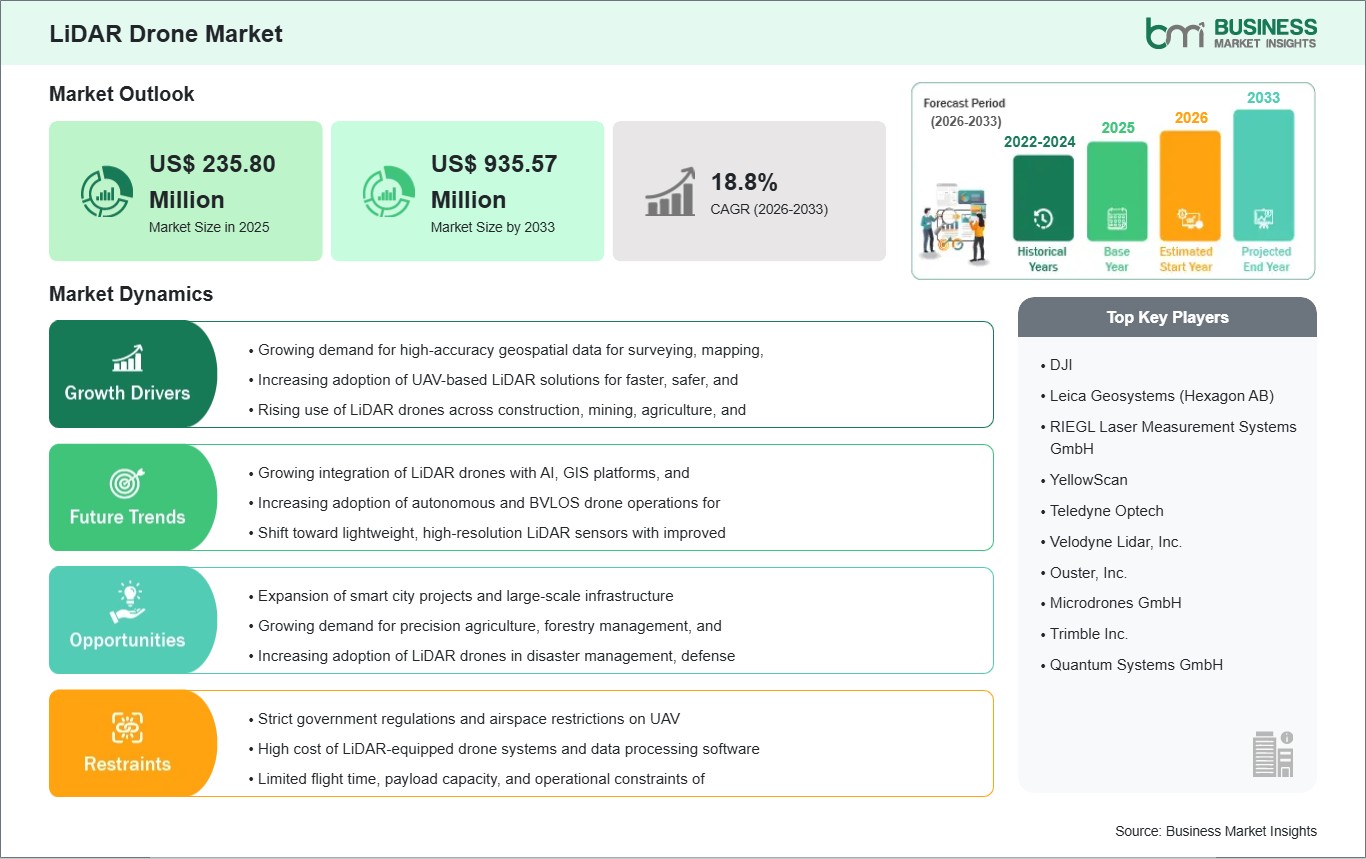
The LiDAR drone marketsize is expected to reach US$ 935.57 million by 2033 from US$ 235.80 million in 2025. The market is estimated to record a CAGR of 18.8% from 2026 to 2033.

Report Coverage
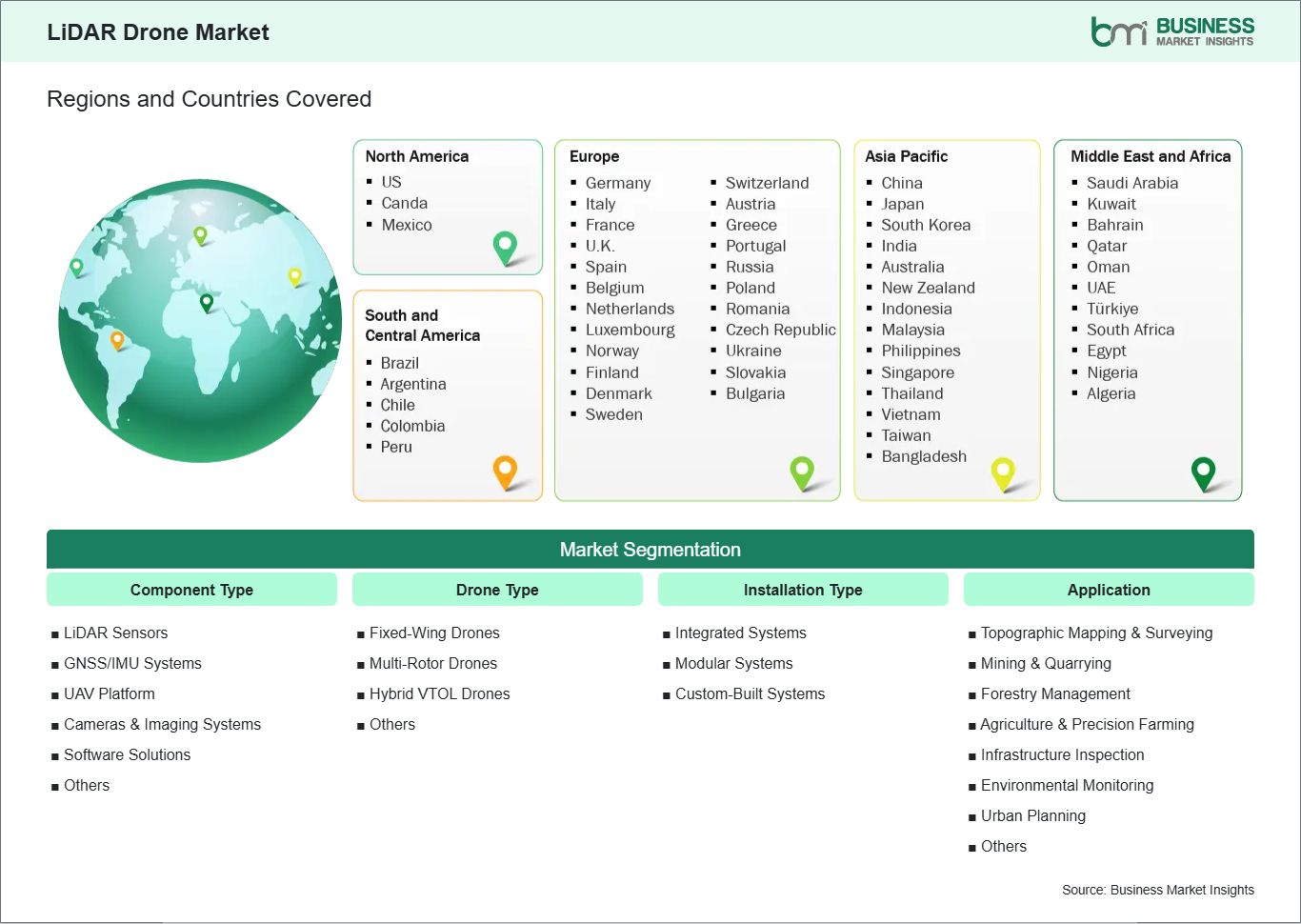
  • Component Type: LiDAR Sensors, GNSS/IMU Systems, UAV Platform, Cameras & Imaging Systems, Software Solutions, Others
  • Drone Type: Fixed-Wing Drones, Multi-Rotor Drones, Hybrid VTOL Drones, Others
  • Installation Type: Integrated Systems, Modular Systems, Custom-Built Systems
  • Application: Topographic Mapping & Surveying, Mining & Quarrying, Forestry Management, Agriculture & Precision Farming, Infrastructure Inspection, Environmental Monitoring, Urban Planning, Others
US$ 235.80 Mn Market size in 2025
US$ 935.57 Mn Market Size by 2033
18.8% CAGR, 2026 - 2033
2026-2033 Forecast Period

01 Market Summery

Executive Summary and Global Market Analysis

The LiDAR Drone Market refers to the industry focused on unmanned aerial vehicles (UAVs) equipped with LiDAR (Light Detection and Ranging) sensors used for high-precision 3D mapping, terrain modeling, surveying, and spatial data acquisition. These systems combine drone mobility with advanced laser-based scanning technology to generate highly accurate geospatial information across industries such as construction, agriculture, mining, oil & gas, forestry, infrastructure development, defense, and environmental monitoring.

The market is witnessing strong growth driven by increasing demand for high-resolution geospatial data, rapid adoption of UAV-based surveying solutions, and the need for faster, safer, and more cost-effective alternatives to traditional land surveying methods. LiDAR-equipped drones significantly reduce fieldwork time while improving accuracy in complex terrains, making them highly valuable for large-scale infrastructure projects, smart city development, and precision agriculture applications. Additionally, advancements in lightweight LiDAR sensors, improved battery life, and AI-powered data processing are further accelerating adoption.

However, the market faces challenges such as high initial system costs, regulatory restrictions on drone operations in several regions, and the requirement for skilled professionals to process and interpret LiDAR-generated datasets. Weather sensitivity and limited flight endurance of drones can also impact operational efficiency in certain environments.

Despite these challenges, the LiDAR drone market holds strong long-term growth potential due to increasing investments in geospatial intelligence, expansion of autonomous surveying technologies, and integration of LiDAR data with GIS, AI, and cloud-based analytics platforms. Ongoing innovations in sensor miniaturization, real-time data processing, and autonomous flight systems are expected to significantly enhance market adoption across commercial and government applications.

02 Strategic Insights

LiDAR Drone Market: Strategic Insights

lidar-drone-market-market-strategic-framework
FREE PDF
Request your free sample
Request free sample
03 Segment Analysis

LiDAR Drone Market Segmentation

The LiDAR Drone Market is segmented based on component type, drone type, installation type, application, and end user, reflecting the diverse deployment of UAV-based LiDAR systems for mapping, surveying, and spatial intelligence across multiple industries.

By Component Type

  • LiDAR Sensors: Core technology component used for high-precision 3D data capture and mapping
  • Navigation & Positioning Systems (GNSS/IMU): Ensures accurate geolocation and flight stability during data collection
  • Cameras & Imaging Systems: Used for visual data integration with LiDAR point clouds for enhanced mapping accuracy
  • UAV Platforms (Drones): Aerial vehicles that carry LiDAR payloads for data acquisition
  • Software Solutions: Includes data processing, point cloud analysis, 3D modeling, and GIS integration tools
  • Others: Includes batteries, storage systems, and communication modules.

By Drone Type

  • Fixed-Wing Drones: Used for large-area mapping and long-endurance surveying missions
  • Multi-Rotor Drones: Widely used for high-precision, short-range surveying and complex terrain mapping
  • Hybrid VTOL Drones: Combine vertical takeoff with fixed-wing efficiency for extended operational flexibility
  • Others: Includes specialized UAV platforms designed for niche surveying applications.

By Installation Type

  • Integrated LiDAR Systems: Fully embedded LiDAR payload systems designed for plug-and-play UAV deployment
  • Modular LiDAR Systems: Detachable and interchangeable LiDAR units mounted on different drone platforms
  • Custom-Built Systems: Application-specific configurations tailored for defense, mining, and large-scale infrastructure projects.

By Application

  • Topographic Mapping & Surveying: High-accuracy terrain modeling for construction, infrastructure, and land development
  • Mining & Quarrying: Volume estimation, site monitoring, and resource planning applications
  • Forestry Management: Tree height measurement, biomass estimation, and forest density analysis
  • Agriculture & Precision Farming: Crop health monitoring, irrigation planning, and yield optimization
  • Infrastructure Inspection: Roads, railways, bridges, and power line monitoring
  • Environmental Monitoring: Flood mapping, coastal erosion analysis, and disaster management
  • Urban Planning & Smart Cities: 3D city modeling and infrastructure planning
  • Others: Archaeology, defense mapping, and research applications.

By End User

  • Construction & Infrastructure: Used for site planning, earthwork analysis, and project monitoring
  • Mining & Natural Resources: Supports exploration, excavation planning, and operational optimization
  • Agriculture: Enables precision farming and crop analytics
  • Forestry & Environmental Agencies: Used for ecological monitoring and conservation planning
  • Oil & Gas: Pipeline inspection and terrain analysis in remote locations
  • Defense & Security: Surveillance, terrain mapping, and mission planning
  • Government & Municipal Bodies: Urban planning, land surveying, and disaster management
  • Others: Includes academic institutions, research organizations, and mapping service provid.
04 Market Forces

LiDAR Drone Market Drivers and Opportunities

Growing Demand for High-Accuracy Geospatial Data and Rapid Surveying Solutions Driving Market Growth

The LiDAR Drone Market is primarily driven by the increasing demand for highly accurate geospatial data, rapid land surveying, and efficient 3D mapping solutions across industries such as construction, mining, agriculture, forestry, and infrastructure development. Traditional surveying methods are often time-consuming, labor-intensive, and less effective in complex terrains, whereas LiDAR-equipped drones provide fast, precise, and cost-effective data acquisition with high spatial resolution.

The growing need for real-time terrain analysis and digital mapping in large-scale infrastructure projects is further accelerating market adoption. Governments and private organizations are increasingly using LiDAR drones for urban planning, smart city development, disaster management, and environmental monitoring. Additionally, the expansion of construction activities, transportation networks, and energy infrastructure is boosting demand for aerial surveying technologies.

Technological Advancements, Expansion of UAV Applications, and Integration with AI and GIS Creating Strong Growth Opportunities

Opportunities in the LiDAR Drone Market are expanding significantly due to continuous advancements in LiDAR sensor miniaturization, drone autonomy, and data processing technologies. Improvements in lightweight LiDAR systems, longer drone flight endurance, and enhanced GNSS/IMU accuracy are enabling more efficient and precise mapping operations across diverse environments.

The integration of LiDAR data with GIS platforms, AI-based analytics, and cloud computing systems is transforming how spatial information is processed and utilized. This is enabling real-time 3D modeling, predictive terrain analysis, and automated decision-making across industries such as agriculture, mining, oil & gas, and forestry management.

Furthermore, the growing adoption of autonomous drones and BVLOS (Beyond Visual Line of Sight) operations is significantly expanding the operational scope of LiDAR drones. Increasing investments in smart infrastructure, climate monitoring, and environmental conservation are also creating new application areas. Emerging economies are further offering strong growth potential due to rising investments in geospatial intelligence and modernization of surveying practices.

05 Size and Share Analysis

LiDAR Drone Market Size and Share Analysis

The LiDAR droneis projected to grow from US$ 935.57 million by 2033 from US$ 235.80 million in 2025. The market is estimated to record a CAGR of 18.8% from 2026 to 2033.

By component type, LiDAR sensors hold the largest market share owing to their critical role in high-accuracy 3D mapping, terrain modeling, and spatial data acquisition. These sensors are increasingly being integrated into UAV platforms to deliver precise elevation data and dense point cloud generation. GNSS and IMU systems also account for a significant share due to their importance in ensuring positional accuracy and flight stability during data collection missions. Additionally, software solutions are witnessing rapid growth as industries increasingly rely on advanced point cloud processing, GIS integration, and AI-based spatial analytics.

By drone type, multi-rotor drones dominate the market due to their ability to perform high-precision surveys in confined and complex environments, making them ideal for construction sites, urban mapping, and infrastructure inspection. Fixed-wing drones hold a significant share in large-area surveying applications such as agriculture, mining, and environmental monitoring due to their longer flight endurance and wider coverage capability. Hybrid VTOL drones are gaining traction as they combine long-range efficiency with vertical takeoff and landing flexibility, making them suitable for diverse operational requirements.

06 Report Highlights

LiDAR Drone Market Report Highlights

Report Attribute Details
Market size in 2025 US$ 235.80 Million
Market Size by 2033 US$ 935.57 Million
Global CAGR (2026 - 2033)18.8%
Historical Data 2022-2024
Forecast period 2026-2033
Segments Covered By Component Type
  • LiDAR Sensors
  • GNSS/IMU Systems
  • UAV Platform
  • Cameras & Imaging Systems
  • Software Solutions
  • Others
By Drone Type
  • Fixed-Wing Drones
  • Multi-Rotor Drones
  • Hybrid VTOL Drones
  • Others
By Installation Type
  • Integrated Systems
  • Modular Systems
  • Custom-Built Systems
By Application
  • Topographic Mapping & Surveying
  • Mining & Quarrying
  • Forestry Management
  • Agriculture & Precision Farming
  • Infrastructure Inspection
  • Environmental Monitoring
  • Urban Planning
  • Others
Regions and Countries Covered
North America US, Canada, Mexico
Europe Germany, Italy, France, U.K., Spain, Belgium, Netherlands, Luxembourg, Norway, Finland, Denmark, Sweden, Switzerland, Austria, Greece, Portugal, Russia, Poland, Romania, Czech Republic, Ukraine, Slovakia, Bulgaria
Asia-Pacific China, Japan, South Korea, India, Australia, New Zealand, Indonesia, Malaysia, Philippines, Singapore, Thailand, Vietnam, Taiwan, Bangladesh
South and Central America Brazil, Argentina, Chile, Colombia, Peru
Middle East and Africa Saudi Arabia, United Arab Emirates, Kuwait, Bahrain, Qatar, Oman, Turkiye, South Africa, Egypt, Nigeria, Algeria
Market leaders and key company profiles
  • DJI
  • Leica Geosystems (Hexagon AB)
  • RIEGL Laser Measurement Systems GmbH
  • YellowScan
  • Teledyne Optech
  • Velodyne Lidar, Inc.
  • Ouster, Inc.
  • Microdrones GmbH
  • Trimble Inc.
  • Quantum Systems GmbH
FREE PDF
Request your free sample
Request free sample
07 Report Coverage

LiDAR Drone Market Report Coverage and Deliverables

The "LiDAR Drone Market Size and Forecast (2022-2033)" report provides a detailed analysis of the market covering below areas:

  • Market size and forecast at global, regional, and country levels for all market segments covered under the scope
  • Market trends, as well as drivers, restraints, and opportunities
  • Market analysis covering key trends, global and regional framework, major players, regulations, and recent developments
  • Industry landscape and competition analysis covering market concentration, heat map analysis, prominent players, and recent developments for the market
  • Detailed company profiles, including SWOT analysis
08 Geographic Insights

LiDAR Drone Market Geographic Insights

The LiDAR Drone Market demonstrates significant regional variation, influenced by differences in geospatial technology adoption, infrastructure development activities, smart city initiatives, regulatory frameworks for UAV operations, and investment in digital mapping and surveying technologies across major global economies. Growth patterns are closely linked to rising demand for high-accuracy terrain mapping, infrastructure monitoring, environmental assessment, and autonomous surveying solutions across both public and private sectors.

North America holds a significant share of the LiDAR drone market due to early adoption of advanced UAV technologies, strong investment in geospatial intelligence, and widespread use of LiDAR systems in construction, mining, defense, and infrastructure development. The United States dominates the regional market, supported by strong demand for smart city development, large-scale infrastructure modernization projects, and increasing use of drones for surveying, disaster management, and environmental monitoring. Canada also contributes notably through applications in forestry management, natural resource exploration, and land surveying across remote and difficult terrains.

Asia Pacific is the fastest-growing regional market, driven by rapid urbanization, infrastructure expansion, and increasing investment in smart city and digital mapping initiatives. China, India, Japan, and South Korea are the major contributors. China leads due to large-scale infrastructure projects, extensive use of drones in surveying and mapping, and strong domestic UAV manufacturing capabilities. India is witnessing rapid adoption supported by infrastructure development, mining activities, and government-led digital land mapping programs. Japan and South Korea are focusing on high-precision surveying, disaster management applications, and advanced robotics-integrated drone systems.

Overall, the LiDAR Drone Market is globally interconnected, with North America and Europe leading in technological maturity and early adoption, Asia Pacific driving the fastest growth through large-scale infrastructure and urbanization projects, and emerging regions steadily increasing adoption as awareness of geospatial intelligence and UAV-based surveying continues to expand.

global-market-geography
FREE PDF
Request your free sample
Request free sample
09 Report Guidance

LiDAR Drone Market Report Guidance

  • The report includes qualitative and quantitative data in the LiDAR drone market across component type, drone type, installation type, application, end user, and geography.
  • The report starts with the key takeaways (chapter 2), highlighting the key trends and outlook of the LiDAR drone.
  • Chapter 3 focuses on the research methodology of the study.
  • Chapter 4 includes ecosystem analysis.
  • Chapter 5 highlights the major industry dynamics in the LiDAR drone, including factors that are driving the market, prevailing deterrents, potential opportunities, as well as future trends. Impact analysis of these drivers and restraints is also covered in this section.
  • Chapter 6 discusses the LiDAR dronescenario, in terms of historical market revenues, and forecast till the year 2033.
  • Chapters 7 to 10 cover LiDAR dronesegments by technology, vehicle type, application, and geography across North America, Europe, Asia Pacific, Middle East and Africa, and South and Central America. They cover the market revenue, forecast, and factors driving the market.
  • Chapter 11 describes the competitive analysis along with the heat map analysis for the key players operating in the market.
  • Chapter 12 describes the industry landscape analysis. It provides detailed descriptions of business activities such as market initiatives, new developments, mergers, and joint ventures globally, along with a competitive landscape.
  • Chapter 13 provides detailed profiles of the major companies operating in the LiDAR drone. Companies have been profiled on the basis of their key facts, business descriptions, products and services, financial overview, SWOT analysis, and key developments.
  • Chapter 14, i.e., the appendix, is inclusive of a brief overview of the company, list of abbreviations, and disclaimer.
10 Industry Activity

Recent Developments

The LiDAR drone marketis evaluated by gathering qualitative and quantitative data post primary and secondary research, which includes important corporate publications, association data, and databases. A few of the key developments in the LiDAR drone marketare:


  • In April 2026, Hall Lidar Inc announced the launch of its first-generation acoustic drone detection system. The UDL-64 (Ultimate Drone Listener) system delivers real-time 3D situational awareness in complex operational environments, representing a major step forward in security addressing aerial threats.
  • In April 2026, CHC Navigation (CHCNAV), a global technology leader in mapping, navigation, and positioning solutions, announced the AlphaAir 6 (AA6), a flagship airborne LiDAR system designed for UAV-based laser scanning, drone LiDAR mapping, and aerial surveying in high-relief and complex terrain. Combining prism scanning technology with a high-grade inertial navigation system, the AA6 delivers a maximum ranging capability of up to 2,100 m and supports efficient data capture at typical flight altitudes of 400 to 600 m above ground level.
11 Trust & Transparency

Research Methodology

The market analysis combines proprietary research with secondary data from government agencies, company disclosures, regulatory filings, industry databases and expert interviews. Market estimates are validated through data triangulation, cross-market benchmarking and analyst review.

View Full Research Methodology

Key Sources Referred:

World Bank - Global Trade IndicatorsWorld Trade Organization (WTO)(International Monetary Fund )IMFInternational Trade Administration (ITA)Company websiteCompany annual reportsCompany investor presentations

12 Questions Answered

Frequently Asked Questions

How big is the LiDAR Drone Market?

The LiDAR Drone Market is valued at US$ 235.80 Million in 2025, it is projected to reach US$ 935.57 Million by 2033.

What is the CAGR for LiDAR Drone Market by (2026 - 2033)?

As per our report LiDAR Drone Market, the market size is valued at US$ 235.80 Million in 2025, projecting it to reach US$ 935.57 Million by 2033. This translates to a CAGR of approximately 18.8% during the forecast period.

What segments are covered in this report?

The LiDAR Drone Market report typically cover these key segments-

  • Component Type(LiDAR Sensors, GNSS/IMU Systems, UAV Platform, Cameras & Imaging Systems, Software Solutions, Others)
  • Drone Type (Fixed-Wing Drones, Multi-Rotor Drones, Hybrid VTOL Drones, Others)
  • Installation Type (Integrated Systems, Modular Systems, Custom-Built Systems)
  • Application (Topographic Mapping & Surveying, Mining & Quarrying, Forestry Management, Agriculture & Precision Farming, Infrastructure Inspection, Environmental Monitoring, Urban Planning, Others)

What is the historic period, base year, and forecast period taken for LiDAR Drone Market?

The historic period, base year, and forecast period can vary slightly depending on the specific market research report. However, for the LiDAR Drone Market report:

  • Historic Period : 2022-2024
  • Base Year : 2025
  • Forecast Period : 2026-2033
Who are the major players in LiDAR Drone Market?

The LiDAR Drone Market is populated by several key players, each contributing to its growth and innovation. Some of the major players include:

  • DJI
  • Leica Geosystems (Hexagon AB)
  • RIEGL Laser Measurement Systems GmbH
  • YellowScan
  • Teledyne Optech
  • Velodyne Lidar, Inc.
  • Ouster, Inc.
  • Microdrones GmbH
  • Trimble Inc.
  • Quantum Systems GmbH
Who should buy this report?

The LiDAR Drone Market report is valuable for diverse stakeholders, including:

  • Investors: Provides insights for investment decisions pertaining to market growth, companies, or industry insights. Helps assess market attractiveness and potential returns.
  • Industry Players: Offers competitive intelligence, market sizing, and trend analysis to inform strategic planning, product development, and sales strategies.
  • Suppliers and Manufacturers: Helps understand market demand for components, materials, and services related to concerned industry.
  • Researchers and Consultants: Provides data and analysis for academic research, consulting projects, and market studies.
  • Financial Institutions: Helps assess risks and opportunities associated with financing or investing in the concerned market.

Essentially, anyone involved in or considering involvement in the LiDAR Drone Market value chain can benefit from the information contained in a comprehensive market report.

Access the Full LiDAR Drone Market Report

Get segment-level forecasts, regional estimates, competitive benchmarking, company profiles and downloadable Excel datasets.

Access the full LiDAR Drone Market Report
400 pages PDF & Excel | 2026-06-24