
Drone Camera Market Outlook: Size, Share, Trends, Growth Analysis, Competitive Landscape & Forecast, 2026-2033

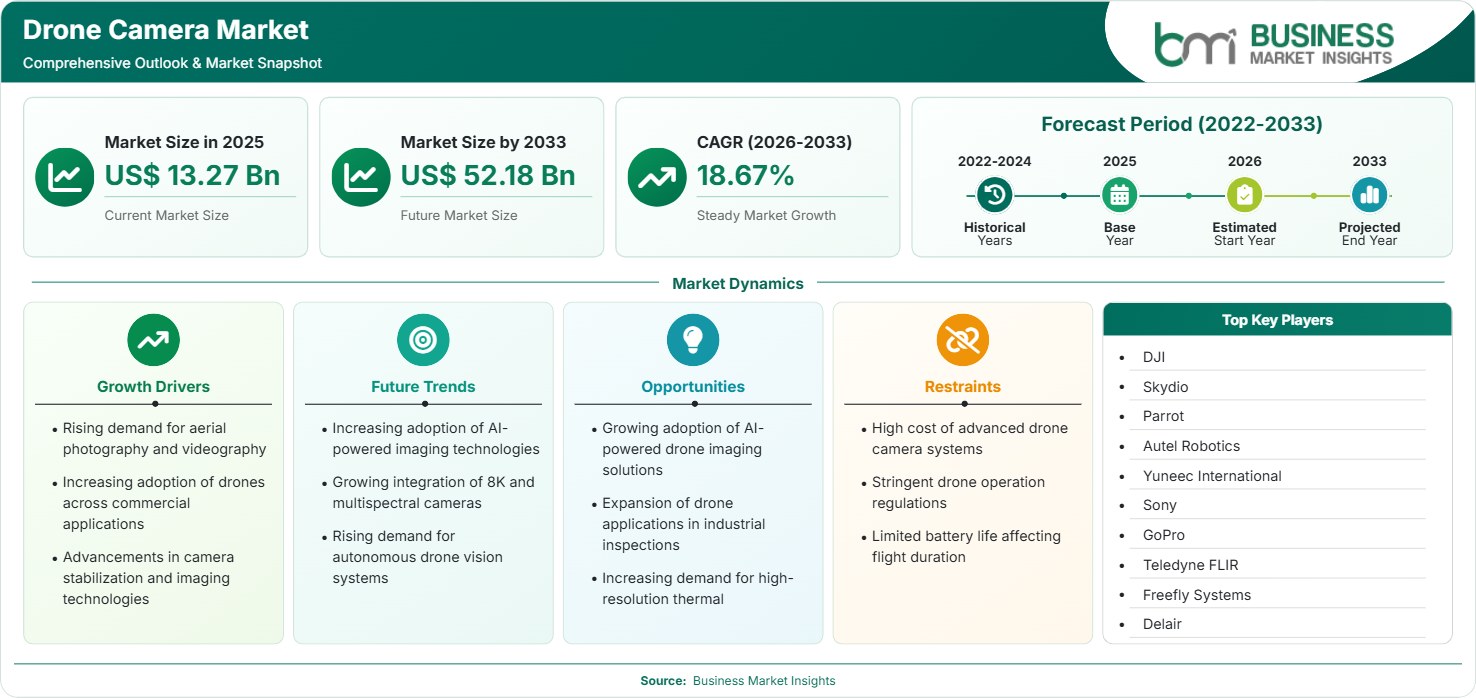
The Drone Camera Market size was valued at US$ 13.27 Billion in 2025 and is projected to reach US$ 52.18 Billion by 2033, growing at a CAGR of 18.67% from 2026 to 2033, driven by AI-enabled imaging, industrial inspection demand, advanced surveillance capabilities, and expanding commercial drone adoption.

Report Coverage
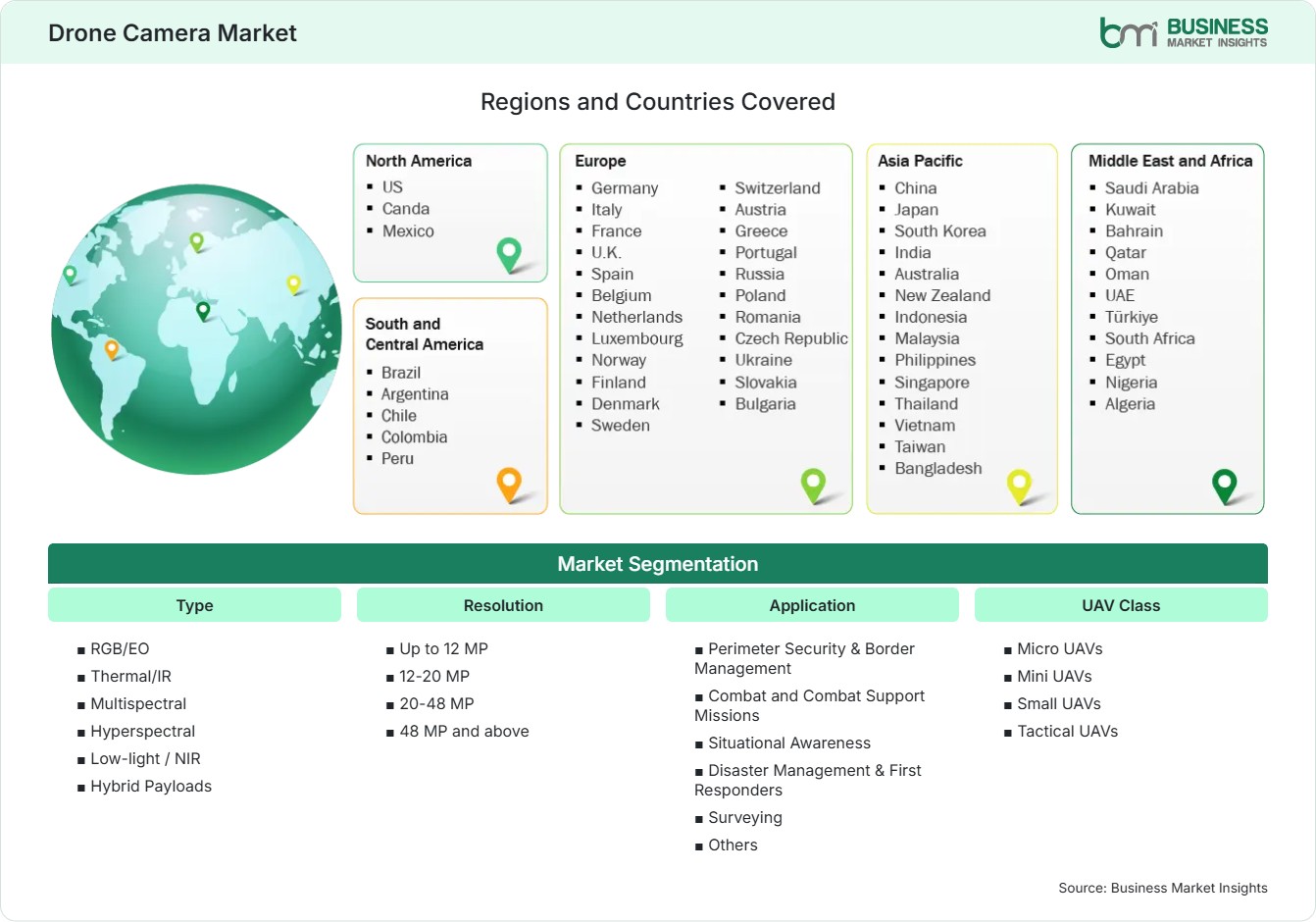
  • Type: RGB/EO, Thermal/IR, Multispectral, Hyperspectral, Low-light / NIR, Hybrid Payloads
  • Resolution: Up to 12 MP, 12-20 MP, 20-48 MP, 48 MP and above
  • Application: Perimeter Security & Border Management, Combat and Combat Support Missions, Situational Awareness, Disaster Management & First Responders, Surveying, Others
  • UAV Class: Micro UAVs, Mini UAVs, Small UAVs, Tactical UAVs
  • End User: Commercial & enterprise operators, Agriculture Operators, Public Safety Agencies, Defense & Intelligence Organizations, Research & Academia, Energy, Power, Oil & Gas, Others
US$ 13.27 Bn Market size in 2025
US$ 52.18 Bn Market Size by 2033
18.67% CAGR, 2026 - 2033
2026-2033 Forecast Period

01 AI Overview

Drone Camera Market Summary

  • North America Region: Market shares for North America are estimated to be at 32%-35% in 2025, which will experience growth at a CAGR of 17%-19% due to the modernization of the defense industry, drone usage in business, demands for aerial imagery, and industrial inspection initiatives. Market share for the United States is estimated to have a CAGR of 17%-19% from 2026-2033.
  • Fastest Growing Region: The Asia Pacific market share ranges between 28%-31% in 2025, growing at CAGR of 20%-22%, on account of agricultural surveillance, infrastructural development, smart city projects, industrial inspections, and higher investments in drone technology in developing nations.
  • Leading Segment: RGB/EO (visible) cameras hold a market share of 35%–38% in 2025, growing with a CAGR of 17%–19% due to widespread aerial photography, mapping applications, surveillance operations, and cost-effective imaging requirements across commercial and government sectors.
  • High Growth Segment: Thermal/IR cameras hold a market share of 22%–25% in 2025, advancing with a CAGR of 21%–23% driven by defense surveillance, industrial inspection, emergency response operations, and increasing demand for night and low-visibility imaging.
  • Key Market Opportunity: AI-powered imaging, autonomous inspection workflows, advanced thermal analytics, and high-resolution payload integration are creating opportunities for drone camera manufacturers to address industrial, defense, and public safety applications.
  • Major Market Players: DJI, Skydio, Parrot, Autel Robotics, Yuneec International, Sony, GoPro, Teledyne FLIR, Freefly Systems, and Delair.
02 Strategic Insights

Drone Camera Market: Strategic Insights

Drone Camera Market Strategic Framework
FREE PDF
Request your free sample
Request free sample
03 Stakeholder View

Key Takeaways

  • Drone camera ecosystems are evolving beyond imaging hardware toward integrated intelligence platforms combining sensors, AI analytics, autonomous flight controls, and cloud-based data processing capabilities.
  • Industrial inspection, defense surveillance, agriculture monitoring, and emergency response applications represent major growth avenues as organizations seek safer and more efficient alternatives to traditional inspection methods.
  • Camera innovation is shifting toward AI-enabled imaging, multispectral analysis, thermal sensing, improved stabilization, and compact high-performance payload designs for specialized missions.
  • Asia Pacific provides strong expansion potential due to increasing infrastructure projects, agricultural modernization programs, defense investments, and growing adoption of commercial UAV solutions.
  • Strategic investments and partnerships are increasing as drone manufacturers collaborate with sensor providers, software developers, and enterprise users to strengthen integrated solutions.
  • Regulatory acceptance and operational standardization will remain important factors influencing long-term adoption across commercial and government applications.
04 Geographic Outlook

Drone Camera Market Regional Highlights

North America Drone Camera Market

North America accounted for a 32%–35% share in 2025 and is projected to register a CAGR of 17%–19% from 2026–2033. The region continues to hold an advantageous position because of applications related to security, business drones, and highly developed technological infrastructure. The Drone Camera Market share includes high demand from security departments, businesses, and professional photographers. The USA holds the leading position due to heavy investment in UAVs.

  • Defense organizations are adopting advanced imaging payloads for surveillance, reconnaissance, and tactical operations requiring reliable aerial intelligence.
  • Commercial operators are deploying drones for construction monitoring, infrastructure inspection, and asset management activities.
  • Technology companies are investing in AI-based analytics to improve automated image interpretation and operational efficiency.
  • Industrial users are increasing drone adoption to reduce inspection costs and improve workplace safety standards.

US Drone Camera Market

The United States represented a 28%–31% share in 2025 and is expected to achieve a CAGR of 17%–19% between 2026–2033. Advanced capabilities in aerospace, substantial defense expenditure, and an abundance of commercial UAVs are advantages of the nation. The Drone Camera Market will grow owing to demand in surveillance systems, industrial inspection devices, and aerial imaging devices in various industries.

  • Defense agencies continue investing in advanced drone payloads for intelligence gathering and mission support operations.
  • Enterprise users are adopting drones for infrastructure monitoring, energy inspections, and operational data collection.
  • AI-enabled camera systems are improving automated analysis, reducing manual processing requirements, and enhancing decision-making.

Europe Drone Camera Market

Europe accounted for a 22%–25% share in 2025 and is forecast to grow at a CAGR of 16%–18% during 2026–2033. The region benefits from industrial automation, environmental monitoring initiatives, and increasing commercial drone integration. Germany, France, and the United Kingdom represent leading markets, while Spain and Italy demonstrate increasing adoption through infrastructure and agricultural applications in drone camera market.

  • Germany is expanding drone utilization through industrial inspection, manufacturing automation, and infrastructure monitoring programs.
  • The United Kingdom is developing drone ecosystems supporting public safety, surveying, and commercial imaging applications.
  • France is increasing adoption through defense modernization and agricultural technology initiatives.
  • European regulations supporting safe UAV operations are encouraging enterprise investment and technology development.

Asia Pacific Drone Camera Market

Asia Pacific represented a 28%–31% share in 2025 and is projected to grow at a CAGR of 20%–22% between 2026–2033. The region demonstrates the highest growth potential due to infrastructure expansion, agricultural modernization, and increasing UAV investments. China, Japan, South Korea, and India are major contributors, with India and Southeast Asian countries showing accelerating commercial adoption in drone camera market.

  • China maintains a strong manufacturing ecosystem supporting drone hardware production and camera technology development.
  • India is expanding drone usage through agriculture monitoring, surveying initiatives, and government-supported UAV programs.
  • Japan and South Korea are adopting drones for industrial automation and advanced inspection applications.
  • Southeast Asian markets are increasing UAV deployment across infrastructure, logistics, and environmental monitoring sectors.

Rest of World Drone Camera Market

South and Central America together accounted for a 7%–10% share in 2025, while the Middle East and Africa contributed a combined 5%–8% share. These regions are expected to grow at CAGRs of 16%–18% and 15%–17%, respectively, supported by agricultural monitoring, security applications, mining operations, and infrastructure development. Brazil, Mexico, UAE, and South Africa represent important drone camera market growth due to increasing drone adoption.

  • Brazil is expanding drone usage in agriculture, environmental monitoring, and land surveying applications through precision technology adoption.
  • Mexico is witnessing increased demand for aerial imaging solutions across construction, security, and industrial inspection sectors.
  • UAE is investing in advanced drone technologies for smart city development, surveillance, and infrastructure management initiatives.
  • South Africa is adopting drone cameras for mining inspections, conservation programs, and public safety applications.
Global Market Geography
FREE PDF
Request your free sample
Request free sample
05 Segment Analysis

Drone Camera Market Segmentation

Type

Type segmentation represents diverse imaging requirements across commercial, defense, and industrial applications. RGB/EO (visible) cameras maintain the largest position with broad usage in photography, mapping, and surveillance. The segment accounted for a 35%–38% share in 2025 and is expected to expand at a CAGR of 17%–19% between 2026–2033. Drone Camera Market scope is expanding through advanced payload integration and specialized imaging solutions.

  • RGB/EO (visible): Provides standard visual imaging for photography, mapping, inspection, and surveillance applications. Adoption remains strong due to affordability, versatility, and compatibility with commercial drone platforms.
  • Thermal/IR: Enables heat-based imaging for defense, firefighting, inspection, and security applications. Demand is increasing due to enhanced visibility during nighttime and challenging environmental conditions.
  • Multispectral: Supports agriculture, environmental monitoring, and scientific analysis through multiple wavelength capture. Growth is driven by precision farming requirements and vegetation health assessment applications.
  • Hyperspectral: Provides detailed spectral information for specialized research, agriculture, and industrial analysis. Adoption is increasing through advanced analytics and improved sensor accessibility.
  • Low-light / NIR (Night-Optimized Visible): Supports nighttime surveillance and security operations through enhanced low-light imaging capabilities. Demand is increasing among public safety and defense users.
  • Hybrid Payloads: Combine multiple imaging technologies into integrated systems for complex missions. Adoption is growing through demand for flexible, multi-purpose drone platforms.

Resolution

Resolution-based solutions represented a significant technology segment in 2025, with 20–48 MP systems holding a 34%–37% share and growing at a CAGR of 18%–20% between 2026–2033. Increasing requirements for detailed mapping, inspection accuracy, and professional imaging are encouraging adoption of higher-resolution cameras across commercial, defense, and industrial drone applications.

  • Up to 12 MP: Supports entry-level photography, basic inspection, and recreational drone applications. Demand remains steady due to affordability and accessibility among smaller operators.
  • 12–20 MP: Provides improved image quality for commercial photography, surveying, and monitoring applications. Adoption is increasing among businesses requiring balanced performance and cost efficiency.
  • 20–48 MP: Serves professional applications requiring detailed imagery, mapping accuracy, and advanced analysis. Growth is supported by infrastructure, agriculture, and industrial inspection requirements.
  • 48 MP and above: Targets high-end applications requiring maximum detail, precision, and advanced data processing. Demand is increasing across defense, research, and specialized industrial operations.

Application

Application-based adoption is led by surveying and perimeter security activities, collectively representing major demand areas in 2025. Surveying applications accounted for a 24%–27% share with a CAGR of 19%–21% between 2026–2033. Growing infrastructure development, security requirements, and automated inspection workflows are accelerating drone camera adoption across multiple operational environments.

  • Perimeter Security & Border Management: Utilizes drone cameras for surveillance, intrusion detection, and remote monitoring. Growth is supported by increasing security requirements and advanced imaging capabilities.
  • Combat and Combat Support Missions: Employs drone cameras for reconnaissance, intelligence gathering, and mission support. Adoption is increasing through defense modernization and tactical UAV deployment.
  • Situational Awareness: Enables real-time visual intelligence for military, public safety, and operational decision-making. Growth is driven by demand for rapid information access.
  • Disaster Management & First Responders: Supports emergency response, search operations, and damage assessment. Demand is increasing due to faster response requirements and safer operational methods.
  • Surveying: Provides aerial mapping, construction monitoring, and land assessment capabilities. Adoption is expanding through infrastructure development and precision measurement needs.

UAV Class

UAV Class segmentation was dominated by small and mini UAV platforms in 2025, with Mini UAVs (2-20 Kg) accounting for a 36%–39% share and expanding at a CAGR of 19%–21% between 2026–2033. Growing commercial applications, improved payload capacity, and operational flexibility are supporting wider deployment of drone cameras across professional industries.

  • Micro UAVs (Below 2 Kg): Support lightweight applications including photography, basic monitoring, and recreational use. Growth is encouraged by affordability and ease of deployment.
  • Mini UAVs (2-20 Kg): Serve commercial imaging, surveying, and inspection applications. Adoption is increasing due to improved payload capacity and operational flexibility.
  • Small UAVs (20-50 Kg): Enable advanced imaging missions requiring longer endurance and higher payload capabilities. Demand is growing across industrial and security applications.
  • Tactical UAVs: Support defense and intelligence operations requiring reliable surveillance and mission-specific imaging payloads. Growth is driven by military modernization programs.

End User

End-user adoption is led by commercial and enterprise operators, representing a 30%–33% share in 2025 and expanding at a CAGR of 18%–20% through 2026–2033. Increasing drone utilization for inspection, monitoring, and analytics is supporting market expansion. Defense, agriculture, and energy sectors are also contributing through specialized imaging requirements.

  • Commercial & enterprise operators: Use drone cameras for inspection, monitoring, photography, and operational analytics. Adoption is increasing through cost reduction and productivity improvement goals.
  • Agriculture Operators: Deploy imaging systems for crop monitoring, field analysis, and precision farming. Growth is supported by agricultural automation and resource optimization.
  • Public Safety Agencies: Utilize drones for emergency response, surveillance, and disaster assessment. Demand is increasing through improved safety and rapid-response requirements.
  • Defense & Intelligence Organizations: Adopt advanced cameras for reconnaissance, surveillance, and tactical operations. Growth is driven by security challenges and modernization initiatives.
  • Research & Academia: Apply drone imaging for scientific studies, environmental analysis, and technology development. Adoption is supported by innovation programs and research funding.
  • Energy, Power, Oil & Gas: Use drone cameras for infrastructure inspection, monitoring, and asset management. Growth is supported by safety improvement and operational efficiency requirements.
06 Market Forces

Drone Camera Market Dynamics

Key Market Drivers

Rising Demand for Aerial Photography and Videography

The increasing popularity of aerial photography, content creation, filmmaking, and professional imaging applications is driving demand for advanced drone camera systems. The growth is supported by media production companies, real estate firms, tourism operators, and commercial photographers adopting drones for efficient visual content generation. Improved stabilization, higher-resolution sensors, and automated flight features are enhancing image quality and usability. The Drone Camera Market trends show increasing preference for compact systems capable of delivering professional-grade footage while reducing operational costs compared with traditional aerial imaging methods.

Increasing Adoption of Drones Across Commercial Applications

Drone usage for commercial purposes is increasing in the agricultural industry, construction industry, energy sector, logistics, and inspection industries as the companies try to find safer and more effective means of collecting data. Drones cameras allow remote surveillance, assessment, and automation without having to rely too much on the conventional manual inspection process. The companies are adopting unmanned aerial vehicles in order to increase efficiency, improve safety conditions at work, and make better operational decisions. The increased use of commercial drones is possible due to technical progress, cheaper hardware, and software options which is driving the growth of drone camera market

Advancements in Camera Stabilization and Imaging Technologies

Constant advancements in gimbal stabilization, sensor technology miniaturization, optics, and computational photography have improved the efficiency of drones' cameras. Manufacturers are designing lightweight payloads with better resolution and better low light performance that are also assisted by AI.  These technological developments have ensured that drones can be used efficiently in complicated environments such as industrial areas, emergencies, and military operations. The development of improved stabilization technologies has enabled better picture capture and more accurate surveys. The incorporation of new imaging technologies has enhanced the use of camera drones in specialized cases.

Key Market Opportunities

Growing Adoption of AI-Powered Drone Imaging Solutions

The implementation of AI is paving new avenues for drone camera companies, thanks to image recognition, predictions, and decision support that can be done automatically. AI-driven image systems will be capable of spotting defects, classifying images, tracking changes, and processing massive amounts of aerial images with little human involvement. The need for autonomous inspection and surveillance systems is fostering the adoption of edge computing, machine learning techniques, and intelligent payloads. Companies that have an integrated software and hardware platform will be best placed to serve the demands of defense, infrastructure, agriculture, and public safety industries.

Expansion of Drone Applications in Industrial Inspections

The inspection industry offers great prospects for growth as energy, utility, construction, and manufacturing firms become more interested in using drones to make their asset inspections more efficient. Drones can be equipped with cameras for the inspection of pipelines, infrastructure, towers, and industrial complexes without compromising safety and causing disruption. In addition to the use of high-resolution images, the integration of analytics will make it possible to conduct predictive maintenance and quicker failure detection. Investments in the modernization of infrastructure and automation should promote the use of drones in industrial inspections.

Increasing Demand for High-Resolution Thermal Imaging

The need for high-resolution thermal camera payload systems has been rising because organizations are looking for better visibility during low-light conditions. High-quality thermal drones are becoming more common in applications such as defense surveillance, fire-fighting, search and rescue missions, energy inspection, and security. The use of high-resolution thermal sensors in combination with artificial intelligence is resulting in accurate detection capabilities. Companies that manufacture smaller thermal camera payloads, with higher sensitivity and extended operational abilities, can cater to the rising demands from governments and industries.

Market Restraints and Challenges

High Cost of Advanced Drone Camera Systems

Factor: Advanced drone camera systems with thermal sensors, hyperspectral capabilities, AI processing, and high-resolution payloads require significant investment in hardware and software infrastructure. Impact: High acquisition costs can restrict adoption among small enterprises, individual operators, and budget-sensitive users. Professional-level systems also demand further costs associated with maintenance, training, data processing software, and regulatory compliance. Even though the costs have been slowly decreasing through technology, high-end image acquisition systems still pose as an obstacle for firms considering drones for their particular purpose.

Stringent Drone Operation Regulations

Factor: Increasing regulatory requirements related to flight permissions, airspace management, operator certification, and privacy protection affect drone deployment. Impact: Complex compliance processes can delay commercial adoption and increase operational costs for businesses using drone camera solutions. Aviation authorities worldwide are developing frameworks to ensure safe integration of UAVs into existing airspace systems. However, differences between regional regulations create challenges for manufacturers and operators seeking global expansion. Regulatory uncertainty can influence investment decisions, particularly for companies planning large-scale commercial drone operations.

07 Company Analysis

Competitive Landscape

The competitive environment is characterized by rapid innovation in imaging sensors, autonomous flight technologies, payload integration, and software-driven analytics. Drone Camera Market analysis indicates that companies are differentiating through advanced imaging capabilities, AI integration, stabilization technologies, and application-specific solutions. Leading players are focusing on expanding commercial, defense, and industrial offerings while improving performance, reliability, and operational flexibility.

Company Name

Overview

Products and Services relevant to this market

DJI

Global drone technology company specializing in consumer and professional UAV platforms.

Drone cameras, aerial imaging systems, stabilized camera payloads, enterprise solutions.

Skydio

US-based autonomous drone technology company focused on AI-powered UAV systems.

Autonomous drones, intelligent cameras, enterprise inspection solutions.

Parrot

European drone manufacturer providing professional UAV solutions.

Mapping drones, aerial cameras, enterprise imaging platforms.

Autel Robotics

Drone manufacturer offering consumer and professional aerial systems.

High-resolution drone cameras, commercial UAV platforms, imaging solutions.

Yuneec International

UAV company developing aerial imaging and drone technologies.

Camera drones, stabilized imaging systems, professional UAV solutions.

Sony

Electronics company providing advanced imaging technologies and sensors.

Camera modules, imaging sensors, aerial photography technologies.

GoPro

Action camera company serving aerial and adventure imaging markets.

Compact cameras, aerial imaging accessories, video capture solutions.

Teledyne FLIR

Imaging technology provider specializing in thermal sensing solutions.

Thermal cameras, infrared payloads, drone imaging systems.

Freefly Systems

Professional drone manufacturer focused on cinematography applications.

Heavy-lift drones, cinema cameras, aerial production systems.

Delair

Industrial drone company specializing in professional UAV applications.

Long-range UAVs, surveillance cameras, industrial inspection solutions.

10 Trust & Transparency

Research Methodology

The market analysis combines proprietary research with secondary data from government agencies, company disclosures, regulatory filings, industry databases and expert interviews. Market estimates are validated through data triangulation, cross-market benchmarking and analyst review.

View Full Research Methodology

11 Questions Answered

Frequently Asked Questions

Which industries are adopting drone cameras most actively?

Defense, agriculture, construction, energy, public safety, and industrial inspection sectors are major adopters due to efficiency improvements and reduced operational risks.

What does the Drone Camera Market Report analyze?

The report evaluates market size, growth factors, segmentation, competitive landscape, regional trends, opportunities, and technological developments influencing future adoption.

How is AI influencing drone camera development?

AI is enabling automated image analysis, object detection, predictive maintenance, and real-time decision-making, improving the value of drone-generated data across industries.

Which drone camera type has the largest adoption?

RGB/EO visible cameras maintain broad adoption because they support multiple applications including photography, mapping, surveillance, and commercial inspection at relatively lower costs.

What is driving demand for drone camera market globally?

Demand is increasing due to growth in aerial photography, industrial inspections, defense surveillance, agriculture monitoring, and emergency response applications requiring efficient visual data collection.

Access the Full Drone Camera Market Report

Get segment-level forecasts, regional estimates, competitive benchmarking, company profiles and downloadable Excel datasets.

Access the full Drone Camera Market Report
350 pages PDF & Excel | 2026-08-05