
Commercial Drone Market Outlook: Size, Share, Trends, Growth Analysis, Competitive Landscape & Forecast, 2026-2033

Historic Data: 2022-2024   |   Base Year: 2025   |   Forecast Period: 2026-2033
Report Content: Market Scope, Market Segmentation, Market Dynamics, and Competitive Analysis

Report Coverage:
  • Product (Fixed-wing, Rotary, Hybrid)
  • Application (Agriculture, Logistics, Media, Security)
  • End-use (Delivery, Surveillance, Mapping, Entertainment)
  • Propulsion (Electric, Hybrid)
  • Mode (Remote, Optional, Autonomous)

No. of Pages: 400
Report Code: BMIPUB00035365
Category: Aerospace and Defense
Commercial Drone Market

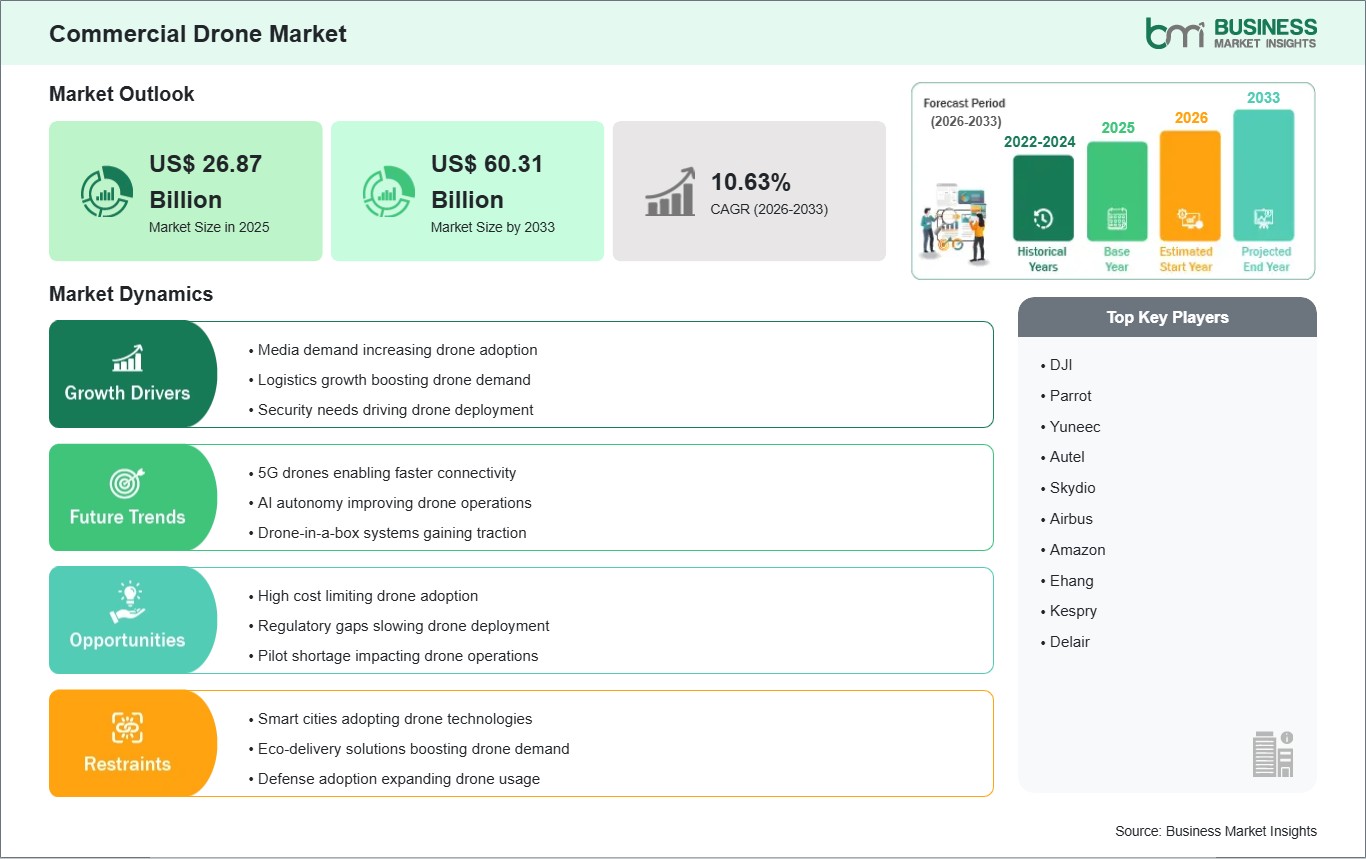
The Commercial Drone Market size is expected to reach US$ 60.31 Billion by 2033 from US$ 26.87 Billion in 2025.The market is estimated to record a CAGR of 10.63% from 2026 to 2033.

Executive Summary and Global Market Analysis:

The commercial drone market refers to the unmanned aircraft being used in a wide variety of industries to gather data, make deliveries, conduct surveillance, or create media content. The commercial drones are fitted with modern sensors and communication technologies that allow them to conduct remote and autonomous operations. They have become an integral part of numerous commercial operations as they increase the efficiency of operations, cut down on costs, and improve data accessibility.

The market shows robust growth trends driven by the growing adoption of aerial data solutions and automation solutions. Companies are implementing drone technology in their operations to speed up work processes, minimize risk, and conduct precision-based monitoring. Drones' usage cases in the field of logistics, agriculture, and security continue to expand and boost deployment around the world.

Segmentation includes several categories, including drones based on the type of application or industry, product type, and propulsion mechanism. Fixed-wing drones are preferred for long-range flights, while rotary drones are mainly utilized in short-range, flexibility-based missions. Hybrids drones are becoming more popular due to increased efficiency. In terms of propulsion systems, electric propulsion prevails due to its simple operation.

Technology development revolves around autonomous navigation, AI-assisted imaging, and instant connectivity. The growing adoption of analytics from the cloud, along with edge computing technology, has enhanced the intelligence and decision-making abilities of drones. This has made it possible for drones to move beyond being manual devices to becoming automated business systems.

The competition environment involves quick innovation in terms of flight time, payload capability, and software integration capabilities. Businesses are now more inclined towards developing autonomy as well as regulatory compliance features. The sector is headed towards the establishment of drone ecosystems for use in industrial automation and decision-making.

Commercial Drone Market - Strategic Insights:

global-market-strategic-framework
Get more information on this report

Commercial Drone Market Segmentation Analysis:

The commercial drone market is segmented based on product, application, end-use, propulsion, and mode, reflecting the expanding role of unmanned aerial systems across industrial operations, automation processes, and data-driven commercial ecosystems.

By Product

  • Fixed-wing: Long-range efficiency supports large-area mapping and surveillance operations.
  • Rotary: High maneuverability enables precise control for short-distance tasks.
  • Hybrid: Combined capabilities improve endurance and operational flexibility across missions.

By Application

  • Agriculture: Precision monitoring supports crop health analysis and resource optimization.
  • Logistics: Drone-based delivery improves last-mile transportation efficiency.
  • Media: Aerial imaging enhances content creation and broadcasting quality.
  • Security: Surveillance systems strengthen real-time monitoring and threat detection.

By End-Use

  • Delivery: Automated parcel transport enhances speed and reduces logistics dependency.
  • Surveillance: Continuous monitoring supports public safety and infrastructure security.
  • Mapping: Geographic data collection enables accurate terrain and urban analysis.
  • Entertainment: Event coverage and filming expand creative production capabilities.

By Propulsion

  • Electric: Battery-powered systems ensure low operational cost and cleaner performance.
  • Hybrid: Extended flight endurance supports high-load and long-duration missions.

By Mode

  • Remote: Manual control enables operator-guided mission execution.
  • Optional: Semi-autonomous systems balance control and automation efficiency.
  • Autonomous: AI-driven navigation supports fully independent drone operations.
Commercial Drone Market Drivers and Opportunities:

Media demand increasing drone adoption

There is a rising demand for commercial drones by media houses and other companies due to the growth in their usage within the media sector. Drones are increasingly being used in the creation of visual content for television programs, advertising campaigns, and live events. The use of drones in media will enhance the capability of capturing perspectives that have been previously hard to achieve and increase the quality of content production.

The cost of acquiring drone systems has continued to fall, making the integration of drones easier in media houses. There is also an improvement in the quality of images captured by drones through improved camera technology. In addition, there is increased safety in the use of drones within urban environments following regulatory frameworks that support their use in such environments. There is also continuous demand for drones from film producers due to increased digital content consumption.

Smart cities adopting drone technologies

The evolution of smart cities is opening up new avenues of commercial drone usage in urban infrastructure management. Usage of drones is increasing in areas such as traffic management, infrastructure management, environmental monitoring, and emergency coordination. This enhances urban infrastructure management through the timely acquisition of information by drones. Smart city architecture is gradually embracing technology connectivity, thus drones are becoming a useful tool for facilitating effective management through better decision-making processes.

More drone usage can be expected as cities deploy advanced monitoring systems and information infrastructure networks. Integration of drones within IoT systems and artificial intelligence algorithms is increasing capacity in urban infrastructure planning and management. Governments are also considering drone corridors and airspace systems that will enable the deployment of drones within cities. In the future, the adoption of smart city technology is likely to make drones integral to urban mobility and infrastructure management systems.

Commercial Drone Market Size and Share Analysis:

The Commercial Drone Market is projected to grow from US$ 26.87 Billion in 2025 to US$ 60.31 Billion by 2033 , registering a CAGR of 10.63% from 2026 to 2033.

By product, rotary drones maintains the leading position due to their vertical take-off and landing capability, eliminating the need for runways and enabling easy deployment in confined or urban environments. Their high maneuverability, stability, and suitability for short-range missions like inspection, surveillance, and photography make them the most widely used commercial drone type.

By application, security dominates because drones are increasingly deployed for surveillance, border monitoring, and critical infrastructure protection. Rising security threats, urban safety concerns, and defense modernization programs drive strong adoption, as drones provide real-time aerial intelligence, rapid response capability, and cost-effective monitoring over large and inaccessible areas.

By end-use, surveillance leads the market as it is the most common and versatile use of commercial drones across industries such as defense, public safety, energy, and infrastructure. Drones enable continuous, real-time monitoring with high efficiency and lower operational cost compared to traditional methods, making them essential for situational awareness and data collection.

By propulsion, electric propulsion accounts for maximum share owing to its cost-effectiveness, low maintenance requirements, and compatibility with lightweight drone systems. Advancements in lithium-ion and battery technologies enhance flight efficiency and endurance, while low noise and zero emissions make electric drones ideal for widespread commercial and urban applications.

By mode, autonomous drones holds a significant share as AI-driven navigation and automation technologies reduce the need for manual control, improving operational efficiency and accuracy. They are widely adopted for large-scale missions such as mapping, surveillance, and delivery, where automation lowers labor costs and enables consistent, scalable, and reliable drone operations.

Commercial Drone Market Report Highlights:

Report Attribute Details
Market size in 2025 US$ 26.87 Billion
Market Size by 2033 US$ 60.31 Billion
Global CAGR (2026 - 2033)10.63%
Historical Data 2022-2024
Forecast period 2026-2033
Segments Covered By Product
  • Fixed-wing
  • Rotary
  • Hybrid
By Application
  • Agriculture
  • Logistics
  • Media
  • Security
By End-use
  • Delivery
  • Surveillance
  • Mapping
  • Entertainment
By Propulsion
  • Electric
  • Hybrid
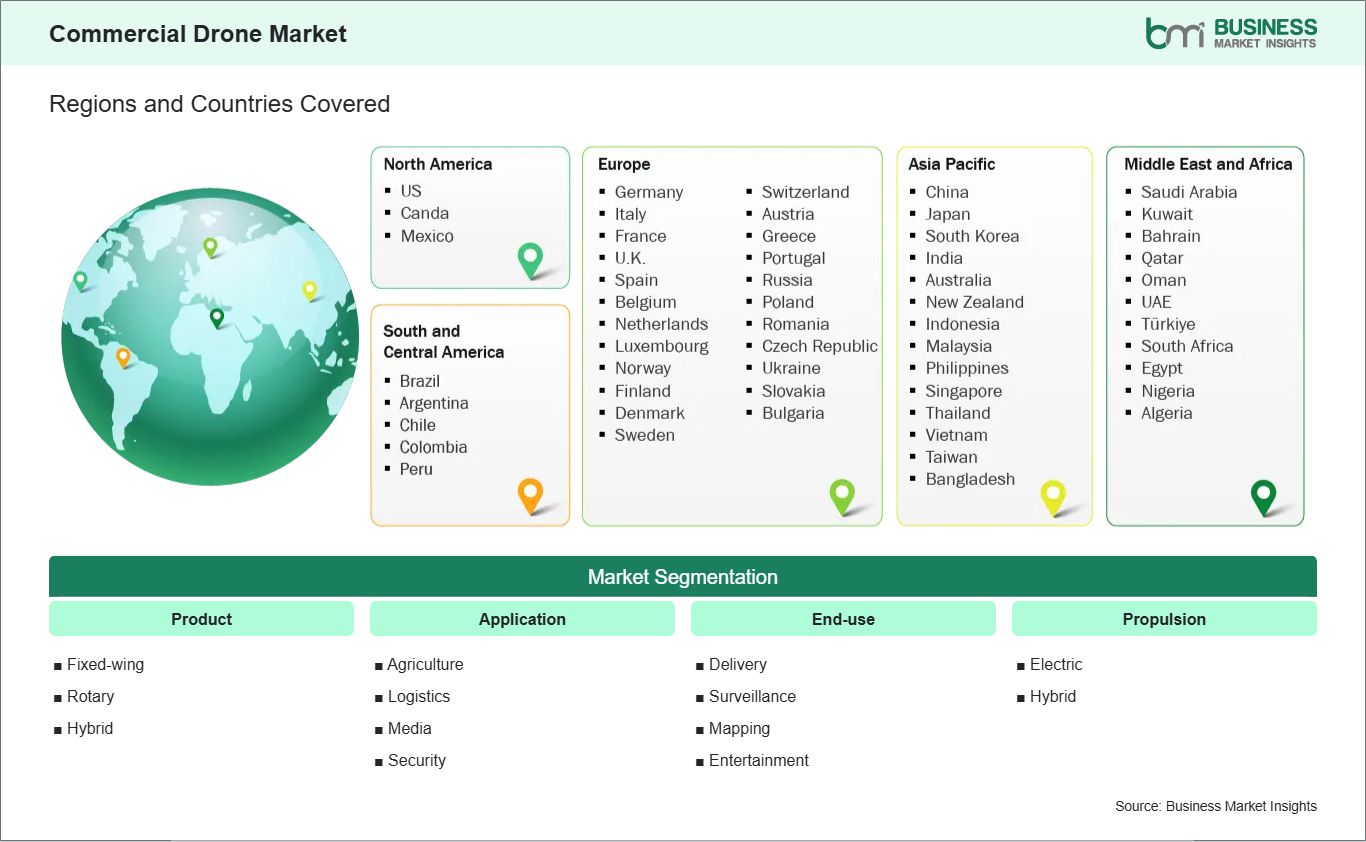
Regions and Countries Covered
North America US, Canada, Mexico
Europe Germany, Italy, France, U.K., Spain, Belgium, Netherlands, Luxembourg, Norway, Finland, Denmark, Sweden, Switzerland, Austria, Greece, Portugal, Russia, Poland, Romania, Czech Republic, Ukraine, Slovakia, Bulgaria
Asia-Pacific China, Japan, South Korea, India, Australia, New Zealand, Indonesia, Malaysia, Philippines, Singapore, Thailand, Vietnam, Taiwan, Bangladesh
South and Central America Brazil, Argentina, Chile, Colombia, Peru
Middle East and Africa Saudi Arabia, United Arab Emirates, Kuwait, Bahrain, Qatar, Oman, Turkiye, South Africa, Egypt, Nigeria, Algeria
Market leaders and key company profiles
  • DJI
  • Parrot
  • Yuneec
  • Autel
  • Skydio
  • Airbus
  • Amazon
  • Ehang
  • Kespry
  • Delair
Get more information on this report

Commercial Drone Market Report Coverage and Deliverables:

The "Commercial Drone Market Size and Forecast (2022-2033)" report provides a detailed analysis of the market covering below areas:

  • The market size and forecast at global, regional, and country levels for all market segments covered under the scope
  • The market trends, as well as drivers, restraints, and opportunities
  • The market analysis covering key trends, global and regional framework, major players, regulations, and recent developments
  • Industry landscape and competition analysis covering market concentration, heat map analysis, prominent players, and recent developments for the market
  • Detailed company profiles, including SWOT analysis

Commercial Drone Market Geographic Insights:

Adoption trends in the commercial drone market vary between regions, impacted by regulation, degree of industry automation, and need for aerial data services. Factors driving growth in regions include increased application of drones within logistics operations, agriculture, surveillance, and media. The sector is also experiencing growth due to improvements in the autonomy, connectivity, and sensor features of drones.

Leading the global market is North America due to its significant technological progress and adoption of unmanned aircraft. The United States makes up the greatest regional demand due to extensive usage in commercial applications close to defense, logistical experiments, and media production. Canada also shows strong activity in drone adoption through mapping, forestry monitoring, and infrastructure assessment applications, facilitated by regulation improvements and corporate uptake.

Asia Pacific is fast becoming a prominent region thanks to massive investments in digital infrastructure projects and smart industries. Leading manufacturers and deployers are the Chinese producers who dominate drone activities in agriculture and surveillance. India sees an increase in agriculture monitoring and disaster control applications. Meanwhile, Japan and South Korea see growing drone activities related to logistics and smart cities.

Europe is shown to be adopting consistently due to stringent regulations, safety, and secure integration of airspace. Examples include Germany, France, and the UK, all of which are adopting drones for the inspection of infrastructures, environmental observation, and media coverage. At the same time, developing nations in the Middle East and Latin America, like the UAE and Brazil, have been adopting drones for smart city technology, oil and gas inspections, and security missions.

global-market-geography
Get more information on this report

Commercial Drone Market Research Report Guidance:

  • The report includes qualitative and quantitative data for the Commercial Drone Market across product, application, end-use, propulsion, mode, and geography.
  • The report starts with the key takeaways (chapter 2), highlighting the key trends and outlook of the Commercial Drone Market.
  • Chapter 3 focuses on the research methodology of the study.
  • Chapter 4 includes ecosystem analysis.
  • Chapter 5 highlights the major industry dynamics in the Commercial Drone Market, including factors that are driving the market, prevailing deterrents, potential opportunities, as well as future trends. Impact analysis of these drivers and restraints is also covered in this section.
  • Chapter 6 discusses the Commercial Drone Market scenario, in terms of historical market revenues, and forecast till the year 2033.
  • Chapters 7 to 12 cover Commercial Drone Market segments by product, application, end-use, propulsion, mode, and geography across North America, Europe, Asia Pacific, Middle East and Africa, and South and Central America. They cover the market revenue, forecast, and factors driving the market.
  • Chapter 13 describes the competitive analysis along with the heat map analysis for the key players operating in the market.
  • Chapter 14 describes the industry landscape analysis. It provides detailed descriptions of business activities such as market initiatives, new developments, mergers, and joint ventures globally, along with a competitive landscape.
  • Chapter 15 provides detailed profiles of the major companies operating in the Commercial Drone Market. Companies have been profiled on the basis of their key facts, business descriptions, products and services, financial overview, SWOT analysis, and key developments.
  • Chapter 16, i.e., the appendix, is inclusive of a brief overview of the company, list of abbreviations, and disclaimer.

Commercial Drone Market News and Key Development:

The commercial drone market is evaluated by gathering qualitative and quantitative data post primary and secondary research, which includes important corporate publications, association data, and databases. A few of the key developments in the commercial drone market are:

  • In February 2023, Skydio announced that it had raised $230 million in Series E funding to scale production of autonomous drones for enterprise, public safety, and critical infrastructure inspection applications, strengthening its position in the commercial drone market.
  • In March 2024, DJI announced that it had introduced DJI Dock 2, a fully automated ‘drone-in-a-box’ solution enabling 24/7 remote commercial drone operations for surveying, inspection, public safety, and industrial monitoring applications.

Key Sources Referred:

International Civil Aviation Organization (ICAO) Federal Aviation Administration (FAA – UAS / Drone regulations) European Union Aviation Safety Agency (EASA) Civil Aviation Administration of China (CAAC) Directorate General of Civil Aviation India (DGCA) Company Websites Company Annual Reports Company Investor Presentations
The List of Companies - Commercial Drone Market
  • DJI
  • Parrot
  • Yuneec
  • Autel
  • Skydio
  • Airbus
  • Amazon
  • Ehang
  • Kespry
  • Delair
Frequently Asked Questions
How big is the Commercial Drone Market?

The Commercial Drone Market is valued at US$ 26.87 Billion in 2025, it is projected to reach US$ 60.31 Billion by 2033.

What is the CAGR for Commercial Drone Market by (2026 - 2033)?

As per our report Commercial Drone Market, the market size is valued at US$ 26.87 Billion in 2025, projecting it to reach US$ 60.31 Billion by 2033. This translates to a CAGR of approximately 10.63% during the forecast period.

What segments are covered in this report?

The Commercial Drone Market report typically cover these key segments-

  • Product (Fixed-wing, Rotary, Hybrid)
  • Application (Agriculture, Logistics, Media, Security)
  • End-use (Delivery, Surveillance, Mapping, Entertainment)
  • Propulsion (Electric, Hybrid)
  • Mode (Remote, Optional, Autonomous)

What is the historic period, base year, and forecast period taken for Commercial Drone Market?

The historic period, base year, and forecast period can vary slightly depending on the specific market research report. However, for the Commercial Drone Market report:

  • Historic Period : 2022-2024
  • Base Year : 2025
  • Forecast Period : 2026-2033
  • Who are the major players in Commercial Drone Market?

    The Commercial Drone Market is populated by several key players, each contributing to its growth and innovation. Some of the major players include:

  • DJI
  • Parrot
  • Yuneec
  • Autel
  • Skydio
  • Airbus
  • Amazon
  • Ehang
  • Kespry
  • Delair
  • Who should buy this report?

    The Commercial Drone Market report is valuable for diverse stakeholders, including:

    • Investors: Provides insights for investment decisions pertaining to market growth, companies, or industry insights. Helps assess market attractiveness and potential returns.
    • Industry Players: Offers competitive intelligence, market sizing, and trend analysis to inform strategic planning, product development, and sales strategies.
    • Suppliers and Manufacturers: Helps understand market demand for components, materials, and services related to concerned industry.
    • Researchers and Consultants: Provides data and analysis for academic research, consulting projects, and market studies.
    • Financial Institutions: Helps assess risks and opportunities associated with financing or investing in the concerned market.

    Essentially, anyone involved in or considering involvement in the Commercial Drone Market value chain can benefit from the information contained in a comprehensive market report.

    Available Report Formats

    pdf-format excel-format pptx-format
    Buy Now
    Sales Assistance
    +1 646 791 7070 (US & UK)
    Customization Form

    Please tell us your area of interest
    (Market Segments/ Regions and Countries/ Companies)