
Inspection Drone Market Outlook: Size, Share, Trends, Growth Analysis, Competitive Landscape & Forecast, 2026-2033

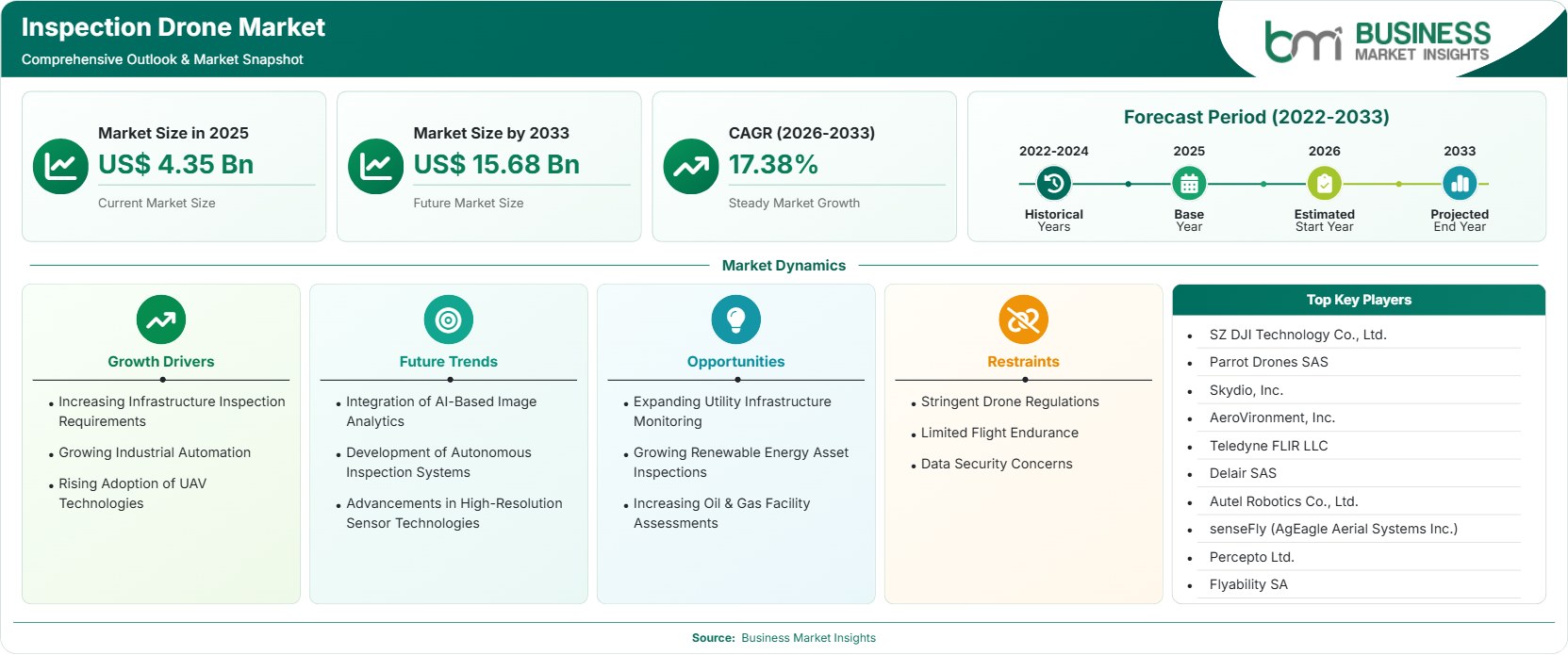
The Inspection Drone Market size was valued at US$ 4.35 Billion in 2025 and is projected to reach US$ 15.68 Billion by 2033, growing at a CAGR of 17.38% during 2026–2033, driven by infrastructure monitoring demand, automation adoption, AI-enabled analytics, and opportunities across energy, utilities, construction, and industrial inspection applications.

Report Coverage
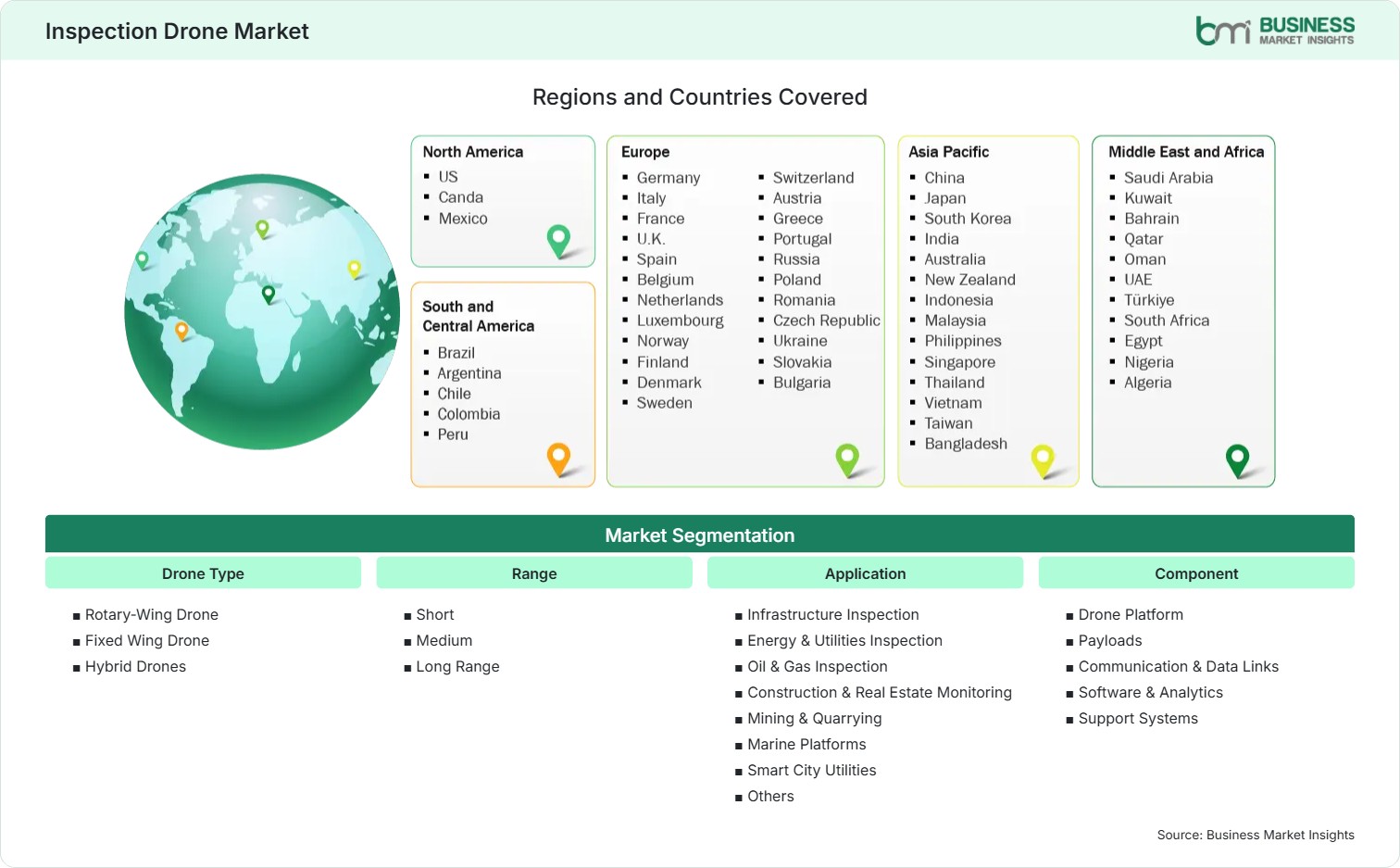
  • Drone Type: Rotary-Wing Drone, Fixed Wing Drone, Hybrid Drones
  • Range: Short, Medium, Long Range
  • Application: Infrastructure Inspection, Energy & Utilities Inspection, Oil & Gas Inspection, Construction & Real Estate Monitoring, Mining & Quarrying, Marine Platforms, Smart City Utilities, Others
  • Component: Drone Platform, Payloads, Communication & Data Links, Software & Analytics, Support Systems
  • Autonomy Level: Manual/Semi-Autonomous, Fully Autonomous, Adaptive AI Autonomy
US$ 4.35 Bn Market size in 2025
US$ 15.68 Bn Market Size by 2033
17.38% CAGR, 2026 - 2033
2026-2033 Forecast Period

AI Overview

Inspection Drone Market Summary

  • North America Region: North America holds 36%–39% share in 2025, growing with a CAGR of 16.5%–17.2% during 2026–2033, supported by infrastructure modernization, utility inspection needs, advanced drone regulations, and enterprise automation opportunities. The US market expands at a CAGR of 16.8%–17.4% through 2033, driven by industrial adoption and technology investments.
  • Fastest Growing Region: Asia Pacific represents 28%–31% share in 2025 and records the fastest CAGR of 19.2%–20.1% during 2026–2033, supported by smart infrastructure development, renewable energy expansion, industrial digitization, urban monitoring requirements, and increasing UAV adoption across emerging economies.
  • Leading Segment: Rotary-Wing Drone accounts for 48%–52% share in 2025, expanding at a CAGR of 17.0%–17.8% during 2026–2033, supported by vertical flight capability, operational flexibility, close-range inspection efficiency, and demand across complex industrial assets.
  • High Growth Segment: Fully Autonomous drones capture 22%–25% share in 2025 and grow at a CAGR of 20.0%–21.0% during 2026–2033, driven by AI navigation, automated data collection, reduced operational costs, and scalable inspection workflows.
  • Key Market Opportunity: Increasing adoption of AI-powered inspection platforms creates opportunities through predictive maintenance, real-time analytics, autonomous operations, and integration with digital twins across energy, infrastructure, manufacturing, and industrial asset management applications.
  • Major Market Players: SZ DJI Technology Co., Ltd., Parrot Drones SAS, Skydio, Inc., AeroVironment, Inc., Teledyne FLIR LLC, Delair SAS, Autel Robotics Co., Ltd., AgEagle Aerial Systems Inc., Percepto Ltd., and Flyability SA.
Strategic Insights

Inspection Drone Market: Strategic Insights

Inspection Drone Market Strategic Framework
FREE PDF
Request your free sample
Request free sample
Stakeholder View

Key Takeaways

  • The eco-system of the business is shifting towards solutions based on an integrated inspection platform that includes drones, sensors, data analytics software, cloud computing, and maintenance services, thus presenting potential throughout the entire industrial value chain.
  • Infrastructure inspection, monitoring of energy assets, and utilities are some of the promising segments for the business as the companies move to predictive maintenance and look for alternatives to manual inspection processes that include significant risk and expenses.
  • Artificial Intelligence, autonomous navigation systems, advanced imaging sensors, and defect detection using machine learning algorithms are driving changes in the development of products.
  • Asia Pacific provides strong investment potential due to expanding infrastructure projects, renewable energy installations, manufacturing growth, and government-backed digitalization initiatives supporting unmanned aerial technology adoption.
  • Strategic partnerships, technology acquisitions, and investments in autonomous drone platforms are increasing as manufacturers and software providers compete to strengthen capabilities in industrial inspection solutions.
Geographic Outlook

Inspection Drone Market Regional Highlights

North America Inspection Drone Market

North America accounted for 36%–39% share in 2025 and is projected to grow at a CAGR of 16.5%–17.2% during 2026–2033. The Inspection Drone Market share in North America is supported by utilities, aerospace, energy, transportation, and construction sectors adopting drone-based monitoring solutions.

  • The United States dominates regional demand through large infrastructure networks, advanced drone technology adoption, and investments in autonomous inspection platforms across industrial sectors.
  • Canada demonstrates increasing adoption through renewable energy projects, infrastructure monitoring initiatives, and demand for efficient inspection solutions across remote locations.
  • Utility companies are deploying drones for powerline inspections, reducing operational risks and improving maintenance planning through high-resolution aerial data.

US Inspection Drone Market

The United States represented 84%–87% of North American revenue in 2025 and is expected to expand at a CAGR of 16.8%–17.4% through 2033. Strong adoption across energy, defense, construction, and infrastructure sectors supports domestic expansion. The country benefits from advanced drone manufacturing capabilities, increasing enterprise automation, and growing demand for autonomous inspection technologies across critical assets.

  • Federal infrastructure investments are encouraging drone deployment for transportation networks, bridges, and public asset monitoring applications.
  • Energy companies are increasing drone usage for pipeline inspections, renewable energy assessments, and maintenance optimization programs.
  • Technology providers are developing advanced autonomous systems with improved sensors, AI analytics, and enhanced flight capabilities for industrial customers.

Europe Inspection Drone Market

Europe accounted for 22%–25% Inspection Drone Market share in 2025 and is forecast to grow at a CAGR of 16.8%–17.6% during 2026–2033. The region benefits from industrial automation, renewable energy expansion, and regulatory progress supporting commercial drone operations. Germany leads adoption through manufacturing and infrastructure applications, while the United Kingdom, France, and Nordic countries demonstrate increasing demand for advanced inspection technologies.

  • Germany supports market expansion through Industry 4.0 initiatives, industrial automation, and demand for efficient manufacturing asset inspections.
  • The United Kingdom is increasing drone adoption across energy infrastructure, construction projects, and transportation monitoring applications.
  • France is investing in renewable energy inspection solutions requiring accurate aerial monitoring and automated data analysis capabilities.
  • Nordic countries demonstrate demand through remote infrastructure monitoring and harsh-environment inspection requirements.

Asia Pacific Inspection Drone Market

Asia Pacific accounted for 28%–31% Inspection Drone Market share in 2025 and is projected to register the fastest CAGR of 19.2%–20.1% during 2026–2033. China leads demand through extensive manufacturing capabilities and infrastructure investments, while India, Japan, South Korea, and Southeast Asian economies create additional opportunities through digital transformation programs and increasing utilization of unmanned aerial technologies.

  • China maintains regional leadership through large-scale infrastructure projects, industrial automation adoption, and strong domestic development of advanced drone platforms for commercial applications.
  • India demonstrates rising demand due to expanding renewable energy installations, smart city projects, transportation infrastructure development, and increasing adoption of automated inspection systems.
  • Japan and South Korea are investing in robotics, artificial intelligence, and precision monitoring technologies to support industrial asset management requirements.
  • Southeast Asian economies are adopting drone-based inspection solutions for construction, energy, marine infrastructure, and urban development projects.

Rest of World Inspection Drone Market

The Rest of World region represented 10%–13% Inspection Drone Market share in 2025 and is anticipated to expand at a CAGR of 15.5%–16.3% through 2033. South and Central America are experiencing increasing adoption through mining operations, energy infrastructure development, and industrial modernization. Middle East and Africa markets are progressing through smart city investments, oil and gas facility monitoring, and large-scale infrastructure projects. Brazil, Saudi Arabia, and the UAE represent important growth opportunities. Middle Eastern countries are deploying inspection drones for oil and gas facilities, construction projects, and advanced city development programs.

  • Brazil is increasing adoption through mining operations, utility monitoring, and infrastructure modernization requiring efficient aerial assessment solutions.
  • Saudi Arabia and the UAE are integrating drone technologies into smart city programs, industrial facilities, and energy sector inspection activities.
  • African markets are adopting cost-effective drone solutions for mining, telecommunications infrastructure, and remote asset monitoring applications.
  • Government-supported digital infrastructure programs are improving opportunities for drone service providers across emerging economies.
  • International technology partnerships are supporting deployment of advanced inspection platforms in developing markets.
Global Market Geography
FREE PDF
Request your free sample
Request free sample
Segment Analysis

Inspection Drone Market Segmentation

Drone Type

Drone Type represents a critical segmentation category as organizations select platforms based on operational requirements, inspection environments, flight duration, and payload capabilities. Rotary-Wing Drone held 48%–52% share in 2025 and is projected to grow at a CAGR of 17.0%–17.8% during 2026–2033. The Inspection Drone Market scope expands through increasing demand for flexible aerial monitoring solutions across industrial applications.

  • Rotary-Wing Drone: Rotary-wing platforms dominate close-range inspection activities due to vertical takeoff capability, hovering efficiency, and suitability for complex infrastructure environments requiring detailed visual assessment.
  • Fixed Wing Drone: Fixed-wing platforms support long-distance monitoring requirements through extended flight endurance, making them suitable for large-scale infrastructure, pipeline, and land inspection operations.
  • Hybrid Drones: Hybrid systems combine vertical takeoff flexibility with extended flight capabilities, supporting advanced inspection missions requiring operational efficiency and wider coverage areas.

Range

Range classification influences operational effectiveness by determining inspection coverage, flight duration, and application suitability. Medium and long-range platforms are gaining adoption as industries require monitoring of extensive assets, remote infrastructure, and large industrial facilities.

  • Short: Short-range drones are widely used for localized inspections requiring precise imaging, quick deployment, and close-distance monitoring of infrastructure components.
  • Medium: Medium-range drones support industrial inspections requiring broader coverage, improved endurance, and efficient monitoring of assets across commercial and public infrastructure.
  • Long: Long-range drones enable large-area inspection missions for pipelines, energy networks, transportation systems, and remote industrial facilities requiring extended operational capabilities.

Application

Application-based segmentation highlights diverse adoption across industrial sectors requiring accurate monitoring, safety improvements, and operational efficiency. Infrastructure Inspection represents the leading application category with strong demand from transportation, utilities, and construction sectors.

  • Infrastructure Inspection: Infrastructure inspection uses drones for bridges, roads, towers, and structural assessments by providing detailed imagery and reducing manual inspection challenges.
  • Energy & Utilities Inspection: Energy and utilities companies deploy drones for powerline, renewable energy, and facility monitoring to improve maintenance efficiency and safety.
  • Oil & Gas Inspection: Oil and gas operators utilize drones for pipeline surveillance, refinery monitoring, and hazardous environment inspections requiring reduced human exposure.
  • Construction & Real Estate Monitoring: Construction companies adopt drones for progress tracking, site surveying, and project management through accurate aerial data collection.
  • Mining & Quarrying: Mining operations use drones for terrain mapping, stockpile measurement, and operational monitoring to improve productivity and resource management.
  • Marine Platforms: Marine applications include offshore platform inspections, vessel monitoring, and remote asset assessment requiring reliable aerial solutions.
  • Smart City Utilities: Smart city programs utilize drones for urban infrastructure monitoring, public asset management, and efficient municipal operations.

Component

Component segmentation includes hardware platforms, sensors, connectivity systems, software solutions, and operational support services. Increasing integration of artificial intelligence, cloud analytics, and advanced payload technologies is improving inspection accuracy. The segment benefits from rising demand for complete drone ecosystems that combine flight capabilities with data processing, reporting tools, and asset management solutions.

  • Drone Platform: Drone platforms provide flight systems, navigation capabilities, and structural components required for industrial inspection operations.
  • Payloads: Payload systems include cameras, thermal sensors, LiDAR, and imaging technologies supporting detailed asset analysis and defect detection.
  • Communication & Data Links: Communication systems enable secure data transfer, remote operation, and reliable connectivity during inspection missions.
  • Software & Analytics: Software platforms process collected information through artificial intelligence, analytics tools, and automated reporting capabilities.
  • Support Systems: Support systems include maintenance, training, integration services, and operational assistance required for efficient deployment.

Autonomy Level

Autonomy level segmentation reflects increasing automation within drone operations, with industries adopting advanced systems to improve efficiency and reduce operational dependency. Fully Autonomous solutions represented a high-growth category due to AI navigation, automated workflows, and improved inspection consistency.

  • Manual/Semi-Autonomous: Manual and semi-autonomous systems remain widely used due to operator control flexibility and suitability for complex inspection environments.
  • Fully Autonomous: Fully autonomous drones enable automated flight planning, data collection, and inspection workflows through advanced artificial intelligence technologies.
  • Adaptive AI Autonomy: Adaptive AI autonomy systems improve decision-making through real-time environmental analysis, dynamic route adjustments, and intelligent inspection optimization.
Market Forces

Inspection Drone Market Dynamics

Key Market Drivers

Increasing Infrastructure Inspection Requirements

The rising complexity and old age of infrastructure are raising the need for automated inspection systems in transportation, utility services, energy sector, and other industrial sectors. The Inspection Drone Market growth is the need for automated systems due to the risk and high cost of the manual inspection system. As per the trend of infrastructure investments through government agencies, there is an increasing global expenditure on transportation and energy infrastructure, which results in the growing requirement for efficient monitoring systems. Drones that have high-resolution cameras and thermal sensors help in identifying the defects quickly and assist in developing predictive maintenance plans.

Growing Industrial Automation

Automated operations are being introduced rapidly within industrial sectors due to the need for increased efficiency, reduced downtime, and enhanced workplace safety within manufacturing plants, power generation facilities, and processing units. Inspection drone systems contribute to this need through provision of accurate information from hard-to-reach sites while minimizing dependency on manual inspection crews. The use of artificial intelligence, cloud computing, and prediction technology allows organizations to be aware of their maintenance needs even before equipment malfunctions. The market trends in the Inspection Drone Market show that more organizations adopting Industry 4.0 approaches have started embracing the inspection drones technology.

Rising Adoption of UAV Technologies

The increased acceptance of unmanned aerial vehicles in the commercial sector is creating new possibilities for the emergence of more tailored solutions for inspection. Innovations in the realm of better battery performance, sensors, aircraft controls, and regulations are helping make this possible. The Inspection Drone Market stands to gain from the rising confidence in business entities that utilize UAVs to gather precise information and increase efficiencies in their operations. Regulators around the world are coming up with more concrete rules regarding the operation of drones in the commercial sector. Energy firms, construction companies, and other infrastructure operators are making investments in UAVs to help conduct inspections more often and minimize disruptions.

Key Market Opportunities

Expanding Utility Infrastructure Monitoring

Utility infrastructure operators represent a major opportunity area as electricity networks, transmission systems, and renewable energy assets require continuous monitoring. Drone-based inspection tools provide an effective way to inspect power lines, substations, and remote locations through reduced inspection time and increased safety of workers. According to Inspecton Drone Market Forecasts, increased investments in the future can be seen in relation to the move towards a model of predictive maintenance and the use of digital monitoring systems. With smart grids being installed and resilient infrastructures being created, there will be more need for aerial inspection.

Growing Renewable Energy Asset Inspections

Expansion of renewable energy installations is creating new opportunities for drone inspection providers supporting solar farms, wind turbines, and related infrastructure. Large-scale renewable projects require frequent monitoring to identify equipment damage, performance issues, and maintenance requirements. The deployment of drones fitted with thermal imaging capabilities and sensors ensures a more expedient analysis of energy assets without any disruption in operations. Increased investments in the generation of renewable energy capacity have led to the adoption of automated solutions for inspection purposes. Companies providing analytical services, maintenance, and asset performance monitoring will be well served by the growing demand.

Increasing Oil & Gas Facility Assessments

Oil and gas firms are implementing the use of drones for enhancing the effectiveness of inspection processes carried out in pipelines, refineries, storage areas, and offshore drilling platforms. Such settings usually require inspections under conditions that pose safety risks when conventional inspection processes are used. The use of drones for monitoring processes is effective in helping to meet requirements such as compliance, planning, and risk reduction. The growing emphasis on efficiency and reliability of operations is prompting the adoption of efficient aerial inspection systems by energy firms.

Market Restraints and Challenges

Stringent Drone Regulations

Factor: Complex regulatory requirements related to commercial drone operations, airspace permissions, and safety compliance can slow deployment across certain regions. Impact: Uncertainty regarding regulation can result in higher operational expenses, increased time delays for project approval processes, and limited usage in cases where organizations require instant inspection capabilities. Aviation regulatory bodies are currently working on setting up guidelines for balancing commercial interests and safety, but varying regional regulations pose obstacles to international providers. Organizations will need to allocate resources for compliance management, operator certification, and enhanced safety measures in order to keep their presence in the market.

Limited Flight Endurance

Factor: Battery limitations and operational constraints restrict flight duration for many drone platforms, particularly during large-scale inspection missions requiring extended coverage. Impact: Low endurance leads to more frequent battery replacements and increased mission planning. While battery and hybrid technology is advancing rapidly, long missions continue to pose challenges in specific uses of drones, especially those of offshore structures, pipelines, and extensive infrastructure networks. Manufacturers are developing lighter materials, advanced energy sources, and new power systems to overcome these challenges. Extended endurance with maintained payload capacity will continue to be one of the competitive factors that will shape the evolution of drones.

Company Analysis

Competitive Landscape

The Inspection Drone Market analysis indicates increasing competition among drone manufacturers, autonomous technology providers, sensor developers, and software companies. Leading participants are focusing on platform innovation, AI integration, advanced payload capabilities, and industry-specific solutions to strengthen their positions across commercial inspection applications.

Company Name

Overview

Products and Services relevant to this market

SZ DJI Technology Co., Ltd.

Global drone technology company providing commercial UAV solutions with strong imaging and autonomous flight capabilities.

Enterprise inspection drones, payload systems, flight platforms, mapping solutions, and industrial data collection technologies.

Parrot Drones SAS

European drone manufacturer specializing in professional UAV systems for commercial and enterprise applications.

Professional inspection drones, imaging systems, mapping tools, and software solutions for industrial monitoring.

Skydio, Inc.

Autonomous drone technology company focused on AI-powered navigation and enterprise inspection applications.

Autonomous drones, obstacle avoidance systems, inspection software, and enterprise workflow solutions.

AeroVironment, Inc.

Aerospace technology provider developing unmanned systems for defense and commercial applications.

UAV platforms, autonomous systems, sensors, and advanced aerial intelligence solutions.

Teledyne FLIR LLC

Technology company providing sensing and imaging solutions for industrial monitoring applications.

Thermal cameras, drone payloads, inspection sensors, and aerial imaging technologies.

Delair SAS

French UAV manufacturer specializing in industrial and defense drone solutions.

Long-range drones, inspection platforms, aerial data services, and industrial monitoring systems.

Autel Robotics Co., Ltd.

Drone manufacturer offering commercial and professional aerial solutions.

Enterprise drones, imaging platforms, intelligent flight systems, and inspection accessories.

AgEagle Aerial Systems Inc.

Drone technology company providing aerial data collection and analytics solutions.

UAV platforms, sensors, mapping services, and agricultural and industrial inspection solutions.

Percepto Ltd.

Autonomous drone-in-a-box technology provider focused on industrial monitoring.

Autonomous inspection systems, remote monitoring platforms, analytics software, and industrial security solutions.

Flyability SA

Swiss drone company specializing in indoor inspection solutions for complex environments.

Collision-resistant drones, indoor inspection platforms, and industrial asset assessment systems.

Trust & Transparency

Research Methodology

The market analysis combines proprietary research with secondary data from government agencies, company disclosures, regulatory filings, industry databases and expert interviews. Market estimates are validated through data triangulation, cross-market benchmarking and analyst review.

View Full Research Methodology

Questions Answered

Frequently Asked Questions

Why are companies investing in drone-based inspection services?

Companies are adopting drone inspection services to reduce operational risks, improve inspection frequency, lower maintenance costs, and access specialized aerial analytics without requiring extensive internal drone management capabilities.

What role do autonomous drones play in future inspection operations?

Autonomous drones enable continuous monitoring, automated mission execution, and reduced dependence on manual operators. These capabilities support large-scale asset management programs requiring frequent inspections and real-time operational visibility.

How does this Inspection Drone Market Report support business decisions?

The report provides insights into technology developments, application opportunities, competitive positioning, regional adoption patterns, and future investment areas for companies evaluating drone-based inspection strategies.

What industries are adopting inspection drones most rapidly?

Energy, utilities, infrastructure, construction, mining, and oil and gas industries are among the fastest adopters due to requirements for safer inspections, reduced downtime, and improved asset monitoring accuracy.

How are AI technologies improving inspection drone market capabilities?

AI technologies enable automated defect detection, intelligent flight planning, and advanced data interpretation. Machine learning algorithms help identify structural issues, analyze inspection imagery, and support predictive maintenance decisions across industrial assets.

Access the Full Inspection Drone Market Report

Get segment-level forecasts, regional estimates, competitive benchmarking, company profiles and downloadable Excel datasets.

Access the full Inspection Drone Market Report
350 pages PDF & Excel | 2026-08-12