Market Summary
Executive Summary and Global Market Analysis
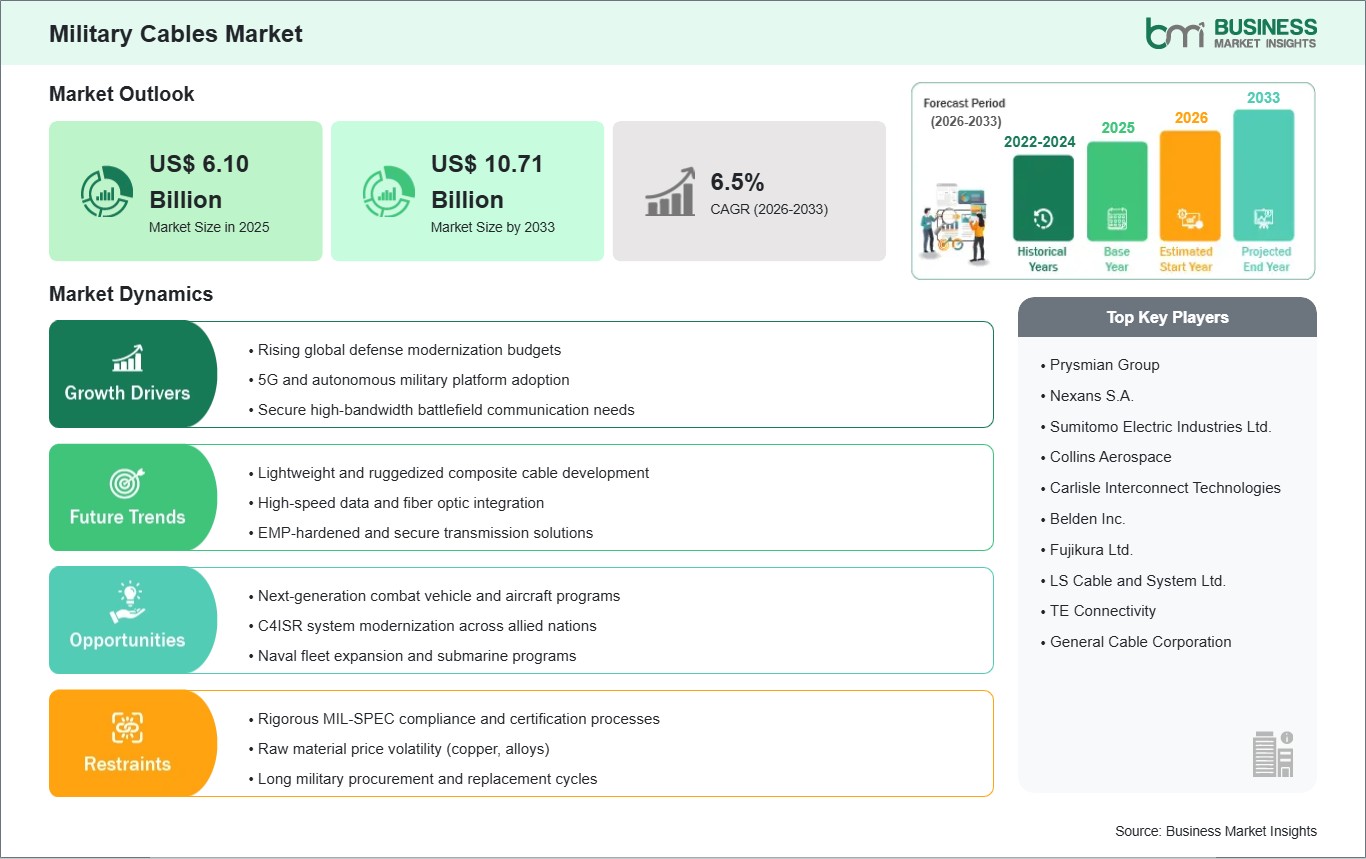
Military cables are ruggedized transmission assemblies designed to carry power, signals, and data across defense platforms operating under vibration, heat, moisture, and electromagnetic stress. These cable systems are engineered to comply with stringent military specifications, ensuring mechanical durability, shielding performance, and signal continuity in mission-critical environments. Their use extends across battlefield communication networks, onboard electronics, sensor architectures, and weapons integration frameworks where system failure tolerance is minimal.
Procurement emphasis has shifted toward electrically resilient and compact interconnect systems as defense programs incorporate denser electronics, secure data channels, and modular subsystems. Demand is also shaped by modernization cycles across land vehicles, naval vessels, and airborne equipment, where legacy wiring is being replaced with assemblies capable of supporting higher bandwidth and stronger interference protection. This requirement is reinforced by the operational need for dependable connectivity during extended deployments and high-load mission profiles.
Segment expansion is broad, although product selection differs by installation constraints and electrical function. Coaxial cables retain importance in signal-intensive architectures, while twisted pair formats support balanced transmission in communication and control systems. Ribbon cables address compact routing requirements in space-constrained assemblies. Platform demand remains closely aligned with refurbishment programs and the complexity of onboard electronics across ground, marine, and airborne deployments.
Material engineering is becoming a central differentiator as cable manufacturers refine conductor composition for weight control, corrosion resistance, and conductivity retention. Copper alloys remain widely preferred for stable electrical performance, while stainless steel and aluminum variants address specific environmental or mass-reduction requirements. At the same time, insulation systems, shielding layers, and jacket compounds are being optimized to improve survivability under thermal cycling, fluid exposure, and mechanical abrasion.
Competitive conditions are shaped by qualification capability, customization depth, and consistency in meeting defense procurement standards. Suppliers compete on assembly reliability, platform-specific design support, and integration readiness rather than broad-volume commercial scale. The market also reflects longer validation cycles and procurement scrutiny, which favor participants with established defense manufacturing processes and the ability to support retrofit as well as next-generation platform programs.
Segment Analysis
Military Cables Market Segmentation
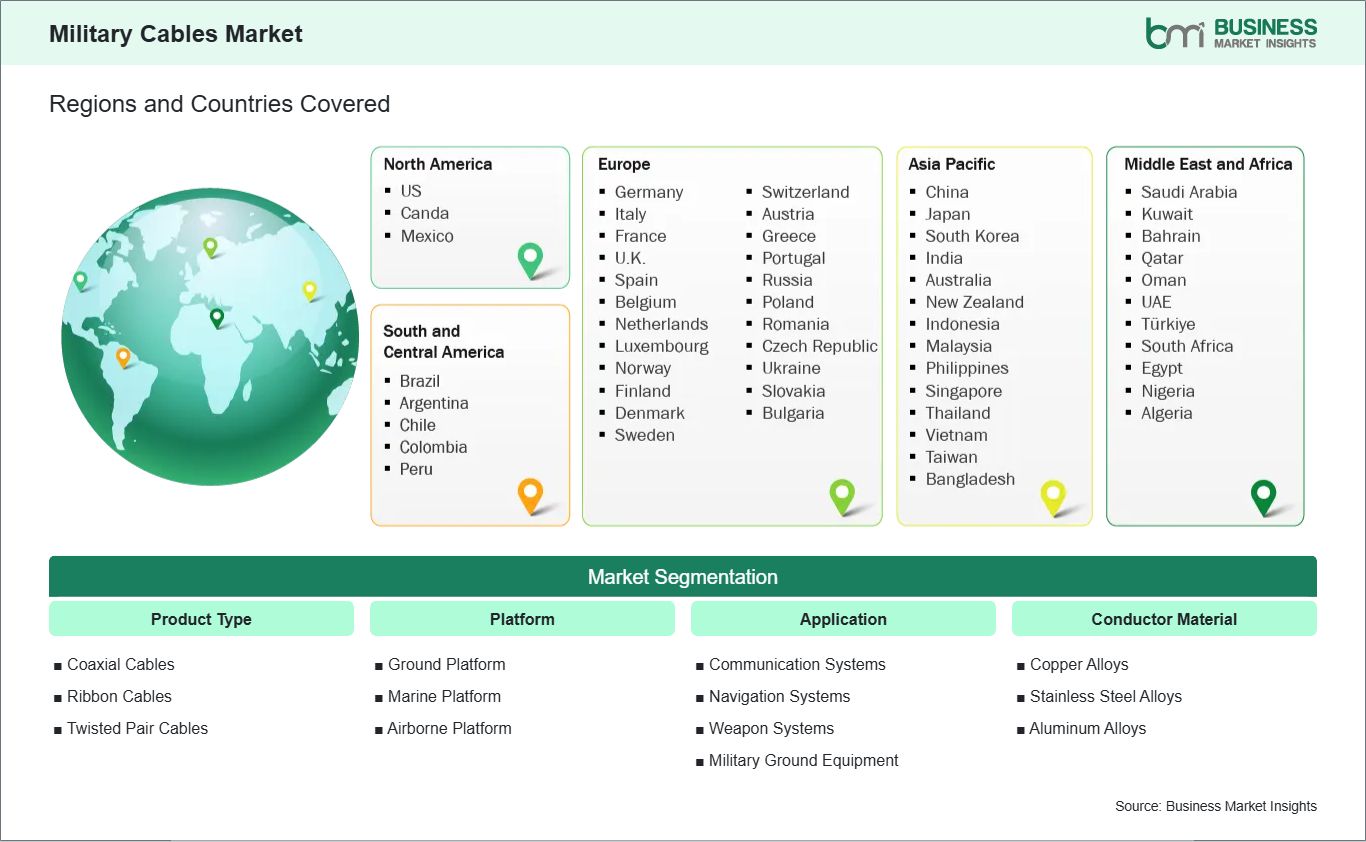
The Military Cables market is segmented by product type, platform, application, and conductor material to reflect deployment-specific performance needs.
By Product Type
- Coaxial Cables: Favored for shielded signal transmission in radar, RF, and secure communications.
- Ribbon Cables: Suited to dense routing layouts in compact electronic assemblies.
- Twisted Pair Cables: Selected for balanced data transfer and interference control.
By Platform
- Ground Platform: Accounts for extensive wiring needs in tactical vehicles and mobile systems.
- Marine Platform: Requires corrosion-resistant cable designs for saltwater exposure and confined routing.
- Airborne Platform: Prioritizes lightweight, high-reliability assemblies for avionics and mission systems.
By Application
- Communication Systems: Supports protected signal paths across tactical and strategic networks.
- Navigation Systems: Enables dependable connectivity for positioning, guidance, and onboard control units.
- Weapon Systems: Endures harsh operating conditions within launch, targeting, and control assemblies.
- Military Ground Equipment: Serves field electronics, portable systems, and support infrastructure.
By Conductor Material
- Copper Alloys: Preferred where conductivity stability and design versatility are essential.
- Stainless Steel Alloys: Applied in demanding environments requiring durability and corrosion tolerance.
- Aluminum Alloys: Chosen to reduce cable weight in mobility-sensitive defense platforms.
Market Forces
Military Cables Market Drivers and Opportunities
Defense Platform Modernization and Electrical System Hardening
Modern defense platforms are integrating more sensors, processors, and secure communication modules, raising the need for cables with stronger shielding, thermal endurance, and routing flexibility. Legacy assemblies often fall short under these requirements, prompting replacement with ruggedized interconnect solutions that preserve signal integrity and electrical continuity across compact and electronics-dense system architectures.
This transition has direct relevance across retrofits and new platform builds, where cable reliability influences mission readiness, maintenance cycles, and subsystem compatibility. As qualification requirements become stricter, procurement decisions increasingly favor cable designs that can withstand electromagnetic exposure, vibration loading, and prolonged service in constrained operational settings without compromising installation efficiency.
Lightweight Materials and High-Performance Cable Engineering
Emerging platform architectures are encouraging innovation in lighter conductor materials, compact cable layouts, and enhanced shielding constructions that support tighter packaging and improved electrical behavior. These developments open new use cases in airborne systems, naval electronics, and mobile defense equipment where reduced mass, corrosion resistance, and stable transmission are critical to sustained system performance.
Future scope extends into next-generation mission electronics, modular upgrade kits, and integrated defense networks that require cable assemblies tailored to demanding installation profiles. Suppliers that advance material science, miniaturization, and qualification-ready customization are positioned to expand program participation as defense organizations seek more efficient and resilient interconnect systems across diverse operating environments.
Size and Share Analysis
Military Cables Market Size and Share Analysis
The Military Cables market size is expected to reach US$ 10.71 Billion by 2033 from US$ 6.10 Billion in 2025. The market is estimated to record a CAGR of 6.5% from 2026 to 2033. This trajectory reflects sustained procurement needs for ruggedized connectivity components that support platform modernization, system reliability, and higher electronic complexity across defense applications.
By product type, coaxial cables hold a leading position due to their suitability for shielded signal transmission in defense electronics. Platform demand remains anchored in ground systems, where extensive wiring architectures support communication units, control modules, and mission equipment operating under mechanically demanding field conditions.
By application, communication systems represent a primary area of use because secure and uninterrupted transmission remains central to defense coordination. Navigation systems, weapon systems, and military ground equipment also sustain meaningful demand as cable performance directly affects data accuracy, signal resilience, and equipment dependability in operational settings.
Report Coverage
Military Cables Market Report Coverage and Deliverables
The "Military Cables Market Size and Forecast (2022-2033)" report provides a detailed analysis of the market covering the areas below:
- Market size and forecast at global, regional, and country levels for all the key market segments covered under the scope
- Market trends, as well as market dynamics such as drivers, restraints, and key opportunities
- Market analysis covering key market trends, global and regional framework, major players, regulations, and recent market developments
- Industry landscape and competition analysis covering market concentration, heat map analysis, prominent players, and recent developments for the market
- Detailed company profiles, including SWOT analysis
Geographic Insights
Military Cables Market Geographic Insights
The Military Cables market shows diverse regional adoption patterns influenced by defense modernization priorities, platform upgrade cycles, procurement frameworks, and the technical demands placed on mission-critical interconnect systems. Global demand reflects a steady requirement for cable assemblies that can withstand harsh operating conditions while supporting secure communications, navigation, and onboard electronics. Procurement emphasis increasingly centers on durability, interference resistance, and compatibility with dense system architectures.
North America maintains a mature position in this sector due to sustained investment in defense electronics, platform sustainment, and advanced mission systems. The regional market benefits from strong integration capabilities, established qualification practices, and a procurement environment that emphasizes reliability across airborne, land, and naval programs. Replacement demand remains important as operators continue to upgrade legacy wiring frameworks to support higher data loads and improved electromagnetic protection.
Asia Pacific is advancing through defense manufacturing expansion, fleet renewal activity, and broader efforts to strengthen indigenous military capabilities. Regional requirements favor cable solutions that balance rugged performance with weight efficiency, especially in airborne systems and mobile ground equipment. As governments increase focus on domestic production and integrated electronics, suppliers capable of meeting exacting performance standards are finding wider opportunities across both established and developing procurement programs.
Europe presents a technically disciplined market shaped by defense interoperability requirements, naval programs, and specialist aerospace platforms, while emerging markets in the Middle East, Africa, and South and Central America show selective uptake tied to modernization agendas and equipment procurement cycles. In these regions, cable selection is closely linked to environmental resilience, maintenance practicality, and long-service reliability, particularly where systems operate in demanding terrain, maritime conditions, or high-temperature settings.
Industry Activity
Recent Developments
Recent developments in the Military Cables market reflect continued emphasis on defense connectivity performance and specialized signal transmission requirements.
- In June 2026, Aptiv PLC (NYSE: APTV), a global industrial technology company and Winchester Interconnect, an Aptiv company and leading supplier of high-performance interconnect solutions for mission critical applications, launched a VITA 67.2 RF connector product line that places up to eight high-frequency signal channels directly inside a standard Open VPX backplane slot. By eliminating most of the external coaxial cabling traditionally required in aerospace and defense systems, the connectors make room for more compute, more sensors, and faster signals inside the same enclosure.
- In March 2026, Amphenol Socapex, a global designer & manufacturer of interconnect solutions for harsh environments, today announced the release of its USB Type C Active Optical Cable (AOC) extender, an innovative solution that delivers high-speed data, video, and power transmission over long distances where traditional copper solutions fail.
Trust & Transparency
Research Methodology
The market analysis combines proprietary research with secondary data from government agencies, company disclosures, regulatory filings, industry databases and expert interviews. Market estimates are validated through data triangulation, cross-market benchmarking and analyst
review.
View Full Research Methodology
Key Sources Referred:
World Bank: Global Trade IndicatorsWorld Trade Organization (WTO)International Monetary Fund (IMF)International Trade Administration (ITA)Company WebsitesCompany Annual ReportsCompany Investor Presentations