
Military Aircraft Market Outlook: Size, Share, Trends, Growth Analysis, Competitive Landscape & Forecast, 2026-2033

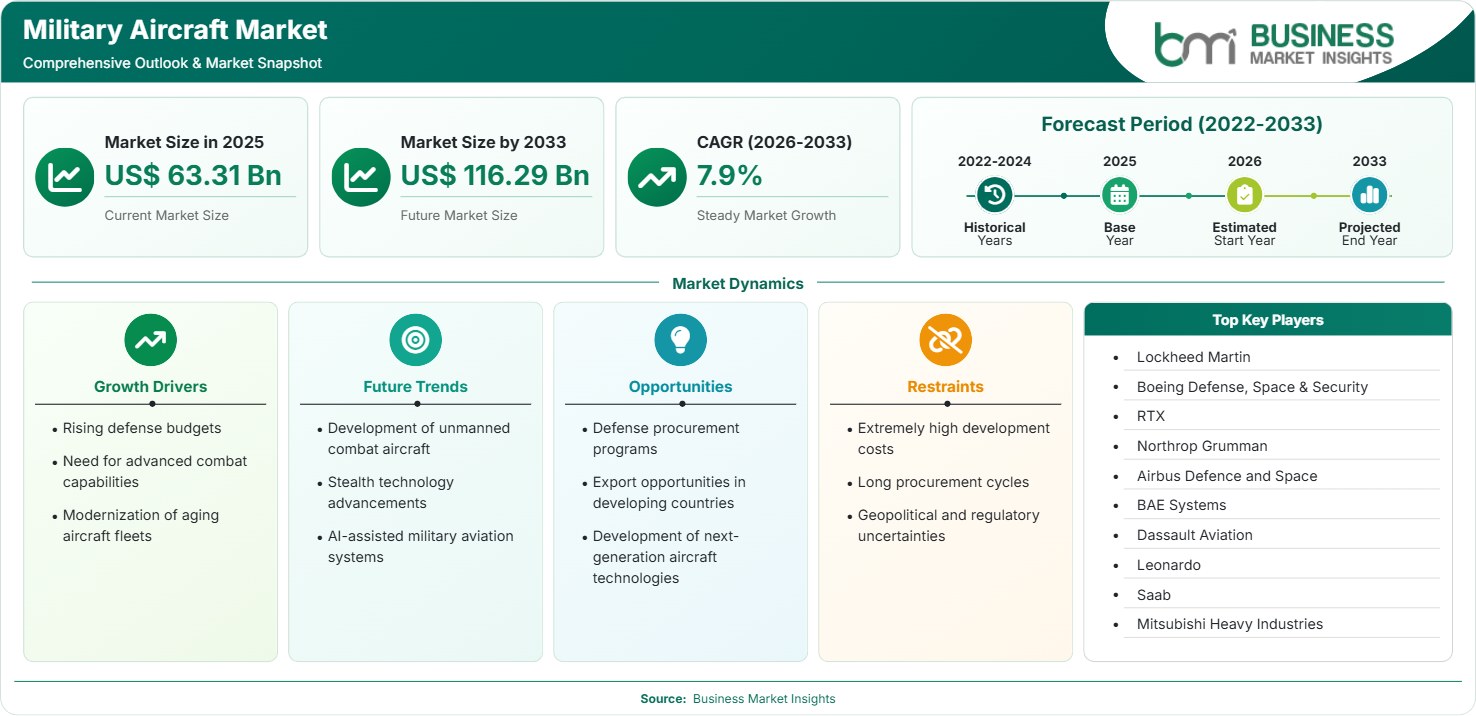
The Military Aircraft Market size was valued at US$ 63.31 Billion in 2025 and is projected to reach US$ 116.29 Billion by 2033, growing at a CAGR of 7.9% during 2026–2033, driven by rising defense budgets, increasing demand for advanced combat capabilities, and modernization of aging aircraft fleets. Expanding defense procurement programs and development of next-generation military aircraft continue creating significant long-term growth opportunities.

Report Coverage
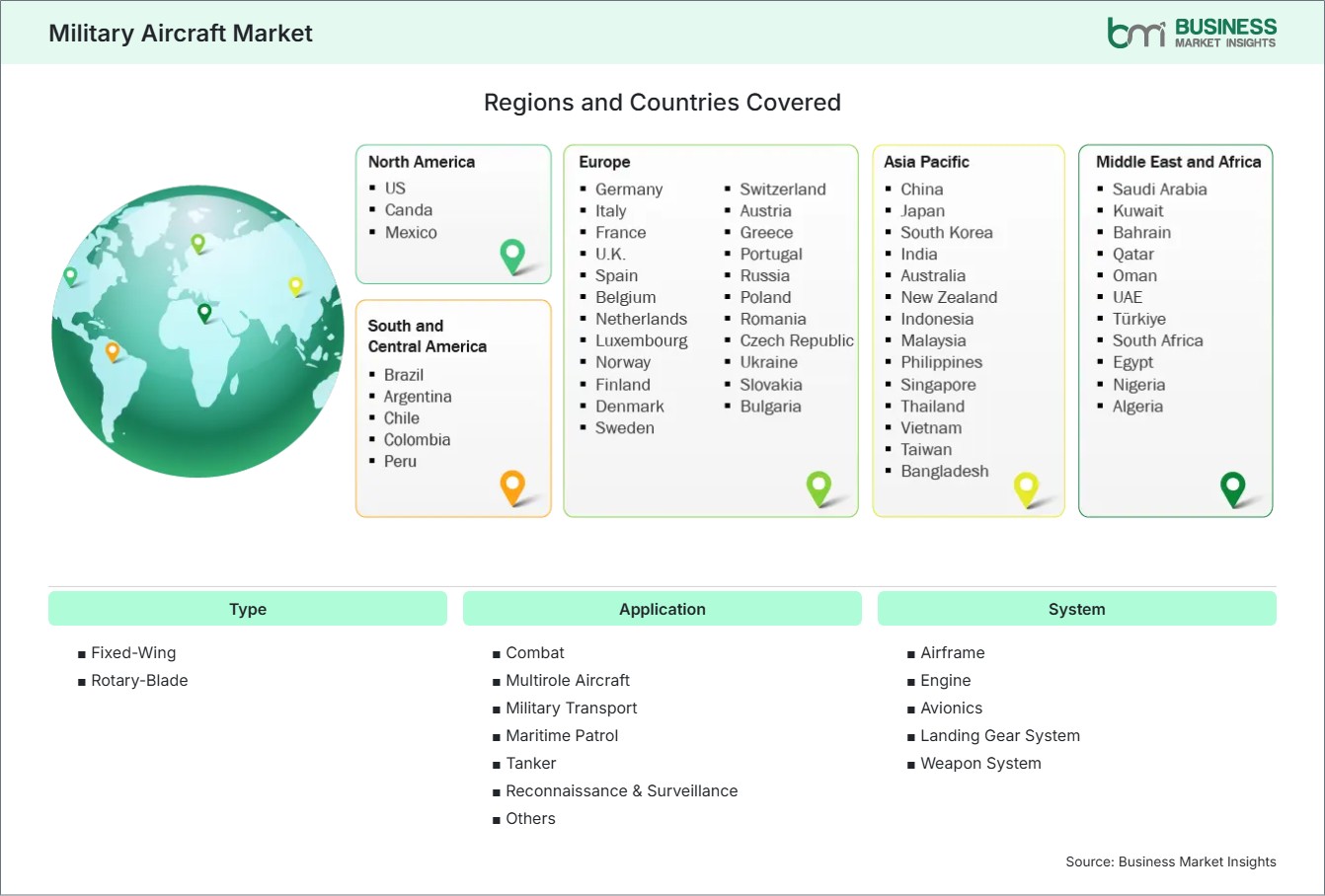
  • Type: Fixed-Wing, Rotary-Blade
  • Application: Combat, Multirole Aircraft, Military Transport, Maritime Patrol, Tanker, Reconnaissance & Surveillance, Others
  • System: Airframe, Engine, Avionics, Landing Gear System, Weapon System
US$ 63.31 Bn Market size in 2025
US$ 116.29 Bn Market Size by 2033
7.9% CAGR, 2026 - 2033
2026-2033 Forecast Period

AI Overview

Military Aircraft Market Summary

  • North America Region: North America holds market share 38%–41% in 2025, growing with a CAGR of 7.2%–7.7%, driven by substantial defense spending, continuous fighter aircraft procurement, and technological leadership. The US market grows at 7.3%–7.8% supported by modernization programs and next-generation aircraft development.
  • Fastest Growing Region: Asia Pacific holds market share 24%–27% in 2025, expanding at a CAGR of 8.8%–9.4%, supported by increasing regional defense investments, indigenous aircraft manufacturing, and military modernization initiatives.
  • Leading Segment: Fixed-Wing aircraft dominate with share 72%–75% in 2025, growing at CAGR 7.8%–8.3%, driven by continued procurement of fighter jets, transport aircraft, and surveillance platforms for modern defense operations.
  • High Growth Segment: Combat aircraft hold share 34%–37% in 2025, growing at CAGR 8.4%–8.9%, driven by increasing geopolitical tensions, fleet replacement programs, and demand for advanced multi-mission fighter aircraft.
  • Key Market Opportunity: Expanding defense procurement programs, export opportunities in developing countries, and investment in next-generation military aircraft technologies are creating sustainable long-term growth opportunities for global manufacturers.
  • Major Market Players: Lockheed Martin Corporation, Boeing Defense, Space & Security, RTX Corporation, Northrop Grumman Corporation, Airbus Defence and Space, BAE Systems plc, Dassault Aviation SA, Leonardo S.p.A., Saab AB, Mitsubishi Heavy Industries, Ltd.
Strategic Insights

Military Aircraft Market: Strategic Insights

Military Aircraft Market Strategic Framework
FREE PDF
Request your free sample
Request free sample
Stakeholder View

Key Takeaways

  • The military aircraft value chain is becoming increasingly integrated as governments, defense contractors, subsystem suppliers, and maintenance providers collaborate to enhance production efficiency, lifecycle support, and mission readiness.
  • Growth opportunities remain strongest in combat aircraft, multirole platforms, and military transport aircraft as nations prioritize modernization programs and replace aging defense fleets with technologically advanced systems.
  • Innovation is focused on stealth technologies, artificial intelligence-enabled avionics, digital mission systems, advanced propulsion, electronic warfare capabilities, and next-generation sensor integration to improve operational effectiveness.
  • Asia Pacific presents the most attractive investment opportunity owing to rising defense expenditure, expanding indigenous aerospace manufacturing, and long-term military modernization initiatives across China, India, Japan, and South Korea.
  • Strategic partnerships, joint development programs, and government defense contracts continue driving mergers, technology collaborations, and production expansion among leading aerospace manufacturers worldwide.
  • Increasing emphasis on domestic defense manufacturing, supply chain resilience, and export competitiveness is encouraging companies to establish localized production facilities and strengthen international industrial partnerships.
Geographic Outlook

Military Aircraft Market Regional Highlights

North America Military Aircraft Market

North America accounts for 38%–41% share in 2025, expanding at a CAGR of 7.2%–7.7%. The military aircraft market share remains the largest worldwide due to high defense spending, continued purchases of new fighter planes, and substantial investments in aeronautical R&D. With substantial government funding and defense manufacturing capabilities, the market will continue to expand in the region.

  • The United States Department of Defense continues investing in fifth-generation fighter aircraft, strategic bombers, aerial refueling platforms, and military transport aircraft to strengthen operational readiness and global defense capabilities.
  • Major defense manufacturers maintain strong production pipelines supported by long-term procurement contracts, continuous technological innovation, and advanced aerospace manufacturing infrastructure.
  • Increasing investment in unmanned combat aircraft, artificial intelligence-enabled mission systems, and next-generation avionics continues strengthening regional technological leadership.
  • Modernization of aging military fleets and increasing focus on interoperability with allied defense forces continue driving procurement of advanced aircraft platforms.

US Military Aircraft Market

The US holds 31%–34% share in 2025, growing at a CAGR of 7.3%–7.8%. The military aircraft market growth is supported by sustained defense modernization programs, expanding aerospace research, increasing procurement of advanced combat aircraft, and continuous investment in next-generation military aviation technologies.

  • Ongoing procurement of advanced fighter aircraft, strategic bombers, aerial refueling aircraft, and military transport platforms continues supporting long-term aerospace manufacturing growth.
  • Government investments in autonomous aviation technologies, electronic warfare capabilities, and integrated mission systems strengthen military aviation modernization efforts.
  • Strong collaboration between defense agencies and aerospace manufacturers accelerates innovation in propulsion technologies, stealth capabilities, and digital battlefield integration.
  • Continuous upgrades of legacy aircraft fleets improve operational readiness while extending aircraft service life through modernization programs.

Europe Military Aircraft Market

Europe captures 26%–29% share in 2025, expanding at a CAGR of 7.4%–7.9%. The military aircraft Market share growth is driven by growing expenditure on defense, multi-national defense cooperation initiatives, and air force modernization in the region. The top markets in the region continue to be France, the UK, and Germany, but growth is the fastest in Eastern Europe at 8.2% - 8.8% CAGR, primarily due to increased security issues and faster military procurement.

  • France, the United Kingdom, and Germany continue investing in advanced fighter aircraft, military transport platforms, and next-generation defense aviation technologies through long-term procurement initiatives.
  • NATO defense commitments and growing regional security requirements are encouraging increased investment in fleet modernization, surveillance aircraft, and strategic air mobility capabilities.
  • European defense manufacturers continue strengthening cross-border industrial partnerships to develop advanced combat aircraft, avionics, propulsion systems, and integrated defense technologies.
  • Eastern European countries are expanding military aviation investments to strengthen defense preparedness and replace aging Soviet-era aircraft with modern platforms.

Asia Pacific Military Aircraft Market

Asia Pacific accounts for 24%–27% share in 2025 and is projected to grow at a CAGR of 8.8%–9.4%. The Military Aircraft Market growth is driven by rising defense budgets, indigenous aerospace manufacturing, increasing geopolitical tensions, and continuous military modernization programs across China, India, Japan, South Korea, and Australia.

  • China continues leading regional procurement through extensive investment in indigenous fighter aircraft, military transport platforms, strategic bombers, and advanced aerospace technologies.
  • India records the fastest regional growth with a CAGR of 9.1%–9.7%, supported by domestic defense manufacturing initiatives, fleet modernization programs, and increasing government defense expenditure.
  • Japan continues expanding investments in advanced fighter aircraft, airborne surveillance platforms, and integrated air defense capabilities to strengthen regional security.
  • Growing defense cooperation, technology transfer agreements, and aerospace manufacturing investments across Southeast Asia continue supporting long-term regional market expansion.

Rest of World Military Aircraft Market

Rest of World represents 8%–10% share in 2025, growing at a CAGR of 7.9%–8.4%. The growth in the markets of South & Central America and Middle East & Africa will continue to expand owing to the increase in defense modernization programs, security threats, and military aviation capability investments.

Saudi Arabia is the leading purchaser of defense aircraft in the Middle East, while Brazil remains the largest market in South America due to the development of its indigenous aerospace industry.

  • Middle Eastern countries continue investing in advanced fighter aircraft, surveillance platforms, and military transport aircraft to strengthen regional defense capabilities.
  • Brazil remains the regional leader owing to its established aerospace manufacturing industry and continued investment in military aviation modernization programs.
  • Rising border security requirements and defense modernization initiatives are encouraging governments to procure advanced multirole aircraft and reconnaissance platforms.
  • Increasing defense partnerships with global aerospace manufacturers continue supporting technology transfer, local manufacturing, and long-term military aviation capability development.
Global Market Geography
FREE PDF
Request your free sample
Request free sample
Segment Analysis

Military Aircraft Market Segmentation

Type

The type segment represents the complete market, with Fixed-Wing aircraft accounting for the largest share of 72%–75% in 2025 and projected to grow at a CAGR of 7.8%–8.3% during the forecast period. Rising procurement of fighter jets, military transport aircraft, airborne surveillance platforms, and tanker aircraft continues supporting segment dominance. The Military Aircraft Market scope is expanding through continuous investments in advanced combat capabilities and fleet modernization programs.

  • Fixed-Wing: Fixed-wing aircraft dominate the market owing to their extensive deployment in combat operations, military transport, reconnaissance, surveillance, aerial refueling, and strategic defense missions across global armed forces.
  • Rotary-Blade: Rotary-blade aircraft continue witnessing steady demand for tactical transport, search and rescue, medical evacuation, logistics support, and battlefield mobility due to their operational flexibility and vertical takeoff capabilities.

Application

The application segment is led by Combat aircraft with a market share of 34%–37% in 2025 and an expected CAGR of 8.4%–8.9% through 2033. Rising geopolitical tensions, defense modernization initiatives, and procurement of advanced multirole fighter aircraft continue strengthening demand across global defense organizations.

  • Combat: Combat aircraft remain the largest application segment due to increasing investments in air superiority, precision strike capabilities, stealth technologies, and advanced mission systems.
  • Multirole Aircraft: Multirole aircraft are increasingly adopted because they efficiently perform air defense, ground attack, reconnaissance, and surveillance missions while reducing overall fleet operating costs.
  • Military Transport: Military transport aircraft support troop deployment, humanitarian assistance, disaster relief, logistics operations, and strategic airlift missions across domestic and international defense operations.
  • Maritime Patrol: Maritime patrol aircraft continue gaining importance for coastal surveillance, anti-submarine warfare, intelligence gathering, and protection of exclusive economic zones.
  • Tanker: Tanker aircraft enable aerial refueling operations that significantly extend mission endurance, operational range, and deployment flexibility for combat and transport aircraft.
  • Reconnaissance & Surveillance: Reconnaissance and surveillance aircraft provide real-time intelligence, border monitoring, electronic surveillance, and battlefield situational awareness using advanced sensor and communication technologies.

System

The system segment is dominated by Airframe, accounting for approximately 31%–34% market share in 2025 and expected to register a CAGR of 7.6%–8.1% during the forecast period. Continuous advancements in lightweight materials, stealth technologies, and structural durability continue driving investments across military aircraft manufacturing programs.

  • Airframe: Airframe systems represent the largest revenue contributor due to their critical role in structural integrity, payload capacity, stealth performance, and overall aircraft durability.
  • Engine: Engine systems continue witnessing strong demand through development of fuel-efficient, high-thrust propulsion technologies capable of supporting next-generation military aircraft performance.
  • Avionics: Advanced avionics enhance navigation, communication, electronic warfare capabilities, mission planning, and real-time battlefield awareness, improving overall operational effectiveness.
  • Landing Gear System: Landing gear systems continue evolving with lightweight materials, improved durability, and enhanced operational reliability for military aircraft operating under demanding mission conditions.
  • Weapon System: Modern weapon systems integrate precision-guided munitions, missile technologies, electronic targeting, and advanced fire-control capabilities to improve combat effectiveness across multiple mission profiles.
Market Forces

Military Aircraft Market Dynamics

Key Market Drivers

Rising Defense Budgets

Increasing defense expenditure across developed and emerging economies is a major factor driving demand for military aircraft. According to the Stockholm International Peace Research Institute (SIPRI), global military spending has continued to reach record levels as governments strengthen national security and military preparedness. Military Aircraft Market growth will be driven by higher investments in fighter jets, transport planes, surveillance equipment, and advanced defensive technologies. Increased budgets for air force modernization and deterrence are being spent by governments due to changing geopolitical scenarios.

Need for Advanced Combat Capabilities

The modern battlefield now requires more sophisticated aircraft that have stealth characteristics, advanced avionics, electronic warfare capabilities, and net-centric warfare capabilities. The defense industries are focusing on designing multirole fighter aircraft that can perform missions such as air superiority, intelligence, surveillance, reconnaissance, and precision strike. Advanced artificial intelligence and sensor fusion, together with secure communications and mission systems, continue to improve operational capabilities. Technological advancement allows the military to gain an advantage in any environment.

Modernization of Aging Aircraft Fleets

A majority of nations are seeking to upgrade their old military airplanes with newer ones, which have superior technology. The process involves purchasing fifth-generation fighter jets, military transport aircraft, maritime patrol aircraft, and aerial refueling aircraft. The older military planes are costly to maintain and are unable to perform tasks that meet the new demands. Modernization will continue to be prioritized due to its importance in enhancing operability and interoperability within allied forces.

Key Market Opportunities

Defense Procurement Programs

Large-scale defense procurement programs continue creating significant opportunities for military aircraft manufacturers and subsystem suppliers worldwide. Governments are announcing long-term acquisition plans to strengthen combat readiness, expand transport capabilities, and improve airborne surveillance capacity. Military Aircraft Market Forecasts show steady investments for high technology aircraft acquisitions due to growing geopolitical risks and modernization requirements. Defense contracts guarantee long-term financial stability of companies and stimulate technology development and industrial cooperation.

Export Opportunities in Developing Countries

Countries that belong to developing nations are now allocating resources to military aviation in order to boost border security, disaster response abilities, and defense readiness. Defense industry manufacturers are now focusing on exporting their products using government-to-government contracts, technology transfer, and industrial cooperation. Increased budget allocations for defense in Asia, the Middle East, Africa, and Latin America are continuing to open markets for fighter aircraft, transport aircraft, and surveillance platform sales.

Development of Next-Generation Aircraft Technologies

Development in terms of the sixth generation of fighters, new propulsion systems, autonomous solutions, and artificial intelligence-based mission capabilities provides ample opportunities for future growth. There is significant investment in next-generation platforms that offer increased stealth, greater range, improved connectivity, and multi-domain warfare capabilities.  Military Aircraft Market trends indicate that continuous research into advanced materials, digital engineering, and unmanned technologies is accelerating platform innovation while creating new opportunities across the aerospace value chain.

Market Restraints and Challenges

Extremely High Development Costs

Factor: Military aircraft development requires substantial investment in research, engineering, testing, certification, advanced manufacturing, and long-term system integration. Impact: Extremely high development costs pose a threat to both the governments and the manufacturers by making them incur financial risks and restrict participation to only a few major aerospace manufacturers. Limited budgets might lead to delays in procurement decision-making or limit the number of aircraft bought. The manufacturers use collaborative efforts in international programs to spread their financial risk.

Long Procurement Cycles

Company Analysis

Competitive Landscape

The military aircraft market analysis indicates a highly competitive environment characterized by long-term government contracts, continuous investment in advanced aerospace technologies, strategic defense partnerships, and next-generation aircraft development programs. Leading manufacturers are strengthening their competitive positions through innovation in stealth technology, avionics, propulsion systems, digital engineering, and integrated mission capabilities while expanding global defense collaborations.

Company Name

Overview

Products and Services Relevant to this Market

Lockheed Martin Corporation

Global aerospace and defense company recognized for advanced military aircraft, missile systems, and defense technologies.

Fighter aircraft, military transport solutions, avionics integration, mission systems, aircraft modernization, and lifecycle support services.

Boeing Defense, Space & Security

Leading defense manufacturer delivering military aircraft, autonomous systems, and integrated aerospace solutions worldwide.

Military aircraft, rotorcraft, surveillance aircraft, defense electronics, logistics support, and aircraft sustainment services.

RTX Corporation

Global aerospace and defense technology company specializing in advanced military systems and integrated defense solutions.

Aircraft engines, avionics, radar systems, weapon integration, sensors, and aerospace support technologies.

Northrop Grumman Corporation

Defense technology company focused on advanced aerospace platforms, autonomous systems, and strategic defense capabilities.

Strategic aircraft, surveillance platforms, mission systems, autonomous technologies, aerospace engineering, and modernization services.

Airbus Defence and Space

European aerospace manufacturer providing military aircraft, space systems, and integrated defense technologies.

Military transport aircraft, tanker aircraft, surveillance platforms, mission systems, aerospace services, and aircraft support solutions.

BAE Systems plc

International defense company delivering military aviation technologies and advanced electronic warfare capabilities.

Combat aircraft systems, avionics, flight controls, mission electronics, aircraft upgrades, and defense integration services.

Dassault Aviation SA

French aerospace company specializing in advanced military combat aircraft and aviation technologies.

Fighter aircraft, mission avionics, flight systems, maintenance support, and military aircraft modernization programs.

Leonardo S.p.A.

Global aerospace and defense company providing military aircraft, helicopters, electronics, and integrated defense solutions.

Military trainers, surveillance aircraft, avionics, mission systems, aerospace engineering, and aircraft lifecycle services.

Saab AB

Swedish defense manufacturer focused on advanced military aircraft, sensors, and integrated defense systems.

Fighter aircraft, airborne surveillance systems, avionics, electronic warfare technologies, and defense support services.

Mitsubishi Heavy Industries, Ltd.

Japanese industrial and aerospace company engaged in defense manufacturing and advanced aircraft development.

Military aircraft manufacturing, aircraft components, aerospace engineering, maintenance services, and defense technology solutions.

Industry Activity

Recent Developments

November 2025

Safran expanded its military aviation presence in India by announcing the development of its first M88 engine maintenance, repair, and overhaul (MRO) facility outside France for the Rafale fighter aircraft. Safran also signed a joint venture and cooperation agreement with Bharat Electronics Limited (BEL) to manufacture the HAMMER air-to-surface weapon in India, strengthening local defense aerospace capabilities.

June 2025

Saab signed a framework agreement with Sabena technics to support aircraft modification work for Saab’s GlobalEye Airborne Early Warning and Control (AEW&C) aircraft. The agreement aims to expand modification capacity and support increasing international demand for the GlobalEye platform.

December 2024

Archer Aviation and Anduril Industries announced a strategic partnership to jointly develop a next-generation hybrid-propulsion VTOL military aircraft for defense applications, targeting potential U.S. Department of Defense programs. The partnership marked Archer’s entry into the defense aviation sector through its Archer Defense initiative.

December 2024

Ministry of Defence (India) and Hindustan Aeronautics Limited (HAL) signed a contract worth approximately INR 13,500 crore for the procurement of 12 Su-30MKI fighter aircraft along with associated equipment for the Indian Air Force. The aircraft will be manufactured at HAL’s Nashik facility with significant indigenous content, strengthening India’s military aircraft production capabilities.

Trust & Transparency

Research Methodology

The market analysis combines proprietary research with secondary data from government agencies, company disclosures, regulatory filings, industry databases and expert interviews. Market estimates are validated through data triangulation, cross-market benchmarking and analyst review.

View Full Research Methodology

Questions Answered

Frequently Asked Questions

What does the Military Aircraft Market Report cover?

The market report provides detailed analysis of market size, regional trends, segmentation, competitive landscape, technological advancements, procurement programs, and future growth opportunities.

What challenges affect market expansion?

Extremely high development costs, lengthy procurement cycles, stringent certification requirements, and complex government acquisition processes remain major challenges affecting market growth.

Which region is expected to experience the fastest growth?

Asia Pacific is projected to witness the highest growth, supported by expanding defense expenditure, indigenous aerospace manufacturing, military modernization programs, and increasing regional security investments.

Which aircraft type dominates the market?

Fixed-wing aircraft hold the largest market share due to extensive procurement of fighter jets, military transport aircraft, surveillance platforms, and aerial refuelling aircraft by defense organizations worldwide.

What factors are driving the Military Aircraft Market?

Rising defense budgets, modernization of aging aircraft fleets, increasing geopolitical tensions, and growing demand for advanced combat capabilities are the primary factors driving global market growth.

Access the Full Military Aircraft Market Report

Get segment-level forecasts, regional estimates, competitive benchmarking, company profiles and downloadable Excel datasets.

Access the full Military Aircraft Market Report
350 pages PDF & Excel | 2026-09-02
Similar Research

Related Market Reports