Market Summary
Executive Summary and Global Market Analysis
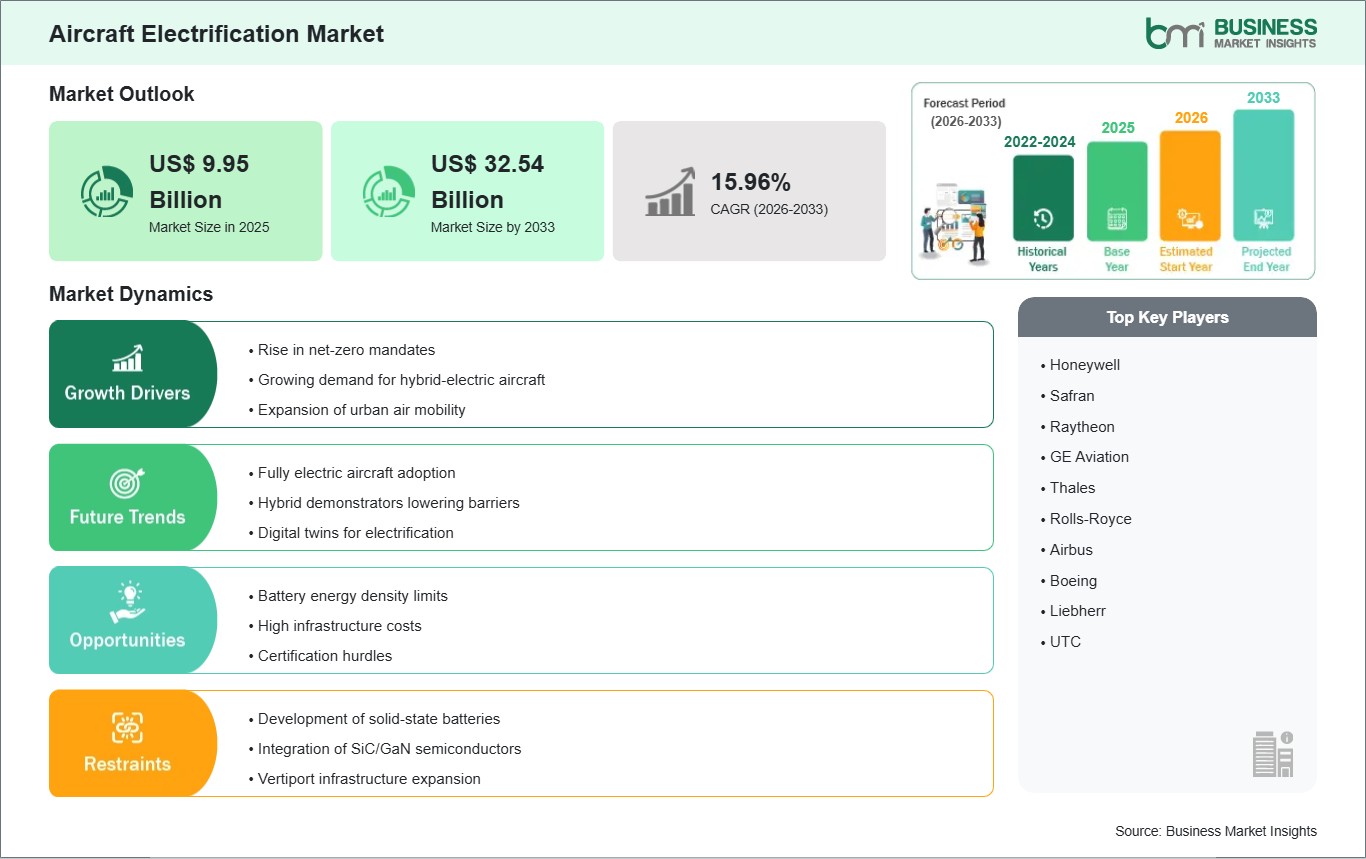
Aircraft electrification involves the integration of electric technologies into aircraft systems to improve operational efficiency, reduce fuel consumption, and lower emissions. These technologies include electric propulsion systems, power generation units, power distribution systems, and advanced energy storage solutions. Aircraft electrification is becoming increasingly important across commercial aviation, military aviation, unmanned aerial vehicles, and advanced air mobility platforms. The market is growing as aviation companies focus on reducing environmental impact, improving aircraft efficiency, and supporting the transition toward sustainable air transportation. Increasing investments in electric propulsion technologies and lightweight electrical systems are also supporting market expansion.
There are several challenges that could affect market growth. High development and certification costs for electric aircraft systems remain a major concern, especially for small and medium-sized manufacturers. Energy storage limitations, including battery weight and charging efficiency, continue to restrict the operational range of fully electric aircraft. The aviation industry also faces infrastructure challenges related to charging systems, airport electrification, and power management capabilities. In addition, regulatory approval processes for electric aviation technologies are complex and time-consuming, which can delay commercialization and deployment across different aircraft platforms.
Despite these challenges, the Aircraft Electrification market is expected to expand steadily due to continuous advancements in electric propulsion systems, lightweight materials, and energy management technologies. Hybrid-electric aircraft concepts and more-electric aircraft architectures are gaining significant attention as the industry moves toward sustainable aviation goals. Advanced air mobility platforms and urban air transportation projects are creating new growth opportunities for electric aircraft systems. Increasing research activities related to high-density batteries, hydrogen-based energy systems, and smart power distribution technologies are also expected to support the long-term development of the Aircraft Electrification market.
Segment Analysis
Aircraft Electrification Market Segmentation
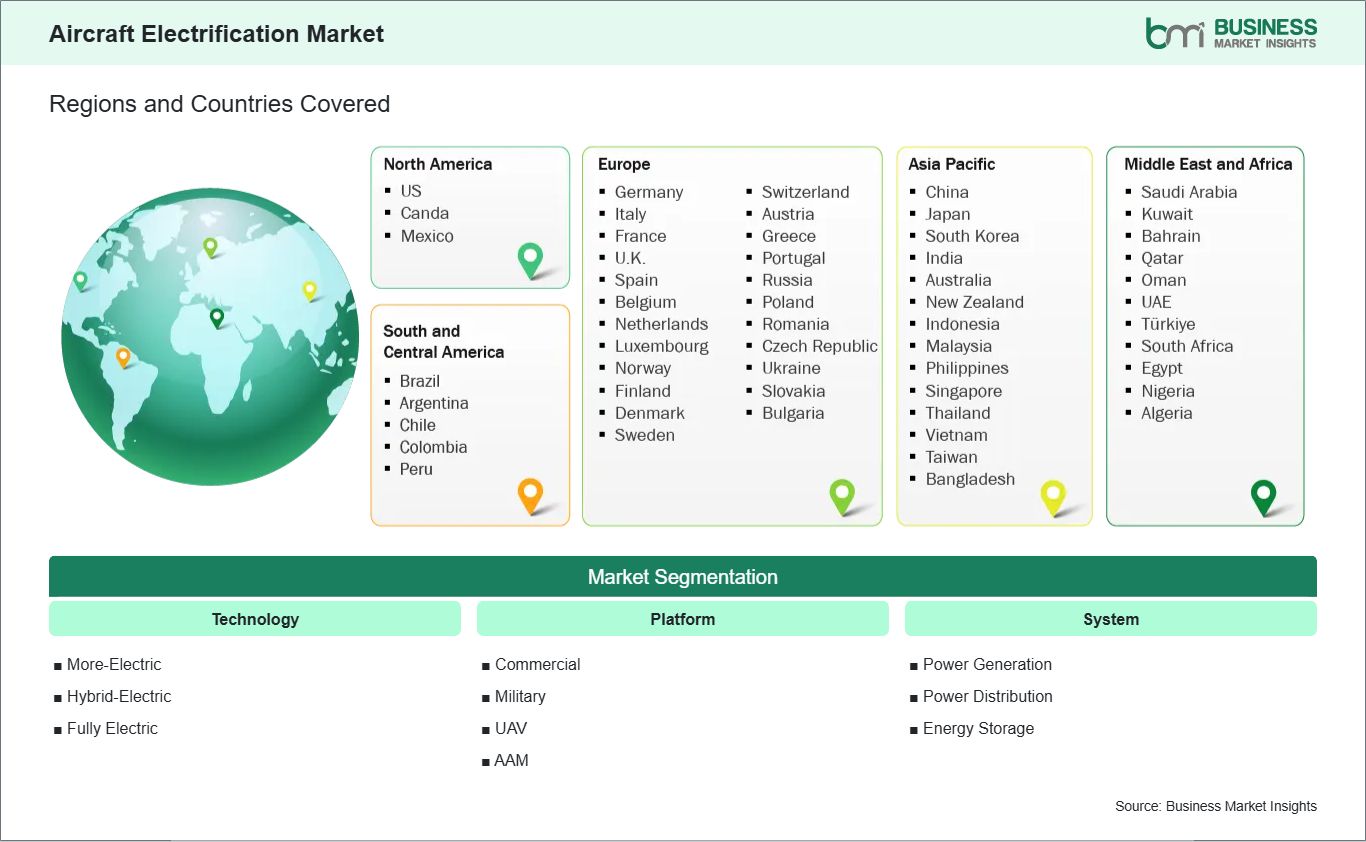
The Aircraft Electrification market is segmented based on technology, platform, and system. These segments support the growing adoption of electric aviation technologies across commercial and defense aerospace applications.
By Technology
- More-Electric: Widely adopted for reducing dependence on hydraulic and pneumatic systems while improving operational efficiency.
- Hybrid-Electric: Gaining attention due to its ability to balance fuel efficiency and operational range.
- Fully Electric: Emerging segment driven by advancements in battery technologies and sustainable aviation initiatives.
By Platform
- Commercial: Represents a major share due to increasing demand for fuel-efficient and environmentally sustainable aircraft systems.
- Military: Growing adoption of electrified systems for improved operational reliability and advanced mission capabilities.
- UAV: Expanding rapidly with increasing deployment of electric-powered unmanned systems across surveillance and logistics applications.
- AAM: Developing segment supported by urban air mobility projects and electric vertical takeoff aircraft development.
By System
- Power Generation: Essential for supporting onboard electrical systems and electrified aircraft architectures.
- Power Distribution: Increasingly important for efficient management of aircraft electrical networks.
- Energy Storage: Witnessing strong growth due to rising focus on lightweight and high-capacity battery technologies.
Market Forces
Aircraft Electrification Market Drivers and Opportunities
Rising Focus on Sustainable Aviation Technologies
The aviation industry is increasingly focusing on reducing carbon emissions and improving fuel efficiency, which is driving demand for aircraft electrification technologies. Airlines, aircraft manufacturers, and regulatory authorities are supporting the adoption of more-electric and hybrid-electric aircraft systems to reduce environmental impact and operational costs. Electrified systems help lower fuel consumption by replacing conventional hydraulic and pneumatic systems with electrically powered alternatives. This transition also supports better aircraft performance, simplified maintenance, and reduced system complexity.
Governments and aviation organizations are introducing environmental policies and emission reduction targets that encourage the development of cleaner aviation technologies. Investments in research and development activities related to electric propulsion, advanced batteries, and energy-efficient aircraft systems are increasing across the aerospace industry. The growth of urban air mobility and advanced air transportation projects is also contributing to higher demand for electric aviation technologies. As sustainable aviation becomes a long-term industry objective, aircraft electrification is expected to play an important role in future aircraft development programs.
Expansion of Advanced Air Mobility and Electric Propulsion Systems
The growing development of advanced air mobility platforms is creating significant opportunities for the Aircraft Electrification market. Urban air mobility projects are increasing demand for electric propulsion systems, lightweight energy storage technologies, and efficient power management systems. Electric vertical takeoff and landing aircraft are gaining attention for urban transportation, cargo delivery, and emergency response applications. These platforms require advanced electrification systems capable of supporting safe, efficient, and low-noise operations.
Technological advancements in battery efficiency, thermal management systems, and lightweight electrical components are supporting the commercial development of electric aircraft platforms. The increasing use of digital power distribution systems and intelligent energy management technologies is improving aircraft operational efficiency and reliability. Research activities related to hydrogen-electric propulsion and next-generation battery technologies are also creating future growth potential for the market. As infrastructure development for electric aviation improves and regulatory frameworks continue to evolve, opportunities for aircraft electrification technologies are expected to expand across commercial, military, and urban mobility applications.
Size and Share Analysis
Aircraft Electrification Market Size and Share Analysis
The Aircraft Electrification Market is projected to grow from US$ 9.95 Billion in 2025 to US$ 32.54 Billion by 2033 , registering a CAGR of 15.96% from 2026 to 2033.
By technology, more-electric aircraft account for a significant share due to the increasing replacement of conventional hydraulic and pneumatic systems with advanced electrical systems. Hybrid-electric technologies are gaining importance with rising focus on fuel efficiency and emission reduction, while fully electric aircraft are witnessing growing development supported by advancements in battery systems and electric propulsion technologies.
By platform, commercial aircraft dominate the market owing to increasing investments in sustainable aviation and fleet modernization programs. Military aircraft continue to adopt electrified systems for improved operational efficiency and mission performance, while UAV and advanced air mobility platforms are witnessing strong growth due to increasing deployment of electric-powered aerial systems across surveillance, logistics, and urban transportation applications.
Report Coverage
Aircraft Electrification Market Report Coverage and Deliverables
The "Aircraft Electrification Size and Forecast (2022-2033)" report provides a detailed analysis of the market covering below areas:
- Market size and forecast at global, regional, and country levels for all the key market segments covered under the scope
- Market trends, as well as market dynamics such as drivers, restraints, and key opportunities
- Market analysis covering key market trends, global and regional framework, major players, regulations, and recent market developments
- Industry landscape and competition analysis covering market concentration, heat map analysis, prominent players, and recent developments for the market
- Detailed company profiles, including SWOT analysis
Geographic Insights
Aircraft Electrification Market Geographic Insights
The Aircraft Electrification Market shows diverse regional adoption patterns influenced by sustainable aviation initiatives, technological advancements, and increasing investments in electric aircraft infrastructure.
North America, being a developed region, has a strong aerospace manufacturing ecosystem and significant investments in electric aviation technologies. The region comprises the United States and Canada, where aircraft manufacturers, technology developers, and aviation authorities are focusing on sustainable aviation programs and electric propulsion research. The region supports the development of more-electric aircraft systems, hybrid-electric propulsion technologies, and advanced air mobility platforms through strong research capabilities and established aviation infrastructure. The presence of advanced testing facilities and regulatory support for electric aviation projects is also contributing to market growth across commercial and defense applications.
Europe is witnessing significant growth due to increasing environmental regulations and strong focus on reducing aviation emissions. The region comprises countries such as Germany, France, and the United Kingdom, where aerospace companies and government organizations are investing in electric aircraft development and sustainable transportation technologies. The region focuses on improving energy-efficient aviation systems and supporting innovation in electric propulsion, battery technologies, and smart power distribution systems. Collaborative research initiatives and growing investments in urban air mobility infrastructure are further supporting the growth of the Aircraft Electrification market across regional aviation networks.
Both regions are contributing significantly to the growth of the Aircraft Electrification market, focusing on sustainable aviation technologies, advanced aerospace infrastructure, and increasing development of electric-powered aircraft systems.
Industry Activity
Recent Developments
The Aircraft Electrification Market is analyzed using a mix of primary and secondary research sources, including corporate publications, industry associations, and verified databases. This approach ensures accurate tracking of innovation trends and strategic developments influencing the market.
- In November 2024, Airbus reached a landmark electrification milestone by executing the inaugural liftoff and maiden flight test campaign of its CityAirbus NextGen eVTOL prototype in Donauworth, Germany. Outfitted with an all-electric, eight-rotor multi-copter configuration and a 40-foot wingspan, the flight campaign focuses on gathering real-time acoustic, structural, and power distribution data. The ongoing evaluations underscore an intense effort by major commercial aerospace primes to mature localized battery-electric platforms for the sustainable urban air mobility sector.
- In September 2023, NASA expanded its Electrified Powertrain Flight Demonstration project to accelerate the development of hybrid-electric propulsion technologies for future commercial aircraft. The initiative focuses on improving aircraft efficiency, reducing emissions, and supporting sustainable aviation programs through advanced electrification systems.
Trust & Transparency
Research Methodology
The market analysis combines proprietary research with secondary data from government agencies, company disclosures, regulatory filings, industry databases and expert interviews. Market estimates are validated through data triangulation, cross-market benchmarking and analyst
review.
View Full Research Methodology
Key Sources Referred:
World Bank - Global Trade Indicators World Trade Organization (WTO) International Monetary Fund (IMF) International Trade Administration (ITA) Company Websites Company Annual Reports Company Investor Presentations