Market Summary
Executive Summary and Global Market Analysis
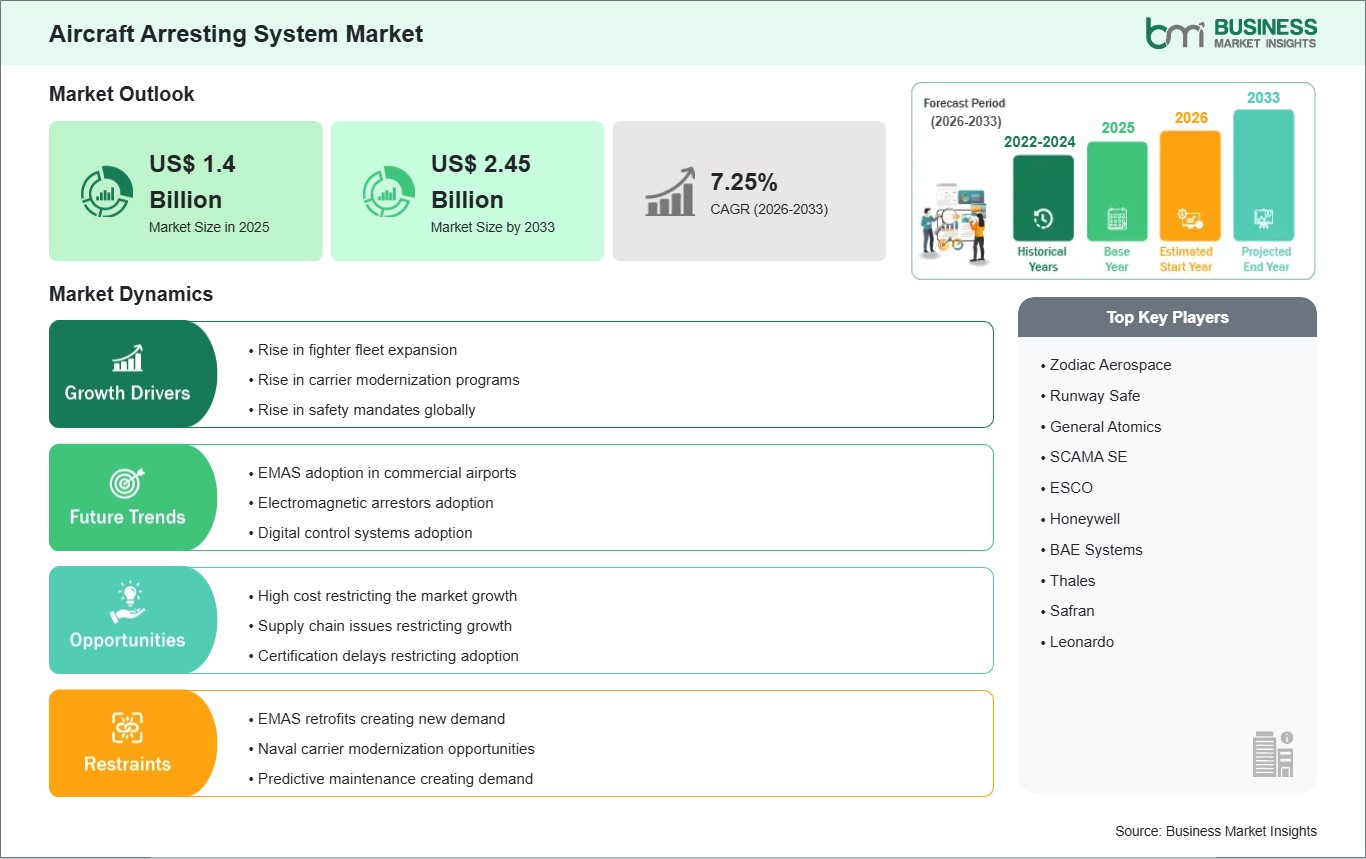
Aircraft arresting systems are specialized safety systems designed to rapidly decelerate aircraft during emergency landings, aborted takeoffs, or carrier-based operations. These systems are widely used across military airbases, naval aircraft carriers, and selected commercial airports where runway safety is critical. Common technologies include cable and reel systems, net barriers, and engineered materials arresting systems (EMAS). The Aircraft Arresting System market is gaining attention due to the growing focus on aviation safety, modernization of military airfields, and increased investments in airport infrastructure. Demand is also increasing as defense agencies upgrade older arresting technologies with more reliable and automated systems capable of supporting modern aircraft platforms and higher operational loads.
Several challenges continue to affect the Aircraft Arresting System market. The installation and maintenance of arresting systems require high capital investment and specialized engineering expertise. Integrating these systems into older airport infrastructure can be technically difficult, especially in locations with limited runway space. Military-grade arresting technologies also require regular inspection and testing to maintain operational readiness, which increases lifecycle costs. In commercial aviation, adoption remains limited because many airports prioritize runway expansion and navigation upgrades over emergency arresting infrastructure. In addition, varying regulatory standards across countries create delays in certification and deployment processes for advanced arresting technologies.
Despite these limitations, the Aircraft Arresting System market is expected to benefit from increasing defense modernization programs and rising investments in aviation safety systems. Technological improvements in energy absorption materials, automated monitoring systems, and lightweight arresting components are improving system efficiency and operational reliability. Naval aviation programs and next-generation fighter aircraft deployments are also supporting demand for advanced arresting systems. The market remains moderately competitive, with manufacturers focusing on durable designs, rapid deployment capabilities, and compliance with evolving aviation safety standards.
Segment Analysis
Aircraft Arresting System Market Segmentation
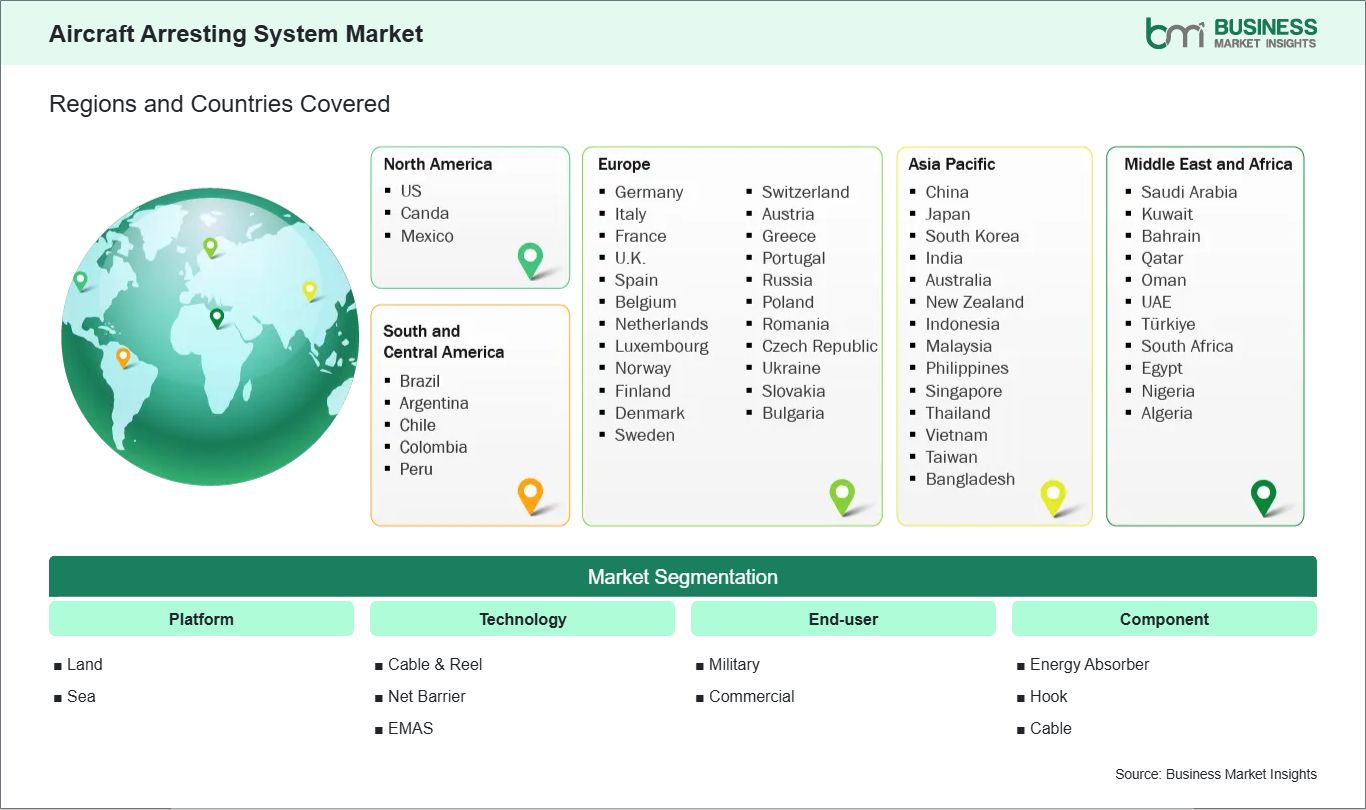
The Aircraft Arresting System market is segmented based on platform, technology, end-user, and component. Different system configurations are designed to support military and commercial aviation safety requirements across land and sea-based operations.
By Platform
- Land: Widely used at military airbases and selected commercial airports for emergency aircraft stopping operations.
- Sea: Primarily deployed on aircraft carriers and naval platforms to support carrier-based aircraft landings.
By Technology
- Cable & Reel: Commonly used for rapid aircraft deceleration during emergency or tactical landing operations.
- Net Barrier: Designed to safely stop aircraft in cases where landing gear or hook systems fail.
- EMAS: Uses crushable materials to slow aircraft at runway ends and improve airport safety.
By End-User
- Military: Represents the major application area due to naval aviation and defense airbase requirements.
- Commercial: Adoption is increasing at airports focusing on enhanced runway safety systems.
By Component
- Energy Absorber: Helps reduce aircraft impact forces during arrestment operations.
- Hook: Enables aircraft engagement with arresting cables during landing procedures.
- Cable: Serves as the primary system element for stopping aircraft movement safely.
Market Forces
Aircraft Arresting System Market Drivers and Opportunities
Growing Focus on Aviation Safety and Defense Infrastructure Modernization
The growing emphasis on aviation safety and military readiness is significantly supporting the Aircraft Arresting System market. Governments and defense organizations are investing in advanced runway safety systems to improve operational reliability during emergency landings and tactical aircraft operations. Military airbases are increasingly replacing aging arresting systems with modern solutions capable of handling heavier and faster aircraft. Rising geopolitical tensions and the expansion of defense aviation fleets are also contributing to demand for improved arresting technologies.
Airport authorities are placing greater attention on runway overrun prevention and emergency response infrastructure. As aviation traffic increases, the need for systems that can minimize aircraft damage and improve passenger safety is becoming more important. Modern arresting systems are being integrated with digital monitoring and automated control technologies to improve system efficiency and maintenance planning. Regulatory authorities are also strengthening airport safety standards, encouraging infrastructure upgrades at both military and selected civilian facilities. These developments are creating long-term opportunities for advanced aircraft arresting solutions across global aviation infrastructure projects.
Advancements in Smart Arresting Technologies and Naval Aviation Expansion
Technological innovation is creating new growth opportunities in the Aircraft Arresting System market. Manufacturers are developing advanced energy absorption systems, lightweight materials, and automated monitoring technologies to improve aircraft stopping performance and reduce maintenance requirements. Digital sensors and predictive maintenance systems are helping operators monitor system health in real time, improving operational efficiency and reducing downtime. These innovations are particularly valuable for military applications where high operational readiness is essential.
Naval aviation programs are also creating opportunities for advanced arresting technologies. The growing deployment of aircraft carriers and next-generation naval aircraft is increasing the need for highly reliable arresting systems capable of handling modern aircraft weights and landing speeds. Emerging economies are investing in defense modernization and expanding naval capabilities, which is supporting future demand. In addition, the increasing adoption of EMAS technology at commercial airports with limited runway expansion capacity is opening new application areas. Continued research into sustainable materials and modular system designs is expected to further improve installation flexibility and operational safety across aviation sectors.
Size and Share Analysis
Aircraft Arresting System Market Size and Share Analysis
The Aircraft Arresting System Market is projected to grow from US$ 1.4 Billion in 2025 to US$ 2.45 Billion by 2033 , registering a CAGR of 7.25% from 2026 to 2033.
By platform, land-based systems account for a major share of the market due to their widespread deployment across military airbases and airport safety zones. Sea-based systems are also witnessing growth with the expansion of naval aviation programs and aircraft carrier modernization projects. By technology, cable and reel systems continue to dominate because of their proven operational efficiency and extensive military adoption, while EMAS technology is gaining attention for improving runway safety at commercial airports.
By end-user, the military segment represents the largest share of the Aircraft Arresting System market owing to increasing defense spending, fighter aircraft operations, and naval fleet expansion. The commercial segment is growing steadily as airport authorities focus more on emergency runway safety infrastructure. By component, cables and energy absorbers remain essential parts of arresting systems, while advanced hook technologies are being integrated into modern aircraft platforms to support safer and more efficient landing operations.
Report Coverage
Aircraft Arresting System Market Report Coverage and Deliverables
The "Aircraft Arresting System Size and Forecast (2022-2033)" report provides a detailed analysis of the market covering below areas:
- Market size and forecast at global, regional, and country levels for all the key market segments covered under the scope
- Market trends, as well as market dynamics such as drivers, restraints, and key opportunities
- Market analysis covering key market trends, global and regional framework, major players, regulations, and recent market developments
- Industry landscape and competition analysis covering market concentration, heat map analysis, prominent players, and recent developments for the market
- Detailed company profiles, including SWOT analysis
Geographic Insights
Aircraft Arresting System Market Geographic Insights
The Aircraft Arresting System Market shows diverse regional adoption patterns influenced by military modernization programs, aviation safety regulations, naval aviation expansion, and airport infrastructure development.
North America remains a mature market for aircraft arresting systems due to strong defense aviation infrastructure and continued investments in military airbases and naval operations. The United States leads the region with extensive deployment of arresting systems across aircraft carriers and air force installations. The region also benefits from advanced aerospace engineering capabilities and strict aviation safety standards. Canada is gradually improving aviation safety infrastructure at selected airports and defense facilities. Continuous modernization of fighter aircraft fleets and runway safety programs is supporting demand for advanced arresting technologies across the region.
Asia Pacific is witnessing growing adoption of aircraft arresting systems due to increasing defense budgets and expanding naval aviation capabilities. Countries such as China and India are investing heavily in aircraft carrier development, military runway modernization, and advanced aviation safety systems. Japan and South Korea are also strengthening defense preparedness and upgrading airbase infrastructure to support modern aircraft operations. The region is seeing rising interest in automated arresting technologies and energy-absorbing runway systems for both military and civil aviation applications. Growing geopolitical tensions and rapid aviation infrastructure development continue to create opportunities for system deployment across emerging economies in Asia Pacific.
Industry Activity
Recent Developments
The Aircraft Arresting System Market is analyzed using a mix of primary and secondary research sources, including corporate publications, industry associations, and verified databases. This approach ensures accurate tracking of innovation trends and strategic developments influencing the market.
- In March 2024, Curtiss-Wright Corporation announced continued deliveries and support activities for advanced aircraft arresting systems used by military airbases and naval aviation platforms. The company focused on improving operational reliability and modernizing arresting gear technologies to support next-generation fighter aircraft operations. The development highlighted growing investments in aviation safety and defense infrastructure modernization.
- In July 2023, General Atomics Electromagnetic Systems continued progress on advanced aircraft launch and recovery technologies for naval aviation applications. The company emphasized enhancements in electromagnetic aircraft support systems designed to improve carrier-based aircraft operations and operational efficiency. The update reflected increasing interest in next-generation aviation support technologies for naval fleets.
Trust & Transparency
Research Methodology
The market analysis combines proprietary research with secondary data from government agencies, company disclosures, regulatory filings, industry databases and expert interviews. Market estimates are validated through data triangulation, cross-market benchmarking and analyst
review.
View Full Research Methodology
Key Sources Referred:
World Bank - Global Trade Indicators World Trade Organization (WTO) International Monetary Fund (IMF) International Trade Administration (ITA) Company Websites Company Annual Reports Company Investor Presentations