Market Summary
Executive Summary and Global Market Analysis
Aircraft communication systems are used to enable voice, data, and navigation-related communication between aircraft, air traffic control centers, satellites, and ground infrastructure. These systems include technologies such as SATCOM, VHF/UHF radios, HF communication systems, and data link platforms that support safe and efficient flight operations. They are widely used in commercial aviation, military aircraft, UAVs, and emerging eVTOL platforms for operational coordination, navigation updates, surveillance, and real-time information exchange. The market is growing as airlines modernize aircraft connectivity systems, defense organizations invest in secure communication infrastructure, and aviation authorities focus on improving digital air traffic management capabilities. Increasing demand for connected aircraft and real-time operational monitoring is also supporting market expansion.
There are some challenges that could slow market growth. Advanced aircraft communication systems require high installation and maintenance costs, which can create difficulties for smaller airlines and operators with limited budgets. Integrating modern communication technologies into older aircraft fleets is also complex because legacy systems may not support new digital infrastructure. Communication systems operating in remote regions and harsh weather conditions can face connectivity limitations and signal disruptions. In addition, growing cybersecurity concerns in connected aviation platforms are increasing the need for secure communication frameworks and continuous software upgrades. Regulatory compliance requirements and certification processes can also increase deployment timelines for new communication technologies.
Even with these challenges, the market is expected to grow as the aviation industry moves toward more connected and digital flight operations. New opportunities are emerging from satellite-based communication systems, software-defined radios, and next-generation air traffic management technologies. Increasing development of UAVs and urban air mobility platforms is also creating demand for lightweight and high-speed communication solutions. Aviation companies are focusing on improving real-time data exchange, inflight connectivity, and autonomous communication capabilities for future aircraft systems. Advancements in artificial intelligence, cloud-based aviation analytics, and integrated digital communication platforms are expected to support long-term market growth and operational efficiency across the global aviation sector.
Segment Analysis
Aircraft Communication System Market Segmentation
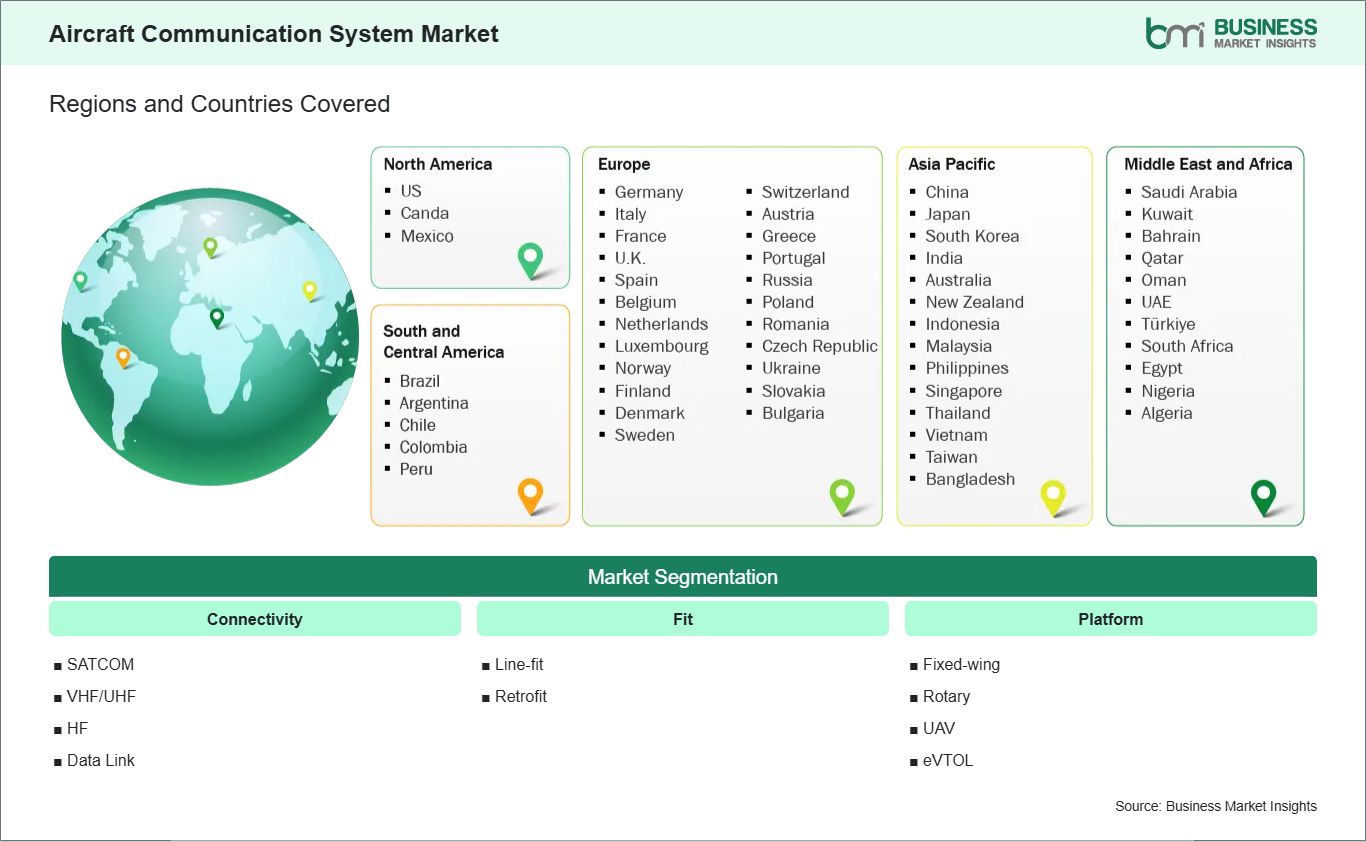
The Aircraft Communication System market is segmented based on connectivity, fit, and platform. Growing demand for secure, high-speed, and reliable aircraft communication technologies is supporting adoption across multiple aviation applications.
By Connectivity
- SATCOM: Widely used for long-range communication, inflight connectivity, and real-time operational monitoring.
- VHF/UHF: Commonly adopted for conventional air-to-ground and air traffic communication systems.
- HF: Used for long-distance communication in remote and oceanic flight routes.
- Data Link: Increasingly adopted for digital communication and automated data exchange in modern aviation systems.
By Fit
- Line-fit: Dominates the market due to integration of advanced communication systems in newly manufactured aircraft.
- Retrofit: Growing steadily as airlines and operators upgrade older fleets with modern communication technologies.
By Platform
- Fixed-wing: Represents a major share due to extensive deployment in commercial and military aviation.
- Rotary: Used in helicopter operations requiring reliable mission and navigation communication systems.
- UAV: Witnessing strong growth with rising deployment in surveillance, logistics, and defense applications.
- eVTOL: Emerging segment driven by development of urban air mobility and connected aviation platforms.
Market Forces
Aircraft Communication System Market Drivers and Opportunities
Increasing Aircraft Connectivity and Aviation Digitalization
The growing demand for connected aircraft operations is a major factor supporting the Aircraft Communication System market. Airlines and aviation operators are increasingly adopting advanced communication technologies to improve flight safety, operational efficiency, and passenger connectivity. Modern aviation systems rely heavily on continuous communication between aircraft, ground stations, and air traffic management infrastructure for navigation, monitoring, and real-time decision-making. Regulatory initiatives promoting modernization of air traffic control systems and digital aviation infrastructure are further supporting the adoption of advanced communication platforms.
The increasing integration of digital cockpit systems, cloud-based aviation analytics, and satellite communication technologies is also driving demand for secure and high-speed communication networks. Commercial aviation operators are focusing on enhancing inflight communication capabilities to support real-time aircraft health monitoring and operational coordination. In military aviation, secure communication systems are becoming increasingly important for mission-critical operations and surveillance activities. These developments are encouraging continuous investment in next-generation communication technologies across both commercial and defense aviation sectors.
Expansion of UAV and eVTOL Communication Technologies
The rapid development of UAVs and eVTOL aircraft is creating significant opportunities for the Aircraft Communication System market. These emerging aviation platforms require advanced communication systems capable of supporting autonomous operations, real-time navigation, and secure data transmission. Growing interest in urban air mobility and unmanned aerial operations is encouraging investment in lightweight, compact, and highly reliable communication technologies.
The increasing use of UAVs in surveillance, logistics, agriculture, and infrastructure inspection is accelerating demand for advanced communication networks that can support beyond-visual-line-of-sight operations. Similarly, eVTOL aircraft developers are focusing on integrating modern connectivity solutions to support safe and efficient urban transportation systems. Advancements in satellite communication, 5G-enabled aviation connectivity, and artificial intelligence-based flight management systems are expected to create additional growth opportunities for communication system providers.
The aviation industry is also witnessing growing interest in integrated digital ecosystems that combine communication, navigation, and operational analytics into unified platforms. This trend is expected to encourage innovation in software-defined communication systems and next-generation airborne connectivity technologies in the coming years.
Size and Share Analysis
Aircraft Communication System Market Size and Share Analysis
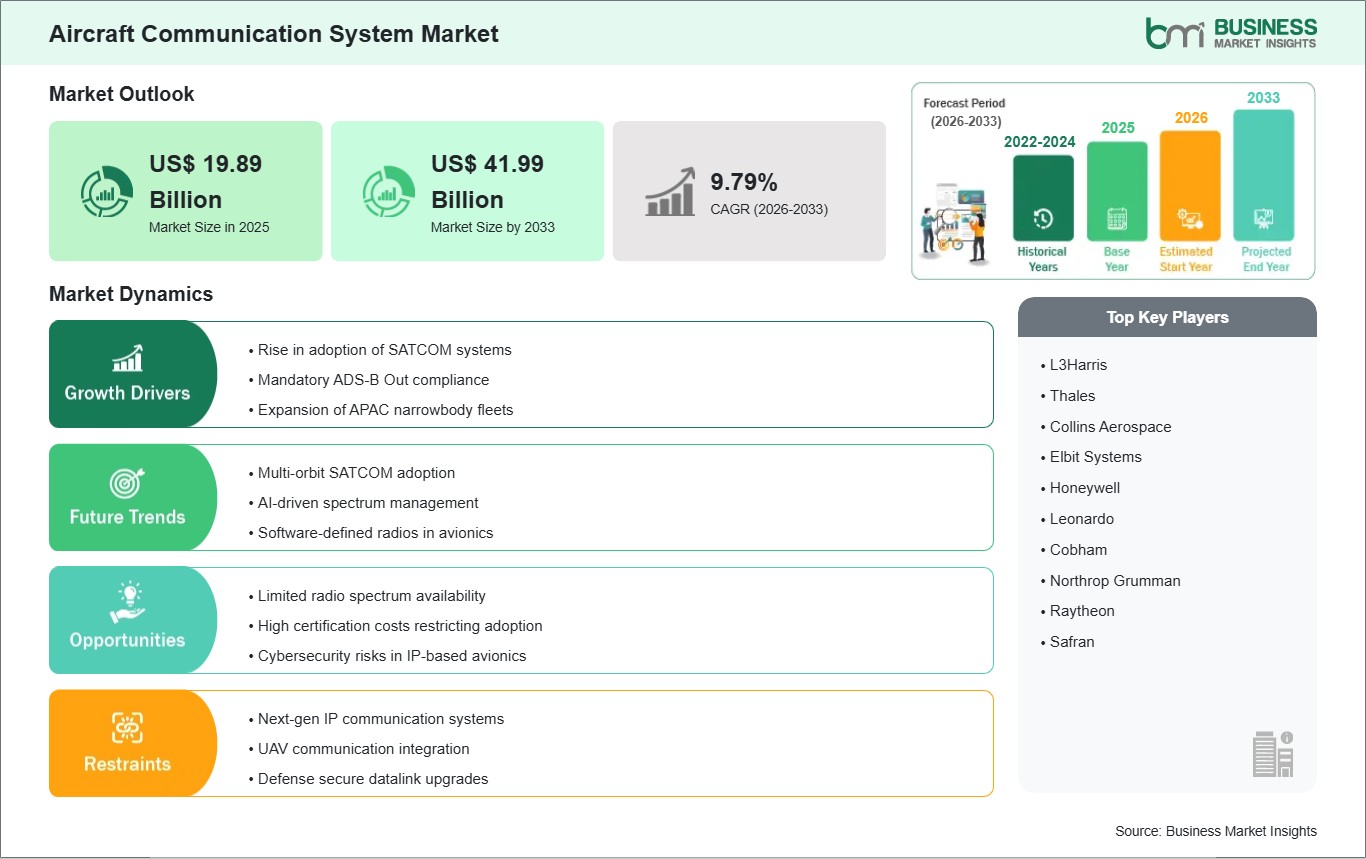
The Aircraft Communication System Market is projected to grow from US$ 19.89 Billion in 2025 to US$ 41.99 Billion by 2033 , registering a CAGR of 9.79% from 2026 to 2033.
By connectivity, SATCOM accounts for a significant share due to its ability to provide reliable long-range communication and high-speed inflight connectivity. VHF/UHF systems continue to maintain strong adoption for conventional air traffic communication requirements, while data link technologies are expanding steadily with increasing digitalization and automation across aviation operations.
By platform, fixed-wing aircraft dominate the market owing to widespread deployment across commercial and military aviation sectors. UAV platforms are witnessing rapid growth due to increasing adoption in surveillance, logistics, and defense applications, while eVTOL aircraft are gaining attention with the development of urban air mobility infrastructure and next-generation connected aviation systems.
Report Coverage
Aircraft Communication System Market Report Coverage and Deliverables
The "Aircraft Communication System Size and Forecast (2022-2033)" report provides a detailed analysis of the market covering below areas:
- Market size and forecast at global, regional, and country levels for all the key market segments covered under the scope
- Market trends, as well as market dynamics such as drivers, restraints, and key opportunities
- Market analysis covering key market trends, global and regional framework, major players, regulations, and recent market developments
- Industry landscape and competition analysis covering market concentration, heat map analysis, prominent players, and recent developments for the market
- Detailed company profiles, including SWOT analysis
Geographic Insights
Aircraft Communication System Market Geographic Insights
The Aircraft Communication System Market shows diverse regional adoption patterns influenced by aviation modernization, increasing aircraft production, and growing investments in advanced communication infrastructure.
North America, being a developed region, has a highly advanced aviation ecosystem and strong adoption of modern aircraft communication technologies. The region comprises the United States and Canada, where commercial airlines, defense organizations, and aviation technology providers are investing in satellite communication systems, digital air traffic management, and connected aircraft platforms. The region focuses on improving flight safety, operational efficiency, and real-time communication capabilities across commercial and military aviation sectors. Strong aerospace manufacturing capabilities and ongoing modernization of aviation infrastructure continue to support the adoption of advanced aircraft communication systems across fixed-wing aircraft, UAVs, and emerging eVTOL platforms.
Asia Pacific is growing significantly, driven by increasing air passenger traffic, expansion of airline fleets, and rising defense modernization programs. The region comprises countries such as China, India, Japan, and South Korea, where governments and aviation operators are investing in advanced communication technologies and next-generation air traffic management systems. The region focuses on strengthening aviation connectivity infrastructure and supporting the growing demand for digital aviation services. Increasing deployment of UAVs, expansion of airport infrastructure, and rising development of urban air mobility projects are also contributing to market growth across the region.
Both regions are contributing significantly to the growth of the Aircraft Communication System Market, focusing on aviation modernization, digital connectivity infrastructure, and increasing demand for reliable airborne communication technologies.
Industry Activity
Recent Developments
The Aircraft Communication System Market is analyzed using a mix of primary and secondary research sources, including corporate publications, industry associations, and verified databases. This approach ensures accurate tracking of innovation trends and strategic developments influencing the market.
- In March 2024, Honeywell announced advancements in satellite communication technologies for connected aircraft operations. The development focused on improving real-time communication capabilities, operational efficiency, and cockpit connectivity solutions for commercial and defense aviation platforms. The initiative supports increasing demand for advanced airborne communication infrastructure.
- In July 2023, Collins Aerospace introduced enhanced aircraft communication and connectivity solutions designed to support next-generation aviation operations. The systems were developed to improve secure communication, flight data transmission, and integration with modern air traffic management infrastructure. The development supports the growing transition toward digital aviation ecosystems.
Trust & Transparency
Research Methodology
The market analysis combines proprietary research with secondary data from government agencies, company disclosures, regulatory filings, industry databases and expert interviews. Market estimates are validated through data triangulation, cross-market benchmarking and analyst
review.
View Full Research Methodology
Key Sources Referred:
World Bank - Global Trade Indicators World Trade Organization (WTO) International Monetary Fund (IMF) International Trade Administration (ITA) Company Websites Company Annual Reports Company Investor Presentations