Market Summary
Executive Summary and Global Market Analysis
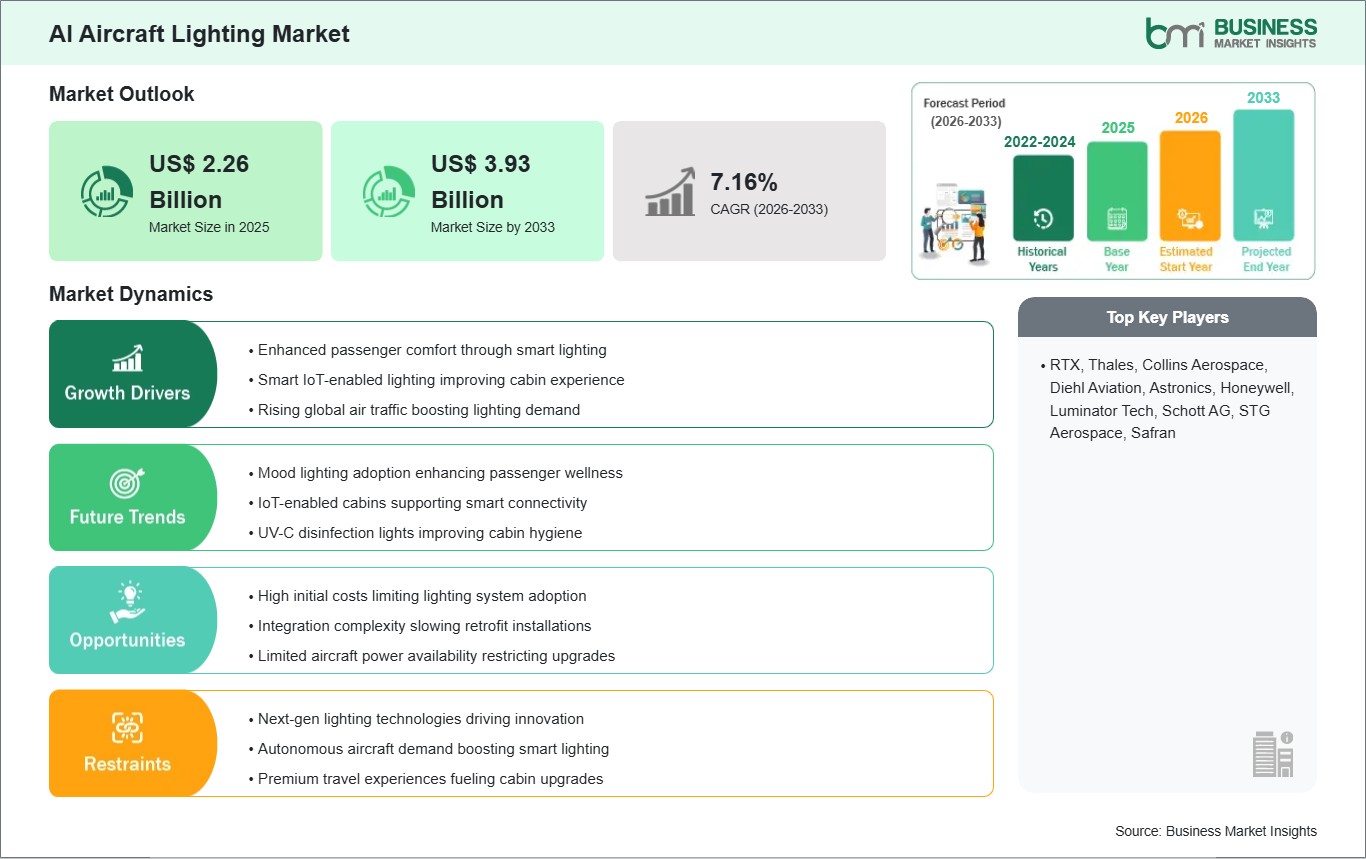
AI Aircraft Lighting refers to intelligent aircraft illumination systems that combine advanced lighting technologies with automation, sensors, and digital control capabilities to improve operational efficiency, passenger comfort, cockpit visibility, and flight safety. These systems are used across commercial aircraft, business jets, and defense aviation platforms for interior cabin lighting, exterior navigation lighting, cockpit illumination, and emergency signaling applications. Increasing focus on fuel efficiency, aircraft modernization, and enhanced passenger experience is encouraging airlines and aircraft manufacturers to adopt energy-efficient lighting technologies such as LED and NVIS-compatible systems.
Several operational and technical challenges continue to influence the AI Aircraft Lighting market. Aircraft lighting systems must comply with strict aviation safety standards and certification procedures, which can increase product development timelines and integration complexity. High replacement and installation costs associated with advanced intelligent lighting systems can limit adoption among cost-sensitive operators. Compatibility issues with legacy aircraft platforms and the need for regular maintenance of electronic components also create operational hurdles.
Despite these constraints, the market continues to benefit from advancements in aircraft electrification and smart aviation technologies. LED lighting systems are witnessing strong adoption due to their lower power consumption, longer operational life, and reduced maintenance requirements. Interior and cockpit lighting applications remain important areas of deployment as airlines focus on improving passenger comfort and pilot visibility. OEMs continue to play a major role in integrating intelligent lighting technologies into new aircraft models, while aftermarket demand is increasing for retrofit and cabin upgrade programs. Competitive activity in the market is focused on lighting durability, digital integration capabilities, energy efficiency, and compliance with aviation safety standards.
Segment Analysis
AI Aircraft Lighting Market Segmentation
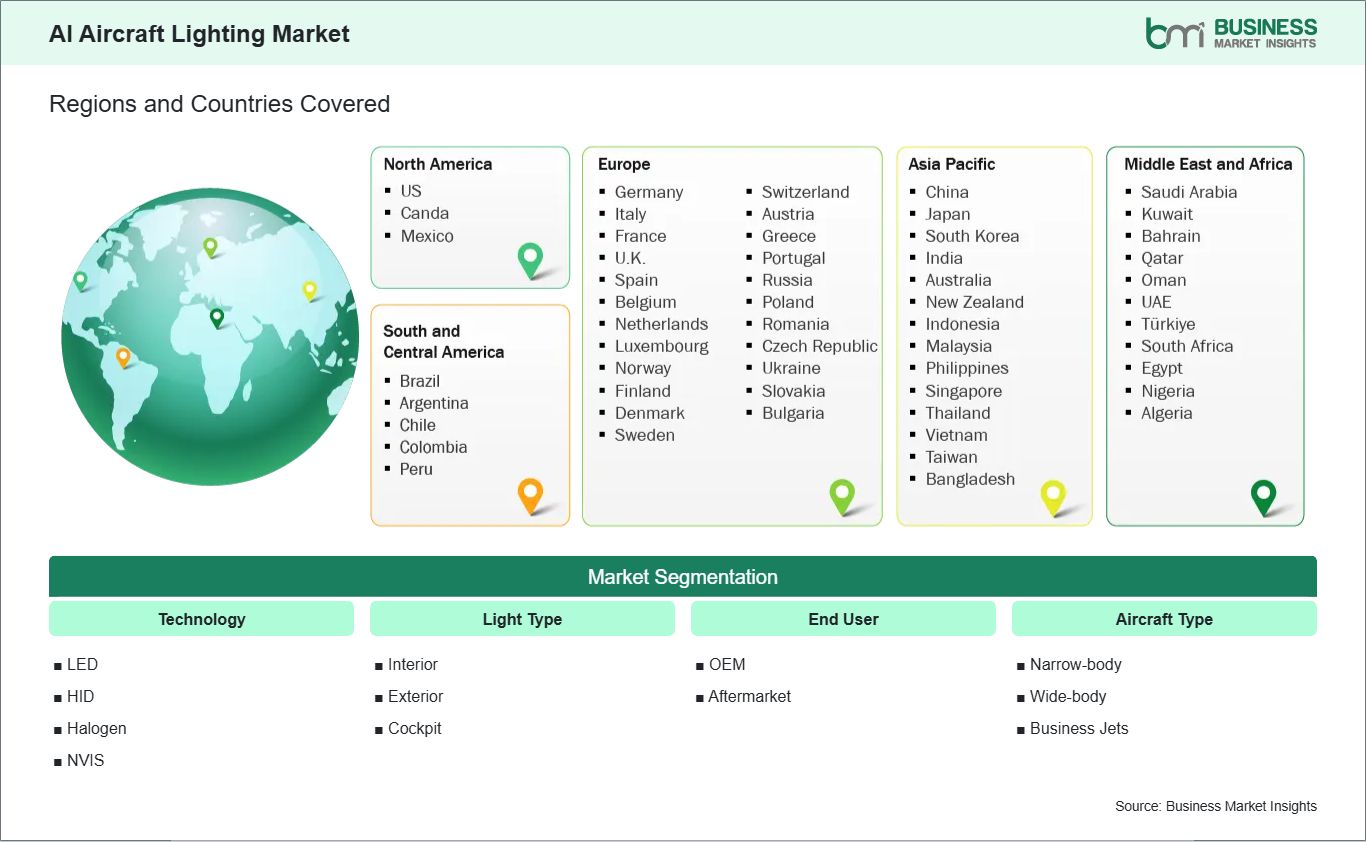
The AI Aircraft Lighting market is segmented based on technology, light type, end user, and aircraft type. Growing adoption of intelligent lighting systems across commercial and business aviation sectors is supporting demand across multiple applications.
By Technology
- LED: Widely adopted due to energy efficiency, longer operational life, and lower maintenance requirements.
- HID: Used in high-intensity exterior lighting applications requiring strong illumination performance.
- Halogen: Common in legacy aircraft systems due to established compatibility and lower upfront costs.
- NVIS: Increasingly used in military and advanced aviation applications requiring night vision compatibility.
By Light Type
- Interior: Focused on passenger comfort, cabin ambiance, and energy-efficient illumination systems.
- Exterior: Used for navigation, anti-collision, taxi, and landing light applications.
- Cockpit: Supports pilot visibility, instrument readability, and operational safety during flights.
By End User
- OEM: Major demand contributor due to integration of advanced lighting systems in newly manufactured aircraft.
- Aftermarket: Driven by retrofit programs, cabin modernization, and replacement requirements.
By Aircraft Type
- Narrow-body: Significant adoption due to increasing commercial aviation operations and fleet expansion.
- Wide-body: Used in long-haul aircraft requiring advanced cabin and exterior lighting systems.
- Business Jets: Demand supported by premium cabin customization and smart lighting integration.
Market Forces
AI Aircraft Lighting Market Drivers and Opportunities
Growing Adoption of Smart and Energy-Efficient Aircraft Systems
The aviation industry is increasingly focusing on fuel efficiency, operational optimization, and improved passenger experience, which is driving the adoption of intelligent aircraft lighting systems. Airlines and aircraft manufacturers are integrating advanced LED and AI-enabled lighting technologies to reduce energy consumption and maintenance requirements. Smart lighting systems can automatically adjust brightness, color temperature, and operational modes based on flight conditions and cabin environments. This capability improves passenger comfort while supporting efficient aircraft operations.
The transition toward connected aircraft and digital cabin management systems is also strengthening market demand. Modern aircraft platforms require integrated lighting systems that can communicate with onboard avionics and automation systems. Regulatory emphasis on aviation safety and emergency visibility standards is encouraging the deployment of advanced cockpit and exterior lighting technologies. Increasing investments in aircraft modernization programs across commercial and defense aviation sectors are further contributing to market expansion. As airlines continue to prioritize operational efficiency and customer experience, intelligent lighting technologies are expected to remain an important area of investment within the aviation industry.
Expansion of Aircraft Retrofit and Smart Cabin Modernization Programs
The growing focus on aircraft cabin modernization and retrofit activities is creating new opportunities for the AI Aircraft Lighting market. Airlines are increasingly upgrading older aircraft fleets with intelligent lighting systems to improve operational efficiency and enhance passenger satisfaction. Advanced lighting technologies provide flexible cabin configurations, mood lighting capabilities, and automated brightness control, supporting premium travel experiences in commercial and business aviation.
The expansion of smart airport infrastructure and connected aviation ecosystems is also encouraging adoption of digitally integrated lighting systems. Emerging developments in AI-powered predictive maintenance and sensor-based monitoring are improving system reliability and reducing downtime. Demand for lightweight lighting materials and compact electronic components is creating opportunities for innovative product development across aircraft categories.
Size and Share Analysis
AI Aircraft Lighting Market Size and Share Analysis
The AI Aircraft Lighting Market is projected to grow from US$ 2.26 Billion in 2025 to US$ 3.93 Billion by 2033 , registering a CAGR of 7.16% from 2026 to 2033.
By technology, LED lighting holds a significant share due to its lower energy consumption, longer operational life, and reduced maintenance requirements compared to conventional lighting systems. NVIS-compatible lighting systems are also witnessing increasing adoption in military and advanced aviation applications requiring enhanced operational visibility.
By light type, interior lighting accounts for a major share of the market as airlines continue focusing on cabin personalization and passenger experience improvements. Exterior and cockpit lighting systems also remain essential for navigation visibility, operational efficiency, and flight safety applications.
Report Coverage
AI Aircraft Lighting Market Report Coverage and Deliverables
The "AI Aircraft Lighting Size and Forecast (2022-2033)" report provides a detailed analysis of the market covering below areas:
- Market size and forecast at global, regional, and country levels for all the key market segments covered under the scope
- Market trends, as well as market dynamics such as drivers, restraints, and key opportunities
- Market analysis covering key market trends, global and regional framework, major players, regulations, and recent market developments
- Industry landscape and competition analysis covering market concentration, heat map analysis, prominent players, and recent developments for the market
- Detailed company profiles, including SWOT analysis
Geographic Insights
AI Aircraft Lighting Market Geographic Insights
The AI Aircraft Lighting Market shows diverse regional adoption patterns influenced by aircraft manufacturing activities, aviation modernization programs, regulatory standards, and investments in advanced aerospace technologies.
North America remains a mature market for AI Aircraft Lighting due to the strong presence of commercial aircraft manufacturers, defense aviation programs, and advanced aerospace infrastructure. The United States continues to lead regional adoption with increasing investments in smart cabin systems, aircraft retrofit programs, and next-generation aviation technologies. Airlines in the region are focusing on passenger comfort enhancements and fuel-efficient aircraft operations, supporting demand for LED and intelligent lighting systems. Canada is also witnessing growth through investments in aerospace manufacturing and maintenance facilities. The region benefits from established regulatory frameworks, strong research capabilities, and high adoption of digital aviation technologies across both commercial and military sectors.
Europe represents an important market driven by aircraft modernization initiatives, sustainability goals, and advanced aviation engineering capabilities. Countries such as Germany, France, and the United Kingdom are actively investing in connected aircraft systems and energy-efficient aviation technologies. Airlines across the region are adopting intelligent cabin lighting systems to improve operational efficiency and passenger experience. European aerospace manufacturers are focusing on lightweight aircraft components and smart lighting integration to support next-generation aircraft development. Increasing emphasis on emission reduction and sustainable aviation infrastructure is also encouraging adoption of low-power LED lighting technologies. The presence of established aerospace supply chains and strong aviation safety regulations continues to support market maturity across the region.
Industry Activity
Recent Developments
The AI Aircraft Lighting Market is analyzed using a mix of primary and secondary research sources, including corporate publications, industry associations, and verified databases. This approach ensures accurate tracking of innovation trends and strategic developments influencing the market.
- In April 2024, Collins Aerospace introduced enhanced aircraft cabin lighting solutions designed to improve passenger comfort and support connected cabin environments. The updated lighting systems focused on energy efficiency, digital integration, and advanced cabin management capabilities for commercial aviation platforms. The development reflected increasing demand for intelligent and customizable aircraft lighting technologies.
- In July 2023, Honeywell announced advancements in connected aircraft technologies that included intelligent cockpit and cabin system enhancements for next-generation aviation platforms. The initiative supported improved operational efficiency, smart avionics integration, and enhanced flight experience capabilities. The development highlighted the growing importance of digitally integrated lighting and electronic systems in modern aircraft operations.
Trust & Transparency
Research Methodology
The market analysis combines proprietary research with secondary data from government agencies, company disclosures, regulatory filings, industry databases and expert interviews. Market estimates are validated through data triangulation, cross-market benchmarking and analyst
review.
View Full Research Methodology
Key Sources Referred:
World Bank - Global Trade Indicators World Trade Organization (WTO) International Monetary Fund (IMF) International Trade Administration (ITA) Company Websites Company Annual Reports Company Investor Presentations