Market Summary
Executive Summary and Global Market Analysis
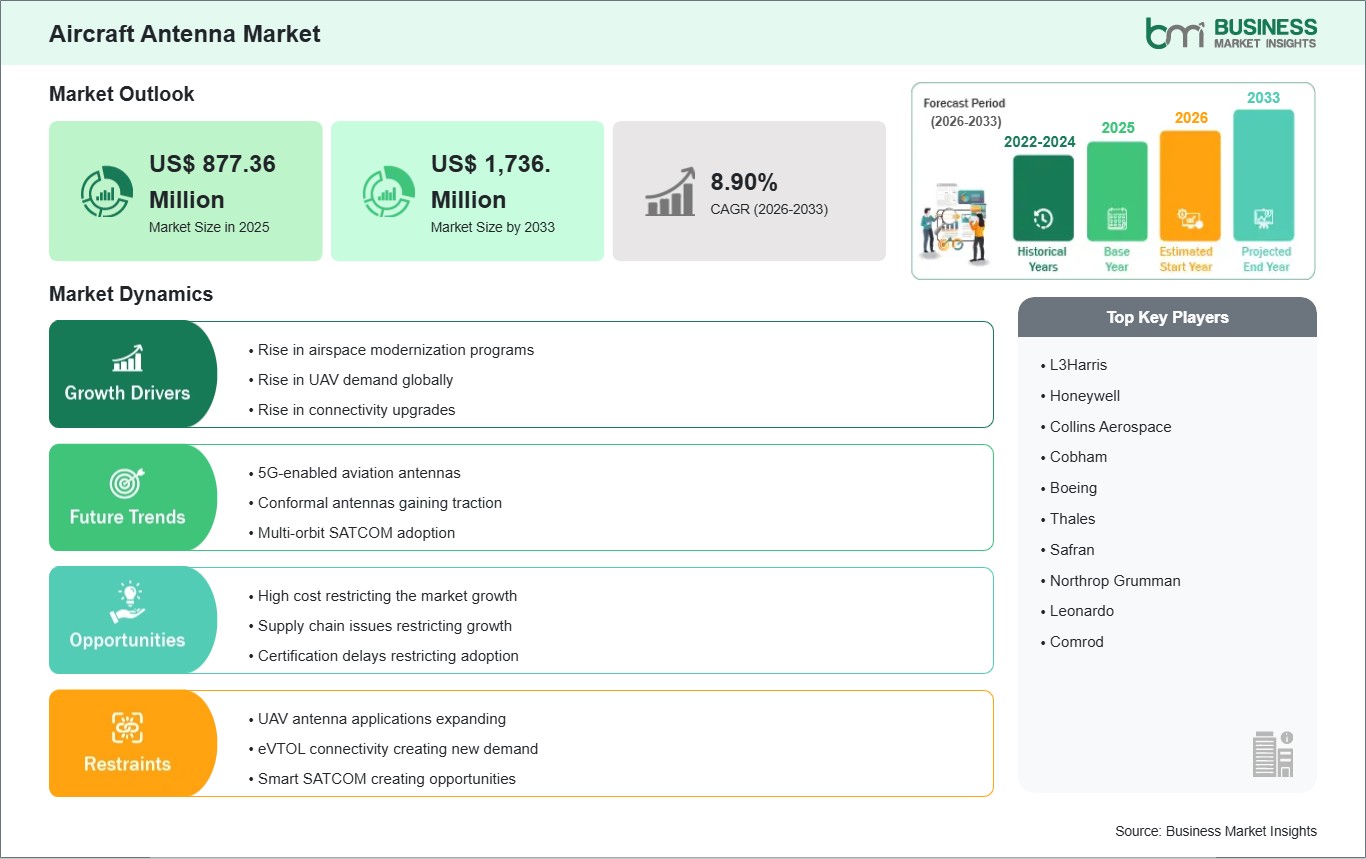
Aircraft antennas are critical communication and signal transmission systems installed on aircraft for navigation, surveillance, communication, and data exchange functions. These antennas support multiple aviation operations such as air traffic communication, satellite connectivity, radar systems, weather monitoring, and flight navigation. The Aircraft Antenna market is witnessing growth due to increasing aircraft production, rising modernization of defense aircraft fleets, and growing demand for connected aircraft technologies. Airlines and military operators are increasingly investing in advanced communication infrastructure to improve operational efficiency, passenger connectivity, and flight safety.
The market is also influenced by evolving aviation communication requirements and rising investments in surveillance systems. Commercial aviation operators are focusing on improving in-flight entertainment and broadband connectivity, while military organizations are expanding airborne surveillance and secure communication capabilities. SATCOM antennas continue to gain importance because of their ability to provide reliable long-distance communication and high-speed data transfer. VHF/UHF antennas remain widely used due to their compatibility with conventional aviation communication systems. The increasing use of ADS-B systems for real-time aircraft tracking and air traffic management is further contributing to market development.
There are certain challenges affecting the Aircraft Antenna market. High installation and maintenance costs associated with advanced antenna systems can create barriers for smaller aircraft operators. Aircraft integration complexities and strict aviation certification procedures may also increase deployment timelines. However, the market continues to create opportunities through miniaturization, smart antenna development, electronically steered antennas, and the expansion of connected aircraft ecosystems. Competition in the market is driven by technological innovation, product reliability, and the ability to meet evolving aviation communication standards.
Segment Analysis
Aircraft Antenna Market Segmentation
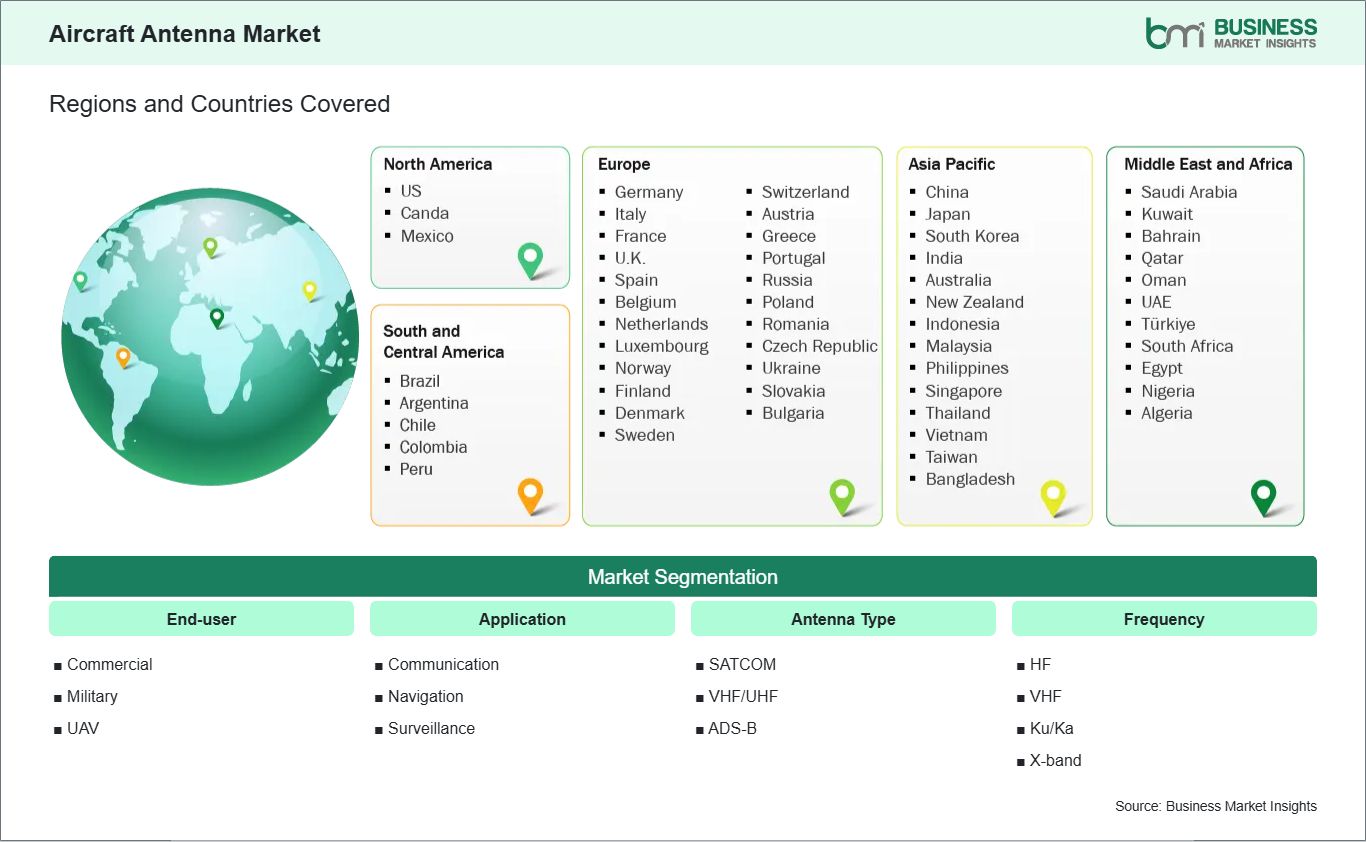
The Aircraft Antenna market is segmented based on end-user, application, antenna type, and frequency. Increasing aircraft communication requirements and rising surveillance applications continue to shape demand across multiple segments.
By End-User
- Commercial: Commercial aviation operators are adopting advanced antennas to support passenger connectivity, communication systems, and navigation functions.
- Military: Military aircraft require secure and high-performance antennas for surveillance, electronic warfare, and tactical communication.
- UAV: UAV platforms are increasingly integrating lightweight and compact antennas for real-time communication and remote operations.
By Application
- Communication: Communication applications account for a significant share due to rising demand for connected aircraft and satellite communication systems.
- Navigation: Navigation antennas are widely used for flight route management, positioning, and air traffic coordination.
- Surveillance: Surveillance applications are growing with increased use of aircraft tracking and airborne monitoring technologies.
By Antenna Type
- SATCOM: SATCOM antennas are gaining demand due to increasing adoption of high-speed airborne connectivity and satellite communication.
- VHF/UHF: VHF/UHF antennas continue to be widely deployed in conventional aviation communication systems.
- ADS-B: ADS-B antennas are increasingly used for aircraft monitoring and improved air traffic management.
By Frequency
- HF: HF antennas support long-range communication requirements for aircraft operations.
- VHF: VHF frequency systems remain important for standard aviation communication.
- Ku/Ka: Ku/Ka-band antennas are witnessing increased adoption for broadband and satellite connectivity.
- X-band: X-band antennas are primarily used in military and surveillance-related applications.
Market Forces
Aircraft Antenna Market Drivers and Opportunities
Rising Demand for Connected Aircraft and Advanced Communication Systems
The increasing demand for connected aircraft technologies is one of the major factors supporting the growth of the Aircraft Antenna market. Airlines and aviation operators are focusing on improving communication capabilities, operational efficiency, and passenger experience through advanced connectivity solutions. Modern aircraft require reliable communication systems for navigation, weather monitoring, real-time aircraft tracking, and in-flight internet services. This has increased the adoption of satellite communication antennas and high-frequency communication systems across commercial aviation.
Defense organizations are also investing heavily in advanced airborne communication infrastructure to improve mission coordination, surveillance, and secure data transmission. The increasing use of unmanned aerial vehicles for intelligence gathering and border monitoring is creating additional demand for compact and high-performance antenna systems. Regulatory developments related to aircraft tracking and aviation safety are also supporting the deployment of advanced surveillance antennas. As aircraft communication systems continue to evolve, manufacturers are focusing on developing lightweight, durable, and multifunctional antennas capable of supporting modern aviation requirements.
Expansion of Satellite Connectivity and Smart Antenna Technologies
The growing adoption of satellite connectivity and smart antenna technologies is creating new opportunities for the Aircraft Antenna market. Aviation operators are increasingly using satellite-based systems to improve communication reliability, navigation accuracy, and broadband connectivity during flights. The expansion of global satellite networks and low-earth orbit communication systems is supporting the development of advanced aircraft antenna solutions capable of handling higher data transmission speeds.
Smart antennas and electronically steered antenna systems are emerging as important innovations within the aviation industry. These technologies allow improved signal quality, reduced aerodynamic drag, and better operational flexibility for aircraft. The increasing integration of artificial intelligence and digital monitoring systems into aviation communication infrastructure is also encouraging the use of intelligent antenna platforms. Growing investments in urban air mobility, autonomous aircraft systems, and next-generation UAVs are expected to create long-term demand for compact and efficient airborne antenna technologies. The market is also benefiting from advancements in lightweight materials and miniaturization techniques that improve antenna performance while reducing aircraft weight.
Size and Share Analysis
Aircraft Antenna Market Size and Share Analysis
The Aircraft Antenna Market is projected to grow from US$ 877.36 Million in 2025 to US$ 1,736. Million by 2033 , registering a CAGR of 8.90% from 2026 to 2033.
By end-user, the commercial segment accounts for a significant share because of rising passenger traffic and increasing installation of in-flight connectivity systems. The military segment continues to witness strong demand for secure communication and surveillance antennas.
By application, communication systems dominate the market due to growing demand for real-time data exchange and satellite connectivity. Surveillance applications are also expanding with increased emphasis on aircraft tracking and monitoring systems.
Report Coverage
Aircraft Antenna Market Report Coverage and Deliverables
The "Aircraft Antenna Size and Forecast (2022-2033)" report provides a detailed analysis of the market covering below areas:
- Market size and forecast at global, regional, and country levels for all the key market segments covered under the scope
- Market trends, as well as market dynamics such as drivers, restraints, and key opportunities
- Market analysis covering key market trends, global and regional framework, major players, regulations, and recent market developments
- Industry landscape and competition analysis covering market concentration, heat map analysis, prominent players, and recent developments for the market
- Detailed company profiles, including SWOT analysis
Geographic Insights
Aircraft Antenna Market Geographic Insights
The Aircraft Antenna Market shows diverse regional adoption patterns influenced by aviation infrastructure expansion, aircraft modernization programs, defense investments, and growing demand for airborne connectivity systems.
North America remains a major market for aircraft antennas due to the strong presence of commercial aviation operators, aircraft manufacturers, and defense modernization programs. The United States continues to invest in advanced airborne communication systems, surveillance platforms, and connected aircraft technologies. Rising adoption of satellite communication systems and next-generation air traffic management infrastructure supports market growth across the region. Canada is also witnessing increased demand for aviation communication technologies due to fleet upgrades and growing defense surveillance activities. The region has a mature aviation ecosystem with strong technological capabilities and high adoption of advanced antenna solutions.
Asia Pacific is witnessing rapid growth in the Aircraft Antenna market because of increasing aircraft procurement, expanding airline networks, and rising investments in aviation infrastructure. Countries such as China and India are focusing on modernizing commercial and military aviation fleets to improve operational efficiency and communication capabilities. Growing demand for in-flight connectivity services and increasing use of UAVs are supporting market development in the region. Japan and South Korea are also investing in advanced aerospace technologies and surveillance systems. The expansion of regional air travel and defense modernization initiatives is creating long-term opportunities for antenna manufacturers across Asia Pacific.
Industry Activity
Recent Developments
The Aircraft Antenna Market is analyzed using a mix of primary and secondary research sources, including corporate publications, industry associations, and verified databases. This approach ensures accurate tracking of innovation trends and strategic developments influencing the market.
- In March 2024, Honeywell introduced a new JetWave X satellite communication system designed to support high-speed in-flight connectivity for commercial and defense aircraft. The platform improves global coverage and enables advanced data transmission capabilities for connected aircraft operations.
- In July 2023, Viasat completed its acquisition of Inmarsat to strengthen global satellite communication services for aviation, maritime, and government applications. The development supports enhanced airborne connectivity capabilities and expands satellite-based communication infrastructure for aircraft operators.
Trust & Transparency
Research Methodology
The market analysis combines proprietary research with secondary data from government agencies, company disclosures, regulatory filings, industry databases and expert interviews. Market estimates are validated through data triangulation, cross-market benchmarking and analyst
review.
View Full Research Methodology
Key Sources Referred:
World Bank - Global Trade Indicators World Trade Organization (WTO) International Monetary Fund (IMF) International Trade Administration (ITA) Company Websites Company Annual Reports Company Investor Presentations