
Aircraft Antennas Market Outlook: Size, Share, Trends, Growth Analysis, Competitive Landscape & Forecast, 2026-2033

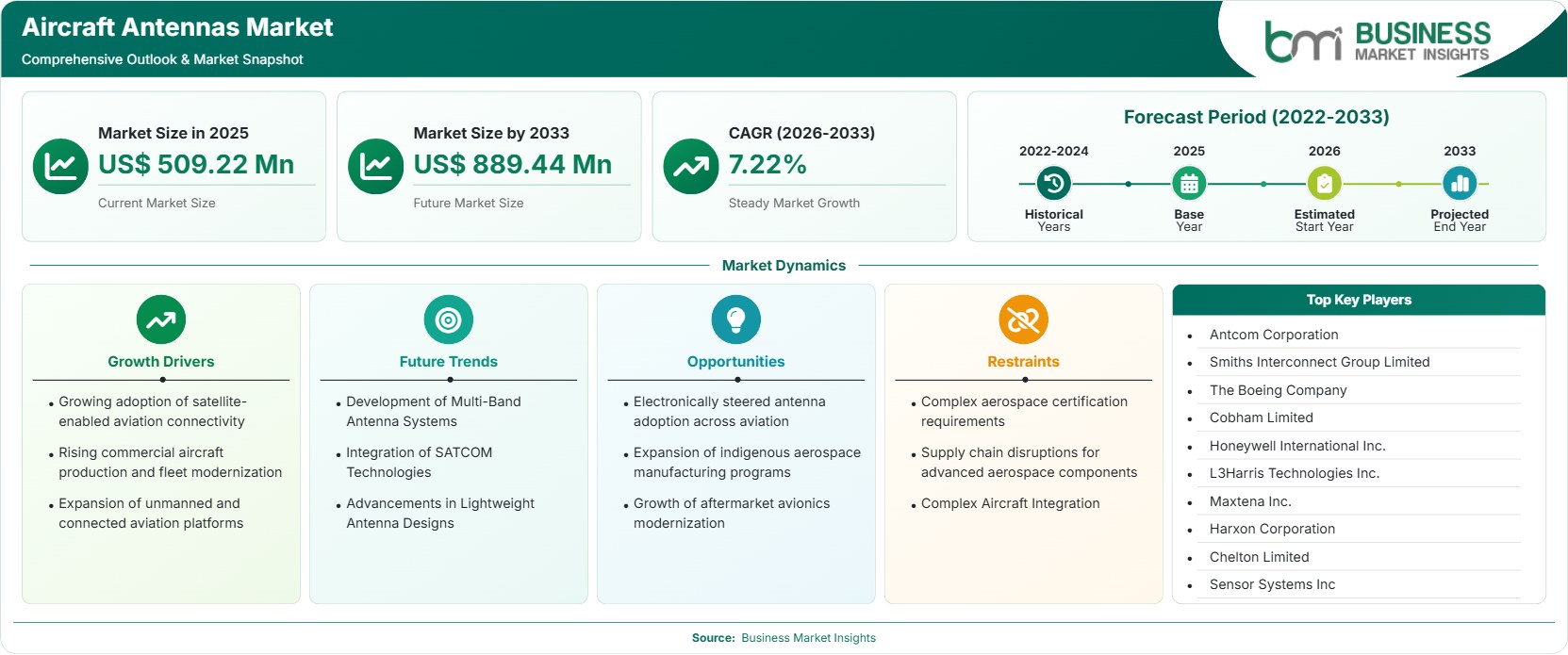
The Aircraft Antennas Market size was valued at US$ 509.22 Million in 2025 and is projected to reach US$ 889.44 Million by 2033, growing at a CAGR of 7.22% during 2026–2033. Rising aircraft deliveries, modernization of military fleets, increasing satellite-based connectivity, and growing demand for advanced communication, navigation, and surveillance systems are creating strong opportunities across commercial and defense aviation.

Report Coverage
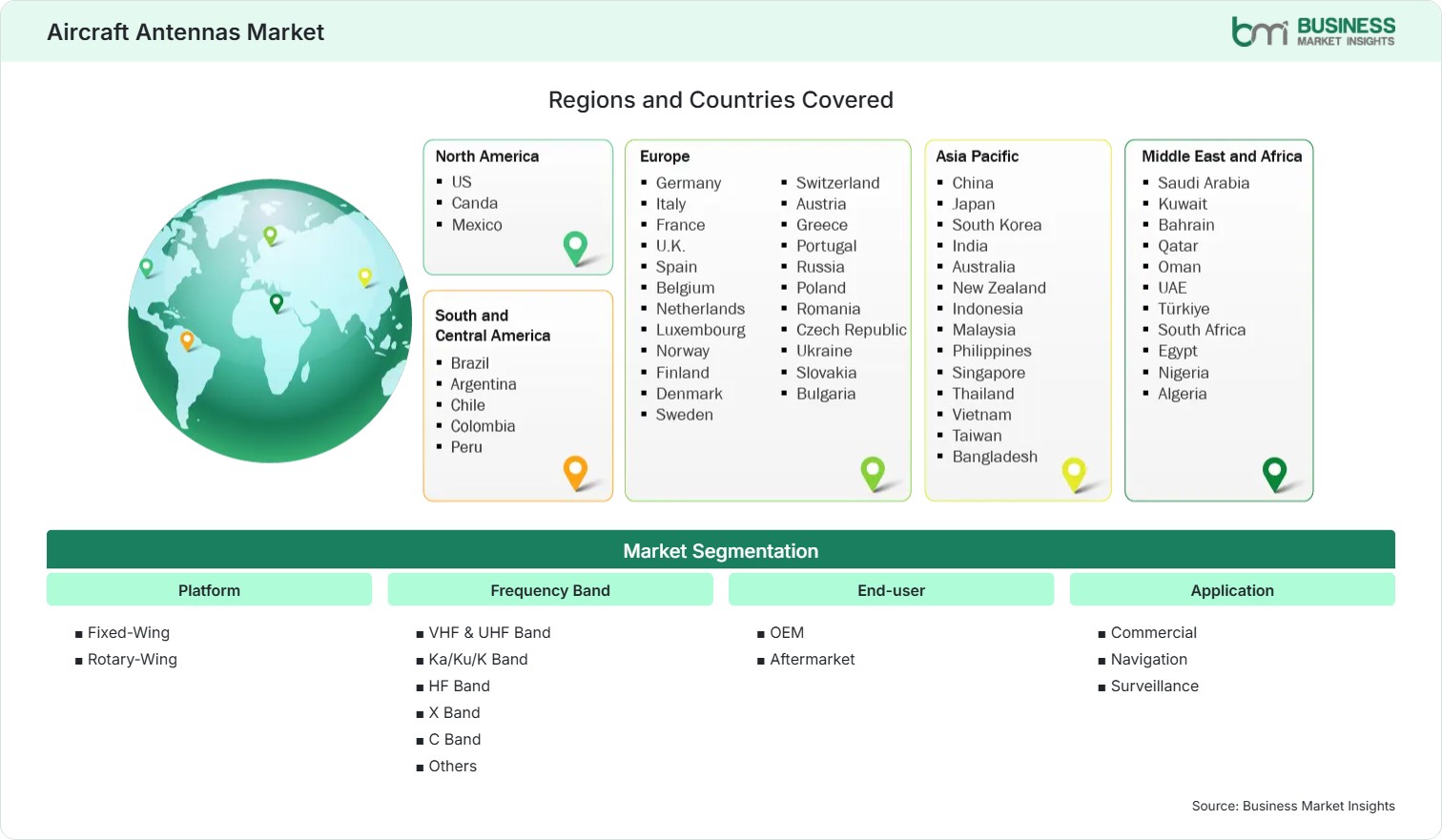
  • Platform: Fixed-Wing, Rotary-Wing
  • Frequency Band: VHF & UHF Band, Ka/Ku/K Band, HF Band, X Band, C Band, Others
  • End-user: OEM, Aftermarket
  • Application: Commercial, Navigation, Surveillance
US$ 509.22 Mn Market size in 2025
US$ 889.44 Mn Market Size by 2033
7.22% CAGR, 2026 - 2033
2026-2033 Forecast Period

AI Overview

Aircraft Antennas Market Summary

  • North America Region: North America holds 36%–39% market share in 2025, growing at a 6.8%–7.3% CAGR during 2026–2033. Fleet modernization, strong aerospace manufacturing, military procurement, and satellite communication investments continue supporting demand for advanced airborne antenna technologies. The U.S. market benefits from sustained commercial aircraft production, defense modernization programs, and expanding in-flight connectivity adoption, advancing at approximately 6.9%–7.4% CAGR.
  • Fastest Growing Region: Asia Pacific accounts for 26%–29% market share in 2025 and is projected to expand at a 8.3%–8.8% CAGR. Expanding airline fleets, domestic aircraft manufacturing, airport infrastructure investments, and increasing defense spending accelerate adoption of advanced communication and navigation antenna solutions.
  • Leading Segment: Fixed-Wing Platform represents 70%–73% market share in 2025 while growing at 6.9%–7.4% CAGR. High commercial aircraft production, defense fleet upgrades, and increasing demand for connected aviation continue driving installation of multifunction aircraft antenna systems worldwide.
  • High Growth Segment: OEM End-user accounts for 60%–63% market share in 2025 and is expected to record 7.8%–8.3% CAGR. Rising aircraft manufacturing, integration of satellite communication systems, and factory-installed digital avionics support sustained original equipment demand.
  • Key Market Opportunity: Increasing deployment of electronically steered antennas, low-Earth-orbit satellite connectivity, next-generation avionics, and unmanned aircraft platforms creates new revenue opportunities for manufacturers serving commercial, military, and advanced air mobility applications globally.
  • Major Market Players: Antcom Corporation, Smiths Interconnect Group Limited, The Boeing Company, Cobham Limited, Honeywell International Inc., L3Harris Technologies, Inc., Maxtena Inc., Harxon Corporation, Chelton Limited, Sensor Systems Inc.
Strategic Insights

Aircraft Antennas Market: Strategic Insights

Aircraft Antennas Market Strategic Framework
FREE PDF
Request your free sample
Request free sample
Stakeholder View

Key Takeaways

  • The industry is evolving toward highly integrated aerospace communication ecosystems where antenna suppliers increasingly collaborate with avionics manufacturers, satellite operators, aircraft OEMs, and software developers to deliver fully connected airborne platforms.
  • The strongest commercial opportunities are emerging within factory-installed communication systems, military modernization programs, and rapidly expanding unmanned aerial vehicle deployments requiring compact, high-performance antenna solutions.
  • Innovation increasingly focuses on electronically steered antennas, conformal antenna designs, lightweight composite materials, and multi-frequency communication technologies supporting next-generation connected aircraft operations.
  • Asia-Pacific presents one of the strongest long-term investment destinations as airline fleet expansion, indigenous aircraft production, airport modernization, and defense procurement continue accelerating aerospace equipment demand.
  • Strategic acquisitions, collaborative technology partnerships, and long-term supplier agreements between aerospace manufacturers and communication technology providers are strengthening competitive positioning while accelerating commercialization of advanced airborne connectivity solutions.
  • Growing adoption of satellite-enabled cockpit communications, predictive maintenance platforms, and real-time flight data transmission is creating additional value opportunities across commercial, business aviation, and defense sectors.
Geographic Outlook

Aircraft Antennas Market Regional Highlights

North America Aircraft Antennas Market

North America maintains industry leadership with approximately 36%–39% Aircraft Antennas Market share in 2025 and is projected to expand at a 6.8%–7.3% CAGR during 2026–2033. Strong aerospace manufacturing capabilities, continuous defense procurement, expanding satellite communication programs, and robust commercial aircraft production sustain regional competitiveness. The presence of leading avionics suppliers and aircraft manufacturers further supports technology commercialization and export opportunities.

  • Commercial aircraft production remains concentrated across major manufacturing facilities, supporting continuous demand for factory-installed communication, navigation, and surveillance antenna solutions.
  • Defense modernization initiatives continue driving procurement of advanced airborne communication systems supporting secure military operations, electronic warfare, intelligence missions, and next-generation tactical aircraft.
  • Satellite communication adoption is expanding rapidly as airlines invest in enhanced passenger connectivity, operational efficiency, predictive maintenance, and real-time flight monitoring capabilities.
  • Continuous investments in aerospace research and certification strengthen innovation across electronically steered antennas, lightweight materials, and integrated multi-band communication technologies.

US Aircraft Antennas Market

The United States represents the dominant contributor within North America, accounting for approximately 78%–82% of regional demand while advancing at 6.9%–7.4% CAGR. Large-scale aircraft manufacturing, advanced defense programs, NASA research initiatives, and strong aerospace supplier networks continue supporting technology innovation and export competitiveness across commercial and military aviation applications.

  • Major aerospace manufacturers increasingly integrate satellite-enabled communication systems into new commercial aircraft platforms, supporting higher production volumes and technological advancement.
  • Rising defense investments strengthen procurement of secure communication antennas for fighter aircraft, surveillance platforms, transport aircraft, and unmanned aerial systems.
  • Continuous FAA modernization initiatives encourage adoption of advanced navigation, surveillance, and communication technologies improving operational safety and airspace efficiency.

Europe Aircraft Antennas Market

Europe accounts for 27%–30% Aircraft Antennas Market share in 2025 while expanding at a 6.7%–7.2% CAGR through 2033. Strong aerospace engineering capabilities, collaborative defense programs, and growing investments in satellite communication technologies support steady demand. France and Germany remain leading contributors, while Poland records one of the fastest growth rates driven by defense modernization and aerospace manufacturing expansion.

  • Airbus production programs continue supporting demand for advanced communication and navigation antenna technologies throughout commercial aviation supply chains.
  • European defense collaboration strengthens procurement of secure airborne communication systems across multiple military modernization initiatives.
  • Investments in sustainable aviation and digital air traffic management encourage development of lightweight, high-efficiency antenna platforms.
  • Expanding satellite connectivity services improve passenger experience while supporting operational efficiency for regional airline operators.

Asia Pacific Aircraft Antennas Market

Asia Pacific Aircraft Antennas Market trends represent 26%–29% of global demand and is projected to register the fastest regional CAGR of 8.3%–8.8% during the forecast period. China leads regional manufacturing capacity, while India demonstrates one of the strongest expansion rates through increasing defense procurement, domestic aircraft production, and rapidly expanding commercial airline fleets.

  • Fleet expansion by regional airlines significantly increases installation of advanced airborne communication and navigation systems.
  • Indigenous aerospace manufacturing initiatives accelerate demand for locally integrated antenna technologies supporting commercial and defense aircraft.
  • Airport modernization and digital aviation infrastructure investments strengthen adoption of connected aircraft technologies.
  • Growing UAV deployment across commercial and defense sectors creates new opportunities for compact multi-band antenna manufacturers.

Rest of World Aircraft Antennas Market

Rest of World contributes 8%–10% of total market demand and is anticipated to grow at 7.4%–7.9% CAGR through 2033. The Middle East benefits from airline fleet expansion and aviation infrastructure investments, while Brazil leads South & Central America through its established aerospace manufacturing ecosystem. Defense modernization across Gulf countries further supports advanced airborne communication technology adoption.

  • Middle Eastern airlines continue investing heavily in premium in-flight connectivity and next-generation fleet expansion programs.
  • Brazil's aerospace manufacturing industry supports increasing regional integration of communication and navigation antenna technologies.
  • Defense procurement programs across Gulf countries encourage adoption of secure airborne communication systems.
  • Expanding maintenance, repair, and overhaul facilities generate additional aftermarket opportunities for antenna manufacturers.
Global Market Geography
FREE PDF
Request your free sample
Request free sample
Segment Analysis

Aircraft Antennas Market Segmentation

Platform

The Platform segment accounted for approximately 70%–73% of the market in 2025 and is expected to grow at a 7.1%–7.6% CAGR through 2033. Fleet expansion, increasing military procurement, and wider adoption of connected aircraft continue supporting demand across fixed-wing and rotary-wing platforms. The Aircraft Antennas Market scope continues expanding as next-generation aircraft integrate multiple communication, navigation, and surveillance antennas into unified avionics architectures.

  • Fixed-Wing: Dominates demand owing to large commercial aircraft production, defense fleet modernization, expanding business aviation, and continuous investments in satellite-enabled communication technologies.
  • Rotary-Wing: Demand benefits from emergency response operations, military modernization, offshore transportation, and growing unmanned helicopter deployments.

Frequency Band

The Frequency Band segment represents a critical technology category, holding approximately 30%–33% share for VHF & UHF systems in 2025 while the overall segment advances at 7.2%–7.7% CAGR. Growing satellite communication adoption, digital cockpit technologies, and modern air traffic management systems continue influencing Aircraft Antennas Market trends across multiple aviation platforms.

  • VHF & UHF Band: Widely deployed for aircraft communication, air traffic management, and navigation because of proven operational reliability and global compatibility.
  • Ka/Ku/K Band: Fastest-growing category supported by expanding in-flight connectivity, broadband satellite communication, and high-speed airborne data transmission.
  • HF Band: Maintains importance for long-distance communication across transoceanic and remote flight operations requiring dependable coverage.
  • X Band: Primarily adopted across military aircraft supporting radar, tactical communications, and secure defense applications.
  • C Band: Increasingly utilized within aviation surveillance and specialized communication systems requiring dependable frequency performance.

End-user

The End-user segment is led by OEMs with approximately 60%–63% market share in 2025 and an expected 7.8%–8.3% CAGR through 2033. Aircraft production growth, factory integration of advanced avionics, and increasing adoption of satellite communication systems continue strengthening original equipment installations, while aftermarket demand benefits from retrofit programs and fleet modernization.

  • OEM: Aircraft manufacturers increasingly integrate communication, navigation, and surveillance antennas during production to reduce lifecycle costs while improving aircraft performance and certification efficiency.
  • Aftermarket: Retrofit projects, maintenance cycles, avionics upgrades, and fleet modernization initiatives generate stable replacement demand for certified antenna systems.

Application

The Application segment is expected to maintain balanced demand, with Commercial applications accounting for approximately 54%–57% share during 2025 and expanding at a 7.0%–7.5% CAGR. Increasing passenger connectivity expectations, digital flight operations, and advanced navigation technologies continue driving sustained adoption across aviation sectors.

  • Commercial: Airlines increasingly deploy advanced communication antennas supporting broadband connectivity, operational efficiency, predictive maintenance, and improved passenger experience.
  • Navigation & Surveillance: Airspace modernization, enhanced situational awareness, and regulatory requirements encourage deployment of high-performance navigation and surveillance antenna systems.
Market Forces

Aircraft Antennas Market Dynamics

Key Market Drivers

Growing adoption of satellite-enabled aviation connectivity

Commercial airlines are rapidly expanding broadband connectivity services as passenger expectations shift toward uninterrupted in-flight internet access and digital entertainment. According to IATA, global passenger traffic is showing improvement and recovery above the pre-pandemic levels. This has encouraged the airlines to enhance their communication technology on board. On the other hand, there has been an increased adoption of secure satellite communication systems by the military in order to perform intelligence, surveillance, and tactical operations. As a result, there is a growing demand for multi-band, low weight, and electronically steered antennas that ensure reliable communication at high speed.

Rising commercial aircraft production and fleet modernization

The aircraft manufacturers continue ramping up production due to the large backlog of orders that the airlines around the world have placed on them. The fleet modernization plans favor fuel efficient planes which have integrated communication, navigation, and surveillance capabilities. At the same time, the old planes are being fitted with avionics in order to meet the latest demands of air traffic control. The defense authorities are replacing their older fleets with new planes which require a secure communications architecture.

Expansion of unmanned and connected aviation platforms

The deployment of unmanned aerial vehicles in areas of defense, logistics, agriculture, emergency services, and infrastructure monitoring is leading to an increase in the need for compact airborne communications equipment. UAVs need small-sized antennas that will help in providing functionalities like real-time control, telemetry, satellite communications, and surveillance. Additionally, modern air mobility programs are including digitally connected avionics starting from the design phase. This provides new opportunities for the producers of airborne antennas.

Key Market Opportunities

Electronically steered antenna adoption across aviation

Electronically steered antennas provide many advantages over mechanical systems in terms of greater accuracy for satellite tracking, reduced drag, and multi-frequency band capabilities. Commercial airlines are increasingly considering their adoption in order to enhance customer connectivity and communications. There is also benefit for defense aviation in terms of increased reliability and security in communications. Further advancements in phased array technology, semiconductor technology, and lightweight composite materials will lead to better commercial viability. Aircraft Antennas Market Forecasts indicate growing demand as production costs gradually decline and aircraft manufacturers adopt next-generation connectivity architectures.

Expansion of indigenous aerospace manufacturing programs

Many nations around the Asia Pacific and Middle East regions are making large investments in their own domestic capabilities to manufacture aerospace components. The government is using its incentives, technology transfer programs, and strategic relationships with international aerospace companies to develop supply chains within their own nations. All these efforts are providing more chances for antenna manufacturers interested in entering into OEM supply agreements.

Growth of aftermarket avionics modernization

Many aircraft worldwide continue flying for decades, thus generating a continuous need for improvements in communication facilities. Airlines and military organizations have been increasingly investing in modernizing existing aircraft with communication services through satellite, enhanced navigation systems, and improved surveillance systems. Thus, MRO service providers, integration experts, and approved parts manufacturers will continuously generate aftermarket revenues due to the repetitive replacement process.

Market Restraints and Challenges

Complex aerospace certification requirements

Factor: Aviation authorities impose rigorous certification, environmental testing, electromagnetic compatibility validation, and airworthiness approval before airborne antennas can enter commercial service. Impact: These lengthy qualification procedures increase development costs, delay commercialization timelines, and create higher entry barriers for emerging manufacturers. Companies must invest significantly in engineering validation, regulatory documentation, testing infrastructure, and quality management systems before achieving large-scale market access, extending product development cycles and reducing short-term profitability.

Supply chain disruptions for advanced aerospace components

Factor: High-performance airborne antennas depend on specialized electronic components, advanced composite materials, precision machining, and certified manufacturing suppliers. Impact: Semiconductor shortages, geopolitical trade restrictions, and logistics disruptions increase procurement costs while extending production lead times. Manufacturers may experience delayed deliveries, fluctuating margins, and reduced operational flexibility, particularly when supporting time-sensitive commercial aircraft production schedules and defense procurement programs.

Company Analysis

Competitive Landscape

The competitive environment remains moderately consolidated, with established aerospace suppliers competing through product innovation, satellite communication integration, certification expertise, and long-term OEM partnerships. Aircraft Antennas Market analysis indicates that manufacturers are expanding investments in lightweight antenna technologies, electronically steered arrays, multi-band communication systems, and defense-specific solutions to strengthen competitive positioning.

Company Name

Overview

Products and Services Relevant to this Market

Antcom Corporation

Specializes in advanced antenna technologies serving aerospace, defense, and unmanned systems with high-performance communication products.

GPS/GNSS antennas, SATCOM antennas, airborne communication antennas, navigation antennas, and custom aerospace antenna solutions.

Smiths Interconnect Group Limited

Global provider of connectivity technologies supporting aerospace, defense, security, and industrial applications through advanced RF engineering.

High-frequency antennas, RF components, microwave assemblies, aerospace connectivity solutions, and communication systems.

The Boeing Company

Leading global aircraft manufacturer integrating advanced communication and navigation technologies across commercial and military aircraft.

Integrated aircraft antenna systems, communication infrastructure, surveillance technologies, and connected aircraft solutions.

Cobham Limited

Recognized aerospace supplier delivering communication, navigation, and satellite connectivity technologies for civil and defense aviation.

Aviation antennas, SATCOM terminals, communication systems, navigation equipment, and surveillance solutions.

Honeywell International Inc.

Major avionics supplier delivering integrated aerospace systems focused on connected aircraft, navigation, and operational efficiency.

Aircraft communication systems, GPS antennas, avionics, navigation equipment, and satellite connectivity technologies.

L3Harris Technologies, Inc.

Defense and aerospace technology company providing secure airborne communication and electronic systems worldwide.

Tactical communication antennas, surveillance systems, military avionics, airborne networking, and SATCOM technologies.

Maxtena Inc.

Develops compact, high-performance antenna technologies for aerospace, satellite communication, and defense applications.

GPS antennas, GNSS antennas, phased-array solutions, SATCOM antennas, and custom airborne antenna products.

Harxon Corporation

Manufacturer of precision GNSS and positioning technologies supporting aviation, surveying, and industrial navigation applications.

GNSS antennas, aviation positioning solutions, navigation antennas, and communication antenna technologies.

Chelton Limited

Aerospace communications specialist supplying antenna systems for commercial aviation, military platforms, and UAV applications.

Airborne communication antennas, navigation antennas, military antenna systems, and electronic aviation equipment.

Sensor Systems Inc.

Designs rugged airborne antenna products supporting commercial aircraft, military aviation, helicopters, and unmanned platforms.

VHF/UHF antennas, GPS antennas, SATCOM products, surveillance antennas, and custom aviation antenna systems.

Trust & Transparency

Research Methodology

The market analysis combines proprietary research with secondary data from government agencies, company disclosures, regulatory filings, industry databases and expert interviews. Market estimates are validated through data triangulation, cross-market benchmarking and analyst review.

View Full Research Methodology

Questions Answered

Frequently Asked Questions

What technologies are expected to shape future industry development?

Electronically steered antennas, phased-array communication systems, low-Earth-orbit satellite connectivity, lightweight composite materials, AI-enabled avionics, and integrated multi-band communication technologies are expected to define future market evolution.

How does the Aircraft Antennas Market Report support business strategy?

The report helps stakeholders evaluate competitive positioning, technology trends, regional opportunities, investment priorities, supply chain developments, and future demand across commercial, defense, and unmanned aviation sectors.

Which platform generates the highest revenue?

Fixed-wing aircraft represent the largest revenue-generating platform because of high commercial aircraft deliveries, military procurement programs, business aviation expansion, and continuous fleet modernization worldwide.

Which region leads the global Aircraft Antennas Market?

North America remains the leading regional market due to its strong aerospace manufacturing ecosystem, extensive defense investments, presence of major aircraft OEMs, and continuous adoption of advanced communication technologies.

What factors are driving demand for aircraft antennas?

Demand is primarily driven by increasing commercial aircraft production, defense modernization, satellite-based communication adoption, in-flight connectivity, and continuous advancements in digital avionics requiring high-performance communication and navigation systems.

Access the Full Aircraft Antennas Market Report

Get segment-level forecasts, regional estimates, competitive benchmarking, company profiles and downloadable Excel datasets.

Access the full Aircraft Antennas Market Report
350 pages PDF & Excel | 2026-08-18