Market Summary
Executive Summary and Global Market Analysis
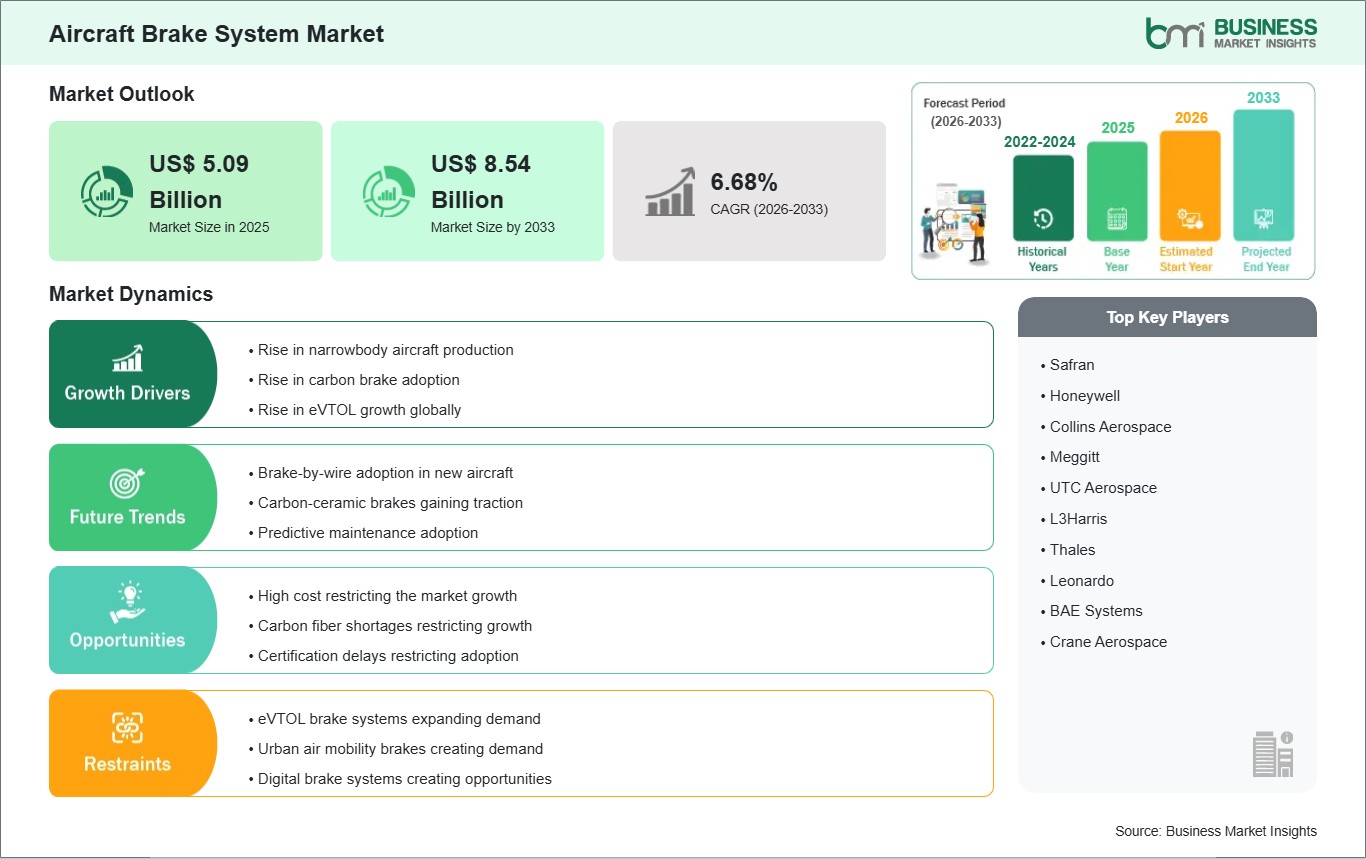
Aircraft brake systems are critical safety components used to control aircraft speed during landing, taxiing, and parking operations. These systems include carbon, steel, and carbon-ceramic brake technologies combined with hydraulic, electro-hydraulic, or electric actuation systems. Aircraft brake systems are widely used across commercial aviation, military aircraft, and unmanned aerial vehicle platforms to ensure operational safety and efficient braking performance. Aircraft Brake Systems have been witnessing steady growth owing to the rising demand for aircraft deliveries, increasing air travel, and the upgradation of aircraft used in both civil and defense applications. Aircraft manufacturers have also become concerned with producing light and sturdy brake systems to increase fuel efficiency and minimize maintenance costs.
There are several factors that may limit market growth. Advanced braking systems, particularly carbon and electric brake technologies, involve high manufacturing and maintenance costs. Aircraft brake systems also operate under strict aviation safety regulations and certification standards, which increase development complexity and approval timelines. In addition, fluctuations in raw material prices and supply chain disruptions may affect production activities and component availability. Older aircraft fleets often require costly retrofitting and maintenance procedures, which can create financial challenges for operators and maintenance providers.
Despite these challenges, the Aircraft Brake System market is expected to expand due to ongoing technological advancements and increasing demand for efficient aircraft systems. The growing adoption of electric braking systems and lightweight carbon brake technologies is creating new growth opportunities across commercial and military aviation. Aircraft manufacturers are increasingly focusing on reducing aircraft weight and improving operational efficiency through advanced braking solutions. Rising investments in UAVs and next-generation aircraft platforms are also supporting long-term demand for compact, durable, and high-performance brake systems across global aerospace applications.
Segment Analysis
Aircraft Brake System Market Segmentation
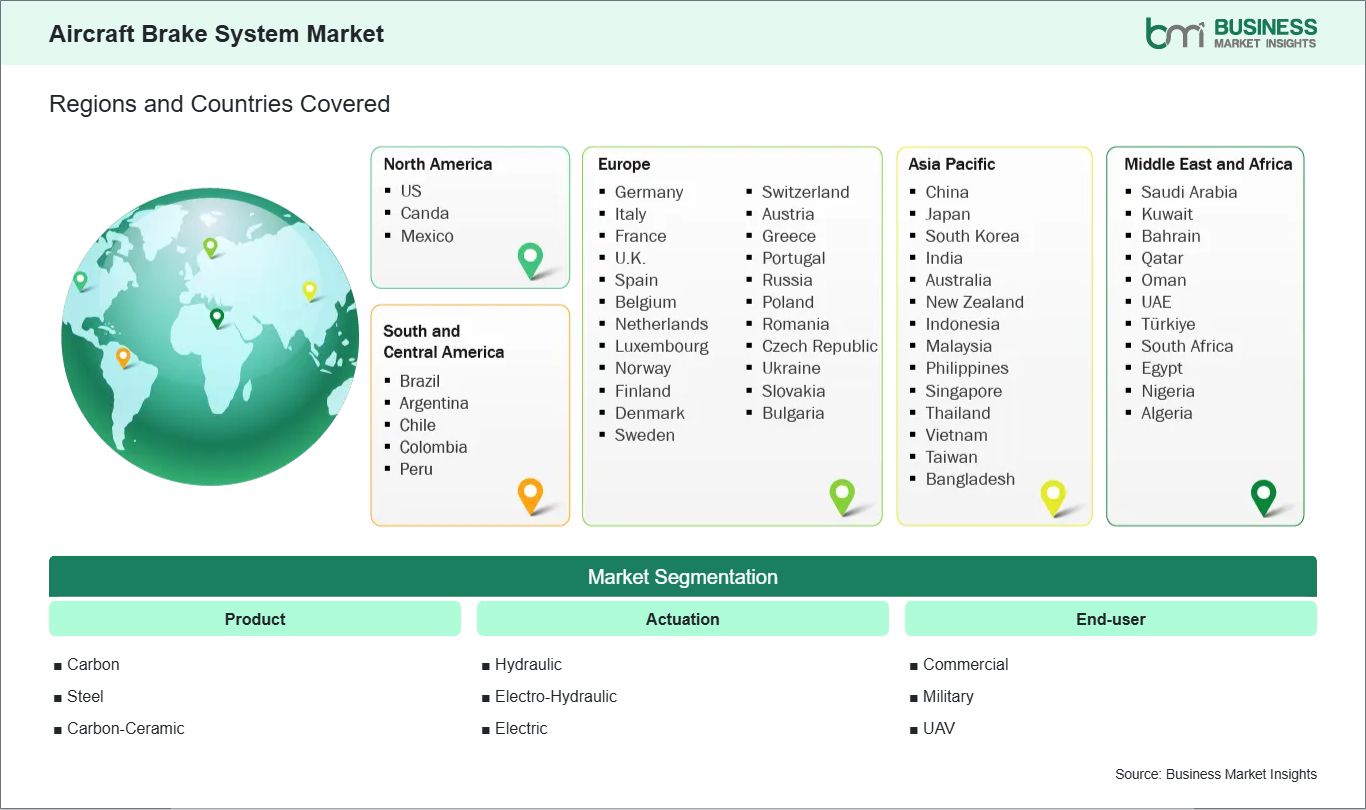
The Aircraft Brake System market is segmented based on product, actuation, and end-user. Each segment plays an important role in supporting aircraft safety, operational efficiency, and braking performance across different aviation applications.
By Product
- Carbon: Widely adopted due to lightweight properties, high heat resistance, and longer operational life in commercial and military aircraft.
- Steel: Used in aircraft requiring cost-effective and durable braking solutions with reliable operational performance.
- Carbon-Ceramic: Gaining adoption for advanced aircraft systems due to enhanced thermal stability and reduced maintenance requirements.
By Actuation
- Hydraulic: Commonly used in conventional aircraft braking systems because of reliable force transmission and operational efficiency.
- Electro-Hydraulic: Combines hydraulic performance with electronic control for improved braking precision and system monitoring.
- Electric: Increasingly adopted in modern aircraft due to reduced weight, simplified maintenance, and better energy efficiency.
By End-User
- Commercial: Dominates the market owing to rising aircraft deliveries and growing airline fleet expansion activities.
- Military: Generates strong demand for high-performance and durable braking systems in defense aircraft operations.
- UAV: Witnessing increasing adoption of lightweight and compact brake systems for advanced unmanned aerial applications.
Market Forces
Aircraft Brake System Market Drivers and Opportunities
Aircraft Fleet Expansion Supporting Brake System Demand
The increasing expansion of global aircraft fleets is driving demand for advanced aircraft brake systems across commercial and military aviation sectors. Rising air passenger traffic and growing investments in airport infrastructure are encouraging airlines to procure new aircraft equipped with efficient braking technologies. Operators in the commercial airline industry have an increasing need to minimize downtime and improve the efficiency of their operations. The defense sector is also investing in its aircraft fleet upgrades to improve its mission effectiveness and safety, which contributes positively to market development.
Development in aircraft design and technology has been responsible for incorporating more efficient brake systems that can accommodate higher loads when landing the plane. Regulators maintain stringent safety requirements for aircraft, which in turn drive manufactures to produce more efficient and durable braking systems. In addition, the increasing production of unmanned aerial vehicles and advanced aircraft platforms is expanding the need for compact and lightweight braking technologies across aerospace applications.
Electric Braking Technologies Creating Future Growth Potential
The growing adoption of electric aircraft systems is creating new opportunities for the Aircraft Brake System market. Aircraft manufacturers and airlines are increasingly focusing on electric braking technologies that reduce aircraft weight, simplify maintenance procedures, and improve fuel efficiency. Electric brake systems eliminate several hydraulic components, helping reduce overall aircraft complexity and operational costs. These systems also provide better braking control, real-time monitoring capabilities, and improved integration with digital aircraft management systems.
Hybrid electric aircraft platforms, along with the emergence of new generations of aircraft, will also promote the demand for more modern electric brake systems. In addition to that, there is growth in research on eco-friendly planes, which encourages innovation in weight-saving materials and advanced braking solutions. There are also possibilities of using these systems for UAVs and a new generation of air mobility platforms. Continuous advancements in sensor integration, predictive maintenance, and automated braking technologies are expected to support long-term market growth across commercial and defense aviation sectors.
Size and Share Analysis
Aircraft Brake System Market Size and Share Analysis
The Aircraft Brake System Market is projected to grow from US$ 5.09 Billion in 2025 to US$ 8.54 Billion by 2033 , registering a CAGR of 6.68% from 2026 to 2033.
By product, carbon brake systems account for a significant share due to their lightweight structure, durability, and high heat resistance. Steel brake systems continue to maintain demand in cost-sensitive aircraft applications, while carbon-ceramic brakes are gaining importance because of their improved thermal performance and reduced maintenance requirements.
By actuation, hydraulic systems dominate the market owing to their widespread use in conventional aircraft braking operations. Electro-hydraulic systems are witnessing steady adoption due to improved braking precision and operational control, while electric brake systems are growing with increasing focus on lightweight aircraft technologies and fuel efficiency improvements.
Report Coverage
Aircraft Brake System Market Report Coverage and Deliverables
The "Aircraft Brake System Size and Forecast (2022-2033)" report provides a detailed analysis of the market covering below areas:
- Market size and forecast at global, regional, and country levels for all the key market segments covered under the scope
- Market trends, as well as market dynamics such as drivers, restraints, and key opportunities
- Market analysis covering key market trends, global and regional framework, major players, regulations, and recent market developments
- Industry landscape and competition analysis covering market concentration, heat map analysis, prominent players, and recent developments for the market
- Detailed company profiles, including SWOT analysis
Geographic Insights
Aircraft Brake System Market Geographic Insights
The Aircraft Brake System Market shows diverse regional adoption patterns influenced by aircraft production activities, fleet modernization programs, and increasing investments in aviation safety technologies.
North America, being a developed region, has a strong aerospace manufacturing industry and a high adoption rate of advanced aircraft brake technologies. The region comprises the United States and Canada, where investments are focused on commercial aircraft expansion, military aircraft modernization, and advanced aviation safety systems. The region emphasizes the adoption of lighter carbon-based brake systems, along with electric brake technology, to ensure operational effectiveness and reduce the costs of maintenance. This is made possible by strong aviation infrastructure, experience in the manufacture of aircraft, and regulatory measures that facilitate the use of advanced brake systems in all kinds of aircraft.
Asia Pacific is growing significantly, driven by rising air passenger traffic, expanding airline fleets, and increasing defense aviation investments. The region comprises countries such as China, India, Japan, and South Korea, where governments and aerospace companies are strengthening domestic aircraft production and aviation infrastructure. The region focuses on improving aircraft operational safety, enhancing maintenance capabilities, and supporting next-generation aerospace technologies. Increasing procurement of military aircraft and growing adoption of UAV platforms are also contributing to the growth of the Aircraft Brake System Market across commercial and defense sectors.
Both regions are contributing significantly to the growth of the Aircraft Brake System Market, focusing on aviation modernization, aircraft safety improvements, and increasing adoption of advanced braking technologies.
Industry Activity
Recent Developments
The Aircraft Brake System Market is analyzed using a mix of primary and secondary research sources, including corporate publications, industry associations, and verified databases. This approach ensures accurate tracking of innovation trends and strategic developments influencing the market.
- In July 2024, Safran Landing Systems announced the expansion of its carbon brake production capabilities to support increasing demand from commercial aircraft manufacturers and airline operators. The development focused on improving manufacturing efficiency and supporting next-generation aircraft braking technologies. The expansion also aimed to strengthen the company's global aerospace supply chain operations.
- In February 2023, Collins Aerospace introduced enhanced electric brake system technologies designed for commercial and military aircraft platforms. The updated systems focused on reducing aircraft weight, improving braking efficiency, and enabling predictive maintenance capabilities through advanced digital monitoring solutions. The development supported broader industry efforts toward aircraft electrification and operational efficiency.
Trust & Transparency
Research Methodology
The market analysis combines proprietary research with secondary data from government agencies, company disclosures, regulatory filings, industry databases and expert interviews. Market estimates are validated through data triangulation, cross-market benchmarking and analyst
review.
View Full Research Methodology
Key Sources Referred:
World Bank - Global Trade Indicators World Trade Organization (WTO) International Monetary Fund (IMF) International Trade Administration (ITA) Company Websites Company Annual Reports Company Investor Presentations