
Military Trainer Aircraft Market Outlook: Size, Share, Trends, Growth Analysis, Competitive Landscape & Forecast, 2026-2033

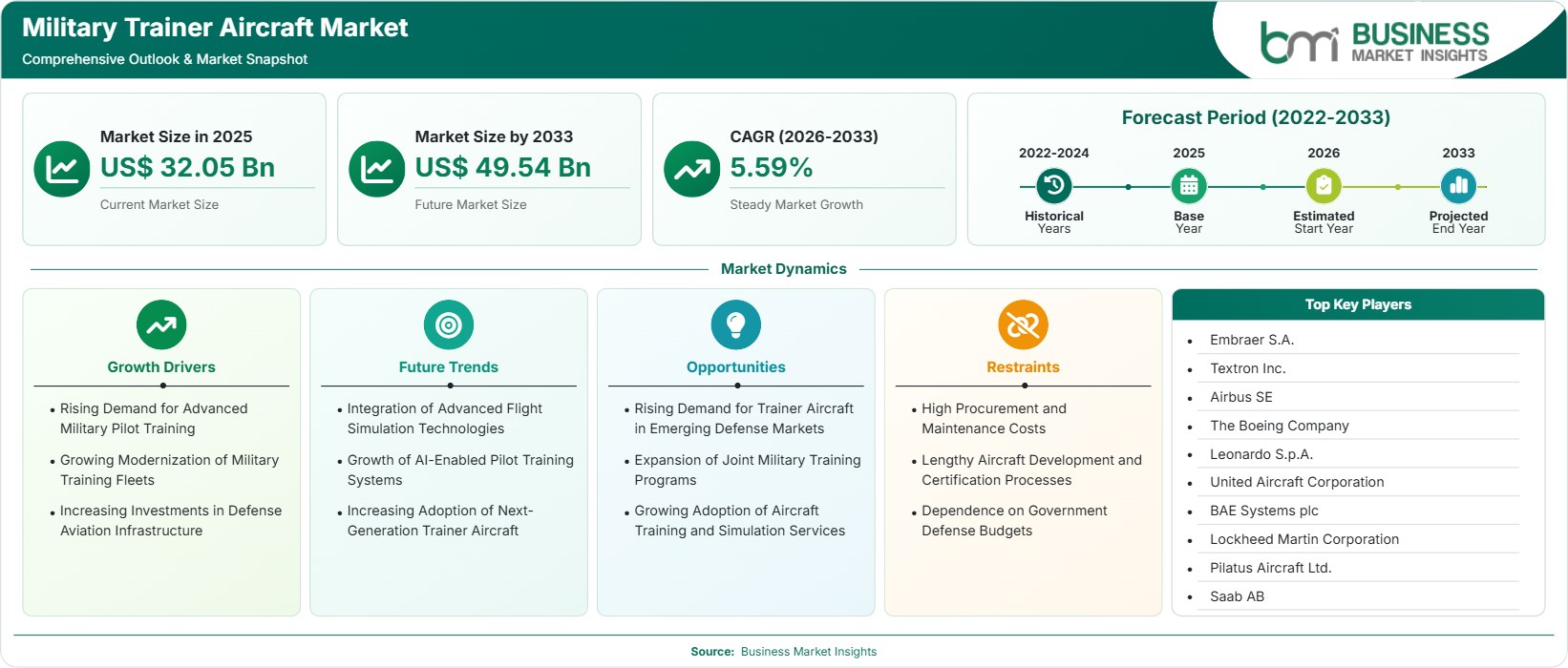
The Military Trainer Aircraft Market size was valued at US$ 32.05 Billion in 2025 and is projected to reach US$ 49.54 Billion by 2033, growing at a CAGR of 5.59% during 2026–2033. Rising defense modernization programs, increasing pilot training requirements, adoption of advanced simulation technologies, expansion of fighter aircraft fleets, and investments in integrated training ecosystems are creating strong opportunities across military aviation training infrastructure worldwide.

Report Coverage
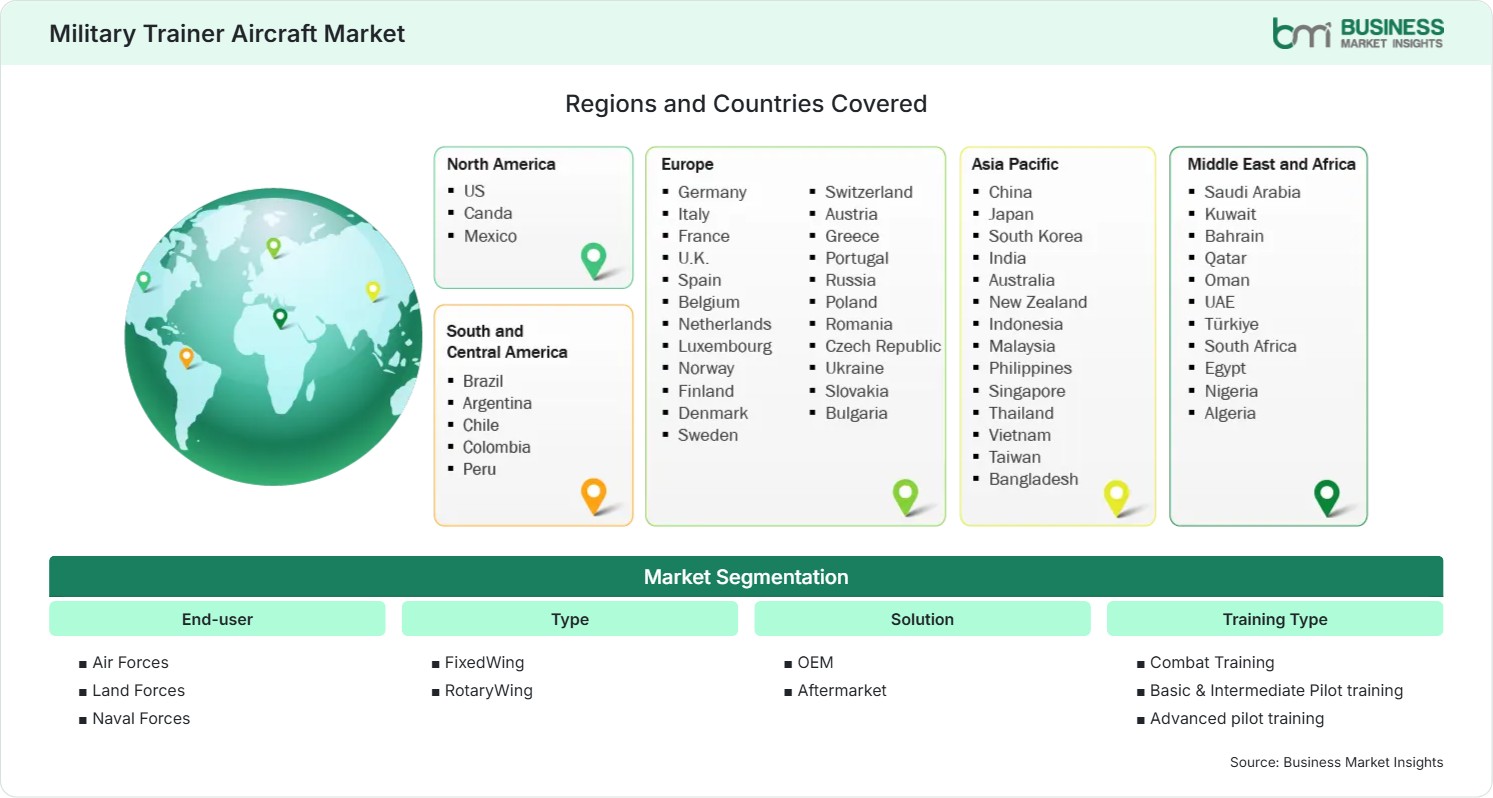
  • End-user: Air Forces, Land Forces, Naval Forces
  • Type: FixedWing, RotaryWing
  • Solution: OEM, Aftermarket
  • Training Type: Combat Training, Basic & Intermediate Pilot training, Advanced pilot training
US$ 32.05 Bn Market size in 2025
US$ 49.54 Bn Market Size by 2033
5.59% CAGR, 2026 - 2033
2026-2033 Forecast Period

01 AI Overview

Military Trainer Aircraft Market Summary

  • North America Region: North America holds a military trainer aircraft market share of 34%–38% in 2025 and is projected to grow at a CAGR of 4.8%–5.2% during 2026–2033. Growth is supported by fighter fleet modernization, pilot pipeline expansion, simulator integration, readiness enhancement programs, advanced training technologies, increasing instructor efficiency, defense budget allocations, interoperability initiatives, modernization priorities, and long-term military aviation investments. The U.S. remains the dominant market due to large-scale pilot production requirements and trainer modernization programs, advancing at a CAGR of 4.9%–5.3%.
  • Fastest Growing Region: Asia Pacific accounts for 24%–28% share in 2025 and is expected to register a CAGR of 6.7%–7.3% through 2033. Growth is fueled by indigenous aerospace development, rising military expenditure, training infrastructure expansion, regional security priorities, combat aircraft acquisitions, pilot capacity enhancement, technology transfers, simulator investments, fleet modernization initiatives, and increasing operational readiness requirements.
  • Leading Segment: Fixed-Wing represents 68%–72% share in 2025 and is anticipated to grow at a CAGR of 5.3%–5.8% through 2033. Demand is supported by advanced jet trainer procurement, fighter transition requirements, operational readiness goals, modern avionics integration, mission rehearsal capabilities, training standardization initiatives, cost efficiency benefits, instructor productivity improvements, and multi-stage pilot development programs.
  • High Growth Segment: Advanced Pilot Training captures 28%–32% share in 2025 and is forecast to expand at a CAGR of 6.4%–7.0% during 2026–2033. Expansion is driven by fifth-generation fighter preparation, realistic mission simulation, digital training platforms, operational complexity increases, avionics proficiency requirements, instructor modernization efforts, pilot competency development, data-based performance assessment, and combat readiness priorities.
  • Key Market Opportunity: Defense organizations are accelerating investments in integrated training environments combining aircraft, simulators, analytics software, mission planning tools, and support services to improve readiness, optimize training efficiency, reduce costs, and enhance pilot qualification outcomes.
  • Major Market Players: Embraer S.A., Textron Inc., Airbus SE, The Boeing Company, Leonardo S.p.A., United Aircraft Corporation, BAE Systems plc, Lockheed Martin Corporation, Pilatus Aircraft Ltd., and Saab AB.
02 Strategic Insights

Military Trainer Aircraft Market: Strategic Insights

Military Trainer Aircraft Market Strategic Framework
FREE PDF
Request your free sample
Request free sample
03 Stakeholder View

Key Takeaways

  • The military aviation training value chain is evolving beyond aircraft procurement, with increasing emphasis on integrated ecosystems that combine simulators, training software, maintenance services, mission planning tools, and instructor support capabilities.
  • Advanced pilot training continues to represent the strongest military trainer aircraft market growth avenue due to increasing deployment of fifth-generation combat aircraft requiring higher training intensity, sophisticated mission rehearsal, and greater avionics familiarity.
  • Aircraft manufacturers are investing in embedded simulation, synthetic training environments, artificial intelligence-enabled performance assessment, and digital mission analytics to enhance pilot readiness and training efficiency.
  • Asia Pacific presents one of the most attractive regional investment opportunities owing to defense modernization programs, indigenous aerospace initiatives, expanding combat aircraft fleets, and increasing pilot capacity requirements.
  • Defense agencies are increasingly adopting long-term procurement models involving industrial participation, local manufacturing, technology transfer, and lifecycle support arrangements, creating new partnership opportunities for industry participants.
  • Lifecycle affordability and readiness outcomes are becoming key procurement criteria, encouraging adoption of trainer aircraft that deliver high operational availability, lower maintenance complexity, and improved training productivity.
04 Geographic Outlook

Military Trainer Aircraft Market Regional Highlights

North America Military Trainer Aircraft Market

North America accounted for 34%–38% of global market revenue in 2025 and is forecast to register a CAGR of 4.8%–5.2% during 2026–2033. The region benefits from extensive military aviation infrastructure, strong defense budgets, and continuous investments in pilot readiness. The Military Trainer Aircraft Market share remains highest in North America due to large-scale pilot production pipelines, modernization of aging trainer fleets, and growing adoption of simulation-enabled training environments. Demand is further supported by long-term procurement planning and integration of advanced training technologies.

  • The United States continues investing in military pilot production programs to address force readiness requirements and future aviation workforce challenges.
  • Advanced simulation technologies are increasingly integrated with aircraft-based instruction to improve training outcomes and reduce operating costs.
  • Defense procurement strategies increasingly prioritize trainer aircraft equipped with embedded simulation and digital mission management capabilities.
  • NATO interoperability requirements continue supporting investments in advanced pilot training systems and modernization projects.
  • Long-term sustainment contracts and lifecycle support services are becoming increasingly important procurement considerations.

US Military Trainer Aircraft Market

The United States represents 74%–78% of North American demand and is expected to grow at a CAGR of 4.9%–5.3% through 2033. Continued defense modernization efforts, increasing requirements for combat-ready pilots, and investments in advanced training ecosystems support military trainer aircraft market expansion. Growing fifth-generation fighter deployment is increasing the need for sophisticated trainer aircraft capable of replicating operational conditions while improving pilot proficiency and mission preparedness.

  • Pilot throughput enhancement initiatives continue supporting demand for modern trainer aircraft and simulator systems.
  • Advanced fighter aircraft programs are encouraging procurement of next-generation lead-in fighter training platforms.
  • Integrated training environments combining digital and live instruction are becoming central to readiness strategies.
  • Domestic aerospace manufacturers benefit from strong procurement visibility and long-term defense contracts.

Europe Military Trainer Aircraft Market

Europe held 22%–26% of global revenue in 2025 and is anticipated to expand at a CAGR of 5.1%–5.7% through 2033. The regional military trainer aircraft market benefits from defense modernization efforts, enhanced security priorities, and growing investment in military preparedness. Italy remains a leading market supported by its trainer aircraft manufacturing base, while Poland is among the fastest-growing countries with a CAGR of 6.0%–6.6%. Demand increasingly centers on integrated training capabilities and advanced pilot development solutions.

  • Rising defense budgets across European nations support aircraft fleet modernization and pilot training investments.
  • Italy maintains a strong industry position through established trainer aircraft manufacturing and export capabilities.
  • Poland continues strengthening military aviation capacity through modernization and readiness enhancement initiatives.
  • Collaborative European training programs improve interoperability and optimize resource utilization.
  • Demand for advanced jet trainers is increasing as combat aircraft technologies become more sophisticated.

Asia Pacific Military Trainer Aircraft Market

Asia Pacific represented 24%–28% of global revenue in 2025 and is projected to record the fastest CAGR of 6.7%–7.3% through 2033. Rapid defense modernization, expanding combat aircraft inventories, and increasing investment in indigenous aerospace capabilities are driving regional demand. China and India remain major procurement centers, while South Korea emerges as a high-growth market with an estimated CAGR of 7.2%–7.8%. Governments are prioritizing pilot development and operational readiness initiatives.

  • National aerospace development programs continue supporting local trainer aircraft manufacturing and technology advancement.
  • India is investing heavily in military aviation capability development and pilot training infrastructure.
  • South Korea demonstrates strong growth through advanced defense technology adoption and training modernization.
  • Rising geopolitical tensions are encouraging increased spending on military readiness and aviation training.
  • Strategic industry partnerships support technology transfer and long-term capability development.

Rest of World Military Trainer Aircraft Market

Rest of World accounted for 14%–18% of global revenue in 2025 and is expected to grow at a CAGR of 5.8%–6.4% through 2033. The Middle East continues investing in advanced military aviation training capabilities, while South & Central America demonstrates selective demand driven by modernization requirements. Saudi Arabia remains a leading Middle Eastern military trainer aircraft market, while Brazil continues benefiting from domestic aerospace manufacturing expertise and trainer aircraft development capabilities.

  • Gulf countries continue investing in pilot competency development to support advanced combat aircraft operations.
  • Brazil benefits from strong aerospace capabilities and continued military aviation investments.
  • Lifecycle support and maintenance services increasingly influence procurement and platform selection decisions.
  • Governments seek cost-efficient training solutions that balance readiness objectives with fiscal considerations.
  • Regional partnerships are promoting aerospace workforce development and technology transfer initiatives.
Global Market Geography
FREE PDF
Request your free sample
Request free sample
05 Segment Analysis

Military Trainer Aircraft Market Segmentation

End-user

The End-user segment is led by Air Forces, which account for 58%–62% share in 2025 and are expected to grow at a CAGR of 5.7%–6.2% through 2033. Demand is driven by increasing pilot production requirements, fighter fleet modernization, and investments in advanced aviation readiness programs. The Military Trainer Aircraft Market scope continues to expand as military organizations prioritize specialized training capabilities across diverse operational environments.

  • Air Forces: Represent the primary demand source due to large pilot development pipelines, fighter transition training requirements, advanced mission preparation needs, and continuing modernization of military aviation assets.
  • Land Forces: Utilize training aircraft and rotary-wing platforms for reconnaissance, mobility support, tactical coordination, and aviation competency development across diverse operational missions.
  • Naval Forces: Adoption is supported by maritime surveillance requirements, helicopter operations training, mission preparedness programs, and increasing investments in naval aviation modernization initiatives.

Type

Fixed-Wing aircraft dominate the segment with 68%–72% share in 2025 and are projected to grow at a CAGR of 5.3%–5.8% through the forecast period. Demand is supported by advanced pilot development programs, lead-in fighter training requirements, and operational efficiency advantages. The segment remains central to global military aviation training strategies and fleet modernization efforts.

  • Fixed-Wing: Widely used for basic, intermediate, and advanced pilot instruction due to operational flexibility, cost efficiency, and compatibility with fighter pilot transition requirements.
  • Rotary-Wing: Supported by military helicopter training needs involving transport operations, surveillance activities, tactical missions, and specialized aviation competency development programs.

Solution

OEM solutions account for 62%–66% share in 2025 and are forecast to register a CAGR of 5.5%–6.0% through 2033. New trainer aircraft procurement, integrated training packages, and modernization investments support growth. Long-term aftermarket services remain essential for sustaining operational readiness and fleet availability across military aviation organizations.

  • OEM: Benefits from new aircraft deliveries, complete training ecosystem offerings, simulator integration, modernization initiatives, and growing military aviation procurement activity worldwide.
  • Aftermarket: Driven by maintenance support, aircraft upgrades, avionics modernization, spare parts demand, and long-term fleet sustainment requirements across defense organizations.

Training Type

Advanced Pilot Training holds 28%–32% share in 2025 and is expected to register the strongest CAGR of 6.4%–7.0% through 2033. Current Military Trainer Aircraft Market trends indicate increasing emphasis on combat mission preparation, fifth-generation aircraft familiarization, advanced simulation technologies, and data-driven pilot performance assessment designed to improve operational readiness.

  • Combat Training: Focuses on tactical mission execution, operational scenario replication, combat preparedness development, and proficiency enhancement in challenging mission environments.
  • Basic & Intermediate Pilot Training: Establishes foundational flight skills, aircraft handling procedures, safety awareness, and standardized instructional competencies required for pilot progression.
  • Advanced Pilot Training: Supports sophisticated fighter transition requirements through realistic mission rehearsal, digital training tools, embedded simulation, and advanced avionics familiarization.
06 Market Forces

Military Trainer Aircraft Market Dynamics

Key Market Drivers

Rising Demand for Advanced Military Pilot Training

Modern aircraft for warfare are getting more complex, demanding that pilots operate sensor fusion, avionics, electronic warfare systems, and a net-centric environment. Air forces are modifying their training syllabus to cater to these needs by lowering risks in operation during transition of aircraft. The acquisition of fifth generation fighter jets is contributing to the rising need for advanced aircraft with simulation capabilities for pilots' training. Emphasis on mission rehearsals, digital learning programs, and performance analysis is also evident from the training institutions. This is continuing to fuel the demand for modern training aircraft.

Growing Modernization of Military Training Fleets

A large number of military organizations are currently engaged in modernizing their aging trainer aircraft fleets, which experience high levels of maintenance, limited avionics and operational efficiency. Fleet modernization projects tend to concentrate around aircraft with digital cockpit systems, simulation systems and improved teaching capacities. Modern trainer aircraft enhance readiness outcomes while reducing maintenance costs and complexity. The transition to the modernized training platform allows defense organizations to adjust their training programs to the conditions of the modern combat environment. In the context of the changing military doctrines of aviation forces, modernization projects become one of the key drivers of procurement.

Increasing Investments in Defense Aviation Infrastructure

Governments are allocating greater resources toward military aviation infrastructure, including training academies, simulation centers, operational air bases, and aviation maintenance facilities. These investments support larger pilot training pipelines and improve long-term force readiness. Modern training infrastructure enables more efficient use of trainer aircraft while providing access to advanced instructional technologies. Integrated learning environments combining simulators and live aircraft operations are becoming increasingly common across defense organizations. Investment in aviation infrastructure also supports local aerospace development and long-term capability enhancement strategies. These factors continue strengthening demand for modern trainer aircraft and associated support systems.

Key Market Opportunities

Rising Demand for Trainer Aircraft in Emerging Defense Markets

Several emerging economies are increasing military expenditure to strengthen aviation capabilities and improve national security preparedness. Rising fighter aircraft procurement in these countries creates parallel demand for pilot development platforms and associated training solutions. Many governments are investing in domestic aviation infrastructure and exploring partnerships with established manufacturers. Military Trainer Aircraft Market Forecasts indicate that emerging defense markets will remain important growth contributors due to their expanding training requirements and modernization priorities. Suppliers capable of offering localized support, industrial participation agreements, and technology-transfer opportunities are expected to strengthen their competitive positioning within these rapidly developing markets.

Expansion of Joint Military Training Programs

Regional defense cooperation initiatives are encouraging adoption of shared military training facilities and multinational pilot development programs. These collaborative arrangements enable participating nations to optimize training resources while enhancing interoperability between allied forces. Joint training programs often require standardized aircraft platforms, common instructional methodologies, and integrated simulation technologies. As defense partnerships expand, demand for advanced trainer aircraft capable of supporting multinational operations is expected to increase. Manufacturers offering flexible training solutions and scalable support services are likely to benefit from growing interest in collaborative military aviation training initiatives.

Growing Adoption of Aircraft Training and Simulation Services

Military organizations increasingly recognize the benefits of combining live-flight training with advanced simulation environments. Simulation-based instruction improves safety, reduces operational expenses, and enables realistic mission scenario development. Demand is growing for comprehensive services that include aircraft operation, simulator access, performance analytics, instructor support, and mission planning capabilities. Training-as-a-service models are also attracting interest from defense organizations seeking greater operational flexibility. This trend creates attractive opportunities for providers capable of delivering integrated training ecosystems that enhance readiness while improving resource utilization and training effectiveness.

Market Restraints and Challenges

High Procurement and Maintenance Costs

Factor: Advanced military trainer aircraft require significant expenditure for acquisition, avionics integration, simulator deployment, infrastructure development, and long-term maintenance support. Impact: High ownership costs can delay procurement decisions, limit fleet expansion plans, and constrain investments among countries with restricted defense budgets. Modern training platforms often require specialized technical expertise, advanced maintenance facilities, and continuous software upgrades, adding to lifecycle expenses. Budgetary constraints may encourage governments to extend the service lives of existing platforms rather than pursue immediate replacement programs. As a result, cost considerations remain a significant challenge for broader adoption of advanced trainer aircraft solutions.

Lengthy Aircraft Development and Certification Processes

Factor: Military trainer aircraft programs involve extensive design validation, testing procedures, safety assessments, certification requirements, and performance evaluations before operational deployment. Impact: Lengthy development cycles can increase program costs, delay market entry, and reduce procurement flexibility for defense organizations. Manufacturers must comply with rigorous military standards and evolving operational requirements, which can lead to schedule extensions and technical complexities. Delayed certification may postpone revenue generation and affect production planning. These challenges create barriers for new military trainer aircraft market entrants and can slow the introduction of advanced training technologies into operational service.

07 Company Analysis

Competitive Landscape

The Military Trainer Aircraft Market analysis highlights a competitive environment characterized by established aerospace manufacturers, defense contractors, and specialized trainer aircraft developers focused on advanced flight training, simulator integration, and lifecycle support services.

Company Name

Overview

Products and Services Relevant to this Market

Embraer S.A.

Global aerospace manufacturer with strong presence in defense aviation and military training platforms.

A-29 Super Tucano training aircraft, pilot training support, modernization services, and integrated aviation solutions.

Textron Inc.

Diversified aerospace and defense company serving military and commercial customers worldwide.

Beechcraft military trainers, aviation support services, training solutions, and sustainment programs.

Airbus SE

Major aerospace company with broad defense and military aviation capabilities.

Military training support, aircraft systems integration, simulation technologies, and aviation services.

The Boeing Company

Leading defense contractor with extensive military aviation expertise.

Advanced trainer aircraft programs, pilot instruction platforms, maintenance support, and training technologies.

Leonardo S.p.A.

Prominent military trainer aircraft manufacturer with a strong international customer base.

M-345, M-346 trainer aircraft, simulation systems, logistics support, and training services.

United Aircraft Corporation

Major aerospace organization supporting military aviation development and production.

Military trainer aircraft, aviation modernization programs, and technical support services.

BAE Systems plc

Global defense company active across air, maritime, cyber, and training domains.

Military flight training systems, aircraft support capabilities, and simulation-enabled instruction solutions.

Lockheed Martin Corporation

Leading defense technology provider with extensive aerospace capabilities.

Integrated training systems, simulator technologies, pilot readiness solutions, and aviation support services.

Pilatus Aircraft Ltd.

Specialist aircraft manufacturer widely recognized for military training platforms.

PC-7 and PC-21 trainer aircraft, pilot development solutions, and associated support services.

Saab AB

Defense and aerospace company focused on advanced military technologies and training capabilities.

Training systems, simulation solutions, aviation support services, and military readiness platforms.

10 Trust & Transparency

Research Methodology

The market analysis combines proprietary research with secondary data from government agencies, company disclosures, regulatory filings, industry databases and expert interviews. Market estimates are validated through data triangulation, cross-market benchmarking and analyst review.

View Full Research Methodology

11 Questions Answered

Frequently Asked Questions

What does this Military Trainer Aircraft Market Report evaluate?

This report evaluates market dynamics, competitive positioning, regional demand patterns, segment performance, growth opportunities, industry challenges, and future strategic developments across the military training aircraft ecosystem.

How are simulation technologies influencing training programs?

Simulation technologies enable realistic mission practice, reduce operating costs, improve safety, accelerate pilot proficiency development, and support training for increasingly sophisticated combat aircraft systems.

Why is Asia Pacific emerging as a high-growth region?

The region benefits from increasing defense expenditure, indigenous aerospace manufacturing initiatives, military modernization programs, expanding pilot training requirements, and growing investments in aviation infrastructure.

What is the leading segment within the market?

Fixed-Wing aircraft represent the leading segment because they are widely used across basic, intermediate, and advanced pilot training programs and support fighter transition requirements efficiently.

What factors are driving demand for military trainer aircrafts?

Growing fighter aircraft modernization programs, increasing pilot shortages, advanced avionics complexity, and expanding investments in simulation-supported instruction are driving demand for modern military training platforms globally.

Access the Full Military Trainer Aircraft Market Report

Get segment-level forecasts, regional estimates, competitive benchmarking, company profiles and downloadable Excel datasets.

Access the full Military Trainer Aircraft Market Report
350 pages PDF & Excel | 2026-08-24