Market Summary
Executive Summary and Global Market Analysis
Military laser systems comprise directed-energy weapons and non-weapon laser technologies used for targeting, ranging, sensing, navigation, and threat engagement across defense missions. These systems convert concentrated light into precise operational effects, enabling armed forces to perform detection, designation, tracking, and interception tasks with greater control. Their role spans both combat and support environments, linking battlefield awareness with strike accuracy.
Procurement momentum reflects the need for faster response against drones, rockets, optical threats, and contested surveillance conditions. Defense planners are prioritizing systems that reduce collateral exposure, improve aiming precision, and strengthen layered protection across mobile and fixed installations. This shift is also supported by broader modernization programs that favor compact, software-integrated, and mission-adaptable architectures.
By type, weapons systems draw attention for counter-unmanned and air-defense roles, while non-weapons systems remain embedded in daily military operations through laser rangefinders, LiDAR, designators, and gyros. Platform distribution is equally broad, with land systems supporting maneuver units, airborne systems enabling precision engagement, naval platforms enhancing layered defense, and space-based concepts attracting strategic interest.
Technology development is moving toward improved beam quality, thermal management, compact power integration, and scalable output across solid-state, fiber, semiconductor, gas, liquid, and free-electron formats. Solid-state and fiber architectures remain central to current deployment pathways because they align with ruggedization and platform integration needs. At the same time, sensing and designation functions continue to benefit from miniaturization and higher processing efficiency.
Competitive conditions are shaped by defense primes, subsystem specialists, and laser technology developers pursuing program wins, demonstrations, and platform-specific integration pathways. The market remains technically demanding, with procurement decisions influenced by reliability, power availability, maintenance practicality, and doctrinal fit. As operational testing expands, differentiation is increasingly tied to mission endurance, control software maturity, and adaptability across multiple defense scenarios.
Segment Analysis
Military Laser Systems Market Segmentation
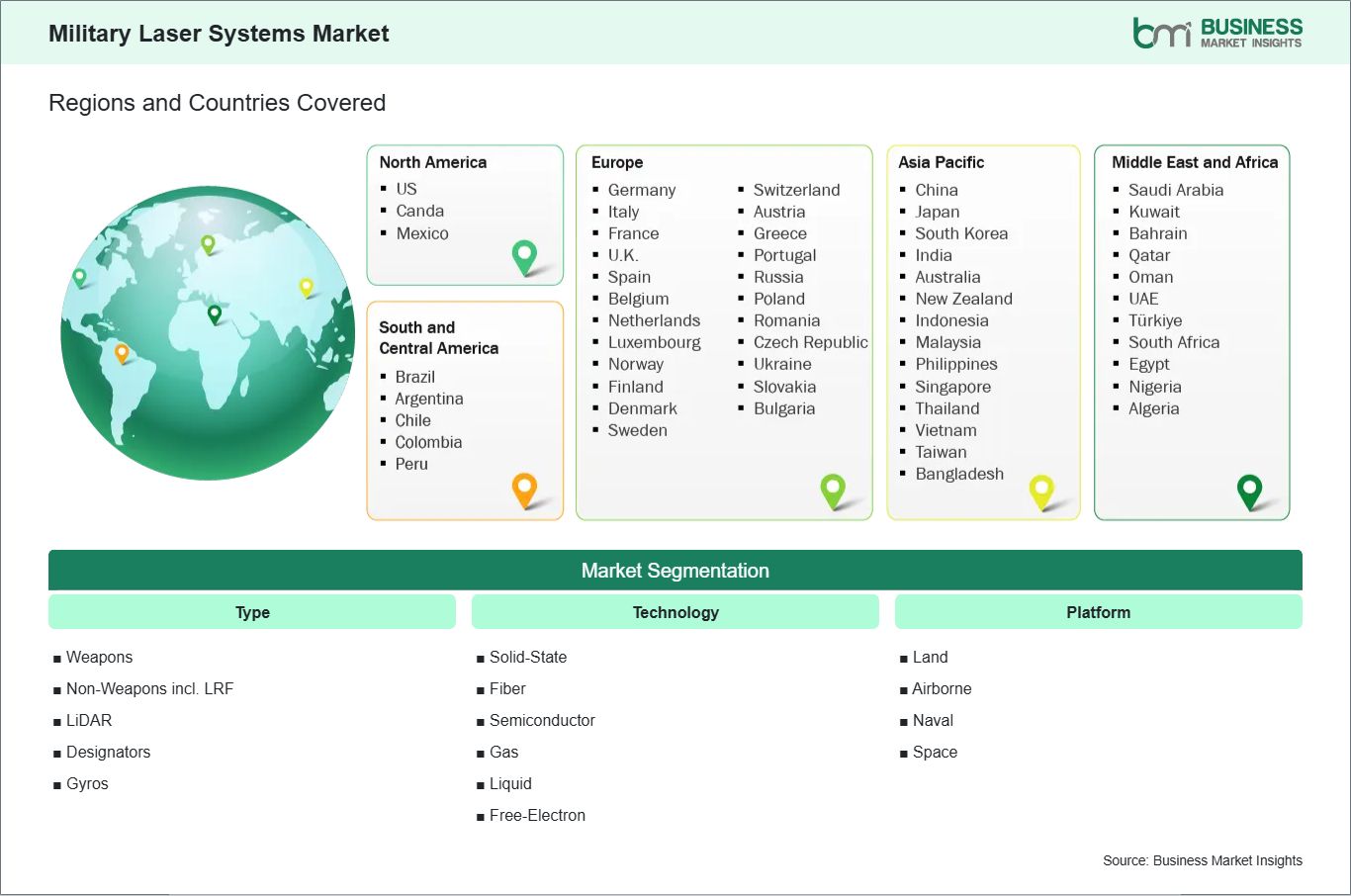
The Military Laser Systems market is segmented by Type, Technology, and Platform. Each category reflects distinct operational priorities, integration pathways, and mission requirements.
By Type
- Weapons : Prioritized for counter-drone, missile defense, and tactical air defense missions
- Non-Weapons incl. LRF, LiDAR, Designators, Gyros : Embedded across targeting, sensing, navigation, and reconnaissance workflows
By Technology
- Solid-State : Favored for compact design and robust field integration
- Fiber : Selected for beam quality, efficiency, and modular scaling
- Semiconductor : Supports compact subsystems and specialized targeting functions
- Gas : Retains relevance in selected high-energy defense applications
- Liquid : Evaluated for thermal handling in advanced configurations
- Free-Electron : Explored for high-power defense concepts and future naval missions
By Platform
- Land : Anchors mobile air defense, surveillance, and targeting operations
- Airborne : Extends precision engagement and electro-optical mission support
- Naval : Strengthens layered ship defense and maritime tracking capability
- Space : Represents an emerging frontier for strategic sensing concepts
Market Forces
Military Laser Systems Market Drivers and Opportunities
Rising Requirement for Precision Counter-Drone and Layered Air Defense
The spread of low-cost drones, loitering threats, and fast aerial targets has intensified demand for precise interception tools. Military planners need systems that engage rapidly, limit collateral effects, and complement missile-based defenses across layered architectures. Laser weapons align with this need by offering controlled energy delivery, repeatable targeting, and flexible deployment across land and naval formations facing persistent aerial pressure.
This requirement is reshaping acquisition priorities, test programs, and platform integration strategies across major defense budgets. Its relevance extends beyond frontline combat, influencing base protection, convoy security, and maritime screening missions. As armed forces refine doctrines for distributed operations, military laser systems gain stronger relevance as responsive tools that support sustained defensive coverage under evolving threat conditions.
Expansion of Multi-Function Non-Weapon Laser Architectures
Defense modernization is widening the role of non-weapon laser systems that support ranging, designation, navigation, terrain mapping, and sensor fusion. Innovation in compact optics, processing, and beam control is enabling these functions to serve across manned platforms, unmanned systems, and networked mission environments. LiDAR-enabled awareness, designator precision, and gyro-supported stabilization illustrate how utility is extending beyond traditional targeting roles.
Future scope centers on deeper integration with autonomous systems, battlefield networking, and mission-specific payload packages across multiple domains. This expansion can improve navigation resilience, target handoff efficiency, and reconnaissance fidelity in contested environments. As defense forces seek broader functionality from each installed subsystem, non-weapon laser architectures create a wider opportunity base for this sector.
Size and Share Analysis
Military Laser Systems Market Size and Share Analysis
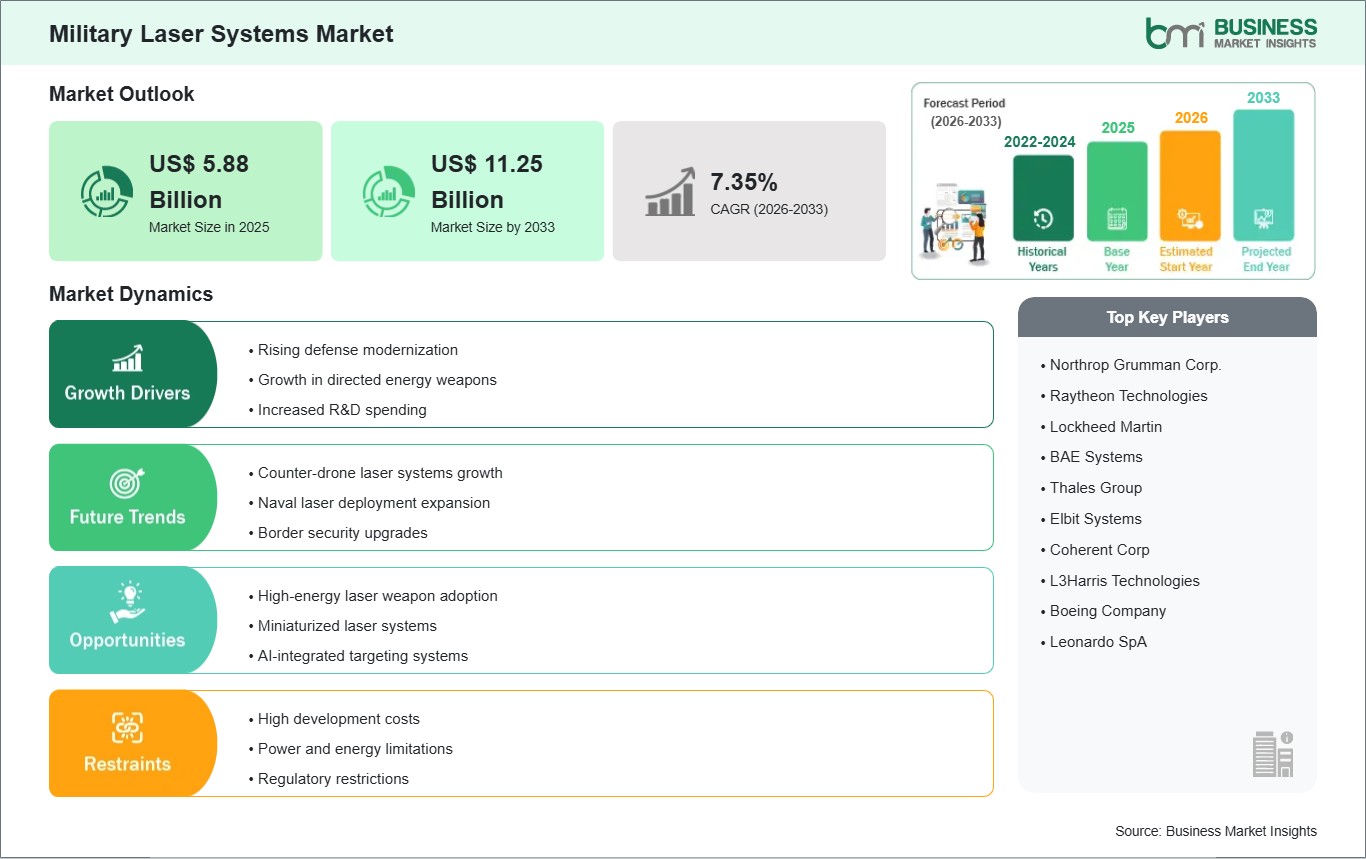
The Military Laser Systems market size is expected to reach US$ 11.25 Billion by 2033 from US$ 5.88 Billion in 2025. The market is estimated to record a CAGR of 7.35% from 2026 to 2033. This trajectory reflects stronger defense emphasis on precision engagement, advanced sensing, and platform-ready electro-optical capabilities that can support both combat and mission-support requirements.
From a segment perspective, non-weapon systems maintain broad operational relevance because rangefinding, designation, navigation, and sensing functions are continuously embedded across defense workflows. Among technologies, solid-state and fiber formats hold a favorable position due to integration practicality, compactness, and efficiency characteristics. On the platform side, land-based deployment remains central because it aligns with maneuver support and mobile protection requirements.
Application leadership is shaped by counter-unmanned defense, target designation, surveillance support, and precision guidance assistance across operational theaters. Land and airborne roles remain prominent because they combine tactical responsiveness with wide mission utility. Naval applications also strengthen the overall market profile as fleets pursue layered protection and optical tracking functions under increasingly contested maritime conditions.
Report Coverage
Military Laser Systems Market Report Coverage and Deliverables
The " Military Laser Systems Market Size and Forecast (2022-2033)" report provides a detailed analysis of the market covering below areas::
- Market size and forecast at global, regional, and country levels for all the key market segments covered under the scope
- Market trends, as well as market dynamics such as drivers, restraints, and key opportunities
- Market analysis covering key market trends, global and regional framework, major players, regulations, and recent market developments
- Industry landscape and competition analysis covering market concentration, heat map analysis, prominent players, and recent developments for the market
- Detailed company profiles, including SWOT analysis
Geographic Insights
Military Laser Systems Market Geographic Insights
The Military Laser Systems market shows diverse regional adoption patterns influenced by defense modernization priorities, threat exposure, procurement cycles, and platform integration readiness. Across the global landscape, armed forces are balancing immediate tactical requirements with longer-term investment in directed-energy weapons and non-weapon laser subsystems. This creates a market structure in which sensing, designation, and protection needs evolve differently by theater and operational doctrine.
North America retains a strong position because its defense ecosystem supports experimentation, system integration, and rapid technology transition across land, naval, and airborne programs. Procurement activity is reinforced by counter-drone requirements, layered air defense planning, and sustained interest in scalable high-energy solutions. The region also benefits from an established industrial base capable of advancing optics, beam control, power management, and software-defined mission systems.
Asia Pacific presents a broad opportunity set shaped by rising security competition, military technology indigenization, and increasing emphasis on surveillance and precision engagement tools. Regional demand extends beyond weaponized systems into rangefinding, designation, and navigation support technologies used across air, land, and maritime missions. Procurement approaches vary by country, yet the shared focus on operational responsiveness and platform modernization supports wider sector expansion.
Europe advances through defense collaboration, sensor modernization, and interest in precision effects that can strengthen layered protection without excessive logistical burden. Emerging markets in the Middle East, Africa, and South and Central America contribute through selective procurement tied to border security, infrastructure protection, and force modernization programs. Together, these regions broaden the market by creating demand for both high-energy systems and mission-support laser technologies across varied operating environments.
Industry Activity
Recent Developments
The market continues to evolve through defense contracts, live demonstrations, and platform integration programs. Recent developments highlight stronger emphasis on high-energy weapons and operationally relevant laser architectures.
- In May 2026, Laser Photonics Corporation has announced the introduction of a portable laser system designed for military use, expanding its offerings to the U.S. Department of Defense and other military services. The system was developed in collaboration with its affiliated company Fonon Technologies and is intended for equipment maintenance and field applications. The newly introduced system, known as the DefenseTech MRLS Portable Finishing Laser 1020 (DTMF-1020), is designed for surface preparation on marine and military infrastructure.
- In January 2026, Rheinmetall and MBDA Germany have announced plans to establish a joint venture dedicated to the development and production of advanced laser weapon systems. The company will be set up as a GmbH in Germany and will focus initially on naval laser systems. The collaboration builds on the companies long-standing cooperation since 2019 and their successful development of a naval laser demonstrator. This demonstrator has already been integrated on a German Navy vessel and tested under real operational conditions over an extended period.
Trust & Transparency
Research Methodology
The market analysis combines proprietary research with secondary data from government agencies, company disclosures, regulatory filings, industry databases and expert interviews. Market estimates are validated through data triangulation, cross-market benchmarking and analyst
review.
View Full Research Methodology
Key Sources Referred:
World Bank -Global Trade Indicators World Trade Organization (WTO) International Monetary Fund (IMF) International Trade Administration (ITA) Company Websites Company Annual Reports Company Investor Presentations