Military Embedded Systems Market Regional Highlights
North America Military Embedded Systems Market
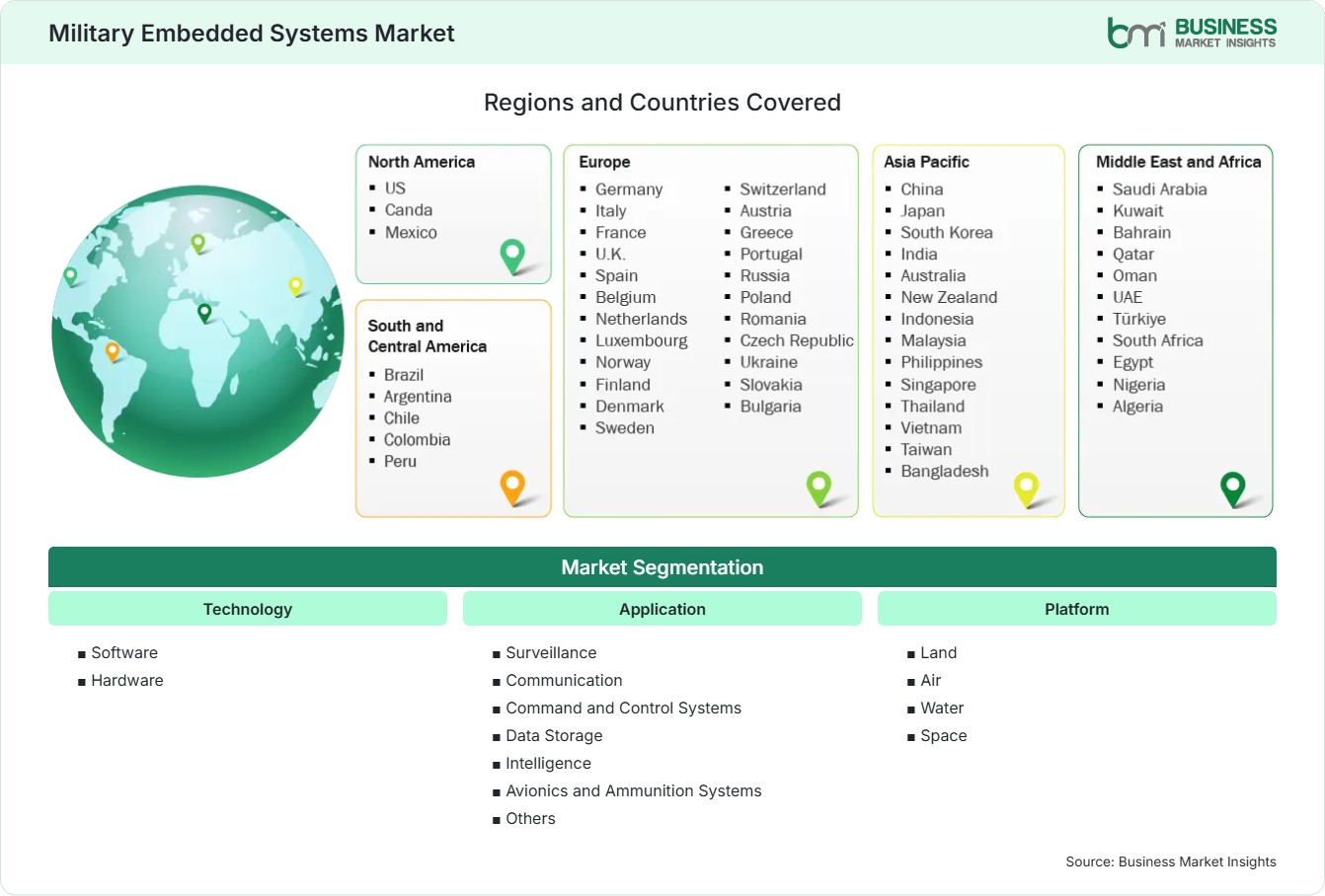
North America holds a 31%–35% share in 2025 and is projected to grow at a 7.2%–8.0% CAGR through 2033. The Military Embedded Systems Market share reflects strong defense electronics capabilities, sophisticated procurement ecosystems, advanced platforms, and sustained demand for secure computing, communications, avionics, and mission systems.
- Defense modernization programs encourage deployment of embedded computing across aircraft, naval platforms, armored systems, missiles, and command infrastructure, increasing demand for rugged electronics and modular processing architectures.
- Established defense contractors and specialized electronics suppliers support sophisticated development ecosystems spanning processors, sensors, communications, avionics, electronic warfare, mission computers, and platform-specific embedded technologies.
- Open architecture initiatives improve opportunities for suppliers capable of delivering interoperable modules, upgradeable software, standardized interfaces, and flexible computing platforms that can support evolving mission requirements.
- Autonomous platforms and battlefield networking are creating additional demand for compact embedded processors capable of supporting sensor fusion, communications, navigation, decision support, and edge analytics.
US Military Embedded Systems Market
The U.S. represents approximately 82%–86% of North American demand in 2025 and is projected to grow at a 7.4%–8.1% CAGR through 2033. Demand is supported by modernization of aircraft, naval assets, ground platforms, autonomous systems, and network-centric military infrastructure.
- U.S. procurement increasingly emphasizes resilient computing, secure communications, artificial intelligence integration, electronic warfare capabilities, and interoperability across interconnected defense platforms.
- Embedded technologies are becoming central to autonomous and semi-autonomous platforms that require onboard processing, sensor integration, navigation, communications, and rapid mission-level decision support.
- Long platform lifecycles create recurring opportunities for technology upgrades because processors, memory, networking, cybersecurity, and mission software can require modernization without replacing entire platforms.
Europe Military Embedded Systems Market
Europe holds a 24%–28% share in 2025 and is projected to grow at a 7.7%–8.5% CAGR through 2033. Germany, France, the United Kingdom, Italy, and Poland remain important markets, while Poland is among the faster-growing national opportunities at approximately 9.0%–10.0% CAGR.
- Germany benefits from defense modernization, advanced industrial capabilities, avionics development, secure communications, and increasing requirements for digitally integrated land, air, and naval platforms.
- France and the United Kingdom maintain strong demand through aerospace and defense programs, mission computing, secure communications, electronic warfare, surveillance, and advanced military networking requirements.
- Italy provides opportunities across aerospace, naval systems, helicopters, radar, communications, and mission electronics, supported by established defense manufacturing and technology development capabilities.
- Poland represents a higher-growth opportunity as military modernization, platform procurement, communications infrastructure, and battlefield digitization increase demand for advanced embedded electronics.
Asia Pacific Military Embedded Systems Market
Asia Pacific holds a 25%–29% share in 2025 and is projected to grow at a 10.2%–11.2% CAGR through 2033. China, India, Japan, South Korea, and Australia represent major demand centers, while India is among the faster-growing markets at approximately 11.0%–12.0% CAGR.
- China combines extensive defense electronics development with demand for autonomous platforms, surveillance, communications, electronic warfare, avionics, and advanced command infrastructure.
- India offers strong expansion potential through indigenous defense manufacturing, modernization programs, unmanned systems, secure communications, and growing emphasis on domestic development of mission electronics.
- Japan and South Korea support demand through advanced aerospace and naval capabilities, missile systems, surveillance technologies, secure communications, and sophisticated electronics manufacturing ecosystems.
- Australia provides opportunities in maritime surveillance, autonomous systems, secure communications, and networked defense capabilities associated with modernization of distributed military operations.
Rest of World Military Embedded Systems Market
Rest of World represents approximately 13%–17% of global demand in 2025 and is projected to grow at a 7.0%–8.0% CAGR through 2033. South America is supported by modernization of aircraft, naval assets, surveillance, and communications, while the Middle East benefits from advanced defense procurement and networked military capabilities.
Middle Eastern demand is concentrated in countries with substantial defense modernization programs, including Saudi Arabia, the United Arab Emirates, Israel, and Qatar. South Africa provides a regional African base for aerospace, defense electronics, surveillance, and communications applications.
- Saudi Arabia and the UAE offer opportunities for embedded computing, surveillance, secure communications, and mission electronics as defense organizations expand digitally connected and technologically advanced platforms.
- Israel provides sophisticated demand for embedded systems used across surveillance, avionics, autonomous platforms, electronic warfare, intelligence, and secure battlefield communications.
- Brazil remains an important South American opportunity because modernization programs support demand for aerospace electronics, naval systems, surveillance, communications, and mission computing.
- South Africa supports regional demand through established aerospace and defense capabilities, surveillance applications, military communications, and requirements for modernized mission electronics.