
Military Communications Market Outlook: Size, Share, Trends, Growth Analysis, Competitive Landscape & Forecast, 2026-2033

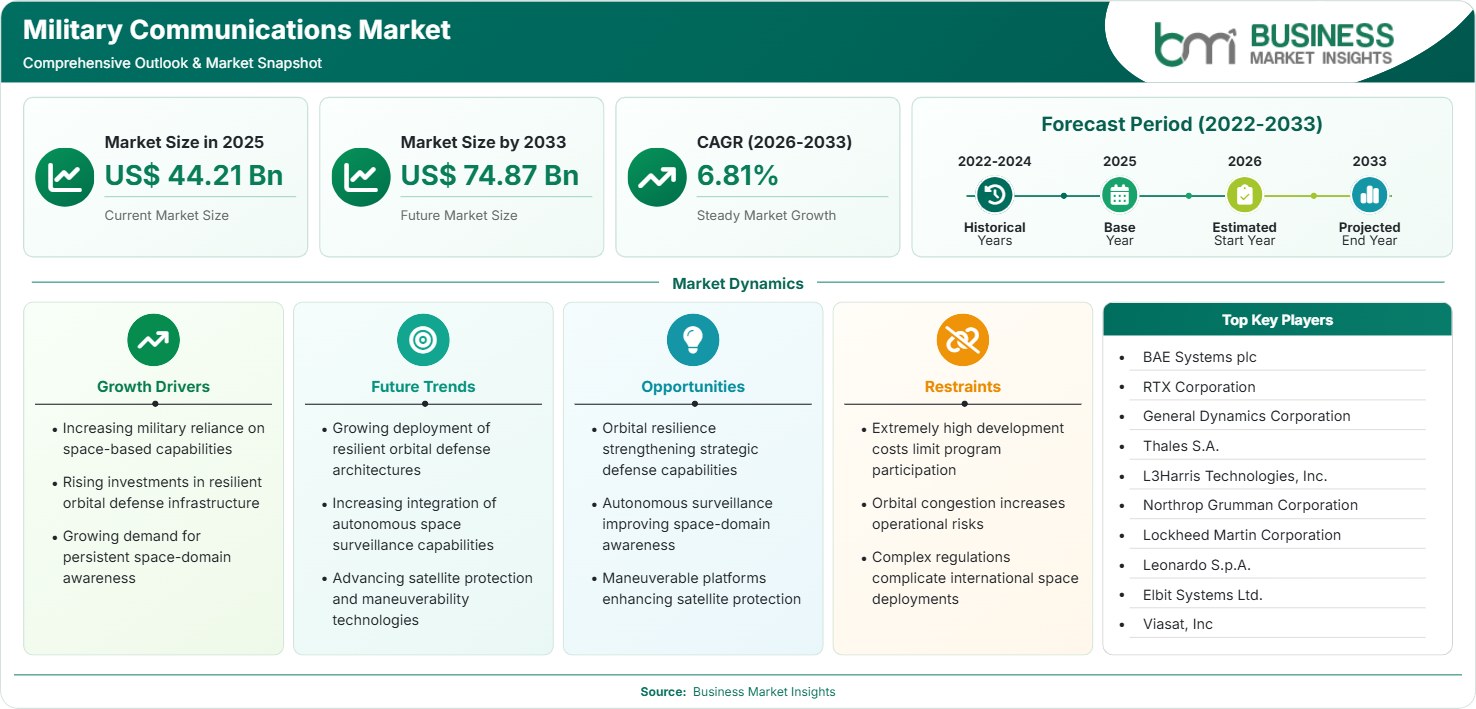
The Military Communications Market size was valued at US$ 44.21 Billion in 2025 and is projected to reach US$ 74.87 Billion by 2033, growing at a CAGR of 6.81% during 2026–2033, driven by resilient networking, software-defined radios, satellite connectivity, electronic warfare requirements, and multi-domain command modernization.

Report Coverage
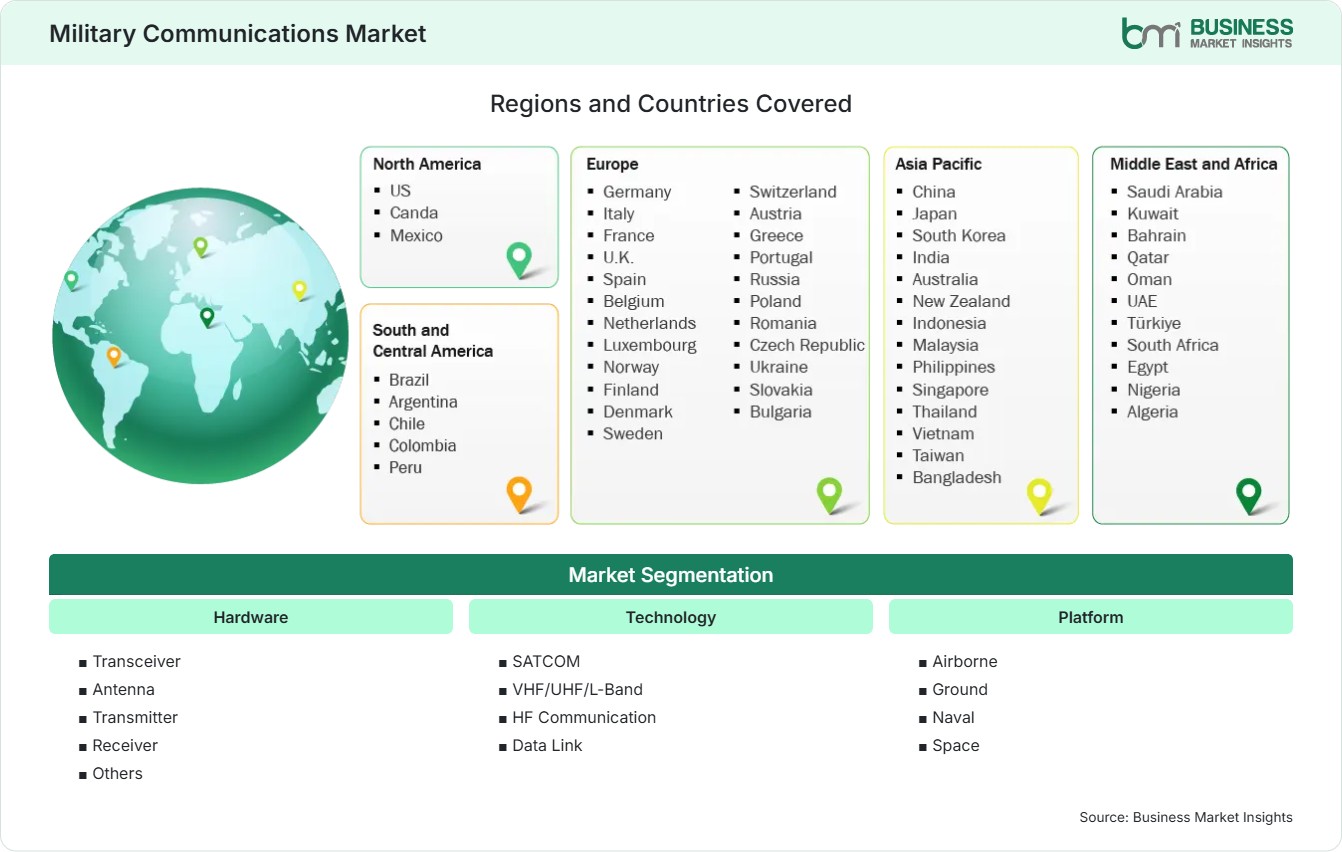
  • Hardware: Transceiver, Antenna, Transmitter, Receiver, Others
  • Technology: SATCOM, VHF/UHF/L-Band, HF Communication, Data Link
  • Platform: Airborne, Ground, Naval, Space
US$ 44.21 Bn Market size in 2025
US$ 74.87 Bn Market Size by 2033
6.81% CAGR, 2026 - 2033
2026-2033 Forecast Period

AI Overview

Military Communications Market Summary

  • North America Region: North America holds a 36%–39% share in 2025, growing at a 6.9%–7.2% CAGR through 2033, influenced by defense-network modernization, protected SATCOM, tactical radios, interoperability requirements, and sustained procurement across joint forces. The US Military Communications Market is supported by C5ISR modernization, Link 16 deployment, resilient communications, and multi-domain operations, with a 6.8%–7.1% CAGR.
  • Fastest Growing Region: Asia Pacific holds a 20%–23% share in 2025 and is projected to register an 8.0%–8.4% CAGR through 2033, supported by indigenous defense production, border security requirements, naval modernization, tactical radio replacement, satellite investment, and expanding unmanned systems.
  • Leading Segment: Hardware accounts for a 68%–72% share in 2025 and is projected to grow at a 6.4%–6.7% CAGR, supported by replacement cycles, secure radios, antennas, transmitters, receivers, resilient tactical networks, platform modernization, and increasing requirements for interoperable communications equipment.
  • High Growth Segment: Software represents a 28%–32% Military Communications Market share in 2025 and is projected to expand at a 7.2%–7.7% CAGR, supported by software-defined networking, adaptive waveforms, AI-enabled network management, cyber resilience, cloud-edge integration, interoperability, and rapid mission capability upgrades.
  • Key Market Opportunity: Protected multi-orbit SATCOM, tactical edge networking, software-defined radios, autonomous platforms, and cross-domain data links create attractive opportunities as militaries prioritize resilient connectivity in contested electromagnetic environments.
  • Major Market Players: BAE Systems plc, RTX Corporation, General Dynamics Corporation, Thales S.A., L3Harris Technologies, Inc., Northrop Grumman Corporation, Lockheed Martin Corporation, Leonardo S.p.A., Elbit Systems Ltd., and Viasat, Inc.
Strategic Insights

Military Communications Market: Strategic Insights

Military Communications Market Strategic Framework
FREE PDF
Request your free sample
Request free sample
Stakeholder View

Key Takeaways

  • Supply-chain structure: The value chain increasingly combines radio hardware, antennas, cryptographic modules, waveforms, networking software, satellite infrastructure, integration, and lifecycle support. Suppliers able to provide interoperable end-to-end architectures are better positioned than component-only vendors.
  • Growth opportunity: Software-defined radios, tactical data links, protected SATCOM, and edge-networking solutions offer strong upside because armed forces need communications systems that can adapt to changing frequencies, threats, missions, and platform configurations.
  • Innovation direction: Open architectures and programmable waveforms are reducing dependence on fixed hardware configurations. BAE Systems, for example, describes software-defined radios designed for software-only capability upgrades, supporting longer operational relevance.
  • Regional opportunity: Asia Pacific offers compelling investment potential because countries are strengthening indigenous defense manufacturing while modernizing naval, airborne, ground, and satellite communication capabilities. India, Japan, South Korea, and Australia represent important procurement markets.
  • Investment and M&A: Competitive positioning increasingly depends on combining communications with C5ISR, electronic warfare, networking, cybersecurity, and space capabilities. Strategic partnerships therefore remain important for expanding technology portfolios and accessing national defense programs.
  • Procurement priority: Resilience against jamming, cyber intrusion, satellite disruption, and infrastructure loss is becoming a central purchasing criterion. Systems capable of switching among multiple communication paths can provide greater operational continuity.
Geographic Outlook

Military Communications Market Regional Highlights

North America Military Communications Market

North America accounted for 36%–39% of the Military Communications Market share in 2025 and is projected to grow at a 6.9%–7.2% CAGR through 2033. US procurement dominates regional demand, supported by tactical networking, protected SATCOM, data links, electronic warfare resilience, and joint-domain interoperability. Canada contributes through modernization of secure communications and allied interoperability. The region benefits from mature defense primes, extensive R&D infrastructure, established standards, and recurring replacement programs across airborne, ground, naval, and space platforms.

  • US defense modernization prioritizes resilient communications capable of supporting contested operations, distributed forces, and data-intensive command-and-control requirements across multiple operational domains.
  • Protected SATCOM is gaining importance as military users seek alternatives to vulnerable communications pathways and require persistent connectivity across dispersed operational theaters.
  • Tactical radio programs increasingly favor software-defined architectures, enabling waveform updates, multiband operation, interoperability, and longer equipment lifecycles without complete hardware replacement.
  • Defense contractors are integrating communications with electronic warfare, intelligence, surveillance, and reconnaissance systems, increasing demand for unified network architectures and secure data exchange.

US Military Communications Market

The US accounts for 82%-86% of total revenue in the North American Military Communications Market, growing at a CAGR of 6.8%-7.1% during 2025-2033. Procurement is driven by defense modernization initiatives, tactical networking, Link 16, protected SATCOM, and resilient command-and-control solutions. The growth of this market is enabled by existing suppliers in the region and testing facilities. Modern programs include fast deployment capabilities, interoperability, and continuity of communications in the face of electronic warfare.

  • US procurement increasingly links communications modernization with Joint All-Domain Command and Control, requiring data movement among sensors, decision-makers, weapons, and distributed forces.
  • Link 16 remains strategically important for coalition interoperability. A 2026 BAE Systems and Collins Aerospace contract supports production of hundreds of MIDS JTRS terminals for US and allied platforms.
  • Protected tactical SATCOM programs are expanding interest in maneuverable satellite architectures, anti-jam technologies, and resilient ground infrastructure for dispersed operations.

Europe Military Communications Market

Europe accounted for 24%-27% of the Military Communications Market in 2025 and is forecast to exhibit a CAGR of 6.6%-6.9% through 2033. Germany, France, the United Kingdom, and Italy remain prominent markets due to defense upgrades and interoperability needs within NATO. Countries like Poland and the Nordic nations offer high growth potential due to security concerns in the region. NATO's digital backbone and data projects strengthen the demand for communications solutions.

  • Germany remains a major European procurement center, with demand supported by land-force modernization, secure networking, protected communications, and broader defense digitization.
  • Poland is positioned as a high-growth market as defense investment increases requirements for tactical radios, command networks, secure data exchange, and interoperable NATO systems.
  • NATO interoperability programs are strengthening demand for standardized communications architectures. Steadfast Cobalt 2025 involved approximately 1,600 participants from 13 Allied Nations during its first phase.
  • France and the United Kingdom continue investing in sovereign communications capabilities, including tactical networking, secure data links, airborne systems, and satellite connectivity.

Asia Pacific Military Communications Market

Asia Pacific accounted for 20% to 23% of the Military Communications Market in 2025 and is expected to grow at an 8.0% to 8.4% CAGR, thus becoming the fastest-growing regional segment. The leading countries are China, Japan, South Korea, India, and Australia, with India and South Korea showing promising growth. Demand within the region arises from maritime security needs, border monitoring, unmanned systems, domestic defense manufacturing, satellite spending, and secure communications across vast territories.

  • India is a high-growth market as domestic defense manufacturing expands alongside demand for tactical radios, C4ISR systems, secure networks, and communications equipment for land and maritime forces.
  • Japan is strengthening resilient communications to support distributed operations, airborne surveillance, naval forces, and interoperability with allied systems across the Indo-Pacific.
  • South Korea continues modernizing tactical communications for network-centric warfare, integrated air and missile defense, unmanned systems, and rapid data exchange.
  • Australia is investing in secure, interoperable communications that support long-range operations, coalition activities, maritime surveillance, and distributed force structures across the Indo-Pacific.

Rest of World Military Communications Market

Rest of World accounted for a 14%–17% share of the Military Communications Market in 2025 and is forecast to grow at a 6.0%–6.4% CAGR. South and Central America show demand for secure tactical communications, border monitoring, and modernization, led by Brazil and Colombia. Middle East and Africa demand is supported by counterterrorism, border security, naval surveillance, and modernization programs. Saudi Arabia, the United Arab Emirates, and Israel remain important technology and procurement centers.

South American and Central American armed forces need interoperable radios, surveillance and communication capabilities, and mobile networks that can function even under extreme conditions. The greatest opportunity in South America lies in Brazil, driven by modernization and indigenous capabilities. In the Middle East and Africa, the acquisition of communication systems is increasingly integrated into C4ISR, unmanned systems, and electronic warfare.

  • Brazil remains a leading South American market, supported by domestic defense production, communications modernization, and requirements covering extensive land and maritime territories.
  • Saudi Arabia and the United Arab Emirates represent attractive Middle Eastern opportunities because procurement increasingly emphasizes secure networking, tactical communications, SATCOM, and integrated command systems.
  • Israel continues to influence regional technology adoption through advanced tactical networking, SDR development, electronic warfare integration, and resilient communications architectures.
  • African demand remains concentrated around border security, peacekeeping, counterterrorism, and mobile communications requirements, creating opportunities for ruggedized and cost-efficient systems.
Global Market Geography
FREE PDF
Request your free sample
Request free sample
Segment Analysis

Military Communications Market Segmentation

Component

The Component Segmentation splits the Military Communications Market into Hardware and Software. The former constituted 68%-72% of market value in 2025 and is expected to register a CAGR of 6.4%-6.7%. This is because the software market is driven by the fast adoption of programmable and network-based architectures. The emergence of connected communications systems is adding software to radios and network equipment, supporting recurring upgrades and lifecycle revenue.

  • Hardware: Hardware remains the dominant component because defense users require rugged radios, antennas, transmitters, receivers, and communications equipment across platforms. Replacement cycles and modernization sustain procurement.
  • Software: Software adoption is accelerating as forces require programmable waveforms, network orchestration, cyber protection, interoperability, and rapid upgrades without replacing complete communications hardware.

Hardware

Hardware is the major part of the Military Communications Market, representing 68%-72% share in 2025 and a 6.4%-6.7% CAGR through 2033. The requirements for hardware include safety and reliability, as well as the ability to maintain communication despite mobility, interference, and infrastructure breakdowns. Platform modernization and replacement of legacy analog systems further support hardware procurement.

  • Transceiver: Transceivers enable two-way voice and data communications across tactical networks. Demand is supported by multiband operation, anti-jam requirements, software-defined architectures, and soldier modernization.
  • Antenna: Antennas determine coverage, connectivity, and signal performance across platforms. Demand is moving toward compact, multiband, electronically adaptable designs for vehicles, aircraft, vessels, and dismounted users.
  • Transmitter: Transmitters support secure transmission of mission-critical voice, imagery, telemetry, and targeting information. Higher power efficiency, frequency agility, and electromagnetic resilience are strengthening procurement requirements.
  • Receiver: Receivers increasingly require sensitivity, frequency agility, signal processing, and anti-jam functionality to maintain communications and extract actionable information within congested electromagnetic environments.

Technology

Technology Segmentation includes SATCOM, VHF/UHF/L-Band, HF Communication, and Data Links. The Military Communications Market is moving towards an architecture that incorporates line-of-sight and beyond-line-of-sight connectivity. Data links and SATCOM have become increasingly significant due to the need to distribute forces and maintain a constant flow of information. VHF/UHF/L-Band remains essential for tactical voice and data communications.

  • SATCOM: SATCOM supports beyond-line-of-sight connectivity for dispersed forces, aircraft, ships, and command centers. Protected and maneuverable satellite architectures are increasing demand.
  • VHF/UHF/L-Band: These frequencies remain essential for tactical voice, data, airborne communications, and platform interoperability. Software-defined radios are improving flexibility across multiple frequency bands.
  • HF Communication: HF provides long-range communications where satellite access or terrestrial infrastructure is limited. It remains relevant for maritime, airborne, and remote tactical applications requiring resilient connectivity.
  • Data Link: Data links enable rapid exchange of targeting, surveillance, positional, and command information. Their importance is increasing as military operations become more network-centric and multi-domain.

Platform

Platforms include airborne, ground, naval, and space. The ground segment constitutes a significant part of procurement because the army uses many tactical radios and network nodes, and the airborne and naval segments need high-performing beyond-line-of-sight communications. The space segment is highly significant due to the development of strategic protected SATCOM and robust satellite networks.

  • Airborne: Aircraft require lightweight, secure, multiband communications supporting voice, tactical data, SATCOM, and network connectivity under high-speed and contested electromagnetic conditions.
  • Ground: Ground forces represent extensive demand for manpack, handheld, vehicle-mounted, and command-post systems. Modernization increasingly emphasizes mesh networking and soldier-to-command connectivity.
  • Naval: Naval platforms require long-range communications, SATCOM, tactical data links, and resilient ship-to-ship connectivity for distributed maritime operations and coalition coordination.
  • Space: Space platforms support protected communications, satellite networking, and beyond-line-of-sight services. Investment is increasing in resilient architectures designed to sustain connectivity despite interference and disruption.
Market Forces

Military Communications Market Dynamics

Key Market Drivers

Modernization of Network-Centric Warfare Infrastructure

Defense forces are replacing legacy communication architectures with software-defined radios, tactical data links, secure IP networks, and integrated C5ISR systems. Digital Backbone is a NATO initiative aimed at linking the maritime, land, air, space, and cyberspace domains, thereby demonstrating an institutional need for persistent data transfer. Thus, market growth is related to modernization budgets focused on interoperability rather than on replacing radios. Orders recently made by L3Harris for about US$300 million in Manpack and Leader radios are examples of procurement of reliable tactical equipment. These programs reinforce Military Communications Market trends toward scalable architectures, secure data sharing, multiband operation, and communications continuity during contested missions.

Rising Demand for Resilient and Anti-Jam Connectivity

Electronic warfare threats are enhancing the importance of communication systems that can change their frequency band, reroute messages via alternate routes, and remain connected even in the face of such threats. Anti-jam radios, protected satellite communications, tactical gateways, and networked communication systems are in demand for military purposes instead of single-path communication systems. The Airborne Tactical Radios by BAE Systems offer multi-band, secure, anti-jam communication solutions, whereas Viasat is developing protected tactical satellite communication architectures. Such initiatives help grow the Military Communications Market by increasing replacement requirements for legacy equipment.

Expansion of Multi-Domain Operations and Data Links

Multi-domain warfare demands quick information transfer among sensors, command posts, aircraft, naval ships, land-based troops, and weapon systems. Tactical data links have been recognized by NATO as critical elements for tactical, operational, and strategic success in multi-domain warfare. The development of Link 16 is further proof of the growing need for secure, low-latency information transfer. Military Communications Market growth drivers include defense organizations integrating manned and unmanned systems into a single communication system. Market trends are shifting towards situational awareness, distributed command, sensor-to-shooter connectivity, and interoperability among national and coalition inventories.

Key Market Opportunities

Protected Multi-Orbit SATCOM and Resilient Satellite Networks

The protected SATCOM solution presents a great opportunity, as military customers require beyond-line-of-sight communication capabilities amid jamming, cyberattacks, and the destruction of physical infrastructure. According to Viasat's contract, the protected tactical SATCOM-Global is scheduled for 2026, and this involves manufacturing a maneuverable dual-band mini-GEO satellite. Such systems may include other networks, such as GEO, LEO, terrestrial, and tactical networks, thereby improving availability. There are vendors that can offer terminals, ground systems, network management, and satellite services.

AI-Enabled Tactical Network Management

AI can improve communications planning by identifying congestion, predicting link degradation, prioritizing mission traffic, and recommending alternate routing. NATO's Data Strategy specifically promotes data exploitation and the use of AI and machine learning models within a secure Alliance data ecosystem. This creates opportunities for software providers that integrate AI into network orchestration without compromising security and control, according to Military Communications Market forecasts. The defense community can leverage intelligent network management to reduce the load on operators and enhance resilience in the face of rapidly changing electromagnetic environments. The highest investment opportunity lies in AI capabilities that span all current radios, tactical gateways, edge nodes, and command nodes.

Unified Connectivity for Manned and Unmanned Forces

The rapid integration of unmanned aerial and ground solutions is driving the need for communication systems that can simultaneously provide connectivity for command, telemetry, sensors, and payload data. Elbit Systems unveiled E-LynX UxS in June 2026 as the means of linking manned and unmanned forces via a single secure network. This presents an opening for tactical radios with a high bandwidth capacity, mesh networking, edge computing, and autonomous network management. Communications solutions providers can increase their market by designing systems that integrate UAVs and soldiers, cars, planes, and command centers.

Market Restraints and Challenges

Electromagnetic Spectrum Congestion and Interference

Factor: Modern military communications operate in a highly crowded electromagnetic environment, subject to jamming, interference, congestion, and electronic attack. Impact: Equipment suppliers must invest significant resources in developing solutions for frequency agility, anti-jam waveforms, adaptive antennas, encryption, and spectrum management. This drives up the cost of development and testing and delays qualification. Also, there is a need to be backward-compatible with older systems. This poses difficulties for procurement because modern militaries cannot judge communications equipment by bandwidth and range alone. The ability to survive electronic attacks is one of the most important performance criteria today.

High Integration Costs Across Legacy and New Networks

Factor: Defense entities possess a hybrid inventory consisting of traditional radios, proprietary waveforms, national standards, and recently fielded software-defined systems. Impact: Integrating these systems into networks involves gateways, protocol conversion, security measures, testing, and specialized engineering skills. NATO interoperability efforts illustrate how difficult it is to connect national systems in a way that ensures secure communication. The costs of integrating systems may lead to deployment delays and reduce the funds available for purchasing new systems. Suppliers are under pressure to provide open-architecture systems with backward-compatibility features. Procurement programs also involve extensive certification.

Company Analysis

Competitive Landscape

The Military Communications Market analysis indicates that competition is concentrated among diversified defense companies with capabilities spanning tactical radios, SATCOM, data links, C5ISR, electronic warfare, and secure networking. The competitive environment favors companies able to combine hardware, software, integration, and lifecycle support.

Company Name

Overview

Products and Services relevant to this market

BAE Systems plc

Major defense technology supplier with extensive communications, electronic systems, and tactical networking capabilities across allied military programs.

Tactical radios, software-defined radios, Link 16 systems, data links, communications and electronic warfare solutions for airborne, naval, and ground platforms.

RTX Corporation

Diversified aerospace and defense company with communications capabilities integrated into networking, sensing, electronic warfare, and command systems.

Collins Aerospace communications, tactical data links, cooperative engagement networking, electronic warfare software, and secure platform connectivity solutions.

General Dynamics Corporation

Major US defense contractor serving land, maritime, communications, and mission systems programs for military customers.

Tactical radios, secure communications, networking systems, mission command infrastructure, satellite communications, and integrated C5ISR solutions.

Thales S.A.

European defense technology company providing communications and digital systems for armed forces and coalition operations.

Software-defined radios, tactical networking, SATCOM solutions, secure communications, battlefield connectivity, and command-and-control infrastructure.

L3Harris Technologies, Inc.

Communications-focused defense technology supplier with broad deployment across tactical, airborne, maritime, and coalition communications programs.

Handheld and manpack radios, tactical networking, data links, SATCOM terminals, resilient communications, and secure C5ISR connectivity.

Northrop Grumman Corporation

Defense technology company combining communications with mission systems, space, networking, and advanced command capabilities.

Tactical communications, space communications, data links, networked mission systems, satellite technologies, and integrated command infrastructure.

Lockheed Martin Corporation

Global defense prime with communications integrated into aerospace, space, missile, and network-centric military systems.

Secure communications, tactical data links, satellite systems, command networks, mission integration, and multi-domain connectivity technologies.

Leonardo S.p.A.

European aerospace and defense company providing communications and electronic systems across airborne, land, naval, and security applications.

Secure tactical communications, software-defined radios, networking systems, data links, electronic systems, and integrated mission solutions.

Elbit Systems Ltd.

Israeli defense technology company specializing in digital land systems, tactical communications, unmanned integration, and C4ISR capabilities.

E-LynX software-defined radios, tactical networks, command systems, unmanned connectivity, data links, and secure battlefield communications.

Viasat, Inc.

Satellite communications and networking provider with growing defense capabilities focused on resilient connectivity and tactical networking.

Protected SATCOM, tactical gateways, multi-path networking, tactical edge connectivity, satellite systems, and secure data communications.

Trust & Transparency

Research Methodology

The market analysis combines proprietary research with secondary data from government agencies, company disclosures, regulatory filings, industry databases and expert interviews. Market estimates are validated through data triangulation, cross-market benchmarking and analyst review.

View Full Research Methodology

Questions Answered

Frequently Asked Questions

Which technology area offers the strongest long-term opportunity?

Protected SATCOM and software-defined tactical networking offer strong long-term potential because they address two critical requirements: persistent connectivity and rapid adaptation. Integration with edge computing, AI-enabled network management, and unmanned platforms can further expand demand.

What should buyers consider when evaluating a Military Communications Market report?

Buyers should examine segmentation by component, technology, platform, and geography, alongside supplier capabilities, procurement activity, interoperability requirements, satellite infrastructure, software-defined systems, and electronic warfare resilience to identify commercially relevant opportunities.

Why are tactical data links becoming more important?

Tactical data links allow aircraft, ships, vehicles, sensors, and command centers to exchange information rapidly. Their importance is increasing as military forces adopt distributed operations and require shared situational awareness across multiple operational domains.

How are software-defined radios changing defense communications?

Software-defined radios allow military users to update waveforms and communications capabilities through software instead of replacing complete hardware units. This supports interoperability, extends equipment lifecycles, and enables faster adaptation to changing operational requirements and electromagnetic threats.

What factors are changing procurement priorities for military communications systems?

Defense organizations increasingly prioritize resilience against jamming, cyberattacks, infrastructure disruption, and satellite interference. Procurement specifications are shifting toward software-defined radios, protected SATCOM, adaptive waveforms, multi-path networking, and interoperability across allied forces.

Access the Full Military Communications Market Report

Get segment-level forecasts, regional estimates, competitive benchmarking, company profiles and downloadable Excel datasets.

Access the full Military Communications Market Report
350 pages PDF & Excel | 2026-09-10
Similar Research

Related Market Reports