
Small Drones Market Outlook: Size, Share, Trends, Growth Analysis, Competitive Landscape & Forecast, 2026-2033

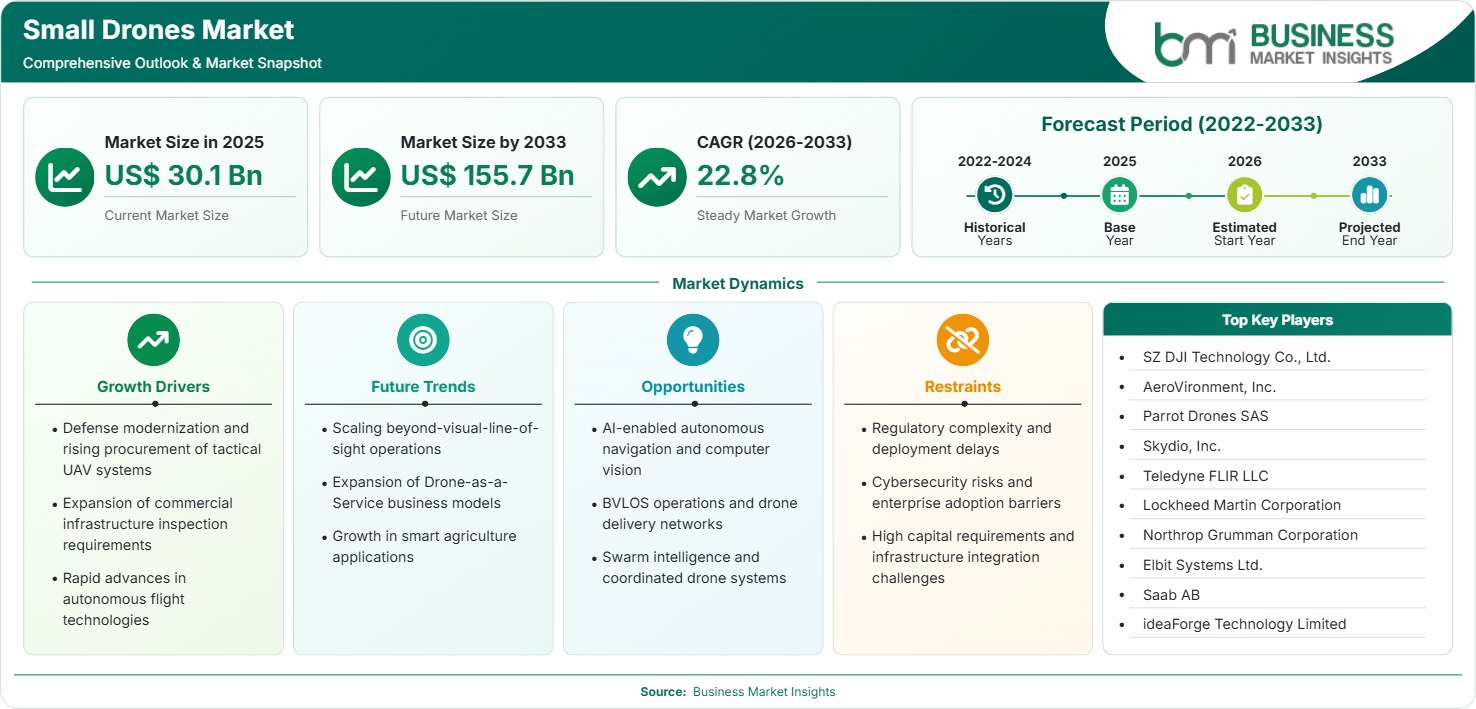
The Small Drones Market size was valued at US$ 30.1 Billion in 2025 and is projected to reach US$ 155.7 Billion by 2033, growing at a CAGR of 22.8% during 2026–2033. Key drivers include defense modernization, AI-enabled autonomous navigation, precision agriculture adoption, infrastructure inspection demand, and public safety deployment. Opportunities emerge from BVLOS operations, drone delivery networks, swarm intelligence, and battery innovation.

Report Coverage
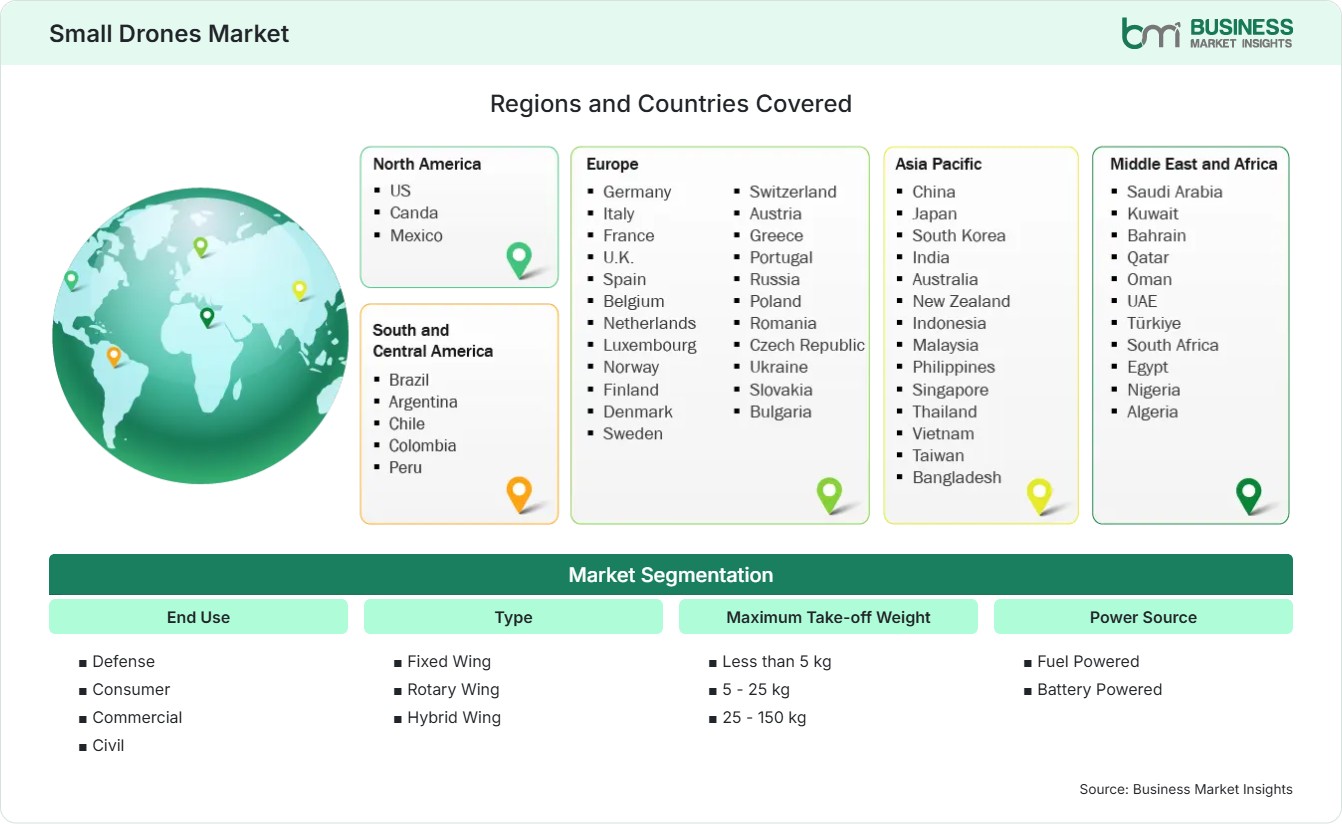
  • End Use: Defense, Consumer, Commercial, Civil
  • Type: Fixed Wing, Rotary Wing, Hybrid Wing
  • Maximum Take-off Weight: Less than 5 kg, 5 - 25 kg, 25 - 150 kg
  • Power Source: Fuel Powered, Battery Powered
US$ 30.1 Bn Market size in 2025
US$ 155.7 Bn Market Size by 2033
22.8% CAGR, 2026 - 2033
2026-2033 Forecast Period

AI Overview

Small Drones Market Summary

  • North America Region: Holds a market share of 34%–37% in 2025, growing at a CAGR of 20%–22% during 2026–2033, supported by defense procurement, enterprise drone deployment, and advanced air mobility initiatives. Opportunities stem from BVLOS approvals, smart infrastructure inspection, and federal security programs driving broader adoption across commercial sectors.
    US market benefits from defense spending and enterprise automation, advancing at approximately 20.5%–22.5% CAGR.
  • Fastest Growing Region: Asia Pacific holds 27%–30% share in 2025 and expands at 25%–27% CAGR during 2026–2033. Manufacturing scale, agricultural digitization, and public safety investments accelerate adoption. Opportunities arise from industrial inspection, logistics innovation, and supportive national drone development frameworks.
  • Leading Segment: Commercial accounts for 38%–41% share in 2025 and advances at 23%–25% CAGR during 2026–2033. Infrastructure monitoring, precision agriculture, surveying, mapping, and utility inspections sustain demand. Opportunities emerge through AI analytics integration and automated asset management solutions.
  • High Growth Segment: Hybrid Wing represents 12%–15% share in 2025 and grows at 27%–29% CAGR during 2026–2033. Extended endurance and vertical takeoff capabilities support adoption. Opportunities arise in border surveillance, logistics, and long-range industrial inspection missions.
  • Key Market Opportunity: Expansion of beyond-visual-line-of-sight operations enables scalable drone delivery, corridor monitoring, emergency response, and industrial inspections, creating recurring software, services, data analytics, and fleet management revenue opportunities worldwide.
  • Major Market Players: SZ DJI Technology Co., Ltd.; AeroVironment, Inc.; Parrot Drones SAS; Skydio, Inc.; Teledyne FLIR LLC; Lockheed Martin Corporation; Northrop Grumman Corporation; Elbit Systems Ltd.; Saab AB; ideaForge Technology Limited.
Strategic Insights

Small Drones Market: Strategic Insights

Small Drones Market Strategic Framework
FREE PDF
Request your free sample
Request free sample
Stakeholder View

Key Takeaways

  • The value chain is increasingly centered around sensors, software, analytics, cloud platforms, and mission services rather than hardware alone.
  • Commercial inspection, surveying, agriculture, and energy applications offer the strongest long-term revenue expansion potential owing to scalable operational savings.
  • Product innovation is shifting toward autonomous navigation, AI-enabled object recognition, swarm operation capabilities, and advanced edge processing.
  • Asia Pacific presents a compelling investment destination due to manufacturing depth, government support, and rapid digital agriculture adoption.
  • Strategic partnerships, defense contracts, and technology acquisitions are increasing as companies seek software capabilities and autonomous flight expertise.
  • Battery technology improvements and hybrid propulsion systems are expanding addressable missions requiring longer endurance and greater payload flexibility.
Geographic Outlook

Small Drones Market Regional Highlights

North America Small Drones Market

North America accounted for 34%–37% Small Drones Market share in 2025 and is projected to expand at a CAGR of 20%–22% through 2033. Defense modernization programs, infrastructure monitoring requirements, and enterprise automation initiatives continue supporting regional demand. Regulatory progress related to remote identification and BVLOS operations strengthens commercial viability. Technology developers benefit from mature funding ecosystems, advanced manufacturing capabilities, and strong procurement channels across public and private sectors, reinforcing sustained market leadership throughout the assessment period.

  • Defense agencies continue expanding procurement of tactical unmanned systems for intelligence, surveillance, and reconnaissance applications across homeland security and military operations.
  • Utilities increasingly deploy drones to inspect transmission lines, substations, and renewable assets, improving workforce safety and reducing maintenance expenses.
  • BVLOS testing corridors and regulatory approvals support commercial scaling opportunities for inspection, mapping, logistics, and emergency response applications.
  • Software providers benefit from growing demand for analytics, digital twins, and AI-based asset management platforms integrated with drone operations.

US Small Drones Market

The United States represents 78%–82% of North American Small Drones Market share and advances at 20.5%–22.5% CAGR. Strong defense budgets, domestic manufacturing initiatives, and enterprise digital transformation programs drive deployment. Commercial adoption remains particularly strong across utilities, agriculture, oil and gas, and public safety agencies. Expanding investments in autonomy software and secure drone ecosystems position the country as a major innovation hub.

  • Federal agencies increasingly emphasize domestic sourcing and cybersecurity requirements, supporting local ecosystem growth.
  • Energy infrastructure operators deploy drones for predictive maintenance and inspection of critical assets.
  • Public safety organizations use aerial platforms for disaster assessment, search and rescue, and emergency coordination.
  • AI-enabled navigation and real-time analytics accelerate operational efficiency across enterprise applications.

Europe Small Drones Market

Europe held 24%–27% Small Drones Market share in 2025 and is forecast to grow at 21%–23% CAGR. Regulatory framework harmonization, industrial automation needs, and environmental monitoring requirements ensure greater regional adaptation. The German region is the highest revenue generator, and the eastern European market is showing faster investment trends. Defensive and infrastructure security measures are ensuring business opportunities for technology and services providers in the region.

  • Germany leads regional demand through industrial inspection and manufacturing applications with growth exceeding 21%.
  • France continues expanding public safety and smart infrastructure drone deployments across municipal projects.
  • Poland represents one of the fastest-growing markets, supported by defense modernization and security investments.
  • Environmental monitoring and climate resilience programs broaden commercial use cases.
  • Advanced air mobility research supports development of integrated drone ecosystems.

Asia Pacific Small Drones Market

Asia Pacific captured 27%–30% share in 2025 and is expected to achieve 25%–27% CAGR, making it the fastest-growing regional market. Ecosystems for large-scale manufacturing, digitization of agriculture, and infrastructural development encourage uptake. China continues to be the key regional player, whereas India and Southeast Asia experience fast growth. Higher levels of government investment in the production of drones locally improve competitiveness and exports within the region.

  • China maintains leadership through manufacturing scale, component ecosystems, and technology innovation.
  • India records one of the strongest growth trajectories due to production incentives and agricultural applications.
  • Japan and South Korea focus on automation, inspection, and public safety deployments.
  • Precision farming solutions accelerate adoption across crop monitoring and resource management activities.
  • Industrial inspections and logistics pilots expand commercial opportunities throughout the region.

Rest of World Small Drones Market

The Rest of World region accounted for 11%–14% share in 2025 and is projected to expand at 22%–24% CAGR. The agricultural and mining industries spur usage within South and Central America. The Middle East and Africa’s main pillars for growth include security, border surveillance, and infrastructure monitoring applications. In terms of revenue generation, Brazil takes the lead regionally. As for the fastest-growing countries, Saudi Arabia is one of them.

  • Brazil leverages drone platforms for precision agriculture, forestry management, and mining operations.
  • Saudi Arabia expands adoption through smart city projects and security modernization programs.
  • Mining operators increasingly use aerial systems for mapping and site monitoring applications.
  • Border security investments support procurement across Middle Eastern nations.
  • Infrastructure development projects create opportunities for surveying and inspection providers.
Global Market Geography
FREE PDF
Request your free sample
Request free sample
Segment Analysis

Small Drones Market Segmentation

End Use

End-use adoption is led by the Commercial segment, which accounts for 38%–41% market share in 2025 and grows at 23%–25% CAGR. The Small Drones Market scope continues expanding through inspection, surveying, agriculture, and security applications. Defense demand remains resilient, while civil deployments increase through public infrastructure programs and emergency response modernization initiatives.

  • Defense: Supports reconnaissance, target acquisition, battlefield awareness, and border monitoring, benefiting from modernization spending and autonomous mission requirements.
  • Consumer: Adoption remains linked to photography, recreation, personal content creation, and affordable technology accessibility.
  • Commercial: Driven by utility inspection, precision agriculture, surveying, mapping, logistics testing, and asset monitoring requirements.
  • Civil: Growth is supported by disaster response, environmental monitoring, search and rescue, and municipal operations.

Type

Type segmentation reflects mission-specific requirements. Rotary-wing platforms lead with 45%–48% share in 2025 due to hovering capability and operational flexibility. Hybrid designs exhibit the strongest momentum, advancing at 27%–29% CAGR. The paragraph incorporates Small Drones Market trends through increasing demand for endurance, efficiency, and multi-mission performance.

  • Fixed Wing: Preferred for long-range surveillance, mapping, and agricultural monitoring applications requiring extended flight duration.
  • Rotary Wing: Widely deployed for inspections, imaging, security operations, and missions demanding vertical maneuverability.
  • Hybrid Wing: Combines endurance advantages with VTOL functionality, supporting logistics and border surveillance deployments.

Maximum Take-off Weight

The 5-25 kg category dominates with approximately 42%–45% share in 2025 and demonstrates strong adoption across industrial and defense applications. Demand is influenced by payload flexibility, sensor integration capacity, and operational efficiency. Growth remains supported by expanding inspection, security, and surveying requirements worldwide.

  • Less than 5 kg: Suitable for consumer, public safety, and light commercial missions where portability is critical.
  • 5 - 25 kg: Supports advanced sensors, industrial inspection tools, and tactical operational requirements effectively.
  • 25 - 150 kg: Increasingly adopted for specialized defense missions, logistics pilots, and heavy payload deployments.

Power Source

Battery-powered platforms account for 68%–71% share in 2025 and are projected to grow at 24%–26% CAGR. Improvements in energy density, reliability, and environmental performance drive adoption. Fuel-powered systems remain relevant for extended endurance missions requiring greater operational range and persistence.

  • Fuel Powered: Favored for long-duration missions, defense surveillance, and remote-area operations requiring endurance.
  • Battery Powered: Dominates commercial deployments through lower operating costs, reduced emissions, and technological advancement.
Market Forces

Small Drones Market Dynamics

Key Market Drivers

Rising Defense Procurement of Tactical UAV Systems

Defense organizations globally are increasing investments in compact unmanned systems for reconnaissance, surveillance, target detection, and situational awareness. Uncertainty in the global political environment sees NATO member nations and Indo-Pacific nations enhancing their tactical capabilities. Use of lightweight UAVs will ensure more flexibility in operations, lower cost of operations, and ease of deployment of the aircraft. The use of AI analytics and secure communications is going to enhance their efficiency on the battlefield. The extensive use of UAVs in military and homeland security areas will increase demand for advanced payloads and electro-optics technology.

Expanding Commercial Infrastructure Inspection Requirements

Utilities, rail operators, telecom firms, and energy companies increasingly rely on drones for inspection and maintenance planning. Drone inspections help minimize risks, increase the safety of the workforce, and speed up data acquisition in comparison to traditional approaches. Image processing through AI facilitates predictive maintenance and asset management processes. The need for digital infrastructure continues to grow for both governments and companies, thus creating further investment in this area, which includes scalable monitoring systems. Cloud analytics is beneficial for making decisions and working more efficiently. The most rapid growth occurs in the sphere of renewable energy plants, pipelines, etc.

Rapid Advances in Autonomous Flight Technologies

Advancements in edge computing, computer vision, AI navigation, LiDAR integration, and sensor fusion are transforming operational capabilities. Autonomy helps to decrease the pilots' workload and increases mission accuracy in commercial and military applications. The use of real-time analysis helps drones detect any anomalies, map their environment, and accomplish complex missions in an efficient manner. Companies are still focusing on software-defined systems that can be updated and customized to perform different kinds of missions. Higher levels of autonomy increase the range of industries that can benefit from using drones.

Key Market Opportunities

Scaling Beyond-Visual-Line-of-Sight Operations

Development in regulations for BVLOS flights provides one of the most promising areas to invest in the long term. Implementation of the technology will be viable in power line inspections, pipeline surveillance, emergency response, and logistics networks. The operators have an opportunity to expand the scope of services and save money on operational costs. The improvements in detect-and-avoid technology and remote traffic management increase the safety and viability of the technology. According to industry-led Small Drones Market Forecasts, BVLOS capability could substantially expand addressable commercial applications and accelerate platform utilization across multiple sectors.

Drone-as-a-Service Business Models

Organizations increasingly prefer subscription and managed-service models instead of purchasing fleets outright. Service providers could supply equipment, pilots, analytics, compliance management, and maintenance in bundled form. This way, they could reduce the cost-of-entry barriers and open up the model to smaller companies. Growing demand exists for such services in agriculture, insurance, construction, mining, and utility companies. Service-oriented business models generate more predictable revenues and scalability, which makes them appealing to investors.

Growth in Smart Agriculture Applications

Precision agriculture continues evolving from pilot projects to mainstream deployment. The trend among farmers is to use drones for crop health surveillance, spraying assistance, irrigation, yield estimation, and livestock tracking. Increasing concerns about food security and labor shortages have led to the adoption of technology. Governments in Asia and Latin America are encouraging agricultural modernization by using subsidies and digital farming initiatives. The analysis-based aerial intelligence makes better use of inputs and improves efficiency. Agricultural applications offer great revenue prospects for industry players in the future.

Market Restraints and Challenges

Regulatory Complexity and Deployment Delays

Factor: Regulatory requirements for drones vary significantly from country to country, region to region, and even application to application. The process of certification, pilot license qualifications, airspace limitations, remote identification, privacy considerations, and operational permissions can pose complicated compliance issues for service providers. Such difficulties become increasingly evident in cases of international flights and novel applications that require permission for Beyond Visual Line of Sight (BVLOS) operations.

Impact: Fragmented and complicated regulatory frameworks may delay the commercialization and implementation of projects across various commercial applications. There may be increased costs of compliance and operation, along with challenges that result from uncertain approval times. Despite the continuous development of regulatory frameworks, variations across regions may hinder the scalability and implementation of successful projects. Improved regulatory convergence and an easier path to obtaining approval may assist in overcoming deployment challenges.

Cybersecurity Risks and Enterprise Adoption Barriers

Factor: Dependency on the connected drones creates an increased risk of cybersecurity risks, data breaches, communication risks, and unauthorized access to the systems. The operational data in enterprise and critical infrastructure applications requires security in transmission, storage, and processing. Risks concerning the software supply chain, firmware, cloud computing platforms, communication networks, and connected control systems might impact procurement and deployment decisions.

Impact: Cybersecurity issues might lead to longer enterprise evaluation and procurement processes, as well as require greater security investments and technical skills. Firms might favor well-known companies that have proven cybersecurity models, secure system designs, and robust data protection technologies. Dealing with such challenges will require frequent software updates, encryption of communications, secure authentication, monitoring vulnerabilities, and adherence to new cybersecurity legislation. Inadequate protection of interconnected devices would pose a risk of causing operational problems, loss of data, financial expenses, and negative reputation, which would be a major obstacle to enterprise adoption.

Company Analysis

Competitive Landscape

The following Small Drones Market analysis highlights major participants operating across defense, commercial, and civil applications.

Company Name

Overview

Products and Services relevant to this market

SZ DJI Technology Co., Ltd.

Global drone leader with extensive commercial and consumer ecosystem presence.

Enterprise drones, imaging payloads, mapping solutions, software platforms, inspection tools.

AeroVironment, Inc.

Defense-focused UAV provider serving military and government customers worldwide.

Tactical drones, loitering systems, intelligence and surveillance solutions.

Parrot Drones SAS

European drone manufacturer focused on professional and public safety markets.

Enterprise drones, analytics software, mapping and inspection solutions.

Skydio, Inc.

Specializes in autonomous navigation and AI-powered drone technology.

Autonomous drones, cloud management software, inspection platforms.

Teledyne FLIR LLC

Sensor and imaging specialist with integrated unmanned systems offerings.

UAV platforms, thermal imaging payloads, surveillance technologies.

Lockheed Martin Corporation

Major defense contractor with unmanned systems expertise.

ISR solutions, autonomous technologies, military drone systems.

Northrop Grumman Corporation

Aerospace and defense company serving security and surveillance missions.

Autonomous systems, advanced sensors, defense UAV technologies.

Elbit Systems Ltd.

Military electronics and unmanned systems provider.

Tactical UAVs, surveillance payloads, mission systems.

Saab AB

Defense and security technology supplier with UAV capabilities.

Reconnaissance platforms, tactical surveillance solutions.

ideaForge Technology Limited

Indian drone manufacturer expanding commercial and defense presence.

Mapping drones, surveillance platforms, enterprise drone services.

Trust & Transparency

Research Methodology

The market analysis combines proprietary research with secondary data from government agencies, company disclosures, regulatory filings, industry databases and expert interviews. Market estimates are validated through data triangulation, cross-market benchmarking and analyst review.

View Full Research Methodology

Questions Answered

Frequently Asked Questions

What does a Small Drones Market Report typically evaluate?

A comprehensive report examines market structure, regional performance, technology trends, competitive positioning, regulatory developments, growth opportunities, and strategic recommendations.

Which region offers the strongest long-term expansion potential?

Asia Pacific presents strong potential due to manufacturing ecosystems, government support, agricultural modernization, and increasing industrial automation adoption.

What technology trends are shaping future product development?

Autonomous navigation, computer vision, edge AI, sensor fusion, digital twins, and advanced battery technologies are influencing next-generation capabilities.

How are defense organizations using compact drones?

Defense agencies employ compact systems for reconnaissance, surveillance, target identification, battlefield assessment, and border monitoring operations.

What factors are driving adoption in commercial industries?

Commercial users gain measurable benefits from automation, reduced inspection costs, enhanced safety, faster data collection, and AI-enabled analytics supporting operational efficiency.

Access the Full Small Drones Market Report

Get segment-level forecasts, regional estimates, competitive benchmarking, company profiles and downloadable Excel datasets.

Access the full Small Drones Market Report
350 pages PDF & Excel | 2026-09-02