
Agriculture Drones Market Outlook: Size, Share, Trends, Growth Analysis, Competitive Landscape & Forecast, 2026-2033

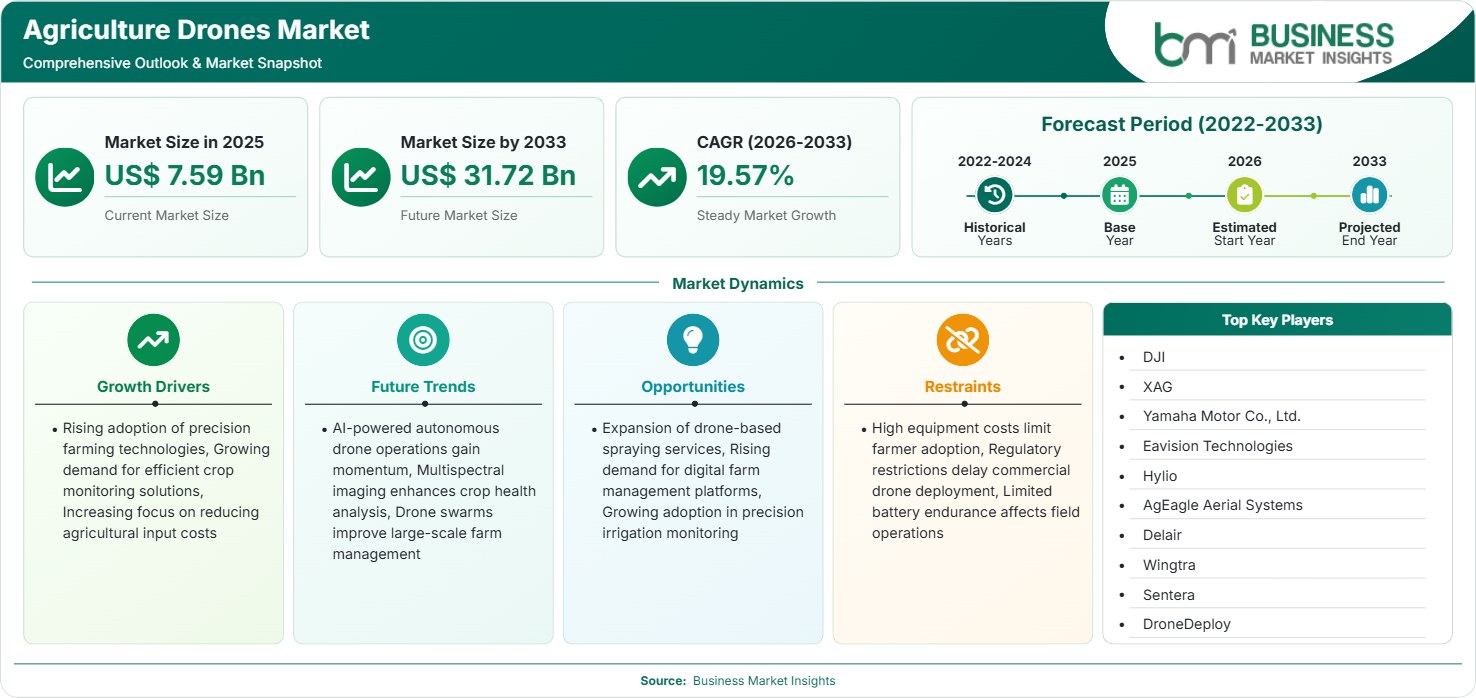
The Agriculture Drones Market size was valued at US$ 7.59 billion in 2025 and is projected to reach US$ 31.72 billion by 2033, growing at a CAGR of 19.57% during 2026–2033. Rising adoption of precision farming technologies, increasing demand for efficient crop monitoring solutions, and stronger emphasis on reducing agricultural input costs continue to accelerate market expansion.

Report Coverage
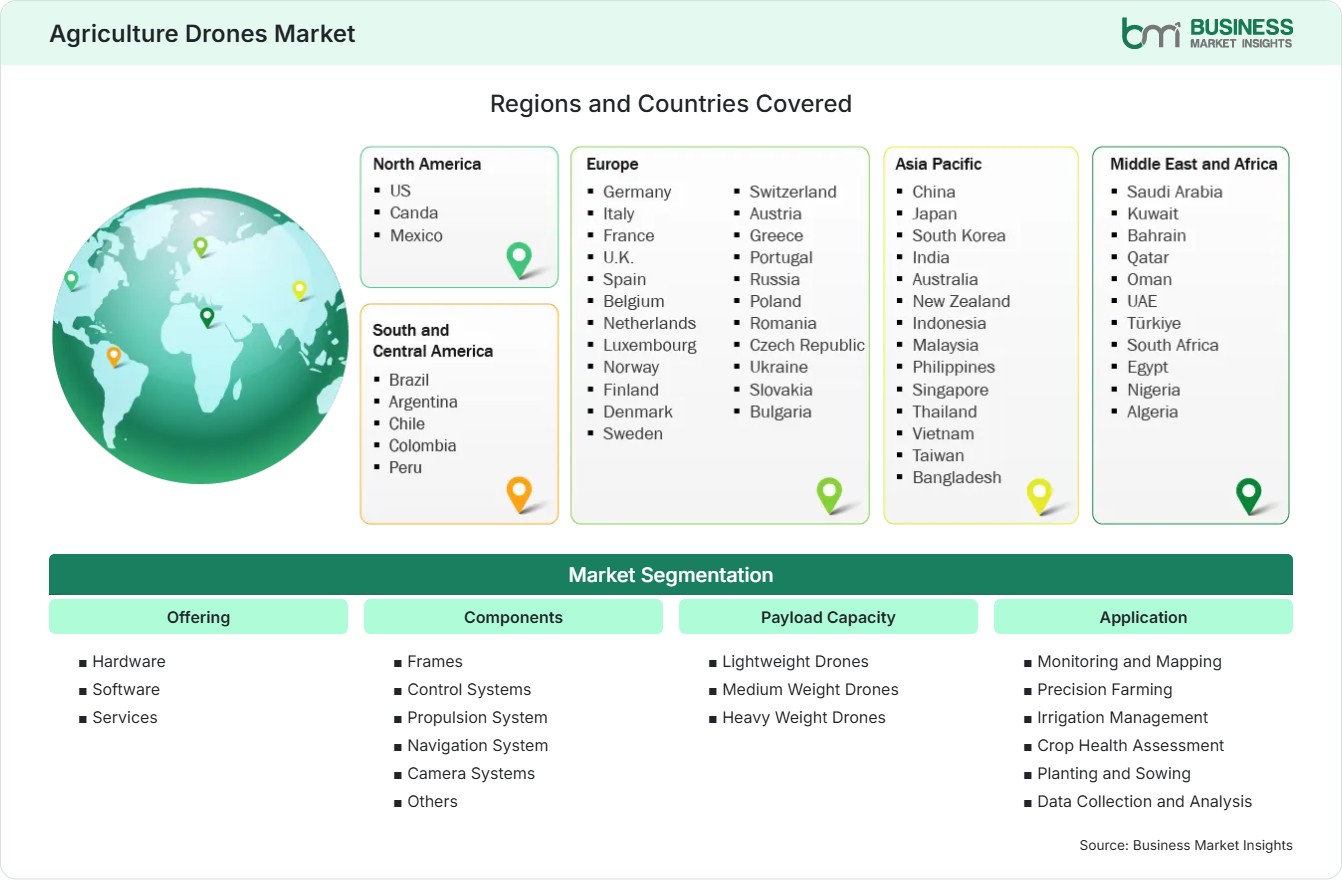
  • Offering: Hardware, Software, Services
  • Components: Frames, Control Systems, Propulsion System, Navigation System, Camera Systems, Others
  • Payload Capacity: Lightweight Drones , Medium Weight Drones , Heavy Weight Drones
  • Application: Monitoring and Mapping, Precision Farming, Irrigation Management, Crop Health Assessment, Planting and Sowing, Data Collection and Analysis
US$ 7.59 Bn Market size in 2025
US$ 31.72 Bn Market Size by 2033
19.57% CAGR, 2026 - 2033
2026-2033 Forecast Period

01 AI Overview

Agriculture Drones Market Summary

  • North America Region: North America accounts for 32%–35% market share in 2025 and is projected to expand at a CAGR of 18.7%–19.3% during 2026–2033. Strong adoption of precision agriculture, digital farm management, and commercial drone services supports regional demand. The U.S. remains the largest market with a CAGR of 18.9%–19.5%, driven by technological innovation and large-scale commercial farming.
  • Fastest Growing Region: Asia Pacific represents 34%–37% market share in 2025 and is expected to record a CAGR of 20.8%–21.5%, supported by increasing government initiatives, expanding mechanized farming, and rising investment in precision agriculture technologies.
  • Leading Segment: Hardware accounts for 58%–61% market share in 2025 and is anticipated to grow at a CAGR of 18.9%–19.6%, driven by increasing deployment of agricultural drones equipped with advanced imaging, navigation, and spraying capabilities.
  • High Growth Segment: Precision Farming captures 28%–31% market share in 2025 and is projected to register a CAGR of 21.2%–21.9%, supported by growing adoption of data-driven farming practices and precision crop management.
  • Key Market Opportunity: Increasing integration of artificial intelligence, cloud-based analytics, and autonomous flight technologies is creating new opportunities for precision agriculture and large-scale farm automation.
  • Major Market Players: DJI, XAG, Yamaha Motor Co., Ltd., Eavision Technologies, Hylio, AgEagle Aerial Systems, Delair, Wingtra, Sentera, and DroneDeploy.
02 Strategic Insights

Agriculture Drones Market: Strategic Insights

Agriculture Drones Market Strategic Framework
FREE PDF
Request your free sample
Request free sample
03 Stakeholder View

Key Takeaways

  • Precision agriculture continues transforming farm operations by enabling accurate monitoring, targeted input application, and improved crop productivity through advanced aerial intelligence.
  • Service-based drone deployment models are expanding access for small and medium-sized farms that seek advanced technologies without significant capital investment.
  • Artificial intelligence, machine learning, and multispectral imaging are becoming core technologies supporting automated crop analysis and precision farm management.
  • Asia Pacific presents the strongest long-term investment opportunity due to expanding agricultural modernization, supportive government policies, and increasing technology adoption among commercial growers.
  • Partnerships between drone manufacturers, agricultural technology firms, and digital platform providers are accelerating development of integrated smart farming ecosystems.
  • Growing focus on sustainable farming practices is encouraging adoption of drone technologies that reduce chemical usage, optimize irrigation, and improve environmental monitoring.
04 Geographic Outlook

Agriculture Drones Market Regional Highlights

North America Agriculture Drones Market

North America represents 32%–35% Agriculture Drones Market share in 2025 and is projected to register a CAGR of 18.7%–19.3% during 2026–2033. Large commercial farms, widespread precision agriculture adoption, and advanced digital farming infrastructure continue supporting regional expansion. Agricultural producers increasingly invest in drones equipped with multispectral imaging, automated flight planning, and advanced analytics to improve crop productivity and reduce operating costs.

  • Precision agriculture adoption continues increasing across large-scale grain, corn, soybean, and specialty crop farms.
  • Farm operators increasingly integrate drones with satellite imagery, GPS guidance, and farm management software.
  • Investments in autonomous spraying technologies improve operational efficiency while reducing chemical application costs.
  • Strong research collaboration accelerates innovation in agricultural robotics and intelligent farm automation.

US Agriculture Drones Market

The United States contributes 82%–85% of North American revenue and is expected to expand at a CAGR of 18.9%–19.5% through 2026–2033. Growing adoption of precision farming technologies, commercial drone services, and AI-enabled crop monitoring solutions continues supporting long-term market development.

  • Commercial farms increasingly adopt autonomous drones for mapping, spraying, and crop health assessment.
  • Investments in digital agriculture platforms strengthen farm productivity and operational decision-making.
  • Advanced sensor technologies improve crop monitoring accuracy and resource management.
  • Expansion of agricultural drone service providers improves technology accessibility for growers.

Europe Agriculture Drones Market

Europe accounts for 23%–26% market share in 2025 and is forecast to register a CAGR of 18.2%–18.9% during the forecast period. Sustainability objectives, precision farming initiatives, and increasing investments in agricultural digitalization continue driving regional demand. France leads adoption, while Spain records the fastest growth through expanding smart farming investments and modern irrigation practices.

  • Precision farming programs continue supporting technology adoption across commercial agriculture.
  • Environmental regulations encourage efficient fertilizer and pesticide application using drone technologies.
  • Digital agriculture investments strengthen demand for advanced mapping and crop monitoring systems.
  • Agricultural cooperatives increasingly deploy shared drone services for cost-effective farm management.

Asia Pacific Agriculture Drones Market

Asia Pacific holds 34%–37% market share in 2025 and is projected to record the fastest 20.8%–21.5% CAGR during 2026–2033. Rapid agricultural modernization, labor shortages, government subsidies, and expanding commercial farming continue driving strong regional demand. China remains the largest market, while India demonstrates the fastest growth supported by precision farming initiatives and expanding agricultural mechanization.

  • Government-supported smart agriculture programs continue accelerating drone deployment across farming regions.
  • Precision irrigation and crop monitoring technologies improve productivity while conserving natural resources.
  • Growing commercial farming operations increase investment in autonomous spraying and mapping drones.
  • Expansion of agricultural technology startups supports innovation in farm automation and digital agriculture.

Rest of World Agriculture Drones Market

The Rest of World region accounts for 5%–8% market share in 2025 and is anticipated to expand at a CAGR of 18.5%–19.2% during 2026–2033. Increasing agricultural modernization, commercial farming expansion, and government-backed digital farming initiatives continue supporting demand across Latin America, the Middle East, and Africa.

  • Brazil leads regional adoption through large-scale commercial farming and precision agriculture investments.
  • Gulf countries continue investing in smart irrigation and sustainable agricultural technologies.
  • Commercial farming expansion increases demand for advanced crop monitoring and spraying drones.
  • Technology partnerships improve access to digital farming solutions across emerging agricultural markets.
Global Market Geography
FREE PDF
Request your free sample
Request free sample
05 Segment Analysis

Agriculture Drones Market Segmentation

Offering

The offering segment accounts for the largest portion of industry revenue as hardware platforms remain essential for field operations, while software solutions improve mission planning and agronomic decision-making. It represented 58%–61% market share in 2025 and is expected to expand at a CAGR of 18.9%–19.6% during 2026–2033. Growing investment in integrated drone ecosystems continues widening the Agriculture Drones Market scope across commercial farming, plantation management, and precision agriculture applications.

  • Hardware: Maintains market leadership owing to rising deployment of fixed-wing and multirotor drones equipped with high-resolution cameras, precision spraying systems, advanced navigation modules, and intelligent flight controllers.
  • Software & Services: Registers strong adoption as farmers increasingly utilize cloud-based analytics, mission planning software, maintenance services, operator training, and drone-as-a-service platforms for efficient farm management.

Components

The components segment continues evolving with continuous improvements in flight efficiency, automation, and imaging technologies. It accounted for 26%–29% market share in 2025 and is projected to register a CAGR of 19.8%–20.5% during 2026–2033. Manufacturers are enhancing payload capability, navigation accuracy, and battery performance to improve operational efficiency across diverse agricultural environments.

  • Frames: Designed using lightweight composite materials that improve durability, payload support, and flight stability while enabling extended agricultural operations under varying field conditions.
  • Control Systems: Enable autonomous navigation, flight stability, route optimization, and precision spraying through intelligent onboard computing and real-time operational monitoring.
  • Propulsion System: Supports efficient flight performance by improving endurance, lifting capability, energy efficiency, and operational reliability across different agricultural applications.
  • Navigation System: Utilizes GPS, GNSS, RTK positioning, and obstacle avoidance technologies to deliver accurate flight paths and highly precise field coverage.
  • Camera Systems: Provide multispectral, thermal, RGB, and hyperspectral imaging capabilities for crop monitoring, disease identification, and vegetation health analysis.

Payload Capacity

Payload capacity significantly influences drone selection according to farm size, spraying requirements, and operational efficiency. The segment represented 44%–47% market share in 2025 and is anticipated to grow at a CAGR of 19.2%–19.9% through 2026–2033. Increasing adoption of specialized agricultural drones supports broader deployment across commercial farming operations requiring different carrying capacities.

  • Lightweight Drones (Upto 10 kg): Widely used for aerial mapping, crop surveillance, field inspections, and small-scale farming operations requiring agile and economical drone platforms.
  • Medium Weight Drones (Upto 10 - 25 Kg): Preferred for precision spraying, fertilizer application, and commercial farm monitoring because they balance payload capacity with operational flexibility.
  • Heavy Weight Drones (Above 25 kg): Gain traction among large commercial farms for high-volume spraying, seed distribution, and extended field operations requiring greater payload capability.

Application

Application diversity continues expanding as farmers increasingly adopt drones for multiple agricultural activities beyond aerial imaging. This segment accounted for 28%–31% market share in 2025 and is expected to register the fastest 21.2%–21.9% CAGR during the forecast period. Current Agriculture Drones Market trends indicate growing reliance on artificial intelligence, real-time analytics, and automated aerial operations to improve agricultural productivity and sustainability.

  • Monitoring and Mapping: Enables accurate field surveys, vegetation mapping, terrain assessment, and crop planning through high-resolution aerial imagery and advanced geographic information technologies.
  • Precision Farming: Supports targeted fertilizer application, variable-rate crop treatment, and data-driven farm management, improving productivity while reducing resource consumption.
  • Irrigation Management: Assists farmers in identifying moisture variability, irrigation inefficiencies, and water stress using multispectral and thermal imaging technologies.
  • Crop Health Assessment: Detects nutrient deficiencies, pest infestations, disease outbreaks, and vegetation stress before visible symptoms affect crop yield.
  • Planting and Sowing: Improves seed placement accuracy, planting efficiency, and labor productivity across large agricultural fields using autonomous drone systems.
  • Data Collection and Analysis: Generates actionable agricultural intelligence through aerial imaging, environmental monitoring, predictive analytics, and cloud-based farm management platforms.
06 Market Forces

Agriculture Drones Market Dynamics

Key Market Drivers

Rising adoption of precision farming technologies

Precision agriculture has been the way to increase agricultural productivity using optimized resources such as water, fertilizers, and pesticides. Agricultural drones with multispectral sensors, GPS, and AI technology help farmers make their decision-making process based on the current state of the field. It was stated by FAO that world food production needs to be increased significantly in order to satisfy future demands. These developments continue supporting Agriculture Drones Market growth by improving operational efficiency, reducing input waste, and enabling sustainable farming practices across commercial agriculture.

Growing demand for efficient crop monitoring solutions

Modern farmers are beginning to use drones for monitoring their crops so as to be able to notice stress, any nutritional deficiency, pests or problems with irrigation before it becomes serious. High resolution images coupled with cloud computing help them assess vast farmlands in a fast manner which could have taken a lot of efforts and time to do. Further developments in sensors and autonomous flight are making drone monitoring more accurate and affordable. With commercial agriculture expanding across the globe, there is an increased need for aerial monitoring.

Increasing focus on reducing agricultural input costs

Increasing costs associated with fertilizer, crop protection chemicals, fuel, and labor are motivating farmers to use technologies that increase efficiency. Drone technologies help apply fertilizers and other agricultural chemicals and deliver water more efficiently, reducing unnecessary input use and costs without affecting yield. These developments continue shaping Agriculture Drones Market trends, particularly among large farms seeking higher profitability through data-driven agricultural management.

Key Market Opportunities

Expansion of drone-based spraying services

The demand for professional services of drone spraying has become high because farmers want to gain access to the technology without having to make big investments. Drone companies have started providing commercial spraying services such as spraying pesticides, fertilizers, and other products that protect crops. Such business models provide an opportunity for small and medium-scale farms to access technology while generating income for drone service providers. Agriculture Drones Market Forecasts indicate continued expansion of service-based business models as precision agriculture adoption accelerates worldwide.

Rising demand for digital farm management platforms

The digital agriculture platforms have been emerging as key components of the modern-day agricultural management system through their incorporation of drone imagery, satellite imagery, weather forecasting, and crop analytics. The farmers rely increasingly on cloud platforms to track their crop performance, make optimal use of resources, and plan their future production effectively. There is continuous effort from software developers in improving the artificial intelligence features which allow for automatic analysis of the fields and providing agronomic suggestions.

Growing adoption in precision irrigation monitoring

Water conservation has become a strategic priority for agricultural producers facing changing climate conditions and increasing resource constraints. Drones fitted with thermal and multispectral sensors allow fast detection of inefficiencies in the irrigation system, moisture variability, and stress on crops due to lack of water in huge farmlands. This helps farmers schedule irrigation in an efficient manner while minimizing water usage and expenses. The growing focus on sustainable farming is set to offer robust growth prospects to manufacturers of agricultural drones.

Market Restraints and Challenges

High equipment costs limit farmer adoption

Advanced agricultural drones require significant investment in aircraft, sensors, software, batteries, and operator training. Factor: High cost associated with the process of acquisition and maintenance hinders affordability, especially for small and medium farms that operate under constrained financial means.  Impact: Farmers tend to delay adopting technologies or continue using traditional methods of farming, thus making it difficult to gain a foothold in the market, despite its obvious advantages in terms of efficiency.

Regulatory restrictions delay commercial drone deployment

Commercial agricultural drone operations remain subject to evolving aviation regulations governing pilot certification, airspace access, flight permissions, and operational safety. Factor: Regulatory disparities among different nations pose challenges to manufacturing industries and commercial drone operators seeking to expand their operations overseas. Impact: Time-consuming processes of getting approval and restrictive measures hamper the adoption of the technology, make its use less profitable, and raise costs of compliance for the companies providing services. Industry participants keep working with aviation bodies on developing uniform regulation.

07 Company Analysis

Competitive Landscape

Competition remains highly dynamic as manufacturers focus on autonomous flight technologies, precision spraying capabilities, artificial intelligence integration, and cloud-based farm analytics. Agriculture Drones Market analysis indicates that leading companies are expanding software ecosystems, improving payload efficiency, and developing integrated precision agriculture solutions to strengthen their global presence and support data-driven farming practices.

Company Name

Overview

Products and Services Relevant to this Market

DJI

Global leader in commercial drone technology with an extensive portfolio serving agriculture, infrastructure, surveying, and industrial applications.

Agricultural spraying drones, multispectral imaging systems, flight control software, intelligent farm management tools, and maintenance services.

XAG

Develops autonomous agricultural equipment focused on precision farming and smart agriculture technologies.

Agricultural drones, autonomous spraying systems, farm automation solutions, precision agriculture platforms, and digital farming services.

Yamaha Motor Co., Ltd.

Pioneer in unmanned agricultural aviation with decades of experience in crop spraying technologies.

Unmanned helicopters, agricultural drones, precision spraying equipment, crop management solutions, and technical support services.

Eavision Technologies

Specializes in AI-powered agricultural drones designed for precision spraying in challenging farming environments.

Autonomous spraying drones, obstacle avoidance systems, intelligent navigation software, and crop protection solutions.

Hylio

U.S.-based agricultural drone manufacturer focused on autonomous spraying technologies for commercial farming operations.

Heavy-lift spraying drones, autonomous flight systems, precision application technologies, and fleet management software.

AgEagle Aerial Systems

Provides drone technologies, sensors, and aerial intelligence solutions supporting precision agriculture and industrial applications.

Drone platforms, aerial imaging systems, multispectral sensors, GIS solutions, and agricultural analytics software.

Delair

Develops professional drone solutions for agriculture, infrastructure inspection, surveying, and industrial data collection.

Fixed-wing drones, mapping software, aerial intelligence platforms, and precision agriculture solutions.

Wingtra

Swiss drone manufacturer specializing in high-precision mapping and surveying technologies using VTOL drone platforms.

VTOL mapping drones, aerial survey solutions, agricultural mapping software, and geospatial data services.

Sentera

Develops sensor technologies and analytics platforms supporting precision agriculture and crop intelligence.

Multispectral cameras, crop analytics software, drone imaging solutions, and precision farming applications.

DroneDeploy

Cloud-based drone software provider delivering aerial mapping, analytics, and farm intelligence solutions globally.

Drone mapping platform, AI-powered analytics, farm data management, aerial inspection software, and workflow automation solutions.

10 Trust & Transparency

Research Methodology

The market analysis combines proprietary research with secondary data from government agencies, company disclosures, regulatory filings, industry databases and expert interviews. Market estimates are validated through data triangulation, cross-market benchmarking and analyst review.

View Full Research Methodology

11 Questions Answered

Frequently Asked Questions

What does the Agriculture Drones Market Report include?

The Market Report provides detailed insights into market segmentation, competitive landscape, regional performance, technological innovations, regulatory developments, emerging investment opportunities, and long-term industry outlook.

Which region offers the greatest market opportunity?

Asia Pacific presents the strongest growth opportunity due to expanding agricultural modernization, supportive government initiatives, increasing mechanization, and rising investments in digital farming technologies across major agricultural economies.

Why are agricultural drones becoming more popular among farmers?

Agricultural drones provide faster field monitoring, precise chemical application, improved irrigation management, reduced labor requirements, and real-time crop intelligence, allowing farmers to enhance productivity while lowering operational expenses.

Which application dominates the Market?

Precision farming represents the leading application because it enables accurate crop management, optimized fertilizer application, efficient pesticide spraying, and data-driven farming decisions that improve productivity and reduce operating costs.

What is driving growth in the Agriculture Drones Market?

The market is expanding due to increasing adoption of precision farming, growing demand for crop monitoring, rising labor shortages, advancements in drone technology, and stronger emphasis on improving agricultural productivity while reducing resource consumption.

Access the Full Agriculture Drones Market Report

Get segment-level forecasts, regional estimates, competitive benchmarking, company profiles and downloadable Excel datasets.

Access the full Agriculture Drones Market Report
350 pages PDF & Excel | 2026-08-12