Market Summary
Executive Summary and Global Market Analysis
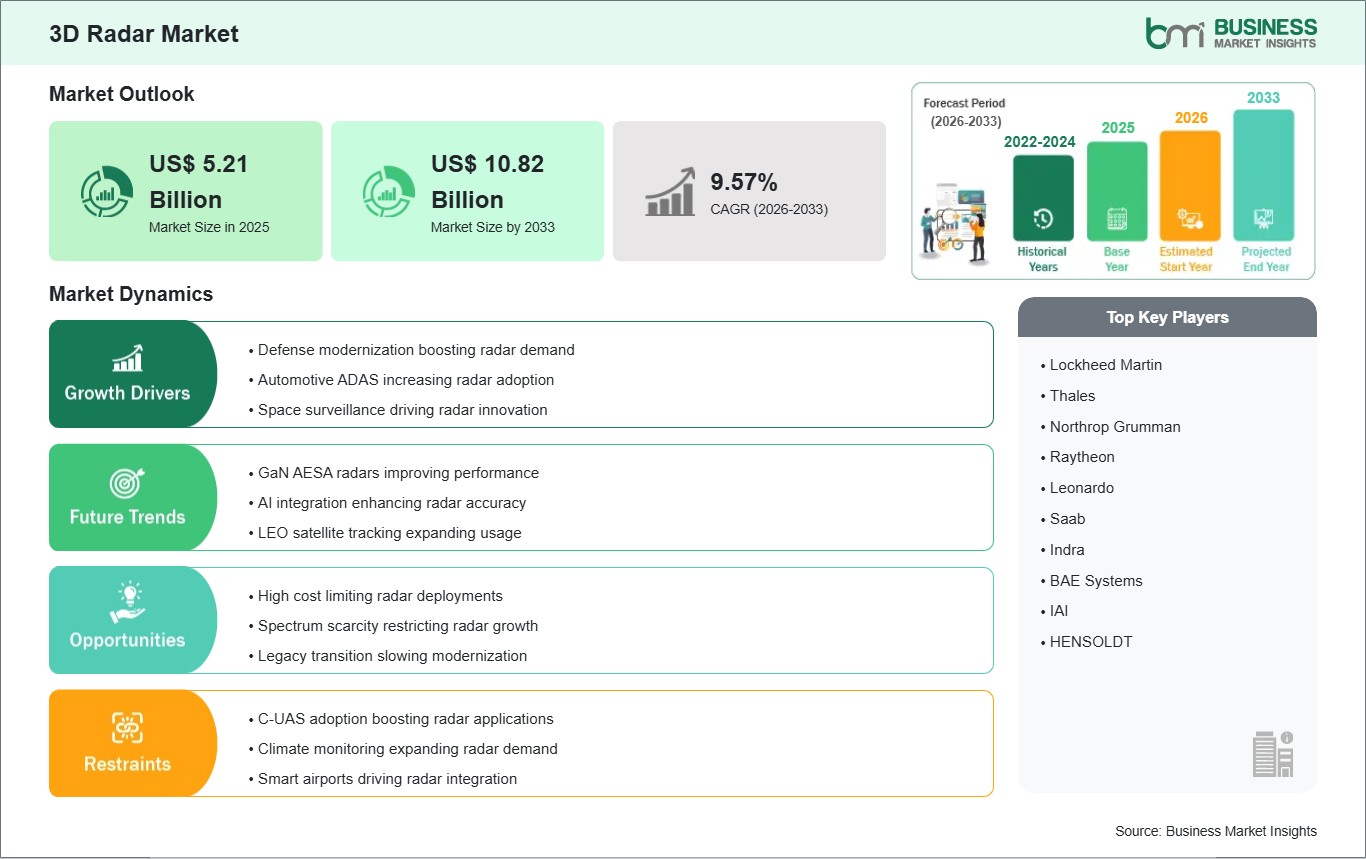
3D radar systems are advanced radar technologies used to detect and track objects by measuring their range, direction, altitude, and movement in real time. These systems are widely used in defense, air traffic control, weather monitoring, automotive safety, and naval surveillance applications. The market is growing due to increasing demand for advanced surveillance systems, rising defense modernization programs, and growing focus on border security and threat detection capabilities. Governments and industries are investing in radar systems that offer improved accuracy, faster target tracking, and enhanced situational awareness across complex operational environments. The growing use of autonomous systems, smart transportation infrastructure, and advanced aviation technologies is also supporting the expansion of the 3D Radar market.
There are several challenges affecting the development and deployment of 3D radar technologies. High development and installation costs can limit adoption among smaller organizations and developing regions. Radar systems also require complex infrastructure, advanced calibration, and skilled operators for efficient performance. Signal interference, spectrum congestion, and environmental conditions can affect radar accuracy and operational efficiency in some applications. In addition, cybersecurity concerns and the need for continuous software upgrades create additional operational and maintenance challenges for end users.
Despite these challenges, the market is expected to grow steadily with advancements in digital signal processing, artificial intelligence, and integrated surveillance systems. Increasing adoption of smart transportation systems, autonomous vehicles, and next-generation defense technologies is creating new opportunities for advanced radar applications. The expansion of air traffic management infrastructure and rising investments in weather monitoring systems are also contributing to long-term market growth. As industries focus on safety, automation, and real-time monitoring capabilities, the global 3D Radar market is expected to expand significantly over the coming years.
Segment Analysis
3D Radar Market Segmentation
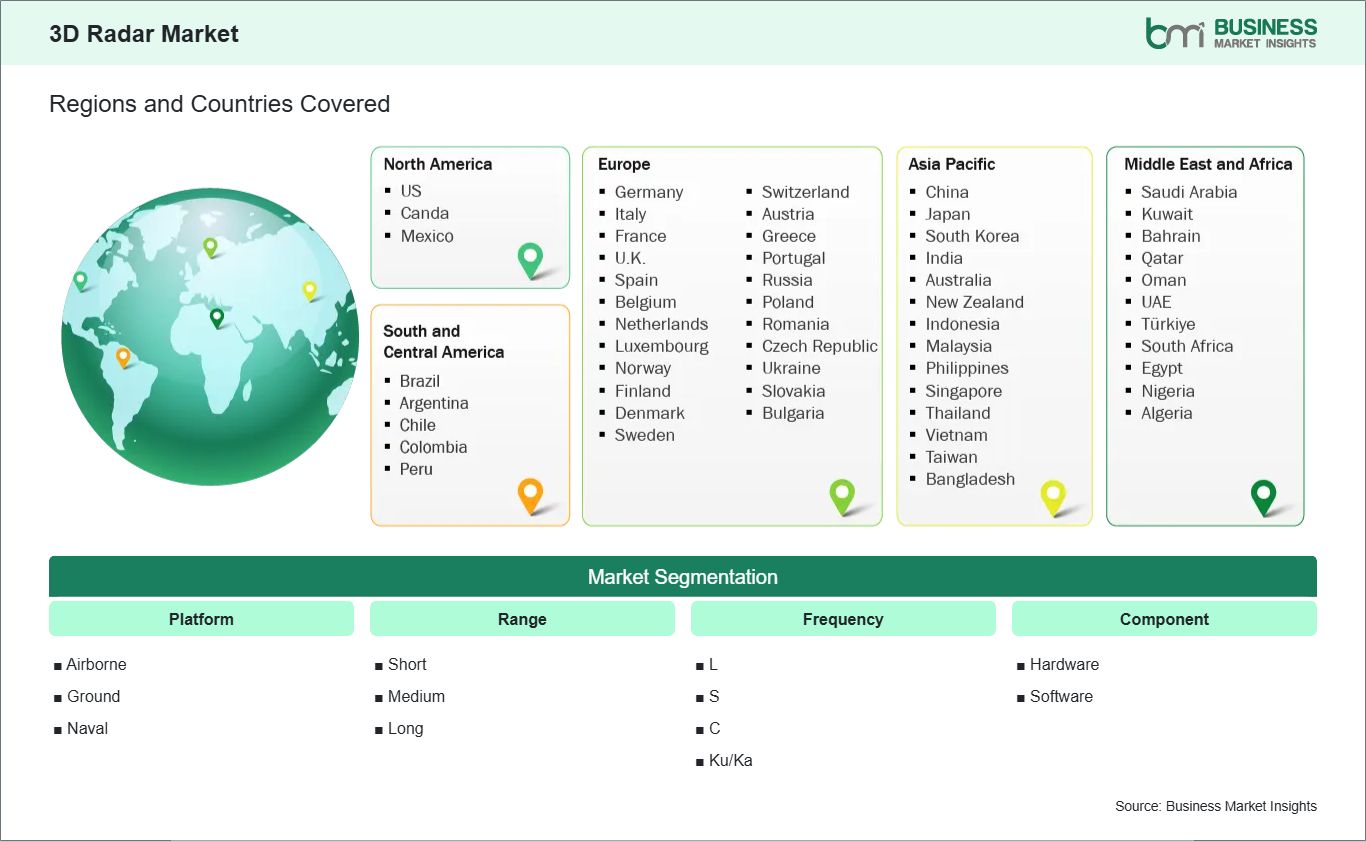
The 3D Radar Market is segmented based on platform, range, frequency, component, and application. Increasing investments in surveillance systems, defense modernization, and smart monitoring technologies are driving growth across major market segments.
By Platform:
- Airborne: Airborne radar systems are widely used for surveillance, target detection, navigation, and defense operations.
- Ground: Ground-based radar systems hold significant demand for border monitoring, military surveillance, and air defense applications.
- Naval: Naval radar systems are gaining adoption for maritime surveillance, threat detection, and coastal security operations.
By Range:
- Short: Short-range radar systems are commonly used for automotive safety, industrial monitoring, and localized surveillance.
- Medium: Medium-range radar systems support airspace monitoring and tactical defense applications.
- Long: Long-range radar systems dominate due to their importance in large-scale surveillance and strategic defense operations.
By Frequency:
- L: L-band radar systems are widely used for long-range detection and air surveillance applications.
- S: S-band radar systems support weather monitoring and maritime surveillance operations.
- C: C-band radar systems are used for defense communication and tracking applications.
- Ku/Ka: Ku/Ka band systems are gaining importance for high-resolution imaging and advanced tracking capabilities.
By Component:
- Hardware: Hardware components dominate the market due to their essential role in radar transmission, reception, and signal processing.
- Software: Software solutions are expanding steadily with increasing demand for real-time analytics, automation, and integrated radar management systems.
By Application:
- Defense: Defense applications hold a major share due to rising military modernization and border surveillance requirements.
- ATC: Air traffic control systems are adopting advanced radar technologies to improve flight monitoring and airspace safety.
- Automotive: Automotive radar applications are growing with increasing adoption of advanced driver assistance systems and autonomous vehicles.
- Weather: Weather monitoring systems use 3D radar technologies for storm tracking and climate observation activities.
Market Forces
3D Radar Market Drivers and Opportunities
Increasing Demand for Advanced Surveillance and Defense Systems
The demand for 3D radar systems is increasing because governments and defense organizations are focusing more on advanced surveillance, threat detection, and border security capabilities. Modern radar systems help detect airborne, ground, and naval threats with improved accuracy and real-time tracking functions. Growing geopolitical tensions and rising investments in military modernization programs are encouraging the adoption of advanced radar technologies across defense sectors. Air traffic control authorities are also upgrading radar infrastructure to improve airspace monitoring and flight safety operations.
The increasing use of radar systems in automotive safety and weather forecasting is further supporting market growth. Advanced driver assistance systems and autonomous vehicle technologies rely on radar sensors for obstacle detection and navigation support. Weather agencies are using 3D radar technologies for storm tracking, rainfall monitoring, and disaster management activities. Advancements in digital signal processing, artificial intelligence, and sensor integration are helping improve radar performance and operational efficiency. The growing focus on real-time monitoring, automation, and national security is contributing significantly to the expansion of the global 3D Radar market.
Rising Integration of AI, Smart Infrastructure, and Autonomous Technologies
The 3D Radar market is creating new opportunities through the integration of artificial intelligence, smart infrastructure, and autonomous systems across multiple industries. AI-enabled radar systems can process large amounts of data quickly, improve target recognition, and support automated threat analysis. Smart transportation projects and connected infrastructure are increasing the demand for radar technologies that support traffic monitoring, intelligent navigation, and public safety operations. The expansion of autonomous vehicles and unmanned systems is also creating strong opportunities for advanced radar integration.
Defense organizations are investing in next-generation radar systems capable of supporting network-centric warfare and multi-domain operations. The increasing adoption of smart cities and digital infrastructure is encouraging the deployment of radar technologies for surveillance, traffic management, and environmental monitoring. Advancements in miniaturization, cloud connectivity, and high-frequency radar technologies are supporting the development of compact and efficient radar systems. Industries are also focusing on improving cybersecurity and data analytics capabilities within radar platforms. As automation and intelligent monitoring systems continue to expand globally, the demand for advanced 3D radar technologies is expected to grow steadily across commercial, industrial, and defense applications.
Size and Share Analysis
3D Radar Market Size and Share Analysis
The 3D Radar Market is projected to grow from US$ 5.21 Billion in 2025 to US$ 10.82 Billion by 2033 , registering a CAGR of 9.57% from 2026 to 2033.
By platform, airborne radar systems hold a significant share due to their widespread use in military aircraft, surveillance operations, and air traffic management systems. Ground-based radar systems continue to witness strong adoption for border security and defense monitoring applications, while naval radar systems are expanding steadily with increasing investments in maritime surveillance and coastal protection activities.
By range, long-range radar systems dominate the market because of their importance in strategic surveillance and threat detection operations. Medium-range systems are growing steadily across defense and aviation sectors, while short-range radar technologies are gaining adoption in automotive safety and industrial monitoring applications. By frequency, L and S bands hold major demand due to their extensive use in surveillance and weather monitoring applications, while Ku/Ka band systems are witnessing increasing adoption for high-resolution imaging and advanced communication capabilities.
By component, hardware accounts for a significant share because of its critical role in radar transmission, reception, and processing operations. Software solutions are gaining importance with increasing demand for real-time analytics, artificial intelligence integration, and automated monitoring systems. By application, defense dominates the market owing to rising military modernization programs and security concerns, while ATC, automotive, and weather applications are witnessing steady growth with increasing investments in smart infrastructure and safety technologies.
Report Coverage
3D Radar Market Report Coverage and Deliverables
The "3D Radar Size and Forecast (2022-2033)" report provides a detailed analysis of the market covering below areas:
- Market size and forecast at global, regional, and country levels for all the key market segments covered under the scope
- Market trends, as well as market dynamics such as drivers, restraints, and key opportunities
- Market analysis covering key market trends, global and regional framework, major players, regulations, and recent market developments
- Industry landscape and competition analysis covering market concentration, heat map analysis, prominent players, and recent developments for the market
- Detailed company profiles, including SWOT analysis
Geographic Insights
3D Radar Market Geographic Insights
The 3D Radar Market shows diverse regional adoption patterns influenced by defense modernization programs, airspace monitoring requirements, smart infrastructure development, and increasing investments in surveillance technologies.
North America, being a developed region, has a strong defense infrastructure and advanced aerospace capabilities supporting the adoption of 3D radar systems. The region comprises the United States and Canada, where investments are being made in military surveillance systems, air traffic management infrastructure, and advanced automotive safety technologies. The region focuses on improving national security, border monitoring, and aerospace defense operations through the deployment of next-generation radar technologies. It has established research capabilities and technological expertise that support continuous advancements in radar signal processing, artificial intelligence integration, and autonomous monitoring systems. The increasing demand for weather forecasting systems and smart transportation infrastructure is also contributing to market growth across the region.
Asia Pacific is growing significantly due to increasing defense spending, rapid industrialization, and expanding transportation infrastructure. The region comprises countries such as China, India, Japan, and South Korea, where governments are investing in military modernization, smart city projects, and advanced surveillance systems. The region is witnessing rising adoption of radar technologies for air defense, naval operations, weather monitoring, and automotive safety applications. Expanding airport infrastructure and increasing focus on border security are further supporting the growth of the 3D Radar market across the region.
Both regions are contributing significantly to the growth of the 3D Radar Market, supported by technological innovation, infrastructure modernization, increasing security requirements, and rising demand for advanced real-time monitoring systems.
Industry Activity
Recent Developments
The 3D Radar Market is analyzed using a mix of primary and secondary research sources, including corporate publications, industry associations, and verified databases. This approach ensures accurate tracking of innovation trends and strategic developments influencing the market.
- In March 2024, Lockheed Martin completed additional testing activities for its next-generation long-range radar systems designed for air and missile defense applications. The development focused on improving target detection accuracy, integrated surveillance capabilities, and operational efficiency across complex defense environments. These advancements support the growing demand for modern radar technologies in military operations.
- In September 2023, RTX Corporation expanded its advanced radar technology portfolio by focusing on integrated air defense and surveillance solutions for military and aerospace applications. The company emphasized enhanced situational awareness, digital radar processing, and next-generation tracking capabilities to support evolving defense requirements. These developments are contributing to the modernization of global radar infrastructure.
Trust & Transparency
Research Methodology
The market analysis combines proprietary research with secondary data from government agencies, company disclosures, regulatory filings, industry databases and expert interviews. Market estimates are validated through data triangulation, cross-market benchmarking and analyst
review.
View Full Research Methodology
Key Sources Referred:
Defense and Aerospace Industry Reports Government Defense and Aviation Publications Company Annual Reports and Filings Technical Journals Research Publications Industry Associations Air Traffic Management and Weather Monitoring Reports