Market Summary
Executive Summary and Global Market Analysis
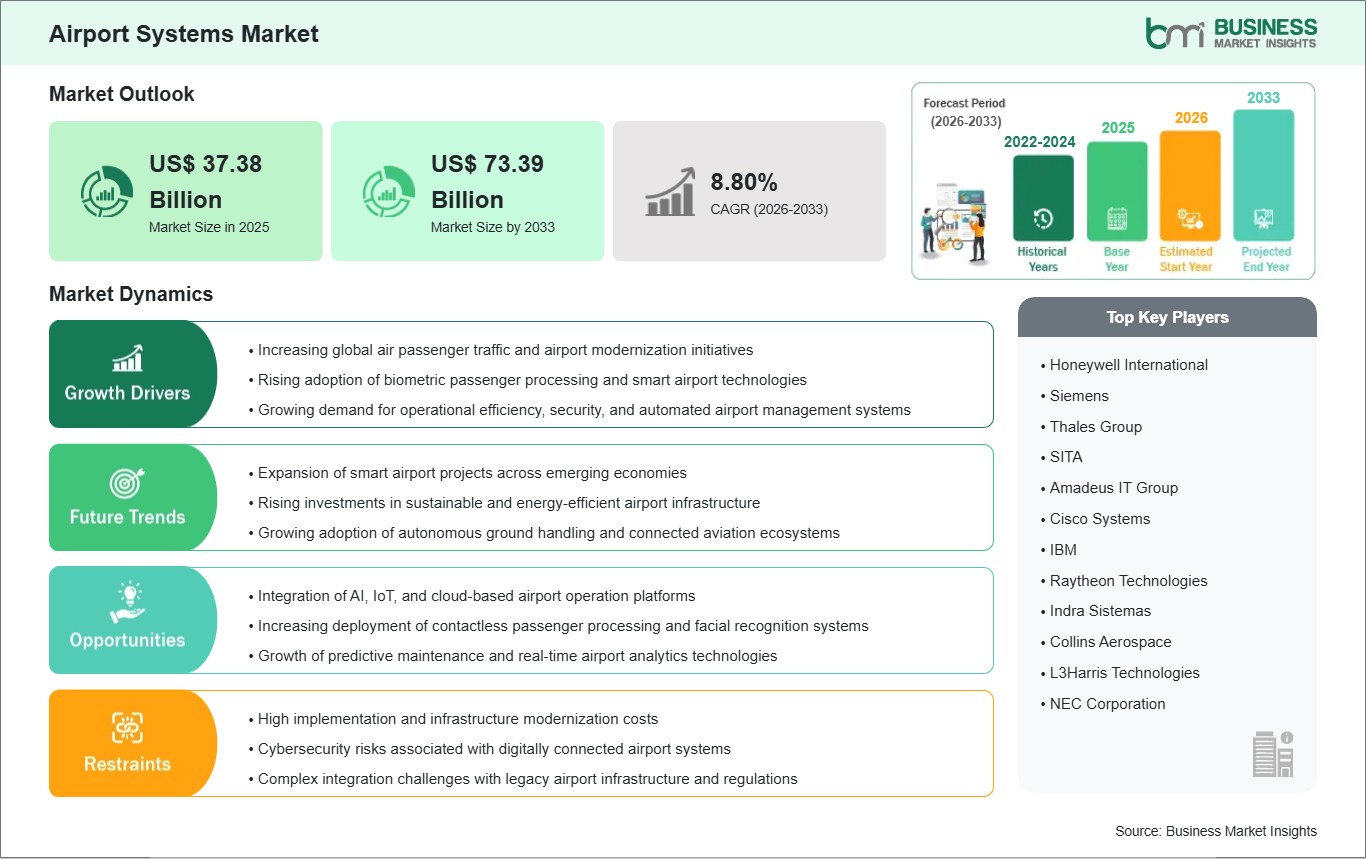
Airport Systems refer to the integrated technological, operational, and infrastructure-based solutions deployed across airport environments to enable efficient airside and landside operations, passenger management, aircraft handling, security enforcement, and real-time airport coordination. These systems encompass a wide range of technologies including airport operation control centers (AOCC), baggage handling systems, passenger processing systems, air traffic management support infrastructure, airport communication networks, biometric identification platforms, security screening systems, smart surveillance technologies, gate management systems, digital signage, and advanced airport IT solutions. Modern airport systems increasingly rely on artificial intelligence (AI), Internet of Things (IoT), cloud computing, digital twins, predictive analytics, and automation technologies to optimize operational efficiency, reduce passenger wait times, enhance safety standards, and improve overall airport experience. The growing global air passenger traffic, rapid airport modernization initiatives, expansion of smart airport programs, and increasing investments in aviation infrastructure development are significantly driving market growth. Additionally, rising emphasis on contactless passenger processing, cybersecurity integration, and real-time operational visibility is accelerating the adoption of next-generation airport systems across both developed and emerging economies.
However, several factors may hinder the growth trajectory of the airport systems market. The deployment of advanced airport infrastructure requires substantial capital investment, particularly for integrated automation platforms, intelligent security systems, and digital airport transformation initiatives, creating financial barriers for small and mid-sized airports. Integration complexities associated with legacy airport infrastructure and interoperability challenges between multiple vendors and system architectures further increase implementation costs and operational risks. The market also faces growing cybersecurity concerns as increasing airport digitalization exposes critical aviation infrastructure to potential cyber threats, ransomware attacks, and data breaches. Regulatory compliance requirements associated with aviation safety, passenger data privacy, and international operational standards add further complexity to system deployment and maintenance. In addition, prolonged procurement cycles, high maintenance costs, shortage of skilled technical personnel, and operational disruptions during infrastructure upgrades may limit rapid adoption across certain regions. Economic uncertainties, fluctuations in air travel demand, and geopolitical instability can also delay airport expansion projects and reduce infrastructure spending by governments and private operators.
Despite these challenges, the long-term outlook for the airport systems market remains highly optimistic as the global aviation industry transitions toward intelligent, automated, and passenger-centric airport ecosystems. Significant opportunities are emerging through the convergence of AI-driven airport analytics, biometric authentication, autonomous ground handling technologies, and cloud-native airport management platforms capable of delivering real-time operational intelligence and predictive decision-making capabilities. The rapid expansion of smart airports and sustainable aviation infrastructure is accelerating demand for energy-efficient building management systems, digital passenger engagement solutions, and intelligent resource allocation platforms. Furthermore, increasing adoption of self-service kiosks, e-gates, facial recognition technologies, and touchless security screening systems is reshaping passenger processing workflows while improving operational throughput and traveler satisfaction. The growth of connected aviation ecosystems, supported by 5G-enabled communication networks and edge computing architectures, is also enabling highly responsive airport operations with improved situational awareness and reduced system latency. Ongoing investments in airport expansion projects across Asia-Pacific, the Middle East, and other high-growth aviation regions, combined with advancements in AI-powered surveillance, predictive maintenance, and integrated airport command platforms, are expected to position the airport systems market for sustained growth as a critical enabler of next-generation aviation infrastructure and smart transportation networks.
Segment Analysis
Airport Systems Market Segmentation
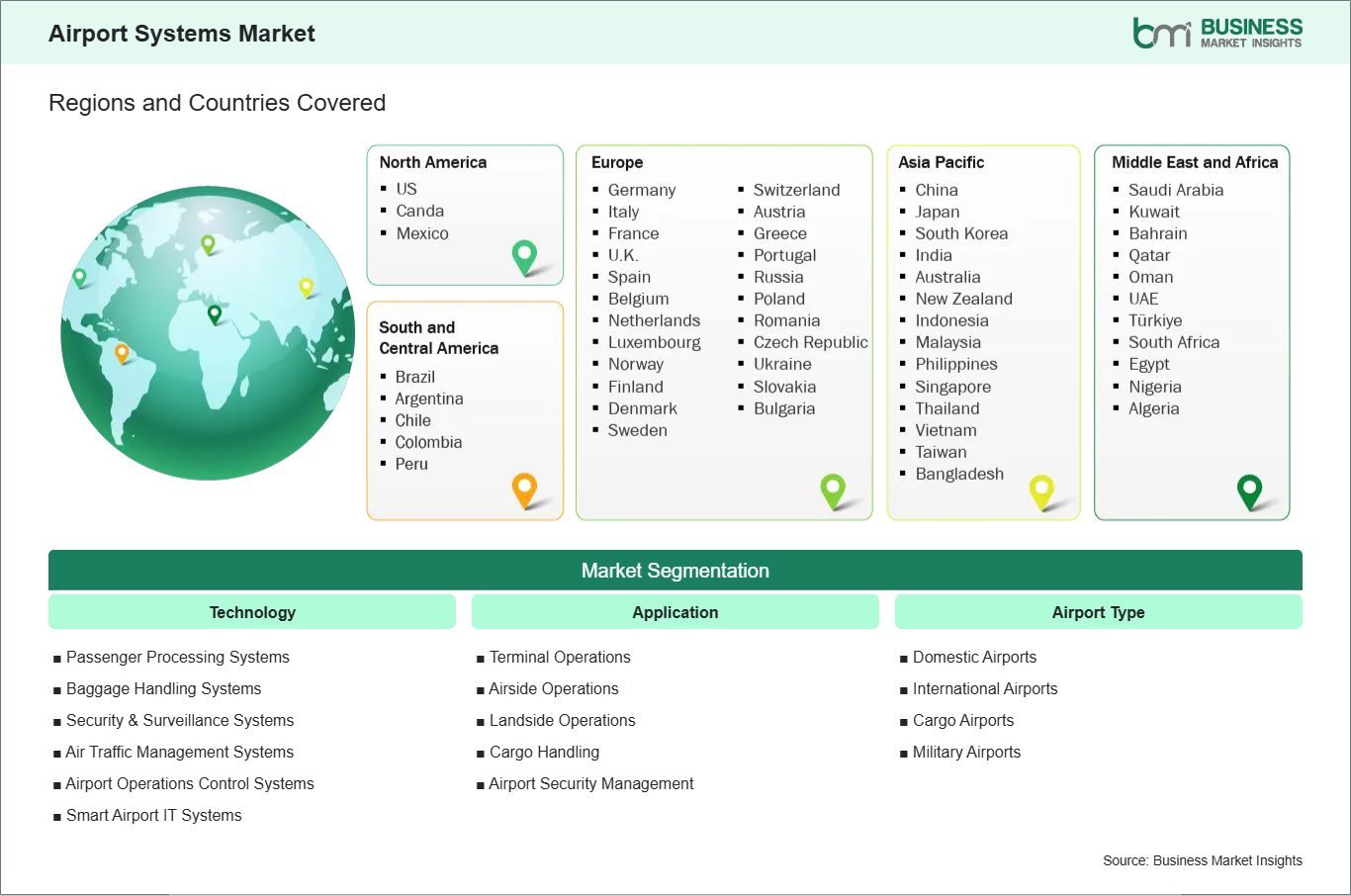
The airport systems marketis segmented based on component, implementation, type, application, and end use, reflecting the increasing adoption of intelligent airport infrastructure, automation technologies, and digital aviation ecosystems across global airports.
By Component
- Hardware: Includes physical airport infrastructure technologies such as surveillance cameras, baggage handling equipment, radar systems, biometric scanners, networking devices, and communication hardware essential for airport operations
- Software: Covers airport management platforms, AI-powered analytics systems, passenger processing software, predictive maintenance solutions, cybersecurity platforms, and integrated operational control applications
- Services: Encompasses consulting, system integration, maintenance, managed services, technical support, and training services required for deployment and ongoing airport system operations
By Implementation
- New Installations: Refers to deployment of airport systems in newly constructed airports, terminal expansions, and greenfield aviation infrastructure projects
- Upgrade & Modernization: Includes modernization of existing airport infrastructure through integration of smart technologies, automation systems, cloud platforms, and digital transformation initiatives
By Type
- Passenger Processing Systems: Includes self-service kiosks, biometric authentication, e-gates, boarding systems, check-in solutions, and queue management platforms designed to improve passenger throughput and convenience
- Baggage Handling Systems (BHS): Covers automated baggage sorting, tracking, conveyor management, RFID-enabled baggage systems, and intelligent baggage reconciliation technologies
- Air Traffic Management Systems (ATM): Includes air traffic control support systems, navigation infrastructure, runway monitoring, flight coordination, and real-time airspace management technologies
- Security & Surveillance Systems: Encompasses AI-powered video surveillance, access control systems, perimeter security, threat detection, facial recognition, and passenger screening technologies
- Information & Communication Systems: Includes airport communication networks, operational databases, digital signage, flight information display systems (FIDS), and integrated communication platforms
- Ground Support Systems: Covers aircraft ground handling technologies, fueling coordination systems, gate management solutions, and airport vehicle monitoring systems
- Emergency Response Systems: Includes incident management systems, fire safety technologies, emergency communication platforms, disaster response coordination, and crisis management solutions
- Others: Includes additional airport operational technologies supporting airport efficiency, sustainability, and passenger experience enhancement
By Application
- Airside: Focuses on runway operations, aircraft movement management, air traffic coordination, apron monitoring, and ground handling activities within secured airport operational zones
- Terminal Side: Covers passenger movement, baggage processing, security screening, boarding operations, and terminal facility management to optimize traveler experience and operational efficiency
- Landside: Includes airport access management, parking systems, transportation coordination, public safety systems, and external airport infrastructure management
By End Use
- Commercial Airports: Includes large-scale passenger airports requiring advanced operational systems, passenger management technologies, and integrated security infrastructure
- Private Airports: Covers corporate and business aviation facilities adopting smart airport technologies for operational efficiency, safety, and premium passenger services
- Military Airports: Includes defense aviation facilities utilizing specialized airport systems for surveillance, secure communication, mission coordination, and military aircraft operations
Market Forces
Airport Systems Market Drivers and Opportunities
Rising Air Passenger Traffic, Smart Airport Modernization, and Demand for Operational Efficiency
The Airport Systems market is being driven by the rapid growth in global air passenger traffic, increasing airport congestion, and the rising need for intelligent airport infrastructure capable of improving operational efficiency and passenger experience. Modern airports are increasingly deploying advanced airport systems including automated baggage handling systems, biometric passenger processing platforms, AI-powered surveillance solutions, airport operation control centers (AOCC), and integrated communication systems to streamline both airside and landside operations. Unlike traditional airport infrastructure, next-generation airport systems leverage artificial intelligence, IoT connectivity, cloud computing, and predictive analytics to deliver real-time operational visibility, improve resource allocation, and reduce delays across airport ecosystems. The growing adoption of smart airport initiatives by governments and aviation authorities is significantly accelerating market demand, particularly as airports seek to enhance passenger throughput, strengthen security standards, and optimize terminal operations.
Increasing investments in airport expansion projects, terminal modernization programs, and aviation infrastructure development are further contributing to market growth. The rising emphasis on contactless passenger processing, especially after the global shift toward health-conscious travel environments, is accelerating the deployment of biometric authentication, self-service kiosks, facial recognition systems, and automated security screening technologies. In addition, the expansion of international tourism, low-cost carrier networks, and cargo aviation activities is increasing pressure on airports to adopt scalable and intelligent operational systems. Regulatory mandates associated with aviation safety, cybersecurity compliance, and passenger data management are also encouraging airports to upgrade legacy infrastructure with digitally integrated platforms. Furthermore, advancements in AI-enabled predictive maintenance, real-time airport analytics, and automated ground support systems are improving airport operational resilience while reducing maintenance costs and downtime. Collectively, these factors are driving sustained market expansion as airports transition toward highly connected, automated, and passenger-centric aviation ecosystems.
Rising Integration of AI, Biometrics, and Connected Smart Airport Ecosystems
Opportunities in the Airport Systems market are expanding rapidly through the integration of artificial intelligence, biometric identification technologies, cloud-native airport platforms, and connected aviation ecosystems. AI-powered airport systems are enabling advanced capabilities such as predictive passenger flow management, intelligent baggage tracking, automated threat detection, and real-time airport resource optimization, significantly improving operational decision-making and airport efficiency. The adoption of biometric technologies including facial recognition, iris scanning, and touchless identity verification is creating major growth opportunities by enabling frictionless passenger journeys, reducing queue times, and enhancing airport security frameworks.
The evolution of smart airports and digital aviation infrastructure is further generating strong opportunities for integrated airport management platforms capable of synchronizing air traffic operations, terminal management, security systems, and passenger engagement services through centralized data-driven architectures. Increasing deployment of IoT-enabled sensors, 5G communication networks, and edge computing technologies is enabling highly responsive airport operations with real-time situational awareness and low-latency communication capabilities..
Size and Share Analysis
Airport Systems Market Size and Share Analysis
The Airport Systems Market is projected to grow from US$ 37.38 Billion in 2025 to US$ 73.39 Billion by 2033 , registering a CAGR of 8.80% from 2026 to 2033.
By component, hardware accounts for a significant share due to the extensive deployment of surveillance systems, biometric scanners, baggage handling equipment, communication devices, and airport operational infrastructure required to support growing passenger volumes and security requirements. Software solutions are witnessing rapid growth as airports increasingly adopt AI-powered airport management platforms, predictive analytics systems, cloud-based operational control solutions, and cybersecurity applications to improve efficiency and real-time decision-making. Services continue to expand steadily owing to rising demand for system integration, maintenance, consulting, managed services, and airport digital transformation support across both developed and emerging aviation markets.
By implementation, upgrade and modernization projects dominate the market as airports worldwide increasingly focus on transforming legacy infrastructure into smart, connected, and automated airport ecosystems. Airports are investing heavily in biometric passenger processing, AI-enabled surveillance, self-service technologies, and advanced operational control systems to improve passenger throughput and operational resilience. New installations are also growing significantly due to the expansion of greenfield airport projects, terminal construction programs, and aviation infrastructure investments across rapidly developing economies. The increasing focus on urban infrastructure management and public safety fuels growth in this segment.
Report Coverage
Airport Systems Market Report Coverage and Deliverables
The "Airport Systems Market Size and Forecast (2022–2033)" report provides a detailed analysis of the market covering below areas:
- airport systems market size and forecast at global, regional, and country levels for all market segments covered under the scope
- airport systems market trends, as well as drivers, restraints, and opportunities
- airport systems market analysis covering key trends, global and regional framework, major players, regulations, and recent developments
- Industry landscape and competition analysis covering market concentration, heat map analysis, prominent players, and recent developments for the airport systems market
- Detailed company profiles, including SWOT analysis
Geographic Insights
Airport Systems Market Geographic Insights
The Airport Systems Market demonstrates diverse regional growth patterns influenced by increasing air passenger traffic, airport modernization initiatives, rising investments in aviation infrastructure, and the growing adoption of smart airport technologies across global transportation networks.
North America holds a significant position in the airport systems market due to the presence of highly advanced aviation infrastructure, strong technology adoption rates, and continuous investments in airport modernization projects. The United States and Canada are witnessing increasing deployment of AI-powered surveillance systems, biometric passenger processing platforms, automated baggage handling technologies, and integrated airport operation control centers (AOCC). The region is strongly focused on improving airport operational efficiency, strengthening aviation security frameworks, and enhancing passenger experience through digital transformation initiatives. Rising investments in cybersecurity infrastructure, real-time airport analytics, and cloud-based airport management systems are further supporting market growth. Additionally, the presence of leading airport technology providers, advanced communication infrastructure, and early adoption of automation technologies are accelerating deployment across major international and regional airports. Growing emphasis on smart airport ecosystems, sustainable airport operations, and contactless passenger processing is also contributing significantly to regional market expansion.
Asia Pacific is experiencing the fastest growth in the airport systems market, driven by rapid urbanization, expanding middle-class air travel demand, and large-scale airport construction and modernization projects across emerging economies. Countries such as China, India, Japan, South Korea, and Singapore are heavily investing in smart airport infrastructure, automated passenger processing systems, AI-based surveillance technologies, and integrated airport communication networks to support rising aviation demand. The region’s strong electronics manufacturing ecosystem and growing investments in digital aviation transformation are enabling large-scale deployment of advanced airport technologies at competitive costs. Increasing government initiatives to develop world-class aviation infrastructure, expansion of low-cost carrier networks, and rising international tourism are further accelerating adoption. Additionally, growing investments in 5G-enabled airport connectivity, autonomous ground handling systems, and cloud-native airport management platforms are driving innovation and long-term market expansion across the region..
Both regions are contributing significantly to the growth of the Airport Systems Market, driven by increasing investments in intelligent airport ecosystems, digital aviation technologies, automation platforms, and passenger-centric airport modernization strategies..
Industry Activity
Recent Developments
The airport systems marketis evaluated by gathering qualitative and quantitative data post primary and secondary research, which includes important corporate publications, association data, and databases. A few of the key developments in the airport systems marketare:
- In May 2026, Vaisala launches the Vaisala Automatic Weather Station AWS810 Airport Edition, a new, purpose-built solution designed to help airports maintain continuous, compliant weather observations as infrastructure ages, traffic grows, and regulatory requirements tighten. The system delivers precise measurements across the airfield, supporting confident decision-making for air traffic control, meteorological services, and airport operations.
- In March 2026, Modaxo Inc., announced the launch of Aerivo, a new brand and organisation that provides Airport Terminal Systems, acquired from ADB SAFEGATE. Aerivo is a leading provider of cloud-based systems used throughout the airport terminal ecosystem, partnering with airports around the world and dedicated to driving efficiency and reliability by optimising airside operations.
Trust & Transparency
Research Methodology
The market analysis combines proprietary research with secondary data from government agencies, company disclosures, regulatory filings, industry databases and expert interviews. Market estimates are validated through data triangulation, cross-market benchmarking and analyst
review.
View Full Research Methodology
Key Sources Referred:
World Bank – Global Trade Indicators World Trade Organization (WTO) (International Monetary Fund )IMF International Trade Administration (ITA) Company website Company annual reports Company investor presentations